
Quarry- & Stone-Related Articles, Links, Books, Etc.
- United States Government Resources (This includes links to various mining, minerals and other government resources.)
(After using the links below, use your “Back” button to return to this site.)
- 1889
Vermont Marble Company Price List: Rutland, Sutherland Falls, & Dark
Marble, Proctor,
Vermont, 415 pp. (cemetery stones,
monuments, and accessories) Due to the size of this book, I have
broken the book into 4 sections in PDF. (Parts 1, 2, & 3, are about
14 MB; Part 4 is 17+ MB.) You can click on the thumbnail image
of the “Index” page below to find the section
of the book you wish to view, and then you can click on one of the
following links to view that section — Part
1. Title page through pp. 99 (14 MB) — Part
2. pp. 100-199 (13+ MB) — Part
3. pp. 200-299 (13+ MB) — Part
4. pp. 300-415 (17+ MB) Peggy
B. Perazzo


Title Page
Index / Contents
- “Algerian Marbles,” The Manufacturer and Builder, Vol. 19, Issue 11, November 1887

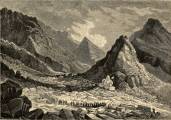
An abandoned ancient quarry in Africa (engraving from unknown publication)
- “American and British Marbles,” in Stone Magazine, Vol. XXVII, No. 2, December 1903, pp. 112-123.
- American Building Stones circa 1887 – “Our Building Stone Supply,” by George P. Merrill, Scientific American Supplement, No. 577, January 22, 1887, & “Our Building Stone Supply,” Conclusion, Scientific American Supplement, No. 578, January 29, 1887.
- “American Marbles” (November 1888) The Manufacturer and Builder, Vol. 20, Issue 11, November 1888, pgs. 250-251. (Article in digital images viewed at American Memory, Library of Congress.)
- “American Stone Fields” (August 1890) The Manufacture and Builder, Vol. 22, Issue 8, August 1890, pg. 177. (Article in digital images viewed at American Memory, Library of Congress.)
- Angers, France - “A Visit to the Slate Quarries of Angers” (1894) Scientific American Supplement No. 974, Munn & Co., New York, September 1, 1894.
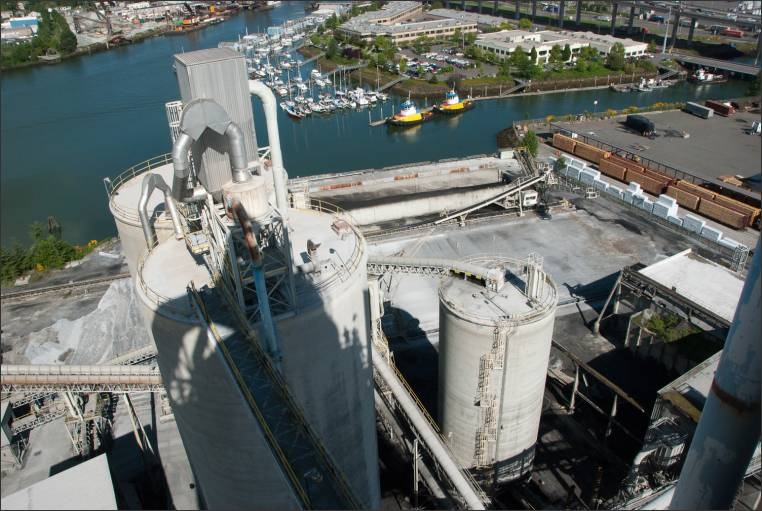
- Ash Grove Cement Plant Photographic Tour, Seattle, Washington – The photographs below and included in the photographic tour of the Ash Grove Cement Plant were taken by Anthony Meadow, who is a member of the Samuel Knight Chapter of the Society for Industrial Archeology – Peggy. B. Perazzo.


 |
 |
 |
“Chudleigh Marble Quarry, in Devonshire” (England) |
“The Lizard, Cornwall: Cliffs of olive green serpentine.” (England) |
“Marble cliffs at Barracombe Bay.” |
 |
 |
 |
“A cornish granite quarry.” (Cornwall, England) |
“A moor in cornwall strewn with granite boulders.” (Cornwall, England) |
“A weathereed crag of Cornish granite.” (Cornwall, England) |
 |
 |
“A Tennessee marble quarry, showing equipment.” (Tennessee, USA) |
“Marble quarry in Galway, Ireland, showing equipment.” |
 |
 |
“A Georgia marble quarry with its clean-cut walls.” (Georgia, USA) |
“Wire saw at work in the Galway marble quarry.” (Galway, Ireland) |
 |
 |
 |
|
|
|
- Australian Quarries – “The Freestone Quarries at Pyrmont, Sydney, New South Wales” (Australia), in the Scientific American Supplement, Vol. XVII, No. 427, New York, March 8, 1884.
 |
Picture from “The Freestone Quarries of Pyrmont, Sydney, |
- Bal Maidens & Mining Women – This web site “explores the many different roles which women and girls have undertaken at mines around the world.”
- Benicia Arsenal - Photographic Tour of the Benicia Historical Museum and Grounds: The Camel Barns, the Spenger Memorial Garden, the Benicia Arsenal Powder Magazine #10, and the Silas Casey Industrial (Tool) Exhibit in Camel Barn building #7, in Benicia, Solano County, California.
- Book of Epitaphs (circa 1890s) - Provided by Office of S. B. Sargent, Manufacturer of & Dealer in All Kinds of Marble & Granite Work, Tilton, New Hampshire (The title and date of publication are unknown, although the S.B. Sargent company is listed in an 1893 publication. The last half of the booklet is in German.)
- The Book of Vermont Marble: A Reference for Architects and Builders, published by the Vermont Marble Company, Proctor, Vermont, Third edition, 1929.
 |
 |
 |
Front cover of The Book of Vermont Marble |
“The William H. Porter Mausoleum, Woodlawn Cemetery, New York, as it looked in the early stages of construction. Trowbridge & Livingston, Architects.” |
“This recent photo (circa 1929) of the old Custom House, Erie, Pa., shows the excellent condition of the marble after nearly a hundred years of exposure. Edward Summers, Architect.” |
- “Brown-Stone (The end of an era)” (November 1869) The Manufacturer and Builder, Vol. 1, Issue 11, November 1869, pgs. 332-333. (Article in digital images viewed at American Memory, Library of Congress.)
- Brunner and Lay Tool Catalog - Brunner & Lay, Manufacturers of Marble, Stone, Granite and Bricklayers’ Tools, Stone Jacks, Derricks, and Contractors’ Supplies, 570 West Polk Street, Corner Jefferson and Polk Streets, Chicago, Illinois. (No date of publication) (Please Note: Using the link at the beginning of this section will take you a menu from which you can access the individual pages of this catalog. You can also use this Brunner and Lay Tool Catalog PDF link to view the booklet.)
- “Building and Ornamental Stones of the United States,” by George P. Merrill, article in Popular Science Monthly, conducted by E. L. and W. J. Youmans, Vol. XXVII, May to October, 1885.
- “Building in War Times” (World War I), in Stone, An Illustrated Magazine, July 1917.


“Banking Office of Brown Bros. & Co., New York – At Hanover and Beaver Streets. Architects: Delano & Aldrich, New York. Built of Georgia white marble...”
“Residence of John Sherman Hoyt, New York – Corner of 79th Street and Park Avenue. Built of stone from Chestnut Hill, Pa. Trimming of Buff Indiana limestone...”
- Building Stone of the
United States - the NIST Test Wall, presented by the
Building and Fire Research Laboratory, sponsored by the National
Park Service. (You
can visit the NIST Test Wall in Gaithersburg, Maryland.)
(The photograph below is used with permission.)
“The stone test wall was constructed to study the performance of stone subjected to weathering. It contains 2352 individual samples of stone, of which 2032 are domestic stone from 47 states, and 320 are stones from 16 foreign countries....” 
(The following description is from the web site.) “The stone test wall was constructed to study the performance of stone subjected to weathering. It contains 2352 individual samples of stone, of which 2032 are domestic stone from 47 states, and 320 are stones from 16 foreign countries. Over 30 distinct types of stones are represented, some of which are not commonly used for building purposes. There are many varieties of the common types used in building, such as marble, limestone, sandstone, and granite. This site presents the existing data and pictures for each particular stone.”
- “The Building Stones in the United States” (October 1884) The Manufacturer and Builder, Vol. 16, Issue 10, October 1884, pgs. 229-230. (Article in digital images viewed at American Memory, Library of Congress.)
- “Building Stones of the Northwest” (in 1892) (Minnesota, Northern Wisconsin, & Canadian north shore of Lake Superior), in Stone, An Illustrated Magazine, June 1892
- California – History of Quarrying in California from the California Indians up to Present Time. Presentation for the International Stonework Symposium 2011 – January 13, 2011. (“History of Quarrying in California from the California Indians up to Present Time” brochure)
- “Cape Ann Quarries, Massachusetts” (1884) Also included in this 1884 article from Harper's New Monthly Magazine are several sketches of stone quarriers and stone cutters at work and other quarry-related pictures.
- Cape Ann, Massachusetts – Leslie
D. Barlett’s
wonderful quarry photographs were displayed in his “Chapters
on a Quarry Wall,” museum installation/photograph
collection at the Cape Ann Historical Museum in Gloucester, Massachusetts,
in early 2008. Since then he has had other presentations and exhibitions in New York City, Vermont, and Michigan. You’ll find more information about his presentations and installations below.
Les Bartlett will be interpreting the Granite Collection Display on August 23, 2014, at 10:30 a.m., at the Cape Ann Museum, in Gloucester, Massachusetts, which will reopen in mid-August. (If you’re able to attend, be sure to view the photograph by Les Bartlett that has been installed on permanent display to the left of the auditorium doorway.) More information about Les and his photographic work and historical research on the Cape Ann granite quarry industry can be obtained on his Cape Ann Granite web site and blog.
One wall from the newly enhanced Granite Collection Display at the Cape Anne Museum, Gloucester, Massachusetts. 
Leslie Bartlett’s new book, Break Stone – Water – Heart: The Lives & Struggles of Cape Ann’s Quarry Workers, will be available on Saturday and Sunday, November 2nd & 3rd, for the first book signing at the Lanesville Community Center located at Lanesville Community Center, 8 Vulcan Street, Gloucester, Massachusetts. He has prepared a You Tube video entitled, “Cape Ann Granite.”

Leslie Bartlett’s next book will be: Break Stone – Water – Heart: The Lives & Struggles of Cape Ann’s Quarry Workers
“Chapters on a Quarry Wall.” is one of Leslie Bartlett’s past installations.
 Cape
Ann Historical Museum, Gloucester, Massachusetts
Cape
Ann Historical Museum, Gloucester, Massachusetts
This photograph was a part of the museum installation, and it is titled ‘Shadowing Ibis.’
Leslie D. Barlett’s “Chapters on a Quarry Wall”Photo Collection New York City, New York
May 5 - May 30, 2009 Give Me Your Hands: The Legacy of the Barre
Sculptors and Their Stone
This was one of Leslie D. Bartlett’s past presentations held
October 2 through December 15, 2011, at the Michigan State University
College of Law.
“Successive waves of master stone sculptors, carvers, and quarrymen came to America during the late 1800s and early 1900s. This photography exhibition documents their lives, their craft, and the plight of some of the immigrant master stone sculptors who have labored with the granite stone from the quarries of Barre, Vermont....”
- Carrara, Italy – “Marble quarries of Ravaccione,
at Carrara,” Italy,
engraving from a late 1800’s magazine.

- Carrara Marble Quarries in Italy (circa 1854) – “Famous Quarries of the World,” Putnam’s Monthly Magazine of American Literature, Science and Art, Vol. 4, Issue 22, October 1854, pp. 404-408. (Quarries described in this article include: The Carrara Marbles Quarries in Italy; the Pentelic and Paros quarries in Greece; the marble quarry at Brandon, Vermont; & the marble quarry at Rutland, Vermont, in the United States.)
- “The Quarries of Carrara,” in Scientific American, Vol. LII, No. 7, New York, February 14, 1885, pp. 103-104.
- “Carrara” (Marble),
article from The Monumental News,
March 1893, pp. 123-125.

- “Carrara and Its Quarries,” in Scientific American, April 8, 1899, pp. 215.
- “The Carrara Marble Industry” (Italy), Scientific American Supplement, Vol. LIII, No. 1376, New York, May 17, 1902, pp. 22045-22046.


The Marble City of Carrara (left above) & How the quarried marble is carried down (right above)
The Famous Marble Quarries of Carrara: The Railway leading to the foot of the quarries (left above) & Quarries at La Piastra (right above)
- Carrara Marble Quarries, Italy, “A Marble World,” Pearson’s Magazine, by E. St. John Hart, February 1903


 |
 |
“The Carrara Mountains, showing railway to quarries.” Scientific American, April 8, 1899, pp. 215 |
“Loading the Marble, Quarries of Carrara.” Scientific American, April 8, 1899, pp. 215 |


 |
 |
 |
A gigantic block of marble used for the statue of the Austrian Empress in “A Marble World” |
“Lower a block from high to low level” |
“A sea of marble, with four blocks on their way down from the quarries” |
 |
 |
“Transferring a block, weighing 40 tons, from the foot of the quarry to Carrara with a team of 40 oxen” |
“Avenza, the port of Carrara, whence the marble blocks are shipped to all parts of the world” |
- Carrara, Italy, Marble Quarries – “The Marble Quarries of Carrara,” by Day Allen Willey, in Scientific American, Vol. XCVII, No. 20, New York, November 16, 1907, pp. 353, 361-362.
 |
 |
 |
“Marble Crags at Carrara” |
“Miners making the electrical connections for blasting a monster block of Carrara marble” |
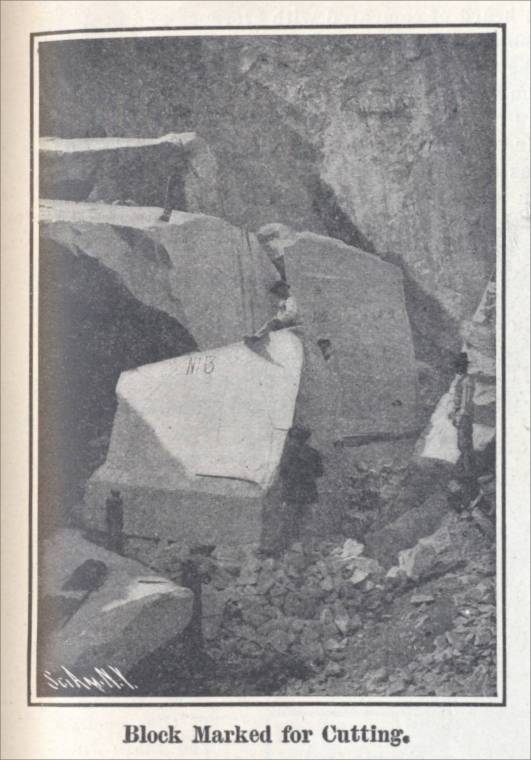
“Block marked for cutting” |
 |
 |
 |
“White Marble Quarry Entrance” |
“Where Carrara sculptors learn their art” |
“Making the gigantic statues” |
 |
 |
“Slab cutting saws operated by steam and water power” |
“Steam power marble planers” |
- Carrara Marble Quarries in Italy – How
to Tour the Marble Quarries of Carrara, by James Martin, Guide
to Europe Travel. (“How to do
a self-drive tour of the Carrara marble quarries. An illustrated virtual
guided tour of some of Carrara’s most famous marble quarries,
souvenir shops, and museum,” by James Martin.)
- More information on the Carrara marble quarries can be obtained on the Marble Museum and Cultural Heritage of Carrara City web site.
- Columbia - Bell Marble Quarry, in Columbia, Tuolumne County – Photographic Tour of the Bell Marble Quarry. (These photographs were taken July 1998)
- Columbia Marble Quarry, Columbia, Tuolumne County, California - Photographic Tour of one of the historic Columbia marble quarries. (These photographs were taken July 1998.)
- “The Coming of Age of Marble” (December 1892) The Manufacturer and Builder,Vol. 24, Issue 12, December 1892, pgs. 278-279. (Article in digital images viewed at American Memory, Library of Congress.)
- “Concerning Building Stones” (June 1890) (This article describes: rock face, pointed face, aze-hammered face, patent hammered, bush hammered, square drove, tooth chiseled, sawed face, fine sand finish, pumice finish, polished surface, and includes a few diagrams of some of these faces.) The Manufacture and Builder, Vol. 22, Issue 6, June 1890, pgs. 129-130. (Article in digital images viewed at American Memory, Library of Congress.)
- Cornwall, England – “Lamorna Cove,” in The Illustrated London News, March 8, 1873, pp. 233-234. (Another article in this section of the magazine is: “The Kaieteur Fall, Guiana,” in what was British Guiana, pp. 234.)

Granite Quarries at Lamorna Cove, Cornwall, England (ca 1873)
- Design Hints For Memorial Craftsmen, published monthly at St. Cloud, Minnesota, by Dan Haslam between 1924 and 1934.
- “Dimension
Stone,” presented by the U. S. Geological Survey
in the “Mineral Information” section of the web site:
(Description of “Dimension Stone” from the web site) “Dimension stone can be defined as natural rock material quarried for the purpose of obtaining blocks or slabs that meet specifications as to size (width, length, and thickness) and shape. Color, grain texture and pattern, and surface finish of the stone are normal requirements. Durability..., strength, and the ability of the stone to take a polish are other important selection criteria.”
- “Construction
Aggregate,” presented on Wikipedia.
(Description of “Aggregate” on the Wikipedia web site) “Construction aggregate, or simply ‘aggregate,’ is a broad category of coarse particulate material used in construction, including sand, gravel, crushed stone, slag, recycled concrete and geosynthetic aggregates. Aggregates are a component of composite materials such as concrete and asphalt concrete; the aggregate serves as reinforcement to add strength to the overall composite material.”
- “Construction
Aggregate,” presented on Wikipedia.
- Drew Daniels Granite Company, Waterbury, Vermont – A Plant and Its Product, Drew Daniels Granite Company, Wholesale Manufacturers, Waterbury, Vermont (circa 1910)

 |
 |
 |
Front cover of A Plant and Its Product, published by the Drew Daniels Granite Co., Waterbury, Vermont ( circa 1910) |
The Drew Daniels Granite Co. Shed No. 2, Waterbury, Vermont (circa 1910) |
The Heald cemetery memorial design in A Plant and Its Product, published by the Drew Daniels Granite Co., Waterbury, Vt. ( circa 1910) |
- Eaton Studio – The F. C. Eaton, Barre, Vermont, Monumental Catalog – early 1900s
 |
 |
Front cover of the F. C. Eaton, Barre, Vermont, monumental catalog |
Inside front cover listing the companies whose monuments are included in this catalog |
 |
 |
 |
|
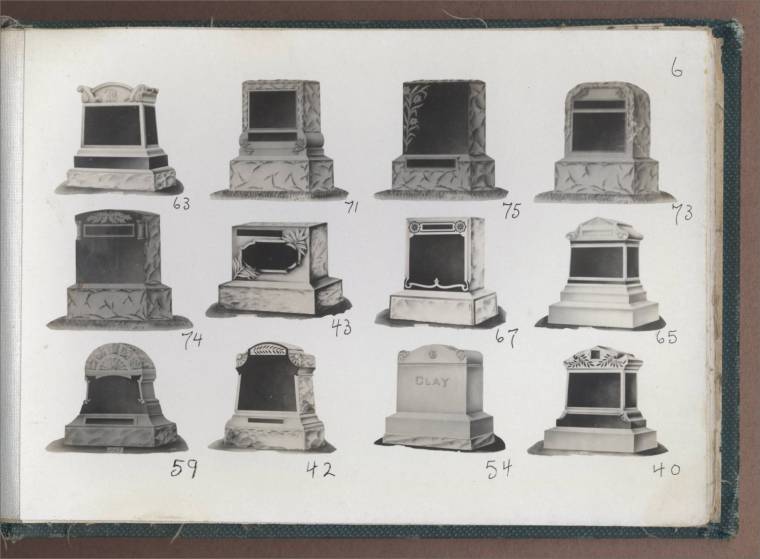
Three examples of the monuments presented in the F. C. Eaton, Barre, Vermont, monumental catalog |
|
- Eby Granite Works Monumental Booklet, Newville, Pennsylvania - The Photographer Visits Eby Granite Works: Proof of Our Low Overhead Expenses and Some Interesting Facts About Monuments. (The booklet includes photographs of the company’s monument displays and the procedure they used to set up a cemetery monument.)
- Economic Geology of the Kenova Quadrangle: Kentucky, Ohio, and West Virginia, Bulletin 349, by Phalen, William Clifton, Department of the Interior, United States Geological Survey, Government Printing Office, Washington, D. C., 1908.
- Epitaphs (booklet), by the Vermont Marble Company, Proctor, Vermont, early 1900s.
- “The Evolution of The Marble Carver,” in Through The Ages Magazine, April, 1926, Vol. 3, No. 12.
- “Egyptian Columns and Capitals,” The Lotus Flower Played an Important Part in the Evolution of the Capitol, in Through the Ages, May 1923.
- Egyptian Obelisks in Egypt Today And Obelisks Moved to Istanbul - Rome - Paris - London & New York - Nova A World of Obelisks (NOVA)
- “Egyptian Stone-Work,” The Manufacturer and Builder, November 1887, pp. 252.
- F.
Barnicoat: High-Grade Granite Statuary and Monuments 1903 Catalog,
Granite, Statuary, and Designs, Office and Studio Intervale Street,
Quincy, Massachusetts, 24 pp.

Front cover of the F. Barnicoat Catalog
- “Famous Quarries of the World,” Putnam’s Monthly Magazine of American Literature, Science and Art, Vol. 4, Issue 22, October 1854, pp. 404-408. (Quarries described in this article include: The Carrara Marbles Quarries in Italy; the Pentelic and Paros quarries in Greece; the marble quarry at Brandon, Vermont; & the marble quarry at Rutland, Vermont, in the United States.)
- “Famous Quarries of Long Ago” (Italy, Greece, France, Algeria), in Through the Ages, May 1923.


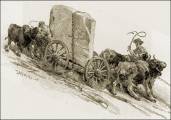
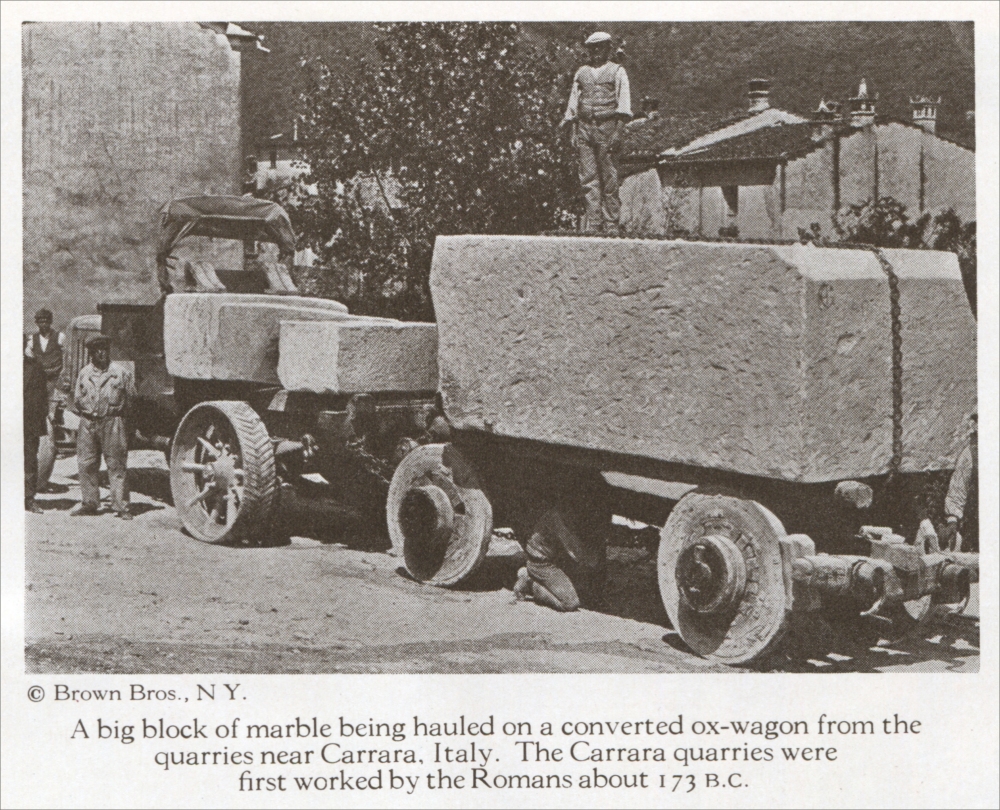
“A big block of marble being hauled on a converted ox-wagon from the quarries near Carrara, Italy.”
“The Arch of Constantine, the body of which is of Carrara marble, while the columns are of Giallo Antico, from Chepton.”


“Medici Chapel in Florence. Many kinds of marble have been used in this wonderfully decorated interior.”
“The statue of Apollo Belvedere, carved out of Parian marble. Some authorities claim that it is of Carrara marble, but this view is not generally accepted.”
- “Famous Quarries of Long Ago” (Italy, Greece, France, Algeria), in Through the Ages, May 1923.
- Flint
Granite Company, Builders of Artistic Memorials in Granite, Marble
and Bronze (Monument
Catalog), circa 1905, 34 pp.

Flint Granite Co. Monument Catalog ca. 1905
- “Foreign vs. American Marbles” (October 1891) The Manufacturer and Builder, Vol. 23, Issue 10, October 1891, pg. 230. (Article in digital images viewed at American Memory, Library of Congress.)
- France – “The Fifty Ton Crane of the Lerouville Quarries,” in Scientific American Supplement, August 12, 1893.
 |
 |
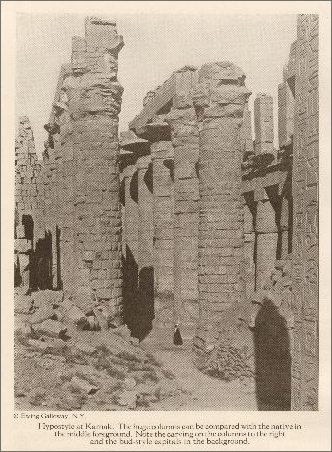
“Hypostyle at Karnak...Ewing Galloway, N.Y.” (1923) |
“Colonnaded Hall at Karnak with square pillars and columns with lotus-bud capitals. Ewing Galloway, N.Y. (1923) |



 |
“A fifty ton crane operating in the Lerouville Quarries.” (France) |
- France – “The Cements of the Gate of France,” in Scientific American Supplement, Vol. XX, No. 517, New York, November 28, 1885, pp. 8256-8258.
 |
 |
 |
“Fig. 1. General View of the Automatic Aerial Cable on Mt. Jalla,” in “The Cements of the Gate of France,” Scientific American Supplement, Nov. 28, 1885 |
“Fig 9. Automatic Aerial Cable - Shipping Station” |
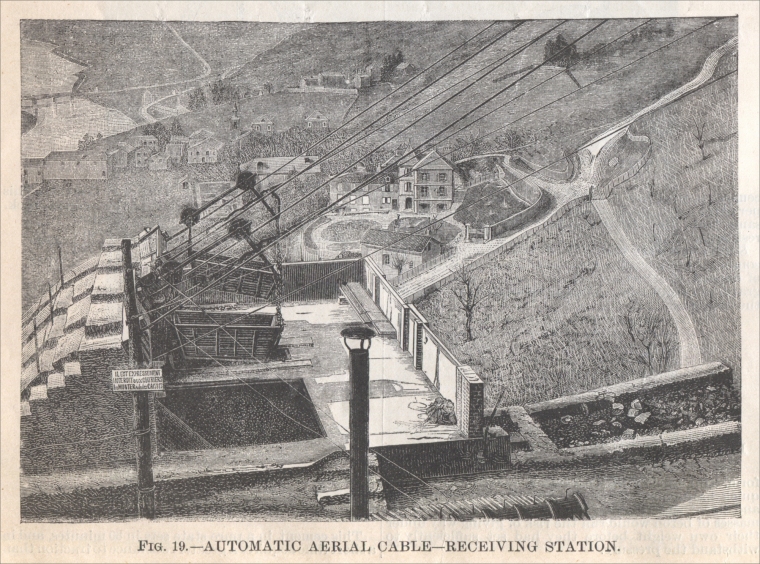
“Fig. 19. Automatic Aerial Cable - Receiving Station” |
- From Quarry to Cemetery Monuments– By using the photographs and history in this section, I want to try to give you a sense of the progression of the rock in the quarries and ending with the marble cemetery monuments created in the late 1800’s through the early 1900’s that we find in our northern California cemeteries today – Peggy B. Perazzo.
- Georgia – Special Granite Designs in the Famous Pride of Elberton Blue Granite, Design Book No. 16 & Price List for Special Granite Designs, No. 16-H, 1920’s. (Monument catalog and price list for Elberton Blue Granite monuments from Georgia)
 |
 |
 |
Special Granite Designs in the Famous Pride of Elberton Granite, Design Book No. 16 (front cover) |
One of the monuments in the Special Granite Designs in the Famous Pride of Elberton Granite, Design Book No. 16 monument catalog |
Price List for Special Granite Designs, No. 16-H (front cover) |
- Georgia Beauties: Catalog Number Twenty-Two (pdf), Cemetery monument catalog of the Georgia Marble Finishing Works, Builders of Fine Monuments, Canton, Georgia (no date of publication – possibly 1940s)
 |
 |
 |
Frong cover of Georgia Beauties Catalog No. Twenty-Two |
The Amtry cemetery stone of Georgia Marble (p. 2) |
Georgia Marble Finishing Works, Canton, Georgia |
-
German Limestone Quarry & Workers (film) – “Solnhofen Germany Limestone Quarry & Use of Limestone in Lithography 74872,” PeriscopeFilm LLC archive (old film of the quarry and men working in the quarry) “This short silent German film shows the Solnhofen Plattenkalk, or Solnhofen limestone, a Jurassic Konservat-Lagerstätte that preserves a rare assemblage of fossilized organisms…The subject of the film is not about fossils however, but about how the rock is quarried as a source of Lithographic limestone…The original source for lithographic limestone was the Solnhofen Limestone named after the quarries of Solnhofen where it was first found…This film is part of the Periscope Film LLC archive.…”
- A Glimpse of the Celebrated Stone Quarries at Bedford, Indiana (booklet ca late 1880s)
- Gold Rush Country, California Building Materials (1998) This is a photographic tour of selected buildings and structures in the Gold Rush Country of California starting at Mariposa in Mariposa County northward to Auburn in Placer County.
- “The
Granite Industry in New England,” by George Rich,
in New England
Magazine, February 1892, pp. 742-763.
(The following locations
are described in this article: Dix Island, Fox Island,
Hallowell, Hurricane Island, Mount Waldo, Penobscot
Bay, Spruce Head, St. George, Vinalhaven, Maine; Concord, New Hampshire;
Cape Ann quarries from Rockport to Bay View, Milford, West Quincy,
and the Quincy district in Massachusetts; Rhode Island; Fitzwilliam
and Oak Hill, New Hampshire; Thomaston, Roxbury, Long Island Sound,
Lyme, Niantic, Groton, Ansonia, Branford, and Stony Creek, Connecticut;
Westerly, Rhode Island; and Vermont.)
“The Granite Industry in New England,” by George Rich, in New England Magazine, February 1892, pp. 742-763 — in PDF format. 
- “Granite
Quarries,” in Scientific Magazine
Supplement No. 1574, Vol. LXI., No. 1574, March 3, 1906, New
York.
A Scene in a Granite Quarry (circa 1906) 
- “The Granite Quarries of the New England Coast,” by S. G. W. Benjamin, in Harper’s Weekly, January 10, 1891, Vol. XXXV, No. 1777, pp. 29-31. (Maine and Massachusetts coastline granite quarries)

“An East Shore Granite Quarry” ca. 1891
- The Great Industries of the United States - Being an Historical Summary of the Origin, Growth, and Perfection of the Chief Industrial Arts of This Country - Quarries (1872)
- Griffith Granite Quarry in Penryn, Placer County, California - Photographic Tour of Quarry (Photographs Taken in November 1997 and the Summer of 2000).
- Griffith Granite Quarry and Museum Photographic Tour, October 2010
- Harrison Granite Company Clientele Catalog (& Monuments), Harrison Granite Company, Established 1845, 200 Fifth Avenue, New York City, Quarries & Works: Barre, Vermont, January 1, 1918, 24 pp.


 |
 |
 |
Harrison Granite Co. Clientele & Monument Catalog Covers |
Title page of the Harrison Granite Co. Clientele & Monument Catalog |
Letter from Harrison Granite Co. to a customer in June 1921 |
- “The Helicoidal or Wire Stone Saw,” in Scientific American Supplement, Vol. XX, No. 520, New York, December 19, 1885.
 |
 |
 |
“Fig. 5. Application of Gay’s Stone Saw in a Marble Quarry” |
“Figs 1, 2, and 3. Apparatus for Sawing Stone” |
“Fig. 4. Apparatus for Sawing Stone into Slabs” |
- “History of Cemetery Memorial Art,” Summary of an address before the National Retail Monument Dealer’s convention at Milwaukee, by S. B. Duffield, in The Monumental News Magazine, early 1900’s, pp. 479-482. (Illustrations include: French’s Melvin Memorial, Concord, Massachusetts; Tomb of Tuleman; Alexander’s Tomb; Tomb of Mausolus; Scipio Sarcophagus; Choragic Monument to Lysicrates; Celtic Cross at Monasterboice, Ireland; Tomb of Theodoric; Petria, City of the Dead; Catacombs of Rome; Column of Trajan; Arch of Titus; Pyramids and Sphinx; Oblisks of Egypt; a 1500-ton stone at Baalbec in quarry; and Temple of Baalbec.)
- “History of the Slate Industry,” excerpt from Hower’s Lightning Slate Reckoner on 33 Practical Sizes Roofing Slate, by F. M. Hower, Proprietor of the Peach Hill Slate Quarry and President of the Eagle Slate Company, Cherryville, Pennsylvania, 1884.
- Hower’s
Lightning Slate Reckoner on 33 Practical Sizes Roofing Slate
(1888/1904), being a complete and most convenient
system of computing the amount in “squares” of any given
number of slate…a very convenient ratio on each of the thirty-three
different sizes for each two, three and four inches lap, mapping
ninety-nine different ratios, together with rules and practical information,
To Quarrymen, Operators on Slate, Slate-roofers and others, by
F. M. Hower, Proprietor of the Peach Hill Slate Quarry and President
of the Eagle Slate Company, Cherryville, Pennsylvania, 1884, 99 pp.
(For an interesting comparison, visit Terry
Hughes’ “Penrhyn Quarries
Slate Calculator,” described on his web site as: “This
calculator was produced by Penrhyn Quarries (McAlpine Slate Ltd.) in 1986, just
before desk top computers became commonplace. It is one stage in the development
of roof design tools from books to spreadsheets.”)
Contents of this book include: “History of the Slate Industry,” “As to Cost of Maintenance and Repairs,” “How Slate are Put On,” “How to Measure a Roof,” “Punching,” “Slate as Siding,” “Weight of Slate,” “Slate” (dimensions), “Table of Ratios,” “How to Use the Tables,” and “Number of Squares in a plane Roof.” 
- Hummelstown
Brownstone Company, Waltonville, Pennsylvania – published inthe early 1900s
The following is a list of the photo captions included in this booklet. (There are several other unnamed photos in addition to a map of the area.) (pp. 8) “Berst House”; (pp. 9 & 10) “General View Quarry No. 4 looking west”; (pp. 16) “North American Building, Philadelphia, Pa.”; (pp. 17) “The Market and Fulton National Bank, New York City"; (pp. 18) “Salem Lutheran Church, Lebanon, Pa.”; “Roman Catholic Protectory, Flatland, Pa.”; “Administration Building, State Hospital, Harrisburg, Pa.”; “Pennsylvania College Building, Gettysburg, Pa.”; (pp. 19) “High School, Altoona, Pa.”; (pp. 20) “York Collegiate Institute, York, Pa.”; “Bullitt Building, Philadelphia, Pa.”; (pp. 21) “City Hall, Wilkes-Barre, Pa.”; “Engine House, Philadelphia, Pa.”; (pp. 22) “Presbyterian Church, Indiana, Pa.”; (pp. 23) “Emory Methodist Episcopal Church, Pittsburgh, Pa.”; (pp. 24 & 25) “General View of Mill and Shops from north side of No. 3 Quarry”; (pp. 26) “Third United Presbyterian Church, Pittsburgh, Pa.”; (pp. 27) “Library, Mount Holly Springs, Pa.” “Residence, Dayton, Ohio”; “United States Post Office, Pottsville, Pa.”; (pp. 28) “Orange County Court-House, Orlando, Florida”; (pp. 29) “Zion Lutheran Church, Hummelstown, Pa.”; “Christ’s Lutheran Church, Lewisburg, Pa.”; (pp. 30) “Home Savings Bank, Washington, D.C.”; “Pottier & Stymus, New York City”; “A. A. Scottish Rite, Williamsport, Pa.”; (pp. 31) “First National Bank, Frackville, Pa.”; “Residence, Washington, D.C.”; (pp. 32) “Harrisburg Academy, Harrisburg, Pa.”; (pp. 33) “Rev. B. F. Stevens Memorial Methodist Episcopal Church, Harrisburg, Pa.”; (pp. 34) “Denny Hall, Dickinson College, Carlisle, Pa.”; (pp. 35) “The Arcade, Cleveland, Ohio”; “Susquehanna Trust Company, Williamsport, Pa.”; (pp. 36) “Union Station, Indianapolis, Indiana”; (pp. 37) “National Exchange Bank, Baltimore, Md.”; “Bank entrance detail”; (pp. 38 & 39) “General View, Rear of Mill”; (pp. 40) “Residence detail, Philadelphia, Pa.”; “Bank entrance detail, Philadelphia, Pa.”; (pp. 41) “Bank entrance detail, New York City”; “College entrance detail, Philadelphia, Pa.”; (pp. 42) “Stevens High School, Lancaster, Pa.”; (pp. 43) “Residence, Broad Street, Philadelphia, Pa.”; “The Citizens Trust Company, Gettysburg, Pa.”)
- Hummelstown
Brownstone: A study of the Hummelstown brownstone industry and
its contribution to the American building arts (South
of the borough of Hummelstown, Dauphine County, Pennsylvania),
by Ben F. Olena.


Postcard Showing Derricks at Corner of Quarry #4 at Brownstone Quarry
Asbury United Methodist Church, Uniontown
- Huntington Botanical Garden Photo Tour – Stones Used in the Garden and Buildings, in San Marino near Pasadena, California, late September, 2010.
- “In The Marble Hills” (in Vermont) (1890) This article about marble quarrying includes several very nice sketches relating to quarrying marble from the Century Magazine, September 1890.
- “In The Marble Quarries of Vermont,” from Popular Mechanics, October 1914.
- India – “Quarrying in India” in 1890 in “The Manufacturer and Builder,” Vol. 22, Issue 6, June 1890, pgs. 129-130.
- Indian Diggings Marble Quarry Area and Indian Diggings Cemetery, El Dorado County, California - Visit to the Indian Diggings Cemetery and Indian Diggings Marble Quarry Area in the summer of 2003.
- “The Industrial Progress of The South” (circa 1880), by J. B. Killebrew, in Frank Leslie’s Popular Monthly, Vol. X, No. 6, December 1880, pp. 642-652.


 |
 |
“A Tennessee Marble Quarry” (1880) |
Front page of “Frank Leslie’s Popular Monthly” Magazine, 1880 |


- Inyo Dolomite Quarries Photographic Tour (These quarries are located in the eastern foothills of the Owens Valley near Lone Pine, Inyo County; and they were known as the Inyo Marble Company quarries in the late 1800s.)
 |
 |
 |
- Ireland – “Slate and its Uses” (On Valentia Island, County Kerry, Ireland), in Harper’s New Monthly Magazine, Vol. 6, Issue 31, December 1852.
- “Isle of Portland, England - Portland Quarry” (Part 2), from The Penny Magazine of the Society for the Diffusion of Useful Knowledge, #378, February 24, 1838. You can also view Part 2 of the “A Week in the Isle of Portland” using this link.) “A Week in The Isle of Portland in 1837” (Part 1 of this two-part article is available by using the preceding link.)
- The Knox Blasting System – “Modern Methods of Quarrying,” in Scientific American Supplement, Vol. XXXII, No. 832, New York, December 12, 1891.
 |
 |
 |
Banner from the December 12, 1891, issue of Scientific American Supplement, No. 832 |
“Fig 3 is a round hole drilled either by hand or otherwise, preferably otherwise, because an important point is to get it round. Fig. 4 is the improved form of hole, and this is made by inserting a reamer, Figs. 5 and 6, into the hole in the line of the proposed fracture, thus cutting two V-shaped grooves into the walls of the hole.” (from the December 12, 1891, issue of Scientific American Supplement) |
“The usual method of charging and tamping a hole in using the new system is shown in Fig. 8. The charge of powder is shown at C, the air space at B and the tamping at A. Fig. 9 is a special hole for use in thin beds of rock” (from the December 12, 1891, issue of Scientific American Supplement) |
- Lessons In Stone - Harvard’s Building Blocks Teach Natural and Cultural History, in Harvard Magazine (Text by Davis B. Williams; photographs by Jim Harrison.)
- Lettering in Marble: A few plates and a few words of explanation - all bearing on the subject of lettering as it applies to the memorial trade, issued by the Vermont Marble Company, Procter, Vermont.
-
“The Lifting Process of Granite Quarrying,” in The Monumental News, Vol. XXL, No. 1, January 1909, pp. 28-29. ( article about a North Carolina Granite Corporation quarry, located in Mount Airy, North Carolina)
(excerpts from the article) “The quarrying problems where the granite deposits lie in mountains of almost solid rock is different from the ordinary quarrying and interesting in many ways. L. B. Ward, in recent number of the Scientific American tells of the lifting practiced in North Carolina, where great rock masses are found in many places.
“The section of the company at an around the vicinity of Mt. Airy is composed almost entirely of these rock masses. The Mt. Airy quarries are situated on a hill many acres in area, very gradual in slope and practically bare of vegetation….”
“The ‘lifting process’ is applicable to quarries of large horizontal areas and in solid masses, and such conditions being almost ideal at the Mt. Airy quarries, this process is altogether used….”
- Lime – “How Lime is Prepared,” in The Rural New-Yorker: A Journal for the Suburban and Country Home, New York, July 25, 1908.
 |
 |
“Ordinary ledges of varying thickness, in Mt. Airy quarries.” |
“View of big ledge showing seam at bottom.” |
 |
 |
“A common form of ledge.” |
“A ‘lift’ being split and drilled into required widths and lengths.” |
 |
 |
 |
The Limestone in the Quarry, Montour County, Pennsylvania |
The Tunnel from Quarry and the Kilns, Montour County, Pennsylvania |
Drawing off the Liime from the Kilns, Montour County, Pennsylvania |
-
“A Day at the London Marble-Works,” from The Penny Magazine – Supplement, Vol. 10, No. 604, August 1841, pp. 337-344. (This 1841 article begins: “The cutting of a piece of stone, and bringing it to a form and appearance adapted to the purposes of the builder, are operations which, until the last few years, have undergone but a very slight amount of change….”)
 |
“Show-room of the London Marble-working company, Esher Street, Millbank, Westminster.” |
Commercial use of material within this site is strictly prohibited. It is not to be captured, reworked, and placed inside another web site ©. All rights reserved. Peggy B. and George (Pat) Perazzo.