
Connecticut
Geology Resources - Connecticut
- Connecticut State Geological and Natural History Survey
- Connecticut Geology
- Earth Science Information for Connecticut Teachers and Students,
Wesleyan University.
- The Influence of Geology on the Connecticut Landscape, Photo Essay by Ralph Lewis, Connecticut State Geologist.
- Connecticut State Minerals Information (USGS)
- The Geologic History of the Earth and Connecticut: Effects it had on our State. Presented by the Yale-New Haven Teachers Institute.
- The Geology of Connecticut,
presented by the Yale-New Haven Teachers Institute, Curriculum Units by
Fellows of the Yale-New Haven Teachers Institute, 1978-2000.
- The Geologic History of Connecticut
- Geology and Connecticut, by Raymond W. Brooks.
- Geology and the Industrial History of Connecticut, 1984 Volume VI.
- Geology of Connecticut, by Lisa Alter.
- The Geology of West River, by Carolyn Kinder.
- The Geology of Litchfield County, Connecticut, a book by John Carter, Geoteknika, Torrington, Connecticut.
- A Location Guide for Rockhounds, (PDF) Collected by Robert C. Beste, PG, St. Louis, Missouri: Hobbitt Press, 2nd ed., December 1996, 148 pp. (Includes chapters on “Mineral Locations by State,” “Appendix and Glossary,” and “Bibliography.”)
- A Mineralogical Pilgrimage Thru Connecticut, by Charles W. Hoadley, Englewood, N. J., American Mineralogist, Volume 2, pages 99-100, 1917. The quarries mentioned in this article include: the Branchville quarry, the famous Gillette quarry,"
- National Geologic Map Database, presented by the United States Geologic Survey.
The Connecticut Stone Industry
- 1856 - Connecticut - The following excerpt is from the 1856, “The Marble-Workers’ Handbook,” page 248: “Connecticut forty years ago (in 1816) furnished the rarest and most beautiful of verd antiques. For in-door work it was admirably fitted; but exposed, as for grave-stones and monuments, it soon parted with its polish and grew dull. Though inexhaustible, the increasing expense of working it has caused it to be neglected.”
- 1882 - The Connecticut Stone and Building Industry in 1882 (transcription), Excerpts from Mineral Resources of the United States, Calendar Year 1882, J. S. Powell, Director, Department of the Interior, United States Geological Survey, Government Printing Office, Washington, D. C., 1883. Excerpts from the chapters on 1) "Structural Materials" and 2) "The Useful Minerals of the United States."
- 1883 and 1884 - The Connecticut Stone Industry, Excerpts from Mineral Resources of the United States - Calendar Years 1883 and 1884 (PDF images of sections), Department of the Interior, United States Geological Survey, Government Printing Office, Washington, D. C., 1885.
- 1885 - The Connecticut Stone and Building Industry in 1885 (transcription), Excerpts from Mineral Resources of the United States, Calendar Year 1885 (PDF images of sections), David T. Day, Geologist, Department of the Interior, United States Geological Survey, Government Printing Office, Washington, D. C., 1887. Excerpts from the chapter on "Structural Materials," by H. S. Sproull.
- 1886 - The Connecticut Stone and Building Industry, 1886 (transcription), Excerpts from Mineral Resources of the United States, Calendar Year 1886 (PDF images of sections), David T. Day, Chief of Division of Mining Statistics and Technology, Department of the Interior, United States Geological Survey, Government Printing Office, Washington, D. C., 1887. Excerpts from the chapters on 1) "Structural Materials," by William C. Day, 2) "Abrasive Materials," by William A. Raborg, and 3) "Novaculite," by George M. Turner.
- 1886 - Connecticut Building and Ornamental Stones (circa 1886), and History of the Connecticut Stone Industry - Excerpt from Report of the United States National Museum Under the Direction of the Smithsonian Institutions For the Year Ending June 30, 1886, Chapter entitled, “The Collection of Building and Ornamental Stones In The U. S. National Museum: A Hand-book and Catalogue,” By George P. Merrill, Curator, Department Lithology and Physical Geology.
- 1887 - The Connecticut Stone and Building Industry, 1887, Excerpts from Mineral Resources of the United States - Calendar Year 1887 (PDF images of sections), J. W. Powell, Director, David T. Day, Chief of Division of Mining Statistics and Technology, Department of the Interior, United States Geological Survey, Government Printing Office, Washington, D. C., 1888.
- 1887 – “Our Building Stone Supply,” (Quarrying in the United States circa 1887), by George P. Merrill, Scientific American Supplement, No. 577, January 22, 1887, & “Our Building Stone Supply” Conclusion, Scientific American Supplement, No. 578, January 29, 1887. Also available is the similar, but earlier and shorter version of this article: “Our Building Stone Supply,” Scientific American, January 8, 1887.
- 1888 - The Connecticut Stone and Building Industry, 1888, Excerpts from Mineral Resources of the United States - Calendar Year 1888 (PDF images of sections), J. W. Powell, Director, David T. Day, Chief of Division of Mining Statistics and Technology, Department of the Interior, United States Geological Survey, Government Printing Office, Washington, D. C., 1890.
- 1889 and 1890 - The Connecticut Stone and Building Industry, 1889, Excerpts from Mineral Resources of the United States - Calendar Year 1889 and 1890 (PDF images of sections), J. W. Powell, Director, David T. Day, Chief of Division of Mining Statistics and Technology, Department of the Interior, United States Geological Survey, Government Printing Office, Washington, D. C., 1892.
- 1891 - The Connecticut Stone and Building Industry, 1891, Excerpts from Mineral Resources of the United States - Calendar Year 1891 (PDF images of sections), J. W. Powell, Director David T. Day, Chief of Division of Mining Statistics and Technology, Department of the Interior, United States Geological Survey, Government Printing Office, Washington, D. C., 1893.
- 1892 - The Connecticut Stone and Building Industry, 1892, Excerpts from Mineral Resources of the United States - Calendar Year 1892 (PDF images of sections), J. W. Powell, Director, David T. Day, Chief of Division of Mining Statistics and Technology, Department of the Interior, United States Geological Survey Government Printing Office, Washington, D. C., 1893.
- 1893 - The Connecticut Stone and Building Industry, 1893, Excerpts from Mineral Resources of the United States - Calendar Year 1893 (PDF images of sections), J. W. Powell, Director, David T. Day, Chief of Division of Mining Statistics and Technology, Department of the Interior, United States Geological Survey, Government Printing Office, Washington, D. C., 1894.
- 1894 - The Connecticut Stone and Building Industry, 1894, Excerpts from Sixteenth Annual Report of the United States Geological Survey (PDF images of sections), Part IV. Mineral Resources of the United States, 1894, Nonmetallic Products, Washington: Government Printing Office, 1894.
- 1895 - The Connecticut Stone and Building Industry, 1895, Excerpts from Seventeenth Annual Report of the United States Geological Survey (PDF images of sections), Part III. Mineral Resources of the United States, 1895, Nonmetallic Products, Except Coal. Washington: Government Printing Office, 1896.
- 1896 - The Connecticut Stone and Building Industry, 1896, Excerpts from Eighteenth Annual Report of the United States Geological Survey (PDF images of sections), Part V. Mineral Resources of the United States, 1896, Nonmetallic Products, Except Coal. Washington: Government Printing Office, 1897.
- 1897 - The Connecticut Stone and Building Industry, 1897, Excerpts from Nineteenth Annual Report of the United States Geological Survey (PDF images of sections), Part V. Mineral Resources of the United States, 1896, Nonmetallic Products, Except Coal. Washington: Government Printing Office, 1898.
- 1898 - The Connecticut Stone and Building Industry, 1898, Excerpts from Twentieth Annual Report of the United States Geological Survey (PDF images of sections), Part VI. Mineral Resources of the United States, 1898, Nonmetallic Products, Except Coal and Coke. Washington: Government Printing Office, 1899.
- 1898/1899 - Connecticut Stone Industry - Kinds of Stone Produced by Other States Other Than the State of Maryland (and compared to the stone quarried in Maryland). Excerpt from Maryland Geological Survey, Vol. II, "A History of the (Maryland) Quarrying Industry," by Edward B. Mathews, 1898.
- 1899 - The Connecticut Stone and Building Industry, 1899, Excerpts from Twenty-first Annual Report of the United States Geological Survey (PDF images of sections), Part VI. Mineral Resources of the United States, 1899, Nonmetallic Products, Except Coal and Coke. Washington: Government Printing Office, 1901.
- 1900 - The Connecticut Stone and Building Industry, 1900, Excerpts from Mineral Resources of the United States - Calendar Year 1900 (PDF images of sections), Charles D. Walcott, Director, David T. Day, Chief of Division of Mining and Mineral Resources, Department of the Interior, United States Geological Survey, Government Printing Office, Washington, D. C., 1901.
- 1901 - The Connecticut Stone and Building Industry, 1901, Excerpts from Mineral Resources of the United States - Calendar Year 1901 (PDF images of sections), Charles D. Walcott, Director, David T. Day, Chief of Division of Mining and Mineral Resources, Department of the Interior, United States Geological Survey, Government Printing Office, Washington, D. C., 1902.
- 1902 - The Connecticut Stone and Building Industry, 1902, Excerpts from Mineral Resources of the United States, Calendar Year 1902 (PDF images of sections), Charles D. Walcott, Director, Department of the Interior, United States Geological Survey, Government Printing Office, Washington, D. C., 1904.
- 1903 - The Connecticut Stone and Building Industry, 1903, Excerpts from Mineral Resources of the United States, Calendar Year 1903 (PDF images of sections), Charles D. Walcott, Director Department of the Interior, United States Geological Survey, Government Printing Office, Washington, D. C., 1904.
- 1904 - The Connecticut Stone and Building Industry, 1904, Excerpts from Mineral Resources of the United States, Calendar Year 1904 (PDF images of sections), Charles D. Walcott, Director, Department of the Interior, United States Geological Survey, Government Printing Office, Washington, D. C., 1905.
- 1905 - The Connecticut Stone and Building Industry, 1905, Excerpts from Mineral Resources of the United States - Calendar Year 1905 (PDF images of sections), Charles D. Walcott, Director, Department of the Interior, United States Geological Survey, Government Printing Office, Washington, D. C., 1906.
- 1906 - The Connecticut Stone and Building Industry, 1906, Excerpts from Mineral Resources of the United States - Calendar Year 1906 (PDF images of sections), George Otis Smith, Director, Department of the Interior, United States Geological Survey, Government Printing Office, Washington, D. C., 1907.
- 1907 - The Connecticut Stone and Building Industry, 1907, Excerpts from Mineral Resources of the United States, Calendar Year 1907 (PDF images of sections), Part II. Nonmetallic Products, George Otis Smith, Director, Department of the Interior, United States Geological Survey, Government Printing Office, Washington, D. C., 1908.
- 1908 - The Connecticut Stone Industry, 1908 (transcription), Excerpts from Mineral Resources of the United States, Calendar Year 1908 (PDF images of sections), Part II - Nonmetallic Products, Department of the Interior, United States Geological Survey, Government Printing Office, Washington, D. C., 1909. Excerpts from the book are from the chapters on: 1)"Stone," by A. T. Coons, and 2) part of the chapter on "Abrasive Materials," by W. C. Phalen.
- 1915 – Connecticut Stone Industry (circa 1915), from Jeffrey Buck's Arbuckle's Trade Cards web site (postcard photograph/map and history)
(The link from which the following information was obtained is no longer available.) < http://www.arbycards.info/arbsr06.htm>"…Of the various mineral productions, iron ore is the most abundant. There are immense quarries of red sandstone at Portland and Cromwell, and marble and limestone is quarried at Canaan and Washington. A large amount of orthoclase comes from Glastonbury and Middletown…."
- 1994 through 2010-2011 - The Mineral Industry of Connecticut – United States Geological Survey (1994 through 2010-2011).
- Map - Preliminary Geologic and Economic Map of Connecticut.
This map was extracted from Bulletin 6 of the Connecticut Geological and Natural History Survey, 1906. Plate XXVIII (From The Commercial Granites of New England, Bulletin 738, 1923. Map size is 640KB) 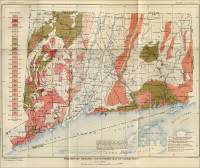
- “The Architecture of the Granite Shed,” By Paul Wood, November 5, 2007, in the Barre Montpelier Times Argus. (New England States: Connecticut, Delaware, Maine, Maryland, Massachusetts, New Hampshire, Rhode Island, and Vermont.)
- Bedrock Mines and Quarries of Connecticut, pamphlet compiled by Robert J. Altamura. Hartford, Connecticut Geological and Natural History Survey, 1987, 57 pp.
- Brownstone Is Back, But Its Use Is Debated, by Tracie Rozhon, New York Times, July 4, 2000.Included is a summary of the history of Portland Stone used as a building material in the area and the use of it in today's world. (This summary is no longer available on the Brooklyn.com web site, although the book is available on many online web sites.)
- Calcite in Connecticut - Excerpt from Connecticut Minerals: Their Properties and Occurrence, Bulletin No. 77, A revision of Bulletin No. 51, 1931, State Geological and Natural Survey, Hartford, Connecticut, 1951, pp. 17)
“Calcite: Also called Calcareous spar, Calc Spar, Calcium carbonate, Carbonate of lime. Vitreous to earthy luster. Hardness 3. Specific gravity 2.72. Transparent to opaque. May be colorless. Has three directions of perfect cleavage that break the crystals into rhombohedrons. Conchoidal fracture. Brittle, Crystallizes in the hexagonal system. Found in crystals, granular, compact, fibrous, etc.
“Occurs in sedimentary rock masses, igneous rocks. Formed by the action of carbonated water on calcium silicates, by metamorphic action, etc.
“Chemical composition: calcium carbonate. CaCO3. Identified by its cleavage and effervescence with acid.
“It contains 65% calcium oxide (lime) and is used as a source of lime, mortar, cement, flux, fertilizer, crayons, etc. Its name is derived from the Latin word for ‘lime.’
“Localities: Allingtown, Berlin, Boardman’s Bridge, Branchville, Branford, Bristol, Brookfield, Canaan, Cheshire, Danbury, Derby, Durham, Farmington, Granby, Guilford, Haddam, Hartford, Lime Rock, Meriden, Middlefield, Middletown, Milford, Monroe, Mount Carmel Center, New Britain, New Haven, North Branford, North Guilford, North Haven, Portland, Roaring Brook, Roxbury, Salisbury, Simsbury, South Britain, Southbury, Southington, Suffield, Trumbull, Vernon, Watertown, West Redding, Woodbridge, Woodbury.”
- Corundum in Connecticut - Excerpt from Connecticut Minerals: Their Properties and Occurrence, Bulletin No. 77, A revision of Bulletin No. 51, 1931, State Geological and Natural Survey, Hartford, Connecticut, 1951, pp. 26).
“Corundum: Luster vitreous to adamantine, sometimes pearly. Hardness 9. Specific gravity 3.9 to 4.1. Transparent to translucent. Color gray, brown, bluish, blue, red, yellow, colorless. Streak white. No cleavage. Parting may be basal or in two directions at 94° to each other. Fracture Conchoidal to uneven. Brittle. Very tough when compact. Crystallizes in the hexagonal system. Found in pyramids, prisms, tabular, compact, and granular.
“Occurs in crystalline limestone, gneiss, mica schist, granite, and other crystalline rocks. Associated with magnetite, mica, chlorite, serpentine, spinel, nephelite. Alters to zoisite, kyanite, margarite, damourite, muscovite, tourmaline.
“Chemical composition: aluminum oxide. A12O3. Identified by the hardness, luster, specific gravity, and parting. Used as an abrasive.
“The Indian name for corundum is ‘kauruntaka’ and our present word has been derived from it. When transparent and clear, corundum is used as a gem. When deep red it is called ruby. All other gem colors of corundum are really sapphire, but in recent years the term sapphire has been reserved for the blue verities. The other colors have been given the names of the gems they most resemble, to which has been added the word ‘oriental.’ Thus the green sapphire is called ‘oriental emerald,’ the yellow sapphire is ‘oriental topaz,’ etc.
“Localities: Barkhamsted, Haddam, Litchfield, Norwich, Washington, West Farms.”
- Connecticut & the Sea - Island Traders (Program transcript, broadcast May 2000) Presented by Simon Pure Productions.
- Connecticut River Valley – The City of Rocks – Explore the Hidden World of Building Stone, by E. B. Keck. This site includes photographs of: Mount Norwottuckin, South Amherst, Massachusetts, and the Middlesex quarry, Portland, Connecticut. (This link is no longer available.)
<http://homepage.mac.com/ebandpck/cityrocks/connecticut.html> - DiscoverySchool.com (Worldbook) - Connecticut. Traprock quarries (a kind of basalt) are located in New Haven and Hartford counties. Granite and feldspar are also quarried Connecticut in small amounts.
(This URL is no longer available.) <http://school.discovery.com/homeworkhelp/worldbook.html>. - Dolomite in Connecticut - Excerpt from Connecticut Minerals: Their Properties and Occurrence, Bulletin No. 77, A revision of Bulletin No. 51, 1931, State Geological and Natural Survey, Hartford, Connecticut, 1951, pp. 29)
“Dolomite: Also called Bitter spar, Pearl spar. Vitreous to pearly luster. Hardness 3.5 to 4. Specific gravity 2.9 to 3.3. Transparent to translucent. Colorless, pink, gray, green, black, brown. Streak white to gray. Perfect cleavage in three directions, forming an angle of 73° 45’. Conchoidal fracture. Brittle. Crystallizes in the hexagonal system. Crystals generally have curved surfaces.
“Occurs in beds and ore deposits, and in cavities in igneous and sedimentary rocks.
“Chemical composition: Dolomite as a rock is magnesian limestone [CaMg(CO3)2]. Dolomite as a mineral contains almost equal amounts of calcium and magnesium, but the latter may be replaced in part by iron or manganese, or both, so that the chemical formula is Ca(Mg,Fe,Mn)(Co3) 2. It may be identified by the hardness, and curved crystals. It does not effervesce in cold dilute hydrochloric acid.
“Used as a building and ornamental stone, as a source of magnesium, and as a refractory. It is named after the French chemist Dolomieu.
“Localities: Berlin, Brookfield, Canaan, Cornwall, Danbury, Durham, Haddam, Housatonic valley, Kent, Litchfield, Middlefield, Milford, New Haven, New Milford, North Stonington, Norwich, Redding, Redgefield, Salisbury, Sharon, Stamford, Washington, Watertown, Worthington.”
- Granite Manufacturers’ Association of New England Officers (1895) The following information is from The Monumental News, August, 1895, Vol. 7, No. 8, Chicago, Illinois, pp. 499.
“President: Henry Murray, Boston, Massachusetts.
Vice-Presidents: W. S. White, Rockland, Me.; Thos. Nawn, Concord, N. H.; Chas. H. More, Barre, Vt.; A. T. Farnum, Providence, R. I., Wm. Booth, New London, Conn.; C. B. Canfield, New York City. Treasurer: Isaac F. Woodbury, Boston.
- Just What is Brownstone?, presented by Tingley’s Tidbits (Source: Gerald Wolfe, New York, A Guide To The Metropolis. Tracie Rozhon, "Brownstone (the Real Thing) Comes Back," NY TIMES, 7/4/2000, p1.)
- Portland Brownstone (photographs and history), by Wayne G. Powell.
- The Portland Brownstone Quarries, a book by Alison C. Guniness, Middletown, Connecticut, 1987.
- Portland Brownstone Quarries (geology, photographs and history), National Historic Landmarks Program.
- Portland Brownstone Quarries (photographs and history), presented on Wikipedia.
- The Portland Sandstone Quarries (Connecticut) (February 1888) The Manufacturer and Builder, Vol. 20, Issue 2, February 1888, pg. 35. (The article includes a sketch: "Portland Sandstone Quarries - Splitting Out the Stone With Wedges."; article in digital images viewed at American Memory, Library of Congress)
- Portland, Connecticut - "Building With Brownstone" Connecticut & the Sea, Broadcast Premiere: May 2000, Program Transcript (Scroll down to "Building with Brownstone.")
- Portland Brownstone Quarries, Portland, Middlesex County, Connecticut. National Park Register as a National Historic Landmark: May 16, 2000; Location of Brownstone Quarries: Brownstone Street and Silver Street, Portland, Connecticut.
- Portland Brownstone Quarries - "Quarries Vie for National Recognition!" The
following article is from "Portland on the Move," Issue 74 ~ News from
your Town Hall ~ March 2000 issue and is used with permission. (The link
from which the following quotation was obtained is no longer available.)
<http://www.portlandct.org/newsletter/march00/march01.htm>"Quarries Vie for National Recognition! - We Need Your Help!!!
"The National Park Service has recently completed their study of the Portland Brownstone Quarries, and are nominating the quarries for a possible designation as a National Historic Landmark!
"On April 10 (2000), the Landmarks Committee in Washington DC will meet to evaluate the nomination. Their recommendations will then be forwarded to the National Park System Advisory Board on April 16 in San Francisco, where the final decision will be made.
"It is important to the future of Portland that the quarries are recognized for their historic significance. It was the acquisition of brownstone that first drew settlers to this location, developing an industry famous the world over. Shipyards were built in town to accommodate the transportation of this construction material to New York and California and even to Europe! The very existence of Portland depended on the economic value of the brownstone quarries.
"When brownstone was replaced by cheaper building materials, the quarries fell into disuse and remained that way for a good portion of the twentieth century. Flood waters filled the excavation sites, and the beauty of the quarries was largely ignored. Indeed, many people in town have no idea that these wonderful sites exist just 200 yards or so from Main Street's business center."
- Serpentine in Connecticut - Excerpt from Connecticut Minerals: Their Properties and Occurrence, Bulletin No. 77, A revision of Bulletin No. 51, 1931, State Geological and Natural Survey, Hartford, Connecticut, 1951, pp. 67-68.)
“Serpentine: Luster greasy, waxy, earthy. Hardness 2 to 5. Specific gravity 2.2 to 2.65. Translucent. Color varies, white to black through all colors, with green predominating. White streak. Fracture Conchoidal, splintery. Brittle. Crystallizes in the monoclinic system. Crystals unknown. Found massive, fibrous, platy.
“Occurs in igneous and metamorphic rocks. Associated with magnesite, chromite, pyrope. Formed from magnesium silicates such as olivine, pyroxene, amphibole.
“Chemical composition: Hydrous magnesium silicate. H4Mg3Si2O9(?).
“Its name is due to its serpentine markings.
“Localities: East Haven, Greenwich, Litchfield, Middlefield, Milford, New Haven, Norfolk, Orange, Ridgefield, Stratford, Winchester.”
- “Tools and Machinery of the Granite Industry,” by Paul Wood, in The Chronicle of the Early American Industries Association, Inc.
- Part I. Vol. 59, No. 2, June 2006. (“Introduction: This article, the first in a series of four on granite working, deals with granite as a material, an industry, and a product and begins the description of the granite quarrying process.”)
- Part II. Vol. 59, No. 3, September 2006. (“Introduction: This article, the second in a series of four on granite working, completes the description of the quarrying process....”)
- Part III. Vol. 59, No. 4, December 2006. (“Granite Finishing: A small number of basic finished dimension stones made up the great majority of granite shed production. For gravestones and private....”)
- Part IV. Vol. 60, No. 1, March 2007. (“This article is the last in a series of four on the tools and machinery of granite working....”)
- The Triassic Sandstone of Connecticut (May 1890) The Manufacture and Builder, Vol. 22, Issue 5, May 1890, pg. 105. (The article includes a sketch: "Sandstone Quarry at Portland, Connecticut."; text of article in digital images viewed at American Memory, Library of Congress)

Printed & Online Sources
- The Ancient Gravestones of Green Burial Ground, Main Street Glastonbury, Connecticut, written and published David Shortell, 2008. (This book is a comprehensive study of the cemetery on Main Street in Glastonbury, Connecticut, along with photos of the fascinating gravestones the book includes a history of the cemetery itself, a statistical analysis, and a CDROM of the pictures as well.)
- “‘And the Men Who Made Them’: The Signed Gravestones of New England,” by Sue Kelly and Anne Williams, in Markers II, pp. 1-103, Association for Gravestone Studies. (Connecticut, New Hampshire , New Jersey, New York, Rhode Island, South Carolina, Vermont, USA)
- “‘And the Men Who Made Them’: The Signed Gravestones of New England, 1984 Additions,” by Sue Kelly and Anne Williams, in Markers III. Association for Gravestone Studies.
- “Archean Limestone and Other Rocks in Norfolk,” by James D. Dana, American Journal of Science, s. 3, v. 39, 1890, pp. 321.
- “The Architecture of the Granite Shed,” By Paul Wood, November 5, 2007, in the Barre Montpelier Times Argus. (New England States: Connecticut, Delaware, Maine, Maryland, Massachusetts, New Hampshire, Rhode Island, and Vermont.)
- Bedrock Mines and Quarries of Connecticut, compiled by Robert James Altamura, publisher: Hartford, Connecticut Geological and Natural History Survey, 1987.
- “Bolton Flagging,” (the Bolton Range in Connecticut) in Scientific American, January 31, 1885. (Slate quarrying and flagging)
- Bulletins 4, 6, 7, 8 and 13 all relate to the Geology of Connecticut, State Geological and Natural History Survey of Connecticut, (This citation is in the book, The Lithology of Connecticut, by Joseph Barrell, and Gerald Francis Loughlin. There are no dates of publication listed.)
- By Their Markers Ye Shall Know Them: A Chronicle of the History and Restorations of Hartford’s Ancient Burying Ground. (Connecticut ), William Hosley and Shepherd M. Holcombe, Sr. Ancient Burying Ground Association, April 1994, ISBN-10: 0964076209, ISBN-13: 978-0964076204.
- “By Their Characters You Shall Know Them: Using Styles of Lettering to Identify Gravestone Carvers,” by Gray Williams, in Markers XVII, Association for Gravestone Studies, 2000. (Connecticut, New York, USA)
- Cemeteries In and Around New London, Connecticut, Conference Guide 2, Association for Gravestone Studies. (This guide covers several cemeteries in the New London, Connecticut area.)
- Cemeteries in the Vicinity of Westfield, Massachusetts, Association for Gravestone Studies. (This guide covers cemeteries in Northern Connecticut, Suffield, Wilbraham, Longmeadow and the Springfield, Massachusetts area.)
- Centennial Address With Historical Sketches of Cromwell, Portland Chatham, Middle-Haddam, and Middletown, and its Parishes, David Dudley Field, William B. Casey, 1853.
- “The Center Church Crypt of New Haven, Connecticut: A Photographic Essay,” Daniel Farber and Jessie Lie, Photographers. Text by Gray Williams, Jr., in Markers IX, Association for Gravestone Studies, 1992.
- “Charles B. Canfield and His Work,” in The Monumental News, January 1896, pp. 24-25.
- “A Chronological Survey of the Gravestones Made by Calvin Barber of Simsbury, Connecticut,” by Stephen Petke, in Markers X, Association for Gravestone Studies, 1993. (Connecticut, Massachusetts, USA)
- The Commercial Granites of New England - Bulletin 738, by Nelson T. Dale, United States Department of the Interior, United States Geological Survey, Washington, D. C.: Government Printing Office, 1923. (The states covered in this book are: Connecticut, Maine, Massachusetts, New Hampshire, and Vermont.)
- “A Common Thread: Needlework Samplers and American Gravestones,” by Laurel K. Gabel, in Markers XIX, Association for Gravestone Studies, 2002. (Connecticut, Massachusetts, Rhode Island, USA; England)
- Connecticut Guide, by Edgar L. Heermance, Emergency Relief Commission, Hartford, 1935.
- Connecticut Historical Collections, by John W. Barber, Durrie and Peck, New Haven, 1836.
- Connecticut Minerals: Their Properties and Occurrence, Bulletin 77, by Julian A. Sohon, Connecticut Geological Survey, 1951, 133 pp.
- “Connecticut Work and Workmen,” by George L. Porter, American Institute of Mining v. 24, Engineers Transactions, 1894, pp. 609-13.
- “Cordierite Gneiss From Connecticut,” by Edmund O. Hovey, American Journal of Science, s. 3, v. 36, 1888, pp. 57-58.
- “The Disappearing Shaker Cemetery,” by Tom Malloy and Brenda Malloy, in Markers IX, Association for Gravestone Studies, 1992. (Connecticut, Maine, Massachusetts, New Hampshire, New York, USA)
- “Eighteenth Century Gravestone Carvers of the Narragansett Basin: John and James New,” by Vincent F. Luti, in Markers XVI, Association for Gravestone Studies, 1999. (Connecticut, Maine, Massachusetts, Rhode Island, USA)
- “Eighteenth Century Gravestone Carvers of the Upper Narragansett Basin: Gabriel Allen,” by Vincent F. Luti, in Markers XX, Association for Gravestone Studies, 2003. (Connecticut, Georgia, Massachusetts, Rhode Island, South Carolina, USA)
- “Eighteenth-Century Gravestone Carvers of the Upper Narragansett Basin: George Allen,” by Vincent F. Luti, in Markers XXII, Annual Journal the Association for Gravestone Studies, edited by Gary Collison, Association for Gravestone Studies, Greenfield, Massachusetts, 2005, pp. 109-159. (Connecticut, Massachusetts, Rhode Island, USA)
-
“The Forlorn Soldier,” by Anthony Roy, presented on the ConnecticutHistory.org (This article begins: “The Forlorn Soldier is a brownstone statue created by James G. Batterson. For over a century the story of the statue was that people rejected it because the right foot was mistakenly thrust forward, which is opposite of the traditional parade-rest military pose….”
- Enfield, Connecticut Stories Carved in Stone, by Bob Clark, Dog Pond Press, December 2006, 272 pp., (paperback) ISBN: 0975536257. (The story of Enfield, the small church-centered farming community which evolved into an industrial area of dams, canals, and mills. Enfield Connecticut: Stories Carved in Stone, takes you into Enfield’s graveyards for a look at more than three hundred years of history, and the people who lived it.) (Also visit Dog Patch Press’s “Stories Carved in Stone” and view their “Gravestone Gallery.”)
- The Face of Connecticut - People, Geology, and the Land, Bulletin 110, by Michael Bell, State Geological and Natural History Survey of Connecticut, 1985. (Mining the Valley starts on page 31 and discusses the Connecticut Brownstone and Trap Rock industries.)
- “‘The Fencing Mania’: The Rise and Fall of Nineteenth-Century Funerary Enclosures,” by Blanche Linden-Ward, in Markers VII,” Association for Gravestone Studies, 1990. (Connecticut, Massachusetts, New York, Rhode Island, USA)
- Flesh and Stone - Stony Creek and the Age of Granite, Edited by Deborah DeFord, published by Stony Creek Granite Quarry Celebration, ISBN 0-918172-29-2. This book is available through the Stony Creek Quarry Workers Celebration either by using the link above or writing to them at P. O. Box 3047, Stony Creek, CT 06405.
- “Folk Art on Gravestones: The Glorious Contrast,” by Charles Bergengren, in Markers II, pp. 171-183, Association for Gravestone Studies. (Connecticut, Massachusetts, Rhode Island, South Carolina, Vermont, Virginia, USA)
- Gazetteer of the States of Connecticut and Rhode Island, by John C. Pease and John M. Niles, Marsh, Hartford, 1819.
- “Geology and Mineralogy of Litchfield,” by John P. Brace, American Journal of Science, s. 1, v. 2, 1820, pp. 370.
- Geology of Connecticut, by Thomas Cook, Bond Press, Hartford, 1933.
- “Geological Hikes in Litchfield County,” by Samuel C. Brown, Rocks and Minerals, v. 22, 1947, pp. 214.
- The Geology of Litchfield County, Connecticut, a book by John Carter, Geoteknika, Torrington, Connecticut.
- “Granites and Related Intrusives of Western Connecticut,” by William M. Agar, American Journal of Science,” s. 5, v, 27, 1934, pp. 354-73.
- The Granites of Connecticut, Bulletin 484, by Nelson T. Dale and Herbert E. Gregory, Department of the Interior, United States Geological Survey, Washington, D. C.: Government Printing Office, 1911. (This document is available on Google Books.)
- Granites of Southern Rhode Island and Connecticut, with Observations on Atlantic Coast Granites in General, J. F. Kemp, Bulletin, Geol. Soc. America, Vol. 10, 1899, pp. 278-382.
- Guide to the Geology of Middletown and Vicinity, by William N. Rice and W. G. Foye, State Geological and Natural History Survey Bulletin 41, 1927.
- Heart of Old New England, by A. Hyatt, Verrill, Dodd, Mead, 1936, New York.
- “Heart of Stone: The Brownstone Industry of Portland, Connecticut,” in The Great Rift Valleys of Pangea in Eastern North America, Peter M. Letourneau and Paul E. Olsen (Editors), Columbia University Press, 2003, pp. 224-247.
- The History and Architecture of Portland, J. P. Loether, G. L. Porteus and D. D. Sherrow, Portland, Conn.: Greater Middletown Preservation Trust, Advocate Press, 1980, 31-41. (Includes information on the men who worked in the Portland brownstone quarries and their families.)
- History of American Manufacturers, by James L. Bishop, Young, Philadelphia, 1864. (2 vols.)
- History of Norfolk, by Joseph Eldridge, Massachusetts Publishing Co., Everett, Mass., 1900.
- “History of the Colony of New Haven,” by Edward E. Atwater, published by the author, New Haven, 1881.
- History of Connecticut, by Benjamin Trumbull, Vol. 1 published in 1797 by Hudson and Goodwin, of Hartford. Vol. 2 published in 1818 by Malthy, Goldsmith, of New Haven.
- History of Eastern Connecticut, by Pliny L. Harwood, Pioneer Publishing Co., Chicago, 1931. (3 vols.)
- History of Middlesex County, Connecticut, New York: J. B. Beers Company, 1885. (The book covers the county's history for 250 years from 1635-1885. A couple of topics of interest covered are the quarries of Haddam, and the brownstone of Portland, Connecticut.)
- “Horses, Oxen and Granite,” (online article) by Paul Wood, January 7, 2008, in the Barre Montpelier Times Argus.
The time period covered in this article is during the early 1800s.
Key words: Adamant Quarries, Montpelier, Vermont; block and tackle; boom derrick; clog chains; John Crouse of Syracuse, New York; Fayette Cutler, Barre, Vermont; double runner sleds; freight Tariffs; Joseph Glidden, Mark Glidden;granite quarries; granite sheds; horse sweep; Jones Brothers, Vermont; “New Hampshire Horses,” railroads; ramp, rollers; single-drum winch; skids; spur track; St. John the Devine Cathedral, New York City; Stanford Mausoleum; wagon pulled by horses and oxen teams, wagons.
- “‘I Never Regretted Coming to Africa’: The Story of Harriet Ruggles Loomis’ Gravestone,” by Laurel K. Gabel, in Markers XVI, Association for Gravestone Studies, 1999. (Connecticut, Vermont)
- “John Huntington, Gravestone Carver of Lebanon, Connecticut,” by Ann F. Shepardson, in Markers XIII, Association for Gravestone Studies, 1996.
- “Jonathan and John Loomis of Coventry, Connecticut,” James A. Slater, in Jessie Lie Farber, ed. “Stonecutters and Their Works,” in Markers I, pp. 131-138, Association for Gravestone Studies.
- “The Joshua Hempstead Diary,” by Ralph L. Tucker, in Markers XII, Association for Gravestone Studies, 1995. (Connecticut)
- “Jotham Warren, The Plainfield Trumpeter,” by James A. Slater, in Markers XIII, Association for Gravestone Studies, 1996. (Connecticut)
- “The Lamson Family Gravestone Carvers of Charlestown and Malden, Massachusetts,” by Ralph L. Tucker, in Markers X, Association for Gravestone Studies, 1993. (Connecticut, Massachusetts, New Hampshire, USA)
- "The Limestone Quarries of Eastern New York, Western Vermont, Massachusetts, and Connecticut," by H. Ries, in the Seventeenth Annual Report, Part 3 (continued), United States Geological Survey, Government Printing Office, Washington, D. C., 1896, pp. 795-811.
- The Lithology of Connecticut, by E. M.Joseph Barrell, Ph.D. and Gerald Francis Loughlin, Ph.D., State of Connecticut State Geological Natural History Survey Bulletin No. 13. State Geological and Natural History Survey, Hartford, Connecticut: 1910.
- A Location Guide for Rockhounds, (PDF) Collected by Robert C. Beste, PG, St. Louis, Missouri: Hobbitt Press, 2nd ed., December 1996, 148 pp. (Includes chapters on “Mineral Locations by State,” “Appendix and Glossary,” and “Bibliography.”)
- “Localities of Minerals,” by John P. Brace, American Journal of Science, s. 1, v. 6, 1823, pp. 250-51.
- Manual of the Geology of Connecticut, by William N. Rice, and H. E. Gregory, State Geological and Natural History Survey Bulletin 6, 1906.
- Marbles and Limestones of Connecticut, by Fred Holmsley Moore, publisher: Hartford, printed by the State Geological and Natural History Survey, 1935. Series: State Geological and Natural History Survey of Connecticut. Bulletin No. 56, State of Connecticut. Public Document No. 47.
- “‘Md. by Thomas Gold’: The Gravestones of a New Haven Carver,” by Meredith M. Williams and Gray Williams, Jr., in Markers V, pp. vi, 1-59, Association for Gravestone Studies. (Connecticut, USA)
- Memorial History of Hartford County, by James H. Trumbull, Osgood, Boston, 1886. (2 vols.)
- “Merrimac Valley Style Gravestones: The Leighton and Worster Families ,” by Ralph L. Tucker, Markers XI, pp. 142-167, Association for Gravestone Studies. (Connecticut, Massachusetts, New Hampshire, USA)
- “Mineral Collecting in Southwestern Connecticut,” by Samuel C. Brown, Rocks and Minerals, v. 5, 1930, pp. 13.
- “Mineral Collecting in the Mianus Gorge,” by Samuel C. Brown, Rocks and Minerals, v. 21, 1946, pp. 499.
- Mineral Guide to New England, by Philip Morrill, House of Color, Intervale, N.H., 1963, 40 pp.
- “Mineral Localities in the Vicinity of Middletown,” by Wilbur G. Foye, American Mineralogist, v. 7, 1922, pp. 4-12.
- “Mineral Localities of Connecticut,” by Frederick S. Eaton, Rocks and Minerals, v. 2, 1927, pp. 141-42.
- “Mineralogical Notice Respecting American Fluates of Lime,” by Archibald Bruce, American Mineralogical Journal, v. 1, 1810, pp. 32-33.
- Minerals of Connecticut, Bulletin 51, by John F. Schairer, State Geological and Natural History Survey, 1931.
- “Minerals of the Strickland Quarry,” by Peter Zodac, Rocks and Minerals, v. 12, 1937, pp. 131-44.
- Mines, Miners and Mining Interest of the United States in 1882, by William R. Balch, Mining Industrial Publishing Co., Philadelphia, 1882.
- North Branford and Northford - 1850 to 1950 (Connecticut), by Janet S. Gregan and Grace Rapone Marx, Arcadia Publishing - Images in America Series, 1998, 128 pp. (The book discusses the New Haven Trap Rock Quarry, which opened in 1914. This became the town's major industry.)
- “Notes on Corumdum and a Graphitic Essonite from Barkhamsted,” by B. K. Emerson, American Journal of Science, s. 4, v. 14, 1902, pp. 234-36.
- “Notes on the Danbury Granodiorite Gneiss,” by William M. Agar, American Journal of Science, s. 5, v. 25, 1933, pp. 1-19.
- “Observations on the Minerals Connected with the Gneiss Range of Litchfield County,” by John P. Brace, American Journal of Science, s. 1, v. 1, 1819, pp. 351-55.
- “Occurrence of Minerals at Haddam Neck,” by H. L. Bowman, Mineralogical Magazine, v. 13, 1902, pp. 97-121.
- “Our Building Stone Supply” (pdf) (Quarrying in the eastern United States circa 1887), from the Scientific American: A weekly journal of practical information, art, science, mechanics, chemistry, and manufactures, New York, Vol. LVI. No. 2 (new series), January 8, 1887.
- “The Papers of Dr. Ernest J. Caulfield on Connecticut Carvers and their Work,” in Markers VII, pp. 9-342, Association for Gravestone Studies.
- Pegmatites of the Middletown Area, Connecticut, Bulletin 1042-Q, by Frederick Stugard, Jr., U.S. geological Survey, Superintendent of Documents, Government Printing Office, Washington, D.C., 1958, pp. 613-683.
- “A Portfolio of Mrs. Forbes’ Cast-Iron Gates,” by Margot Gayle, in Markers VII, Association for Gravestone Studies, 1990. (Connecticut, Massachusetts, New Hampshire, Rhode Island, USA)
- Portland Brownstone: Its Rich History and a look at other Valley Quarries, by Alison C. Guinness.
- The Portland Brownstone Quarries, by Alison C. Guniness, Middletown, Connecticut, 1987.
- “The Portland Brownstone Quarries” by Alison C. Guinness in The Chronicle of the Early American Industries Association Inc., September 2002. (The text of the articles is available for reading on the findarticles.com web site (the photographs are not included). Some back issues of The Chronicle are available from the Early American Industries Association, Inc.)
- “The Quarry that Built Boston and New York City: Portland’s brownstone was once the building material of choice,” by Doe Boyle, in Hog River Journal, Vol. 6, No. 3, Summer 2008, pp. 34-39.
- The following names appear in the above article: Brazos Brothers; the Brainerd Brothers; Brainerd Quarry; Brownstone Exploration and Discovery Park; Brownstone Quorum; Connecticut Steam Brown Stone (on-site mill); Free Stone Quarry (at Chatham) “known by the Name of Johnson’s Quarry; Gildersleeve Shipyard; Joel Hall; Christopher Henning, master carver; Hurlburt and Roberts; Thomas Johnson (competitor of William and James Stancliff); Rick Lane; Chris Markham; Middlesex Quarry Company; Patten and Russell; Portland Brownstone Quarries; Nathan Shaler; Shaler and Hall Quarry; James Stanclift, stonecutter; William and James Stancliff (sons of James Stanclift); Washington College (renamed Trinity College); Wesleyan University; and the Saint John the Baptist Cathedral in Charleston.
- “Quarry with Mile-long Face,” by R. G. Skerrett, Compressed Air Magazine, v. 37 (2), 1932, pp. 3704-8.
-
A Report on the Sandstone of the Connecticut Valley, Especially Its Fossil Footmarks, by Edward Hitchcock, New York, Arno Press, 1974, Reprint of the 1858 ed. issued by W. White, Printer to the State, Boston under title: Ichnology of New England; a report on the sandstone of the Connecticut Valley, especially its fossil footmarks,” ISBN: 0405057431.
- “Review of James A. Slater’s The Colonial Burying Grounds of Eastern Connecticut and the Men Who Made Them,” by Peter Benes, in Markers VI, pp. 232-240, Association for Gravestone Studies. (Connecticut, Massachusetts, USA)
- Riverside Cemetery Middletown, Connecticut, written and David Shortell, March 9, 2007. (This book is a comprehensive study of the cemetery on both sides of the Connecticut River in Middletown, Connecituct, along with photos of the fascinating gravestones the book includes a history of the cemetery itself, a statistical analysis, and a CDROM of the pictures as well.)
- “Rocks and Minerals of Connecticut,” by Hattie Cochrane, in Connecticut Board of Education, Report, 1895/96, 1896, pp. 512-24.
- “Sketch of the Geology and Mineralogy of Salisbury,” American Journal of Science, s. 1, v. 8, 1824, pp. 252-61.
- “Sketch of the Geology, Mineralogy and Scenery of the Regions Contiguous to the River Connecticut,”American Journal of Science, s. 1, v. 6, 1823, pp. 1-86, 203-36; v. 7, pp. 1-30.
- “Sketch of the Mineralogy of the Town of New Haven,” Connecticut Academy of Arts and Sciences Memoirs, v. 1, 1810, pp. 83-96.
- “Sketches of a Tour in the Counties of New Haven and Litchfield,” American Journal of Science, s. 1, v. 2, 1819, pp. 201-35.
- Soldiers’ Monument, Malden, Massachusetts, George T. Brewster, Sculptor, in The Monumental News, July 1895. (According to this article, “The monument stands complete, seventeen feet in height…The pedestal is composed of Stony Creek Granite, polished….” quarried in Stony Creek, Connecticut.)
- “Solomon Brewer: A Connecticut Valley Yankee in Westchester County,” by Gray Williams, Jr., in Markers XI, pp. 52-81, Association for Gravestone Studies. (New York, USA)
- “Some Minerals of The Gillette Quarry, Haddam Neck,” by Sterling G. Gillette, Rocks and Minerals, v. 12, 1937, pp. 333.
- “Some Old Localities in Connecticut,” by Wilbur J. Elwell, “Rocks and Minerals,” v. 12, 1937, pp. 270-71.
- The Stone Carvers of Center Burial Ground: Main Street, East Hartford, Connecticut, written and published by David Shortell, May 2006. (This book is a comprehensive study of the cemetery on Main Street in East Hartford, Connecticut, along with photos of the fascinating gravestones the book includes a history of the cemetery itself, a statistical analysis, and a CD ROM of the pictures as well.)
- “Strickland’s Quarry, Portland,” by Earl V. Shannon, American Mineralogist, v. 5, 1920, pp. 51-54.
- “Symbolic Cemetery Gates in New England,” by Harriette M. Forbes, in Markers VII, Association for Gravestone Studies, 1990. (Connecticut, Massachusetts, Rhode Island, Vermont, USA)
- The Technology of Marble Quarrying, U. S. Bureau of Mines Bulletin 106, by Oliver Bowles, Washington: Government Printing Office, 1916.
- “Thermally Metamorphosed Diorite Near Brookfield,” by William M. Agar, American Journal of Science, s. 5, v. 28, 1934, pp. 401-11.
- “Tools and Machinery of the Granite Industry” (in four parts), by Paul Wood, in The Chronicle of the Early American Industries Association, Inc. (Issues of these magazines are available from th Early American Industries Association, Inc. Parts I, II, and III the four articles are available on the Find Articles web site at the web addresses below, although the photographs are not included.)
- Part I. Vol. 59, No. 2, June 2006. (“Introduction: This article, the first in a series of four on granite working, deals with granite as a material, an industry, and a product and begins the description of the granite quarrying process.”)
- Part II. Vol. 59, No. 3, September 2006. (“Introduction: This article, the second in a series of four on granite working, completes the description of the quarrying process....”)
- Part III. Vol. 59, No. 4, December 2006. (“Granite Finishing: A small number of basic finished dimension stones made up the great majority of granite shed production. For gravestones and private....”)
- Part IV. Vol. 60, No. 1, March 2007. (“This article is the last in a series of four on the tools and machinery of granite working....”)
- “Town of Portland,” in History of Middlesex County, Connecticut, J. B. Beers & Co., 1884.
- “Trap Rock Quarry at Meriden,” by Earl V. Shannon, American Mineralogist, v. 5, 1920, pp. 34.
- “Tributes in Stone and Lapidary Lapses: Commemorating Black People in Eighteenth- and Nineteenth-Century America,” by Angelika Krüger-Kahloula, in Markers VI: pp. 32-100, Association for Gravestone Studies. (Connecticut, Delaware, Georgia, Iowa, Massachusetts, Mississippi, New Hampshire, New York, Pennsylvania, Rhode Island, Texas, Vermont, USA)
- "The Triassic Belt of Massachusetts and Connecticut," by C. R. Longwell, 16th International Geol. Cong., Guidebook 1, 1933, pp. 93-103.
- Useful Minerals of the United States, Bulletin 585, by Samuel Sanford and R. W. Stone, U. S. Geological Survey, 1914.
- “Wanted: The Hook-And-Eye Man (Gershom Bartlett),” by Ernest Caulfield, in Markers I, pp. 12-49, Association for Gravestone Studies. (Connecticut, Vermont, USA)
- “Where the Bay Meets the River: Gravestones and Stonecutters in the River Towns of Western Massachusetts , 1690-1810,” by Kevin Sweeney, in Markers III, pp. 1-46, Association for Gravestone Studies. (Connecticut, Massachusetts, USA)
- Yankee Dreamers and Doers, by Ellsworth Strong Grant, Pequot Press, Chester, Connecticut, 1973. 269 pp. (This book is a photo-pictorial history of the grown of industry in Connecticut after the end of the Revolutionary War. One of the quarry-related companies mentioned is the Middlesex Quarry Co.)
 |
 |
 |
Charles B. Canfield, proprietor of Batterson, Canfield, & Co. (Hartford, Conn.), & New England Monument Co., New York City (1896, The Monumental News) |
The Chester A. Arthur memorial in the Albany Rural Cemetery, Albany, New York (1896, The Monumental News) |
Monument in the article, "Charles B. Canfield and His Work," The Monumental News, Jan. 1896 |
List of Connecticut Quarries from Printed Sources
- Listing of Connecticut Granite Quarries. (This link is not yet available. Please check back in the future. When it is available, you will find that the book includes an extensive list of the old granite quarries from The Commercial Granites of New England, Bulletin 738, Department of the Interior, United States Geological Survey, by T. Nelson Dale, 1923. In this list you will find maps, locations and descriptions of the quarries, and many photographs of the old quarries. You will also find some of these quarries in the list below under quarries below that will give you online links, postcard photographs, old articles and the products produced from the stone such as buildings, monuments, etc.)
- Listing of Connecticut Quarries (excluding Granite)
Stone Carvers, Stone Cutters, etc., in Connecticut
- An
Art for Remembrance – 18th & 19th Century Connecticut Gravestones.
Babbidge Library, Stevens Gallery presented by University of Connecticut,
Storrs. Curators: Ruth Shapleigh-Brown, Jane Recchio. The following list
of stone carvers is from The Colonial Burying Grounds of Eastern
Connecticut and the Men Who Made Them. Memoirs of the Connecticut
Academy of Arts & Sciences, vol. 21. Hamden, Connecticut: Archon Books,
1987, by James A. Slater. The following is a list from the above web site
is only a portion of the stone carvers described in Dr. Slater's book. (The links to the information below is no longer available online, although the book is listed on WorldCat.)
<http://www.lib.uconn.edu/about/exhibits/gravestones/grave.htm>
<http://www.lib.uconn.edu/about/exhibits/gravestones/carverbios.htm>- Amasa Loomis (c.1773-1840) Coventry, Connecticut
- Benjamin Collins (1691-1759) Columbia, Connecticut
- Zerubbabel Collins (1733-1797) (eastern Connecticut and later moved to Vermont)
- David Lamb I (1724-1773) Norwich, Connecticut
- David Lamb II (1750-1788) son of David Lamb, Sr. (above)
- David Miller (1718-1789) Middlefield, Connecticut. He owned a quarry in Middlefield. He was an associate of William Holland.
- Elisha Cowles (1750-1799)
- George Allen & Gabriel Allen (?- 1774) and Gabriel Allen (1743 -?) George Allen (son of George Allen, Sr.) from the Narragansett basin area of eastern Rhode Island
- Gershom Bartlett (1723-1798) native of Bolton, Connecticut but later moved to Pompanoosuc, Vermont where he created stones from slate.
- Glastonbury Lady Carver (an unknown carver) The stones of this unknown carver are found in "old burial grounds on both sides of the Connecticut river and adjacent areas."
- James Hovey (Mansfield, Connecticut)
- John Hartshorne (1650-c. 1737) (Essex County, Massachusetts)
- Julius Collins (1728-1758)
- Lebbeus Kimball (1750/51-1839)
- Obadiah Wheeler (1673-c.1749)
- The Norwich Ovoid Carver
- Peter Barker (eastern Connecticut)
- Silas Brainard (east Haddam, Connecticut)
- The Mannings: Josiah Manning (1725-1806) and his two sons Rockwell Manning (1760-1806) and Frederick Manning (1758-1810) (eastern Connecticut)
- The Stanclift Carvers: James StancliftI (-1712), Portland, Connecticut; William Stanclift (1686-1761); James Stanclift II (1692-1772); lower Connecticut River Valley.
- The Stevens Shop (Newport, Rhode Island)
- Thomas Johnson I (1690-1761), (Deacon) Thomas Johnson II (1718-1774), Thomas Johnson III (of Chatham) (1750-1789). They worked for the Portland brownstone quarries.
- Gabriel Allen - “Eighteenth Century Gravestone Carvers of the Upper Narragansett Basin: Gabriel Allen,” by Vincent F. Luti, in Markers XX, Association for Gravestone Studies, 2003. Connecticut, Georgia, Massachusetts, Rhode Island, South Carolina, USA)
- George Allen - “Eighteenth-Century Gravestone Carvers of the Upper Narragansett Basin: George Allen,” by Vincent F. Luti, in Markers XXII, Annual Journal the Association for Gravestone Studies, edited by Gary Collison, Association for Gravestone Studies, Greenfield, Massachusetts, 2005, pp. 109-159. (Connecticut, Massachusetts, Rhode Island, USA)
- Calvin Barber - “A Chronological Survey of the Gravestones Made by Calvin Barber of Simsbury, Connecticut,” by Stephen Petke, in Markers X, Association for Gravestone Studies, 1993. (Connecticut, Massachusetts, USA)
- Solomon Brewer - “Solomon Brewer: A Connecticut Valley Yankee in Westchester County,” by Gray Williams, Jr., in Markers XI, pp. 52-81, Association for Gravestone Studies. (New York, USA)
- John Huntington - “John Huntington, Gravestone Carver of Lebanon, Connecticut,” by Ann F. Shepardson, in Markers XIII, Association for Gravestone Studies, 1996.
- Jonathan & John Loomis - “Jonathan and John Loomis of Coventry, Connecticut,” James A. Slater, in Jessie Lie Farber, ed. “Stonecutters and Their Works,” in Markers I, pp. 131-138, Association for Gravestone Studies.
- Leighton & Worster Families - “Merrimac Valley Style Gravestones: The Leighton and Worster Families,” by Ralph L. Tucker, in Markers XI, pp. 142-167, Association for Gravestone Studies. (Connecticut, Massachusetts, New Hampshire, USA)
- John & James New - “Eighteenth Century Gravestone Carvers of the Narragansett Basin: John and James New,” by Vincent F. Luti, in Markers XVI, Association for Gravestone Studies, 1999. (Connecticut, Maine, Massachusetts, Rhode Island, USA)
- James A. Slater - “Review of James A. Slater’s The Colonial Burying Grounds of Eastern Connecticut and the Men Who Made Them,” by Peter Benes, in Markers VI, pp. 232-240, Association for Gravestone Studies. (Connecticut, Massachusetts, USA)
- James Stanclift Jr., Stone Carver, who lived in East Middletown, Connecticut
- Stancliff Family Genealogy. From book Descendants of James Stanclift of
Middletown, Connecticut and Allied Families, by Robert C. and Sherry [Smith]
Stancliff, published by S. S. Research, Library of Congress No. 95-78956,
Copyright 1995. (The material is on the
Stanclift Family web site.)
- James Stanclift and sons William and James Stancliff (sic), Stonecutter, in “The Quarry that Built Boston & New York City,” by Doe Boyle, in Hog River Journal, Vol. 6, No. 3, Summer 2008, pp. 34-39.
- Jotham Warren - “Jotham Warren, The Plainfield Trumpeter,” by James A. Slater, in Markers XIII, Association for Gravestone Studies, 1996. (Connecticut)
Commercial use of material within this site is strictly prohibited. It is not to be captured, reworked, and placed inside another web site ©. All rights reserved. Peggy B. and George (Pat) Perazzo.