
List of Quarries in Indiana & Quarry Links, Photographs and Articles
- Bedford, Lawrence County, Indiana – the Furst-Kerber Stone Company
- Bedford, Lawrence County, Indiana – the Furst-Kerber Mill – (colorized postcard photograph; early 1900s; unmailed)
“Turning Columns, Furst-Kerber Mill, Bedford, Ind.” 
- Bedford, Lawrence County, Indiana – the Furst-Kerber Stone Company – “Interior Culling Department, Furst Kerber Stone Co., Bedford, Ind.” (postcard photograph; early 1900s; unmailed)
“Interior Culling Department, Furst Kerber Stone Co., Bedford, Ind.” 
- Bedford, Lawrence County, Indiana – “Furst & Kerber Quarry, Bedford, Indiana” Postcard Photograph presented on Indiana Postcards.
- Bedford, Lawrence County, Indiana – the Furst-Kerber Cut Stone Company (from the Bedford Weekly Mail, Bedford, Indiana, Friday, May 11, 1900)
“The Furst-Kerber Cut Stone Company have the new dynamo for running their electric traveler in position.”
- Bedford, Lawrence County, Indiana – the Furst Kerber Cut Stone Co. (from Indiana. General Assembly. Documentary Journal of Indiana, Vol. II, 1900, pp. 69.
“No. 1.521 – August 17. The Furst Kerber Cut Stone Co., Bedford: Cover or countersink all protruding setscrews in collars on line and counter shafting; and cover gearing in pump pit near doorway.”
- Bedford, Lawrence County, Indiana – the Furst Kerber Stone Co. – Stone Lathes (from Bedford Weekly Mail, Bedford, Indiana, Friday, Oct. 12, 1900)
New Stone Lathes.
“The Furst Kerber Stone Co. have just added two new stone lathes, from Chicago, to the old mill. The new machines are in a new building west of the main building, which is still uncompleted. The larger one will turn a column 23 feet long, and the smaller a column eight feet long. Pete Withman is in charge of the machines.” - Bedford, Lawrence County, Indiana – the Furst-Kerber Cut Stone Company (from the Bedford Weekly Mail, Bedford, Indiana, Friday, January 17, 1902)
$10,000 Stone Residence.
“Carl FURST, the stone contractor, has begun work on a 13-room stone residence for himself at 14th and O streets which will cost in the neighborhood of $10,000 when completed. It will be a valuable improvement, and an ornament to the city.”
- Bedford, Lawrence County, Indiana – the Furst-Kerber Cut Stone Company (from The Fourth Biennial Report of The Indiana Labor Commission For The Years 1903-1904, State of Indiana, 1904. Internet Archive - Texts)
(pp. 46-47) Stone Quarrymen, Bedford.
“On Wednesday, April 1, 1903, a combined lockout and strike occurred at the stone quarries located at Bedford, Lawrence County, which first and last temporarily threw out of employment 1,800 men, and closed operations at eleven quarries. Following is a list of the firms affected:
“…Furst-Kerber Cut Stone Company….”
- Bedford, Indiana, & Chicago, Illinois – the Furst-Kerber Stone Yard / the Furst, Kerber & Co. Stone Yard (from Who’s Who in Chicago; The Book of Chicagoans, a biographical dictionary of leading living men and women of the city of Chicago and environs, John William Leonard, Volume yr. 1905, page 66-67.
“FURST, Henry, retired; b. Ottweiler, near Saarbriicken, Ger., July 25, 1832; s. Jacob and Catharine (Briick) Furst; attended school in native place until 14 years old; learned stone cutting trade in his father’s establishment and quarry; was only 6 years old at time of father’s death and 12 at time of mother’s death; the children kept house together for 5 years thereafter; he then went to Saarbriicken and worked as journeyman stone cutter; came to the U. S., landing at New York, May 1, 1853; went to Akron, O., and then to Cleveland, O., and worked at trade; came to Chicago, June 1, 1855, and worked for the Illinois Stone Co., under Mr. Gindele, supt., until 186l, when, with Mr. Henry Kerber, under name of Furst & Kerber, started a stone yard; this firm was dissolved in 1865, and he then established his yard at 5th Av. and Polk St., continuing actively in business until 1893, when was succeeded by his son, Henry, and his cousin, Carl Furst. The firm of Furst, Kerber & Co., organized, 1898, succeeded to the business, establishing large yards at Bedford, Ind., and maintaining offices at 443 5th Av., Chicago. Residence: 505 Ashland Boul.”
- Bedford, Lawrence County, Indiana – The Furst-Kerber Quarry Company (from The Indiana Oolitic Limestone Industry in 1907, by Raymond S. Blatchley, from the Thirty-second Annual Report of the Department of Geology and Natural Resources of Indiana, 1907, Indianapolis, Wm. B. Burford, Contractor for State Printing and Binding, 1908, pp. 436-437.)
“The Furst-Kerber Quarry Company. – The next quarry on the south side of the Hollow is that of the Furst-Kerber Quarry Company, which has one of the largest stone mills in the State at Bedford. The quarry was opened in June, 1904. The opening exposes numerous north and south fissures and a number of ‘glass seams.’ The quarrying, therefore, is done crosswise to the seams, so as to yield larger size blocks. The waste stone or odd sized blocks are converted into curbing and rock face work. Two feet of dirt and 12 feet of Mitchell limestone are removed. The opening is 85 feet square and 36 feet deep, and yields 20 feet of buff stone. About 50,000 cubic feet were taken out in 1906, but up to July 1, 1907, only a little had been quarried, as the company had a stock of 30,000 cubic feet in store. Two Sullivan machines are operating and 12 men are employed in the quarry.
“It is estimated by this company that it costs 4 cents per cubic foot to produce the stone, and the cost to the other companies operating in the Hollow is probably but little more.”
- Bedford, Lawrence County, Indiana – the Furst-Kerber Cut Stone Company (from Contributions to Economic Geology – Part 1, Structural Materials – General – Field Investigations of Structural Materials, Ernest F. Borchard, 1909.
(pp. 339) “Oolitic Limestone at Bedford and Bloomington, Indiana – Mills
“At Bedford there are 16 mills engaged in producing finished Bedford oolitic limestone. The largest stone mills in operation are those of the Furst-Kerber Cut Stone Company and the Bedford Quarries Company. Most of the mills purchase rough stone either from the Perry-Mathews-Buskirk Stone Company or from the Bedford Quarries Company. Some of the mills operate their own quarries, but during the past year these have been idle, because rough stone could be purchased from the Perry-Mathews-Buskirk Stone Company and the Bedford Quarries Company at a lower price than the cost at the other quarries.
“The various mills in operation at Bedford are the following: (1) Furst-Kerber Cut Stone Company, general offices, 443 Fifth avenue, Chicago, Ill….”
- Bedford, Lawrence County, Indiana – Carl Furst Company, Contractor – Documents in the Harding & Cogswell Records Collection.
Harding & Cogswell Records, CA. 1913–1999, Collection #M 0764 (pdf)
No job number. Contractor: Carl Furst Co.
Job: Hollidaysburg State Hospital. Box 110, Folder 22 - Bedford, Lawrence County, Indiana – the Furst-Kerber Cut Stone Company Lawsuit in 1914 (from The Southeastern Reporter, Vol. 81, 1914, pp. 22-23. (Google eBook)
(116 Va. 95)
Furst-Kerber Cut Stone Co., Inc., v. Wells, et al.
(Supreme Court of Appeals of Virginia. March 2, 1914)1. Mechanics’ Liens (§ 149*) – Account – Sufficiency.
“An account for cut stone furnished by a subcontractor, showing merely the total amount of the bill therefor and the balance due after deducting payments specified, does not show the material was contracted for as an entirety for a specified sum; and, not showing the amount of stone furnished or the prices charged therefore, it is not a sufficient basis for a lien under Code 1904 § 2477….”
2. Mechanic’s Liens (§ 132*) – Time for Filing Claim
“A lien cannot be acquired unless the claim therefore is filed as required by Code 1904 § 2476, within 60 days after the work is completed….”
3. Bankruptcy (§ 138*) – Property Vesting in Trustee.
“A subcontractor who failed to perfect his lien is not entitled, as against the trustee in bankruptcy of the general contractor, to a lien on the balance due him, paid into court by the general contractor….”
“Appeal from Circuit Court of City of Norfolk.
Suit by the Furst-Kerber Cut Stone Company, Incorporated, against Jacob Wells and others. From a decree for defendants, plaintiff appeals. Affirmed.
“Burroughs & Bro. and G. A. Martin, all of Norfolk, for appellant, Thos. W. Shelton, Thorp & Thorp, and J. D. Hank, all of Norfolk, for appellees.”
- Bedford, Lawrence County, Indiana – the Furst-Kerber Company circa 1914 (from History of Lawrence and Monroe counties, Indiana: Their people, Industries, and Institutions, B. F. Bowen & Co., Inc., Indianapolis, Indiana, 1914, pp. 62-63)
“The town of Oolitic owes its existence mainly to the stone industry. The town is a center of many quarries and mills bearing a world-wide reputation. Among the principal ones surrounding the town are: The Indiana Stone Company, the Reed Stone Company, the Indiana Quarries Company, the Consolidated Stone Company, the Furst-Kerber Company, and the Ingles Stone Company. A drive through the country nearby reveals mammoth stacks of cut stone, black smoke from myriad mill chimneys, and stone-heaped cars sidetracked ready to be rushed to different points of the country. The workers live in the picturesque and beautiful hills of Lawrence county, close to their working ground, little noting the magnificent proportions and impressive detail of the wooded and rocky elevations around them.”
- Bedford, Lawrence County, Indiana – the Furst-Kerber Cut Stone Company (from Stone Magazine, 1916, pp. 41)
“The Furst-Kerber Cut Stone Company will cut full sized carvings of Ford automobiles to be used for display purposes in the sales rooms of the Ford Company in New York City and Washington. Plaster models of the machines have been made by Donnelly & Ricci, of New York, and shipped to the stone company.”
- Bedford, Lawrence County, Indiana – the Furst-Kerber Company Quarry & Mills (from “Power Economy and the Utilization of Waste in the Quarry Industry of Southern Indiana,” by Grover C. Mance, Ph.D., Study No. 35, in Indiana University Studies: Contributions to Knowledge made by Instructors and Advanced Students of the University, Bloomington, Indiana, 1917, pp. 5-204.
Horseshoe and Oolitic. About a mile due west of the quarries at Peerless and across the Valley of Salt Creek, a high ridge stands out above the valley. This ridge is known as Buff Ridge and the quarries located along it are sometimes known as the Buff Ridge quarries. These quarries are among the largest and oldest in the entire district. The most northerly opening is the quarry of the Furst-Kerber Company with their mill No. 2 located at the same place. The quarry has been in operation only a few years, but in spite of this fact a large amount of stone has been taken out. The thickness of the workable stone is about 45 feet and it is taken out in 5 channel cuts. The stripping consists of about 10 feet of earth and about 5 feet of the overlying Mitchell limestone. In addition to this, quite a large amount of the first floor is spoiled by mud seams which are very pronounced in a cast and west direction, which represents the general drainage slope. A large quantity of clayey earth has to be removed from the quarry working on account of the large mud seams which penetrate the beds to a considerable depth. The stone is quite coarse in grain, but very uniform in texture and color. Practically the entire output of the quarry is a good grade of buff stone. As the quarry working is opened farther west, the blue stone begins to appear, and if the work is carried on in a very up-to-date manner. The old power plant burned down late in March, 1914, and the new plant had been in operation but a short time when the last visit was made. This plant represents the best practice in the district, and the use of all forms of recording instruments aids the engineer in getting the best possible results from his machinery and in detecting any unnecessary loss.
“The Furst-Kerber Mill No. 2 is located by the quarry of the same company and is one of the best-equipped mills in the district.
(pp. 53)
“Bedford District. The city of Bedford has long been the center of the Indiana limestone industry. It is located near the center of the older part of the stone belt and at the present time is the home of more stone mills and handles more cut stone than all the rest of the stone belt.
“Three quarries and 18 mills are in active operation in and around the city (circa 1918). They are as follows: Ingalls Stone Company, McLaren Mill; Ingalls Stone Company, Main Mill; Reed Stone Company, Mill “A”; J. P. Falt Stone Company; Ingalls Stone Company, Climax Mill; John Rowe Cut Stone Company; Furst-Kerber Stone Company; Shea and Donnelly; Bedford Cut Stone Company; Bedford Steam Stone Works; Indiana Quarries Company, Salem Mill; Henry Strauble Stone Company; Morton Brooks Stone Company; Consolidated stone Company; W. McMillan and Sons Stone Company, Hoosier Mill; Bedford Stone and Construction Company; Stone City Cut Stone Company; E. F. Giberson and Company; Bedford Stone and Construction Company, Quarry; Imperial Stone Company ‘Blue Hole Quarry’; Norton Stone Company, Quarry.
“All the mills mentioned above are located in the city of Bedford and are grouped along the railroads. There are 3 quarries.
“The Bedford Stone and Construction Company’s quarry is located about 2 miles east of the city. The same company operates a mill at the edge of the city. The quarry yields 4 floors of a fine grade of stone. In all, 54 feet of usable stone is being removed. Half of the lower floor is of blue stone, but the line of parting of the buff and blue stone is fairly regular so that only a small amount of mixed stone results. The stripping consists of about 5 feet of dirt and 2 feet of much disintegrated Mitchell limestone. The mud seams are not opened badly by weathering at this point where the present operations are going on. There appears to be a large amount of good stone in sight and a great amount of good stone is still available in the quarry.
“The quarry operated by the Imperial Stone Company is the quarry that has always been known under the name of the ‘Blue Hole’ quarry. It is located in the eastern edge of the city of Bedford. This quarry is one of the oldest quarries in the stone belt. It was first opened by Nathan Hall in the early ‘sixties. The good stone is rather thin at this point, altho the new opening is not cut thru to the bottom of the workable stone as yet. The present floor has light stripping along its western edge where the stone is overlaid by but 5 feet of dirt. At the extreme eastern edge of the opening the Mitchell limestone has reached a thickness of about 20 feet. Two floors have been removed and most of the stone is blue in color.
“The quarry of the Norton Stone Company is located about 2 miles southwest of Bedford. This quarry was first opened in 1888 by Cosner and Norton, and has been in operation most of the time since. The stripping consists of about 5 feet of dirt and about 15 feet of waste rock. About 40 feet of stone is taken out. The quarry is more than half blue stone, but the line of parting is regular, so that but a small amount of mixed stone results.”
- Bedford, Lawrence County, Indiana – the Furst-Kerber Cut Stone Company Advertisement (from The American Contractor, Vol. 40, No. 41, October 11, 1919, pp. 10)
Furst-Kerber Cut Stone Company, Cut Stone Contractors and Quarrymen – Producers of Bedford Indiana Limestone, General Offices, 2301 So. La Salle St., Chicago, Ill. Quarries and Mills, Bedford, Ind.

- Bedford, Lawrence County, Indiana – the Furst-Kerber Cut Stone Company Office Building (from “Bedford’s Latest Stone Office Building” (pdf), in Stone Magazine, Vol. XLIII, No. 7, July 1922, pp. 363)
“…This is the office building of the Fürst-Kerber Cut Stone Company, at Bedford. The company is moving its general offices from Chicago to Bedford as rapidly as circumstances permit, and it is expected by the first of the year to have all the general office activities under way at the latter place....”
“The office structure, which is 35 by 100 feet, two stories and basement, stands about 100 feet south of the company’s No. 1 mill. It is built entirely of buff Bedford Indiana limestone, after plans and specifications by Architect Charles H. Prindiville, of Chicago. All partitions are of solid masonry, and the roof is of red tile….”
“New Office Building for a Stone Company. General Offices for the Fürst-Kerber Cut Stone Company, just completed at Bedford, Ind. ” ( pp. 363) 
- Bedford, Lawrence County, Indiana – the Furst-Kerber Cut Stone Company (The following information is from the article entitled, “County’s Miss Indiana may get a facelift,” BRI, county will work to restore monument, by Terri Jo Cooper, Times-Mail Staff Writer
This 1999 article indicates that the Bedford Revitalization Inc. and others planned to apply for a grant to clean and restore the Soldiers, Sailors, and Pioneers monument, which is located on the Lawrence County courthouse square. Charles Dodd used limestone in 1922 from the Furst-Kerber and Imperial Stone and Consolidated companies. The Miss Indiana sculpture, positioned on the top of the monument, also of limestone, and was formally dedicated in January 1924.
More information is available in this article at the web address above and also on the “Lawrence County Soldiers Sailors and Pioneers” entry on the hmdb.org Historical Marker Database.
- Bedford, Indiana – the Furst-Kerber Cut Stone Co., Quarries and Mills: Bedford, Ind., Chicago Office: 2301 South La Salle St. “Performance based on personal service” (The preceding information is from an advertisement in Stone: An Illustrated Magazine, Vol. XLVI, No. 3, March, 1925, Stone Publishing Co., New York, pp. 130.)
The Furst-Kerber Cut Stone Co.
Quarries and Mills: Bedford, Ind.
Chicago Office: 2301 South La Salle St.Performance based on personal service.
- Bedford, Lawrence County, Indiana – the Furst-Kerber Cut Stone Company (from “Stone In Tennessee War Memorial” (pdf), in Stone: An Illustrated Magazine, November 1925, Vol. XLVI, No. 11, pp. 668)
“Tennessee War Memorial at Nashville, a lasting monument in natural stone, granite, and marble. Indiana Limestone furnished by the Furst-Kerber Cut Stone Company. The D. Y. Johnson Stone Company, cut stone contractors. Architects: McKim, Meade & White and Edward Dougherty.” 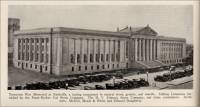
- Bedford, Lawrence County, Indiana – the Furst-Kerber Cut Stone Company (from Stone: An Illustrated Magazine, Vol. XLVII, No. 1, January, 1926, pp. 42.)
“Details of Entrance of New Federal Reserve Bank Building, St. Louis, Mo., Showing Carved Work in Standard Buff Indiana Limestone Executed by the Furst-Kerber Cut Stone Company. Architects: Mauaran, Russell and Crowell.” (pp. 42) 
- Bedford, Lawrence County, Indiana – the Carl Furst Company (The following information is from the “Holy Altar Cross” section of the Philadelphia Church Project – Holy Altar Cross, Philadelphia Church Project Blog. A photograph of the Limestone Holy Cross Altar is included on this web site.)
According to a 1929 issue of Quarries and Mills: Indiana Oolitic Limestone Industry, the “altar is made of Indiana limestone and was carved by the Carl Furst Company of Bedford, Indiana. The architect of record is Henry Dagit, one of the city's more prolific church architects.”
- Bedford, Lawrence County, Indiana – Carl Furst on the 1930 U.S. Federal Census
1930 United States Federal Census – Census & Voter Lists
Name: Larisa Furst
Spouse: Carl Furst
Birth: abt 1868Residence: 1930 - city, Lawrence, Indiana
- Bedford, Lawrence County, Indiana – the Furst-Kerber Cut Stone Company (The following quotations are from the RootsWeb Indiana Archive: “This book has no cover, and no index, and no author…. it is full of Indiana biographies…Typed by Lora Radiches.”
Charles Frank Alhorn, superintendent and general manager of the Dickson Mill, one of the largest and most modern of the stone mills operated by the Indiana Limestone Company at Bedford, has been connected with the chief industry of Bedford since boyhood…When that plant was destroyed by fire two years later he returned to Bedford, spent one year with the Furst-Kerber Cut Stone Company, and then became foreman of the Bedford mill.…”
- Bedford, Lawrence County, Indiana – the Furst-Kerber Cut Stone Company (The following quotations are from the RootsWeb Indiana Archive: “This book has no cover, and no index, and no author…. it is full of Indiana biographies…Typed by Lora Radiches.”
- Bedford, Lawrence County, Indiana – the Carl Furst Stone Company (The following information is from an abstract available on the vLex web site.)
Monon Stone Company and Quarry Workers’ International Union of North America, 14 (1939). National Labor Relations Board, Docket Number: R-773 to R-790, Parts: 22.
“In the Matter of Carl Furst Stone Company and Quarry Workers’ International Union of North America ….”
- Bedford, Lawrence County, Indiana – the Furst-Kerber Cut Stone Company Mills (The following information is from Gazetteer of Limestone Mills of Owen, Monroe, and Lawrence Counties to 1950 (pdf), by Clay W. Stuckey, June 1989)
According to this gazetteer (which covers up through 1950) by Clay W. Stuckey, the Carl Furst Stone Mill is located on Garvey Lane, and the Furst-Kerber Mill No. 1 is located on East Garvey Lane. (See the maps on pp. 42 and 44 in this publication at the web address above to the specific locations.) The mill was later operated by Summitt and Evans.
The Furst-Kerber Cut Stone Company was one of 24 companies to merge into the Indiana Limestone Company. “Some of these were involved in quarrying, some in milling, and some in both. Some worked in Owen, some in Monroe, and some in Lawrence Counties and some worked in multiple counties.” According to the footnote, the preceding information was from a “loose-leaf undated booklet of the Indiana Limestone Company, Bedford, Indiana.”
After the merger, the Furst-Kerber Mill No. 1 became known as the Indiana Limestone Company Whiting Mill. It was torn down sometime after 1939. The Furst-Kerber office building, which was located south of the mill, was used as a church for a time.
The Furst-Kerber Mill No. 2, later known as the Furst-Kerber Needmore Mill, was built in 1911 and was later used for other purposes. (The map on pp. 60 shows the location of the Furst-Kerber Mill No. 2.)
More information about these mills and the other companies that merged to form the Indiana Limestone Company is available in this gazetteer.
- Bedford, Lawrence County, Indiana – the Carl Furst Company (The following information is from Homes of Stone, 1953, available on the Internet Archive – Texts.)
(pp. 30) Indiana Cut Stone Contractors and Quarrymen’s Association
The Carl Furst Company, P.O. Box 469, Bedford, Indiana (Quarriers of Indiana Limestone)
- Bedford, Lawrence County, Indiana – the Carl Furst Company (The following information is from Mineral Yearbook Area Reports Year 1955, by Donald F. Klyce and John B. Patton, Vol. III, Bureau of Mines, 1958, pp. 405.
The Mineral Industry of Indiana (pp. 405)
“Monroe. – Building stone from quarries and mills in the Bloomington area was the most important mineral commodity produced. Dimension limestone was quarried by: Bloomington Limestone Corp., Empire Stone Co., Carl Furst Co....”
- Bedford, Lawrence County, Indiana – the Carl Furst Company (The following information is from Mineral Yearbook Area Reports Year 1957, by Donald F. Klyce and John B. Patton, Vol. III, Bureau of Mines, 1959, pp. 418.)
“Monroe. – Monroe County limestone quarries produced a major portion of the building-stone output of the State. Quarries and mills were operated by Bloomington Limestone Corp., Empire Stone Co., The Carl Furst Co….”
- Bedford, Lawrence County, Indiana – the Carl Furst Company (The following excerpt is from Excursions in Indiana Geology, by Ann M. Burger, Carl B. Rexroad, Allan F. Schneider, and Robert H. Shaver, with contributions by Lawrence F. Rooney and Charles E. Wier, Department of Natural Resources, Geological Survey Guidebook 12, Prepared For The Field Trip of The 58th Meeting of The Association of American State Geologists, May 8-12,1966. Printed by Authority of the State of Indiana, Bloomington, Indiana: 1966, pp. 7.)
“Along the route tall steel derricks rising above the wooded hills and jumbled piles of angular stone stand in mute testimony that this two county area produces more building limestone than any other such area in the world. Ahead is one of the areas of concentrated quarrying, comprised of Indiana Limestone Co., Woolery Stone Co. (fig. 4), Carl Furst Co., and Bloomington Limestone Co. quarries.”
- Bedford, Lawrence County, Indiana – the Carl Furst Stone Co. (The following information is from the Bedford North Lawrence High School – Reflections Yearbook, Bedford, Indiana - Class of 1971, pp. 219.
“…Bedford Carl Furst Stone Co….”
- Bedford, Lawrence County, Indiana – the Carl Furst Company (The following information is from Mineral Yearbook Area Reports: Domestic 1971, by Brinton C. Brown, Vol. 2, 1971, pp. 280.)
“Franklin County Stone Co. and Henson Stone Co. each started small rubble-stone operations in Franklin County. Mr. Larry Evans of the Bedford Stone Service in Lawrence County purchased Limestone Veneers and the Carl Furst Co. The Evan’s companies are producers and fabricators of Salem dimension limestone.
“Poor economic conditions were attributed in the closing of several small dimension stone quarries including Judd Stone Service, Franklin County; Blue Ridge Quarries, Shelby County; Springs Valley Sandstone Co., Orange County; and St. Meinrad Archabbey quarry in Spencer County.”
- Bedford, Lawrence County, Indiana – the Furst Kerber Cut Stone Co. (The following quotation is from Judicial Misapplication of the Indiana Workmen’s Compensation act to Injuries Resulting from an Employer’s Wilful (sic) Conduct, by Thomas F. Mache, Val Paraiso University Law Review, Spring 1979, pp. 563, 570, and 572 footnotes.)
17. “…Furst Kerber Cut Stone Co. v. Mayo, 82 Ind. App. 363, 144 N.E. 857 (1924).”
- Bedford, Lawrence County, Indiana – the Furst-Kerber Quarries & Mills/Carl Furst Quarry – Photographs presented on Quarry Districts Along the Monon, by Tom Kepshire.
The following photographs that relate to the Furst-Kerber Stone Company are available on Tom Kepshire’s “Quarry Districts Along the Monon” web site:
(photograph of the mill) “Near Murdock. Furst-Kerber Mill #2. According to the date on the building, this mill was opened in 1911.”
(photo caption on right) “… Right: Furst-Kerber Mill #2. Old stone pile. Both pictures circa 1984.”
Clear Creek (on the Quarry Districts Along the Monon web site)
(photo caption for “local stone train”) “New 08-19-2011 Local stone train coming off the old stone spur line west of Clear Creek. It is coming back from Maple Hill, University, Carl Furst and Woolery Quarrys (sic) and Mills. – Photos, Tim Swan Collection.”
(photo caption) “Aerial photograph taken circa 1940. It is looking east at the Forburger-Harris Mill in the center and the Wylie Mill of the Bloomington Limestone Company at the top…The branch turns north and serviced Woolery & Sons quarry and Mill, Maple Hill Quarry and Mill, Carl Furst Quarry….”
- Bedford, Lawrence County, Indiana – Carl Furst Stone Company Employees Found Online as of January 2012. (Below are entries for men who once worked for the Carl Furst Stone Company.)
Leland F. Chapman of Williams, Indiana (1906-1999) Find A Grave entry. “He had worked at Carl Furst Stone Mill and Heltonville Limestone.”
Ray H. Conner of Bedford, Indiana (1910-1987) obituary entry by Treva Bean on the RootsWeb Archive web site. “He was a retired stone worker with Carl Furst Stone Company….”
Donald Patton of Bedford, Indiana (1928-1998) Find A Grave Entry. “…Donald Patton of Bedford, IN, died Tuesday, November 17, 1998, at his residence. Born in Lawrence County, IN...He married Ann E. Furst on November 7, 1953, and she survives.” “He was a partner in Century 21 Stone City Realty, an officer of Carl Furst Stone Companys….”
Hubert Cummings – “Linked by Limestone” “Retired draftsman, from left, Chet Young, Henry Conway and Hubert Cummings reminisce about their years in the limestone business….” “He started his career in 1949 as an apprentice under Francis Weir at Ingalls Stone Co. He later worked as a draftsman at Carl Furst Stone…..”
- Bedford, Lawrence County, Indiana – the Carl Furst Stone Company Quarry (The reference below is from Just Arrived From The East: Manufactured and Imported Building Materials in Early Nineteenth-Century Indiana (pdf), A Thesis Submitted to the Graduate School in Partial Fulfillment of the Requirements for the Degree Master of Science in Historic Preservation, by M. Chris Manning, Duncan Campbell, Advisor, Ball State University, Muncie, Indiana, December 2010. (Description of thesis: “This thesis examines the availability and use of manufactured and imported building materials in southern and central Indiana before 1850. Specifically, it seeks to identify the extent to which materials such as paint, machine-cut nails, window glass and prefabricated sash, architectural hardware, and cast iron stoves were imported into the region from both foreign and domestic sources. It examines the transition from handmade and hand-wrought to standardized, mass-produced, and prefabricated building materials and explores the impact of emerging American consumerism, changing economic policy, and advancements in technology and transportation on the built environment of the Indiana frontier.”)
(pp. 130 reference) Campbell, Duncan, and Kristen Brennan. “Borland House and Carl Furst Stone Company Quarry.” National Register of Historic Places Registration Form. Bloomington, IN: United States Department of the Interior, National Park Service, 1999.
- Bedford, Lawrence County, Indiana – the Furst-Kerber Company (The quotation below is from the town of Oolitic section on the genealogytrails.com web site: “Indiana Genealogy Trails – Indiana Creek.” Visit their web site if you’d like to read more about the town of Oolitic and other nearby towns.)
“The town of Oolitic owes its existence mainly to the stone industry. The town is a center of many quarries and mills bearing a world-wide reputation. Among the principal ones surrounding the town are: The Indiana Stone Company, the Reed Stone Company, the Indiana Quarries Company. the Consolidated Stone Company, the Furst-Kerber Company, and the Ingles Stone Company. A drive through the country nearby reveals mammoth stacks of cut stone, black smoke from myriad mill chimneys, and stone-heaped cars sidetracked ready to be rushed to different points of the country. The workers live in the picturesque and beautiful hills of Lawrence county close to their working ground, little noting the magnificent proportions and impressive detail of the wooded and rocky elevations around them.”
- Bedford, Lawrence County, Indiana – Carl Furst was one of the founders of the Furst-Kerber Cut Stone Company. Tom Patton, wrote about his great grandfather, Carl Furst, on his “Life’s a Beach” web site and in his 2007 and 2008 blogs. (You can read Tom Patton’s articles using the links below.)
According to Tom Patton, his maternal great grandfather, Carl Furst, immigrated from Germany, founded the Furst Stone Company (aka the Furst-Kerber Cut Stone Co.), which had quarries located outside of Bloomington to the north. Patton notes that one of the quarries was located on Tapp Road on his “Life’s a Beach” web site.
Carl Furst built a three-story limestone family home, which is described as an “American Foresquare.” Paton’s family owned and lived in the house for over 100 years until a few years ago when it was sold. Mr. Patton wrote that the house includes “a massive limestone wrap-around front porch….,” “turned limestone balustrades,” and “massive turned limestone columns to support the porch roof.”
The present owner of the house, Brian, has a blog, “1901 American Foresquare – aka The Broken House,” that describes the Carl Furst limestone house and how he and his wife are restoring it. Brian wrote that the house is known locally as “The Limestone Mansion” and that Carl Furst used workers from his quarry to build the house in 1901.
In his “Farewell Tour,” Tom Patton wrote that old Carl Furst mill was “still working for Evans Limestone Company” during his visit in 2008. (A photo of the mill is included in his “Farewell Tour.”) In his “Farewell Tour – Day 2,” Tom Patton wrote that he visited the “former Furst-Kerber Cut Stone Company office…which is now a private residence.” (A photograph of the old company office is included in Patton’s “Growing Up.”)
Other structures constructed from locally-quarried limestone that Tom Patton described include: The band shell, picnic tables, and enclosures, 1938 WPA projects in the Fred B. Otis Park; the Lawrence County Courthouse; and the Bedford High School, which is now the middle school.”
Below are the links mentioned in the summary above by Tom Patton about his great grandfather, Carl Furst, and Brian’s link to his description of the limestone mansion and its restoration:
“Life’s a Beach” web site by Tom Patton
“Can You Go Home Again?” by Tom Patton (July 25, 2008)
“Growing Up,” by Tom Patton (July 26, 2008)
“Farewell Tour,” by Tom Patton (July 27, 2008)
“Farewell Tour – Day 2,” by Tom Patton (July 28, 2008)
“1901 American Foresquare – AKA The Broken House,” by Brian.
- Bedford, Lawrence County, Indiana – the Furst-Kerber Mill – (colorized postcard photograph; early 1900s; unmailed)


Commercial use of material within this site is strictly prohibited. It is not to be captured, reworked, and placed inside another web site ©. All rights reserved. Peggy B. and George (Pat) Perazzo.