
List of Quarries
in Vermont & Quarry
Links, Photographs and Articles
- Westfield, Vermont - Steatite/Soapstone Deposits (Excerpt from Report of the United States National Museum Under the Direction of the Smithsonian Institutions For the Year Ending June 30, 1886,
Chapter entitled “The Collection of Building and Ornamental Stones In The U. S. National Museum: A Hand-book and Catalogue,” By George P. Merrill, Curator, Department Lithology and Physical Geology, pp. 285-291. “Soap-Stones of the Various States and Territories,” pp.
359-360.)
“Vermont. - Most of the steatite of this State is found on the east side of the Green Mountains and near the eastern line of the talcose slate formation, beds of it extending nearly the entire length of the State. The rock occurs usually associated with serpentine and hornblende. The beds are not continuous and have, as a rule, a great thickness in comparison with their length. It not infrequently happens that several isolated outcrops occur on the same line of strata, sometimes several miles apart, and in many cases alternating with beds of dolomitic lime stone that are scattered along with them.
“At least sixty beds of this rock occur in the State in the towns of…Westfield….”
- White River Junction, Vermont – Adams & McNichol
(Monument Dealer) (Excerpts from “Motor Truck in the
Monument Business: What Retail Monument Dealers Think of the Efficiency
of Motor Transportation for Memorial Work,” article in Granite
Marble & Bronze, Vol. XXXI, No. 1, January 1921, pp. 32-33d.
“A short time ago Granite Marble & Bronze sent out a questionnaire to thousands of retail monument dealers throughout the country for information regarding the part the motor truck plays in the retail monument business….”
“Of course, the real interest in connection with this digest is in quoting what the dealers have to say about the subject, for the sayings are many and various….”
“Adams & McNichol, White River Junction, Vt.:
“‘We use two trucks, a Garford two-ton and an International one-ton. We haul everything from the shop and do not ship by railroad. For us, therefore, the truck is a great advantage over the team, for the team could not handle these long hauls. Our trucks were equipped with solid tires and we have always used them, but have no real reason for doing so. The motor truck is a great advertisement and enables a dealer to conduct his business on an altogether different plan than he could otherwise do. Of course, this applies to a business that is scattered like ours is among people living in rural communities.’”
-
Williamstown, Washington County, Vermont – the Grearson-Beckett Company, Granite Manufacturers Advertisement from The Monumental News, March 1906, pp. 231)
Grearson-Beckett Company, Granite Manufacturers, Williamstown, Vt.
Large Monumental Work and have every facility for handling it. We are located conveniently to the Barre Quarries. - Williamstown, Washington County, Vermont - Pirie Granite Quarry (AKA Pirie’s Select Barre Granite Quarries, AKA J. K. Pirie Quarry, AKA J. K. Pirie Estate Quarry, AKA the Wells Lamson Co. Quarry)
See: Barre, Washington County, Vermont – the Pirie Granite Quarry (AKA Pirie’s Select Barre Granite Quarries, AKA J. K. Pirie Quarry, AKA J. K. Pirie Estate Quarry, AKA the Wells Lamson Co. Quarry)
Also see: Barre, Washington County, Vermont – the Wells, Lamson, & Co. Granite Quarry(AKA Pirie Granite Quarry, AKA Pirie’s Select Barre Granite Quarries, AKA J. K. Pirie Quarry, AKA J. K. Pirie Estate Quarry)
“Story of The Pirie Quarry,” in The Monumental News: Granite, Marble, Stone, Bronze Sculpture, June, 1923, pp. 343.
“A final decree of settlement was made yesterday in the estate of the late James K. Pirie, prominent Barre quarry owner, by which the extensive quarry is decreed in trust to James G. Pirie and Fred F. Pirie during their lives, to be operated for the benefit of the widow and ten children of the deceased. This trust is created after the bestowal of several private bequests. The order was signed by Judge G. L. Stow of Orange county probate court.
“The decree brings out in some detail an interesting chapter in the history of Barre granite as given in the Barre Times - a chapter which tells of the energy and initiative of a poor boy applied in a field of activity where there was great promise and where those efforts were crowned with such a degree of success that an estate of considerable proportions was left. The amount of the property left in trust is not revealed but it is known that the estate was one of the largest to go through the probate court of the district recently.
“When ‘Jim” Pirie came to Barre in 1880 from Aberdeen, Scotland, by way of Maine and Quincy, Mass., his worldly goods didn’t total very much but he had plenty of enthusiasm and a good working knowledge of granite. He hammered away in Barre stonesheds for a year or so and then, allying himself with George Lamson, he began prospecting on the Barre hill where Midas dreams were to come true in later years.
“‘Jim’ and George went up on S. W. Flint’s pasture, which was worthless as a farm proposition and so poor for pasturage that it couldn’t even be fenced. Their eyes lighted on a boulder that looked promising. So they approached the owner with a view to purchase. They found that while the owner realized he had a worthless pasture he nevertheless wasn’t going to let the land go for little or nothing what with the opening up of quarries in the region.
“So the granite prospectors were somewhat prepared when the owners (sic) asked them $1200 for his stony pasture of a dozen acres - and they readily snapped up the proposition. With eight acres added, Flint ’s pasture has been turning out splendid dark Barre granite by the hundreds of thousands of dollars worth in the forty years since a cow couldn’t find a decent living on the property.
“Having gained title to the flint pasture, Messrs. Pirie and Lamson proceeded in 1882, to strip off what little soil there was and opened a quarry operating under the name of Wells Lamson Co. There they dug out some of the finest Barre granite, and the quarry has since been sending its product to all quarters of the continent. After the settlement of Mr. Lamson’s estate in 1900 Mr. Pirie became the sole operator of the quarry and was at the time of his death in 1921, probably the largest sole operator on the Barre hill.
“For nearly forty years Mr. Pirie was engaged in quarrying operations there. He combined business integrity with a good product and he gained an excellent standing with the trade, so good a standing, in fact, that the company retains on its list of customers today some people who were customers thirty years ago. Thus it will be seen that, starting with the first big rush of the Barre granite industry, Mr. Pirie contributed very largely to the enormous development of the last four decades, maintaining the good will of the trade, of his business associates and of his employees. The Pirie quarry is by no means the largest in the Barre district, but it has always been a prominent factor in the business. It employs under normal times approximately fifty men.
“Several of Mr. Pirie’s boys grew up with the business and two of them, James G. and Fred F., to whom the quarry is left in trust, have been closely associated in the conduct of the business of late. James G. Pirie, has indeed, been actively engaged in the management of the quarrying end of the business for ten years.
“In keeping with the development of the business, a town office of the concern was located in Barre City, being in the Quarry Bank building and being in charge of James G. Pirie, who, a year ago, took up his residence in Barre City and who has since become prominently identified with various affairs of the community. Fred F. Pirie will manage the quarry end of the business and will reside at the quarries where he at present resides. All the eleven heirs to the Pirie estate reside in this vicinity with the exception of one daughter, who is in the south.
“The J. K. Pirie estate on May 5 signed an agreement with the Quarry Workers’ union similar to the agreements made by other quarry companies on the Barre hill which have settled with the union.”
- Williamstown, Washington County, Vermont – J. K. Pirie Granite Quarry Photographs taken by Fred F. Pirie, owner of the Pirie granite quarry, during the 1930s, 1940s, and 1950s (The quarry was located in Williamstown, Vermont; and the business office was located in Barre, Vermont.) These photographs were contributed by and are used with the permission of Paul Wood of the Vermont Granite Museum.

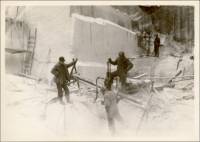

J. K. Pirie Granite Quarry
Photos by J. K. Pirie, mid-1900s
Photos from the Vermont Granite Museum, Paul Wood
- Williamstown, Washington County, Vermont – J. K. Pirie Granite Quarry (The photograph below was contributed by the Wisconsin Historical Society in March 2012. On the back of the photograph is written: “J. K. Pirie #3.” The date and the photographer of the photograph are unknown. The original of this photograph will be sent to Paul Wood of the Vermont Granite Museum. According to Paul Wood, this is a turn-of-the-century photograph taken by O. J. Dodge, a Barre granite industry photographer.)
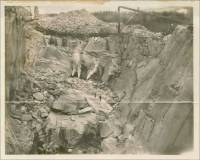
J. K. Pirie Granite Quarry, Williamstown, Vermont
- Williamstown, Washington County, Vermont – Wells Lamson Co. Quarry (AKA Pirie Granite Quarry, AKA J. K. Pirie Quarry, AKA J. K. Pirie Estate Quarry)
See: Barre, Washington County, Vermont – the Wells, Lamson, & Co. Granite Quarry (AKA Pirie Granite Quarry, AKA Pirie’s Select Barre Granite Quarries, AKA J. K. Pirie Quarry, AKA J. K. Pirie Estate Quarry)
Also see: Barre, Washington County, Vermont – the Pirie Granite Quarry (AKA Pirie’s Select Barre Granite Quarries, AKA J. K. Pirie Quarry, AKA J. K. Pirie Estate Quarry, AKA the Wells Lamson Co. Quarry)
(For a summary of the history of the Pirie/Wells Lamson Quarry, see the entry above: “Story of The Pirie Quarry,” in The Monumental News: Granite, Marble, Stone, Bronze Sculpture, June, 1923, pp. 343.)
- Windham, Vermont - Steatite/Soapstone Deposits (Excerpt from Report of the United States National Museum Under the Direction of the Smithsonian Institutions For the Year Ending June 30, 1886,
Chapter entitled “The Collection of Building and Ornamental Stones In The U. S. National Museum: A Hand-book and Catalogue,” By George P. Merrill, Curator, Department Lithology and Physical Geology, pp. 285-291. “Soap-Stones of the Various States and Territories,” pp.
359-360.)
“Vermont. - Most of the steatite of this State is found on the east side of the Green Mountains and near the eastern line of the talcose slate formation, beds of it extending nearly the entire length of the State. The rock occurs usually associated with serpentine and hornblende. The beds are not continuous and have, as a rule, a great thickness in comparison with their length. It not infrequently happens that several isolated outcrops occur on the same line of strata, sometimes several miles apart, and in many cases alternating with beds of dolomitic lime stone that are scattered along with them.
“At least sixty beds of this rock occur in the State in the towns of…Windham….”
-
Windsor, Vermont - the Mower Granite Quarry (from The Commercial Granites of New England, Bulletin 738, by T. Nelson Dale, Department of the Interior, United States Geological Survey, Government Printing Office, Washington, 1923.)
“Windsor Granite,” or “Ascutney Green” granite when first quarried is a dark bluish-gray color. After brief exposure, the color of the granite changes to dark olive green with a medium to coarse texture.
The Mower Quarry was “on the west side of Mount Ascutney nearly 1 ¼ miles south of Brownsville and 580 feet above it, in West Windsor.” The operator was Ascutney Mountain Granite Company of Windsor, Vermont. The granite was sold under the name of “Bronze Vein Green.” The Mower Quarry was opened in 1906. In 1907 the quarry measured about 50 feet square and had an average depth of 10 feet. At the time of the study, the quarry was abandoned.
The granite from the Mower Quarry was used mainly for dies, wainscoting, and indoor columns. An example of usage of this granite is: the two monolithic sarcophagi in the McKinley mausoleum in Canton, Ohio.
-
Windsor, Vermont - the Norcross Granite Quarry (from The Commercial Granites of New England, Bulletin 738, by T. Nelson Dale, Department of the Interior, United States Geological Survey, Government Printing Office, Washington, 1923.)
“Windsor Granite,” or “Ascutney Green” granite when first quarried is a dark bluish-gray color. After brief exposure, the color of the granite changes to dark olive green with a medium to coarse texture.
The Norcross Quarry was “on the north side of Mount Ascutney on the 1,350-foot level, about 950 feet above Windsor village, a little over a mile east-southeast of Brownsville, in Windsor.” The operator was Norcross Bros. Co. of Worcester, Massachusetts. At the time of the study the quarry was abandoned, although it had been operated only occasionally. The granite was reportedly a dark bluish-gray color with medium to coarse texture. The quarry measured about 200 feet from east to west by 40 feet across. It had a working face of 60 feet high on the south “with a rugged cliff above it, making a total face of 80 to 90 feet above the quarry bottom and road.” Transport of the granite was by cart to the rail at Windsor.
Accessory minerals: Magnetite or limenite, titanite, and allanite. Secondary minerals: Kaolin.
The granite from the Norcross Quarry was used for monumental and decorative purposes in the following examples: the sixteen polished columns at the Columbia University Library in New York, the monument to general Gomez in Cuba; a die in the Bennington monument; 34 large columns in the Bank of Montreal; and the columns and die of the W.C.T.U. fountain in Orange, Massachusetts.
- Windsor County, Vermont – U. S. Quarried Slate Products Slate. In 1995 this company operated a slate quarry in Windsor County. At that time the company headquarters was located in Fair Haven, Vermont. (From United States Geological Survey, Mineral Industries Surveys - Directory of Principal Dimension Stone Producers in the United States in 1995, prepared in January 1997.)
- Woodbury, Washington County, Vermont – Ainsworth Quarry
of the St. Johnsbury Granite Co. (circa 1899) (Granite) (Excerpt
from Gazetteer of Washington County, Vermont, 1783-1889,
Part First, compiled and published by Hamilton Child, Edited by William
Adams, Syracuse, N.Y.: The Syracuse Journal Co., Printers and Binders,
April 1899, pp. 520. (This book is available on Google
Book Search – Full
View Books for reading or downloading to your computer in PDF
format.)
“The J. Ainsworth quarry, opened about 1876, is now operated by the St. Johnsbury Granite Co. The quality is good and easily worked, and takes a good polish.”
- Woodbury, Washington County, Vermont - the Ainsworth Granite Quarry (from The Commercial Granites of New England, Bulletin 738, by T. Nelson Dale, Department of the Interior, United States Geological Survey, Government Printing Office, Washington, 1923.)
The Ainsworth Quarry was “on the northeast foot of Robeston Mountain, in Woodbury, about 1,000 feet northeast of the railroad.” The operator was Andrew A. Ainsworth of Hardwick, Vermont. At the time of the report, the quarry was abandoned.
-
Woodbury, Washington County, Vermont - the Drenan Granite Quarries in Woodbury (from The Commercial Granites of New England, Bulletin 738, by T. Nelson Dale, Department of the Interior, United States Geological Survey, Government Printing Office, Washington, 1923.)
The Drenan Quarries were “in Woodbury, on the rising land north of the east end of Robeson Mountain, about 150 feet above the north spur of the Hardwick & Woodbury Railroad.” At the time of the report, they were not in operation. The granite in the quarry was reportedly a dark bluish-gray color of a fine texture.
Accessory minerals: Pyrite, apatite, zircon. Secondary minerals: Kaolin, a white mica, calcite, zoisite.
The granite from the Drenan Quarries was a monumental granite having the same color as “Dark Barre” but having a finer texture. Reportedly it was darker than any of the other granites of Robeson Mountain.
- Woodbury, Vermont – the Fletcher Granite Co. (The following
information is from the section "Stone Trade Notes" in Stone:
An Illustrated Magazine Devoted to Stone, Marble, Granite, Slate, Cement,
Contracting and Building, Vol. XXIV, No. 1, January, 1902, Stone Publishing
Co., New York, pp. 66.)
It is reported that the Fletcher Granite Co. will soon resume the operation of its big quarries at Woodbury, Vermont.
-
Woodbury, Washington County, Vermont - Fletcher Granite Quarry (from The Commercial Granites of New England, Bulletin 738, by T. Nelson Dale, Department of the Interior, United States Geological Survey, Government Printing Office, Washington, 1923.)
This quarry was “on Robeson Mountain near its west-southwest end and on its southeast side, in Woodbury.” The operator was E. R. Fletcher of Woodbury, Vermont. The granite is “Woodbury gray,” a light-gray shade. Transport of the granite was by siding from the Hardwick & Woodbury Railroad, which brings the stone 8 miles to the St. Johnsbury & Lake Champlain Railroad.
Accessory minerals: Pyrite, titanite, zircon, apatite, rutile. Secondary minerals: Kaolin, a white mica, epidote, zoisite, calcite, limonite.
The granite from the Fletcher Quarry was used for monuments and buildings. Examples are: the base of the General Sherman monument in Washington D.C.; the Crandall monument in Crandall Park, Glens Falls, New York; the Fort Meigs monument in Toledo, Ohio (100 feet high); the Englewood National Bank in Chicago, Illinois; the Lincoln Savings Bank in Louisville, Kentucky; the Plymouth Building in Minneapolis, Minnesota; the Courthouse in Omaha, Nebraska; and the Old National Bank in Spokane, Washington.
- Woodbury, Washington County, Vermont - History (granite quarries). Excerpts from the Gazetteer of Washington County, Vermont 1783-1889, Hamilton Child Publication, Syracuse, New York. © Copyright Central Vermont Chamber of Commerce.
-
Woodbury, Washington County, Vermont - the Imperial Blue Granite Quarry (from The Commercial Granites of New England, Bulletin 738, by T. Nelson Dale, Department of the Interior, United States Geological Survey, Government Printing Office, Washington, 1923.)
The Imperial Blue Quarry was located in “on the southeast side of Buck Pond, in Woodbury Township.” The operator was Woodbury Granite Company of Hardwick, Vermont. The granite was reported to be “Imperial Blue,” with a dark bluish-gray color and fine to medium texture. The quarry had reopened in 1907 and, at the time of the report, had a working face of about 100 by 150 feet.
Accessory minerals: clear colorless potash feldspar (microcline), with inclusions of plagioclase and biotite; slightly bluish quartz; slightly milky soda-lime feldspar (oligoclase-andesine), somewhat kaolinized, with oriented inclusions of muscovite; biotite; muscovite. Secondary minerals: Kaolin, carbonate.
The granite from the Imperial Blue Quarry was used entirely for monuments—tombstones and small memorials.
-
Woodbury, Washington County, Vermont - the Nichols Ledge Carter Granite Quarry (from The Commercial Granites of New England, Bulletin 738, by T. Nelson Dale, Department of the Interior, United States Geological Survey, Government Printing Office, Washington, 1923.)
The Nichols Ledge Carter Quarry was located “at the northwest foot of Nichols Ledge in the east corner of the town of Woodbury.” When the report was made, the quarry was no longer in operation. The granite from this quarry was a light to medium bluish-gray color of a fine to very fine texture.
Accessory minerals: Titanite, apatite. Secondary minerals: Kaolin, epidote, calcite.
-
Woodbury, Washington County, Vermont - the four Robeson Mountain Granite Quarries (from The Commercial Granites of New England, Bulletin 738, by T. Nelson Dale, Department of the Interior, United States Geological Survey, Government Printing Office, Washington, 1923.)
The Four Robeson Mountain Quarries were “roughly from 1,400 to 2,100 feet N. 80° E. from the Fletcher quarry, in Woodbury.” The operator was the Woodbury Granite Co. of Hardwick, Vermont. There were type types of granite in the quarries: “Woodbury gray,” a granite of medium-gray color and texture, and the second is “Woodbury Bashaw,” a granite of medium-gray shade “about like that of ‘Concord granite’ but more bluish and with more contrasts….”
Accessory minerals: Pyrite, apatite, zircon, rutile. Secondary minerals: Kaolin and zoisite.
The were four openings. In 1907 the dimensions were estimated to be as follows: “The main and western opening, made in 1880, beginning at the south foot of the ridge, extends about 500 feet along it and 400 feet northward up its side, with an average depth of 50 feet. The ‘upper quarry,’ above and north of the main one, is about 200 feet square, and its north side is at the top of the hill nearly 300 feet high than the lower edge of the main quarry. the third opening, about 800 feet east of the main one, made in 1906, is about 125 by 70 feet and from 10 to 30 feet deep. this produces the finer monumental granite, ‘Woodbury Bashaw.’ The fourth is a small opening made in 1907 about 200 feet northwest of the third.”
Granite from the Four Robeson Mountain Quarries were used in the following.
Buildings: the Pennsylvania capitol in Harrisburg; the Cook County courthouse in Chicago, Illinois; the base course and 36 interior polished columns of the Kentucky capitol in Frankfurt, Kentucky; the City Hall in Cleveland, Ohio; the Hotel Pontchartrain in Detroit, Michigan; the Mercantile Trust Co. Building in St. Louis, Missouri, the main entrance to the State Capitol in Boise, Idaho; the Mandell residence in Boston, Massachusetts, the Post Office in New Bedford, Massachusetts.
Monuments: the Navy Memorial (obelisk), National Military Park, Vicksburg, Mississippi; the Soldiers and Sailors’ Monument in Bloomington, Illinois; the memorial archway in Port Huron, Michigan, and the clock on the Green in Green, Waterbury, Connecticut.
- Woodbury, Washington County, Vermont – the
St. Johnsbury Granite Co. (circa 1899)
See: Woodbury, Washington County, Vermont – Ainsworth Quarry of the St. Johnsbury Granite Co. (circa 1899) above.
- Woodbury, Washington County, Vermont - the Vermont White Granite Quarry (from The Commercial Granites of New England, Bulletin 738, by T. Nelson Dale, Department of the Interior, United States Geological Survey, Government Printing Office, Washington, 1923.)
The Vermont White Quarry was “about midway between Robeson Mountain and Buck Pond…in Woodbury Township.” The operator was the Woodbury Granite Company of Hardwick, Vermont. The granite was reported to be “Vermont White,” of a very light cream color and medium texture. At the time of the report, the quarry face was about 500 by 200 feet.
Accessory minerals: clear colorless potash feldspar (microcline and orthoclase), pale smoky quartz with cavities in sheets; milk-white to cream-colored lime-soda feldspar (oligoclase), generally kaolinized, some of it altered to a white mica, some with oriented inclusions of muscovite; biotite; muscovite. Secondary minerals: Kaolin, carbonate, a white mica.
The granite from the Vermont White Quarry was used mainly for buildings. Examples are: Northwestern Mutual Life Insurance Building in Milwaukee, Wisconsin; the Museum of Fine Arts in Minneapolis, Minnesota; the Soldiers and Sailors’ Memorial in Wichita, Kansas; and the Bridgeport Trust Building in Bridgeport Connecticut.
-
Woodbury, Washington County, Vermont - the Webber Granite Quarries in Woodbury (from The Commercial Granites of New England, Bulletin 738, by T. Nelson Dale, Department of the Interior, United States Geological Survey, Government Printing Office, Washington, 1923.)
The Webber Quarries in Woodbury were “in Woodbury, still farther north of Robeson Mountain, on a mass continuous with that on the southeast side of Buck Pond.” At the time of the report, the quarries were not in operation. The main opening contained a granite of a light bluish-gray color and a medium to fine texture. “It is slightly more bluish and finer textured than the gray of the main quarry of the Woodbury Granite Co. and lighter in shade than their ‘Bashaw” and a trifle darker than “light Barre.” The stone from a opening started in 1907 was a dark bluish-gray color with a fine texture.
Accessory minerals: Magnetite, rutile. Secondary minerals: Kaolin, a white mica, calcite, chlorite, epidote.
- Woodbury, Washington County, Vermont – the Woodbury
Granite Co. (circa 1899) (Granite) (Excerpt from Gazetteer
of Washington County, Vermont, 1783-1889, Part First, compiled
and published by Hamilton Child, Edited by William Adams, Syracuse,
N.Y.: The Syracuse Journal Co., Printers and Binders, April 1899,
pp. 520. (This book is available on Google
Book Search – Full
View Books for reading or downloading to your computer in PDF format.)
“The Woodbury Granite Co. was organized and commenced business in the fall of 1878. The members of the firm are L. W. Voodry and H. W. Town. This enterprise is under the supervision of Mr. Voodry. Their quarry is located about one and a half miles east of Woodbury Center, and one mile from the proposed railroad from Marshfield to Hardwick. Their purchase covers an area of twenty-five acres, and all solid granite, which is a choice quality of gray color, especially adapted for monumental work and building purposes. The granite contains no black knots or iron. The formation is peculiarly and especially favorable to moving enormous sized blocks. The largest ever known to have been quarried was taken out here, and was 275 feet long by fifteen feet square. Two hundred feet in length of this mammoth mass was moved a distance of forty feet by a single blast, after it was split from the quarry. The company is doing a wholesale business with manufacturers, and is sending its products to parties in this and adjacent states, and largely to the far West. The quality of the granite, and the certainty of obtaining any size and form required, insures this enterprise to become one of the great industries of Washington County.”
-
Woodbury, Washington County, Vermont – the Woodbury Granite Company – Woodbury Gray Granite Advertisement (from The Monumental News, Vol. 15, No. 4, April 1903, pp 281)
Woodbury Granite Company
Quantity: Nine urns in one order. Quality: Finest of lathework, combined with the finishing touches of pneumatic tools in the hands of masters of the trade. Results: Entire Satisfaction to our customer, Mr. James Inglis, Troy, New York, Architect and Designer.
Gray Quarries: Woodbury, Vermont – White Quarries: Bethel Vermont
Main office: Hardwick, Vermont, George H. Bickford, General MangerNew York office: 7 E. 42nd Street, H. L. Brown, Representative
Woodbury Granite Company – Woodbury Gray Granite Advertisement (from The Monumental News, Vol. 15, No. 4, April 1903, pp 281) 
-
| “Soldiers’ Monument, Toulon, Illinois. Made by Grearson-Beckett Company of Williamstown, Vermont, for H. M. Teets.” (from The Monumental News, March 1906, pp. 231) |  |


Commercial use of material within this site is strictly prohibited. It is not to be captured, reworked, and placed inside another web site ©. All rights reserved. Peggy B. and George (Pat) Perazzo.