List of Quarries & Businesses
in Vermont & Quarry
Links, Photographs and Articles
- Barre, Washington County, Vermont – the Pirie Granite Quarry (AKA Pirie’s Select Barre Granite Quarries AKA J. K. Pirie Quarry AKA J. K. Pirie Estate Quarry AKA the Wells Lamson Co. Quarry)
-
Barre, Vermont – the J. K. Pirie Estate Granite Quarry from 1882 to 1926 (Granite) (from “J. K. Pirie Estate, Barre, Vermont 1882 – 1926,” Pirie’s Genuine Barre Granite, J. K. Pirie Estate, circa 1926)
(Excerpts from the brochure. The entire brochure is available at the link above.)
“The Scot is never at home except when he is traveling. This explains in part why J. K. Pirie, a journeyman stone-cutter, landed from Scotland at St. George, New Brunswick, in 1878. And he kept traveling. Maine was handy, so he worked his way down through the towns and cities of the coast until he came to Quincy in Massachusetts. From there he sought out South Ryegate in Vermont, and thence, in 1881, he arrived in Barre.
“Here the granite industry was just beginning. He decided to give up journeying and begin with it. With George Lamson he went prospecting into the hills for a likely boulder or two from which to cut monuments. They found a large and attractive one on a twelve-acre lot…So the two partners bought the twelve acres, and started to raise their own crop from its many boulders…Money was later needed for expansion. They borrowed it from their blacksmith, Sidney Wells. Out of this assistance came the firm of Wells, Lamson and Company, which remained as a co-partnership until Mr. Well’s death, when Mr. Pirie bought out his interest. The firm name was retained…in 1900 Mr. Lamson died. Three years later the partnership was dissolved, Mr. Pirie taking the dark quarry, and Mr. Lamson’s successors taking the light quarry and a manufacturing plant which the firm owned. Their part of the enterprise they sold to the Wells-Lamson Quarry Company...For eighteen years, Mr. Pirie continued to run and develop the dark quarry. By the time of his death, in 1921, its product was in the forefront of monumental stones…Mr. Pirie left his quarry as an open estate, to be run by his sons, and after them by his grandsons….” (J. K. Pirie’s sons were James G. Pirie and Fred F. Pirie.)


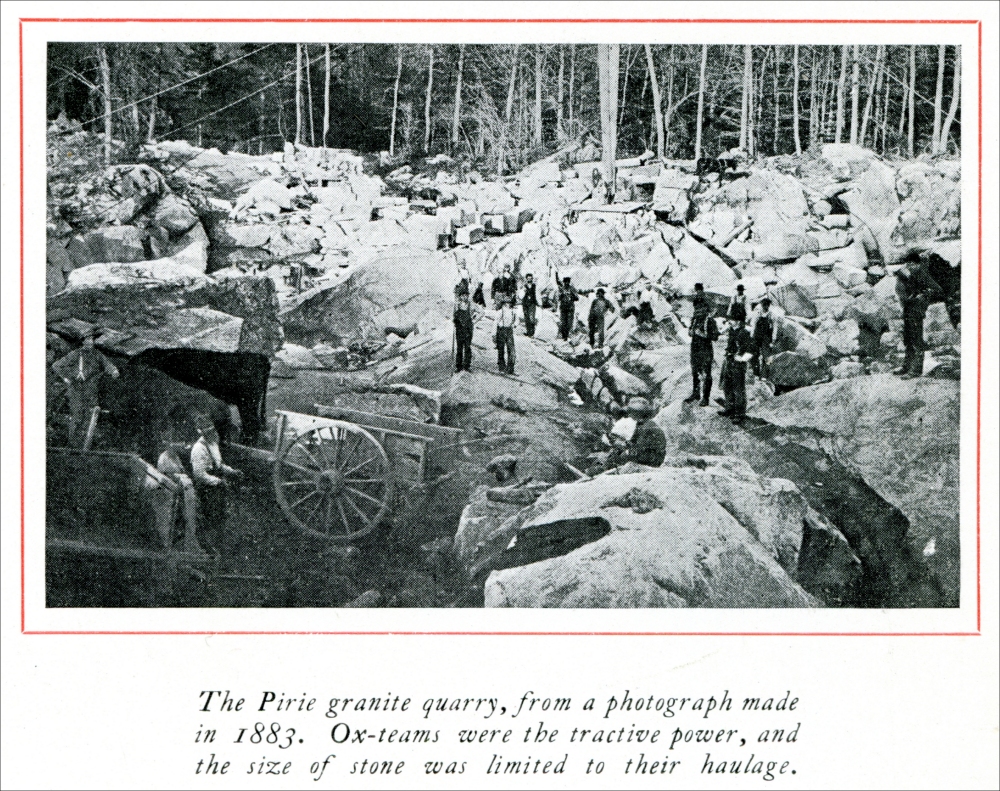
“The Pirie granite quarry, from a photograph made in 1883. Ox-teams were the tractive power, and the size of stone was limited to their haulage.”
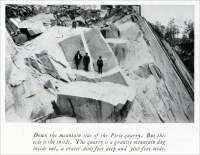
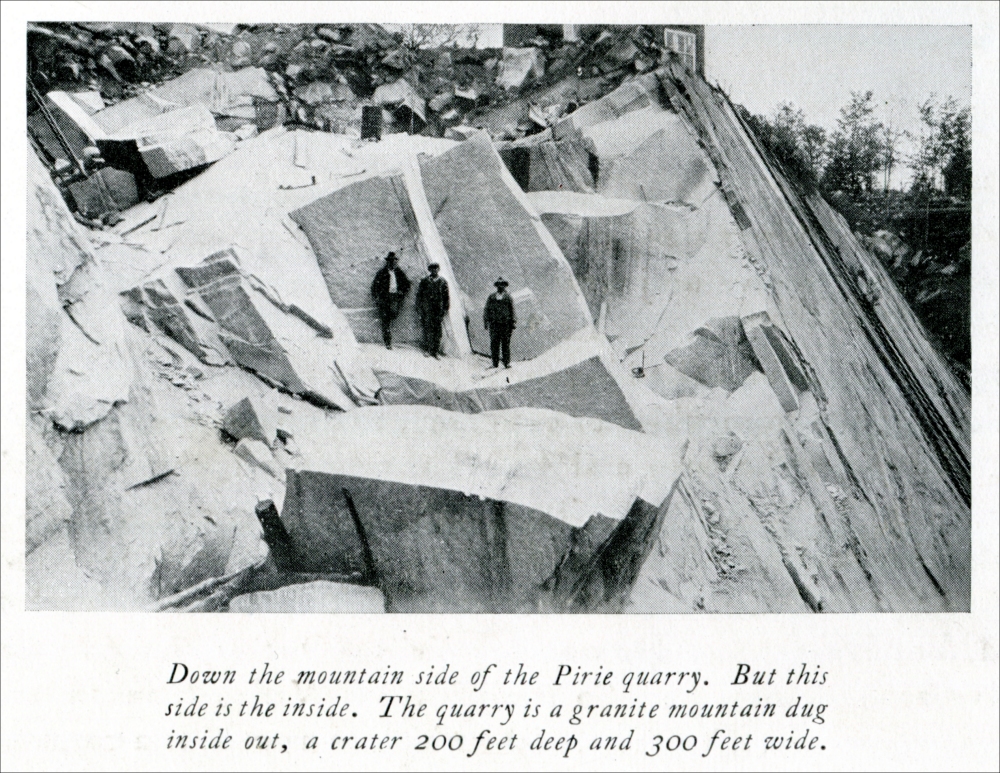
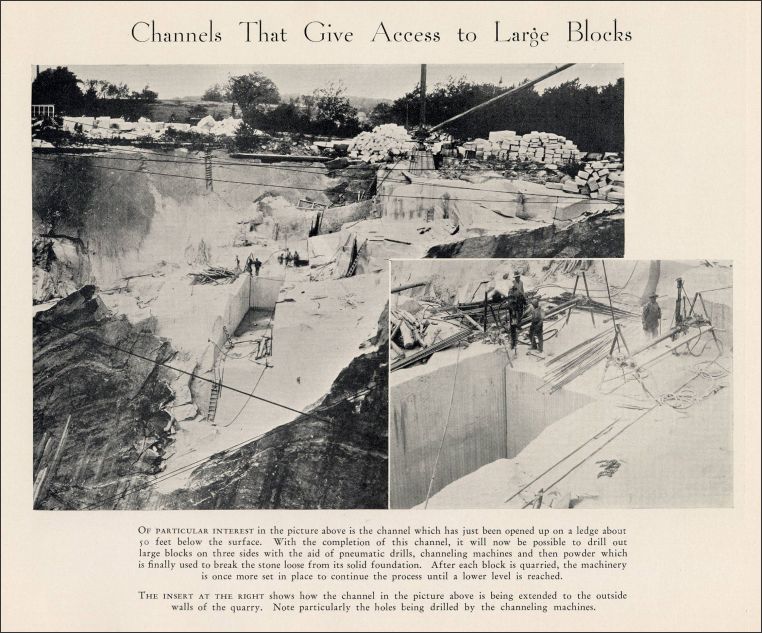
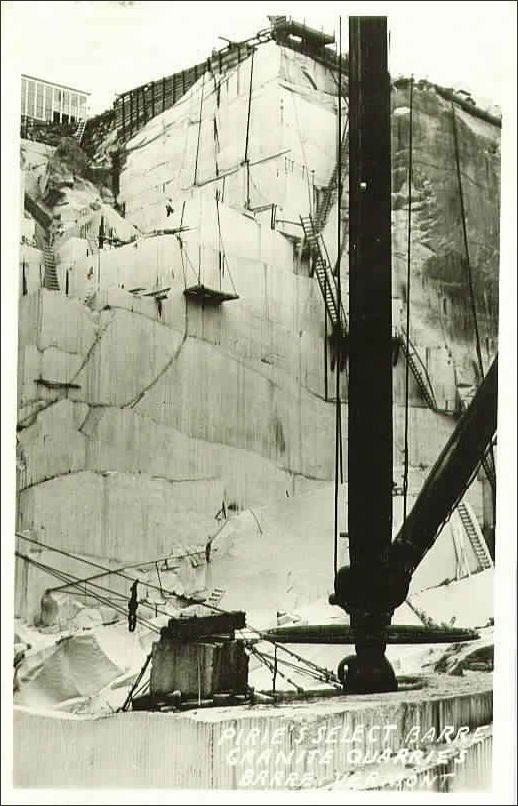
“Down the mountain side of the Pirie quarry. But this side is the inside. The quarry is a granite mountain dug inside out, a crater 200 feet deep and 300 feet wide.”
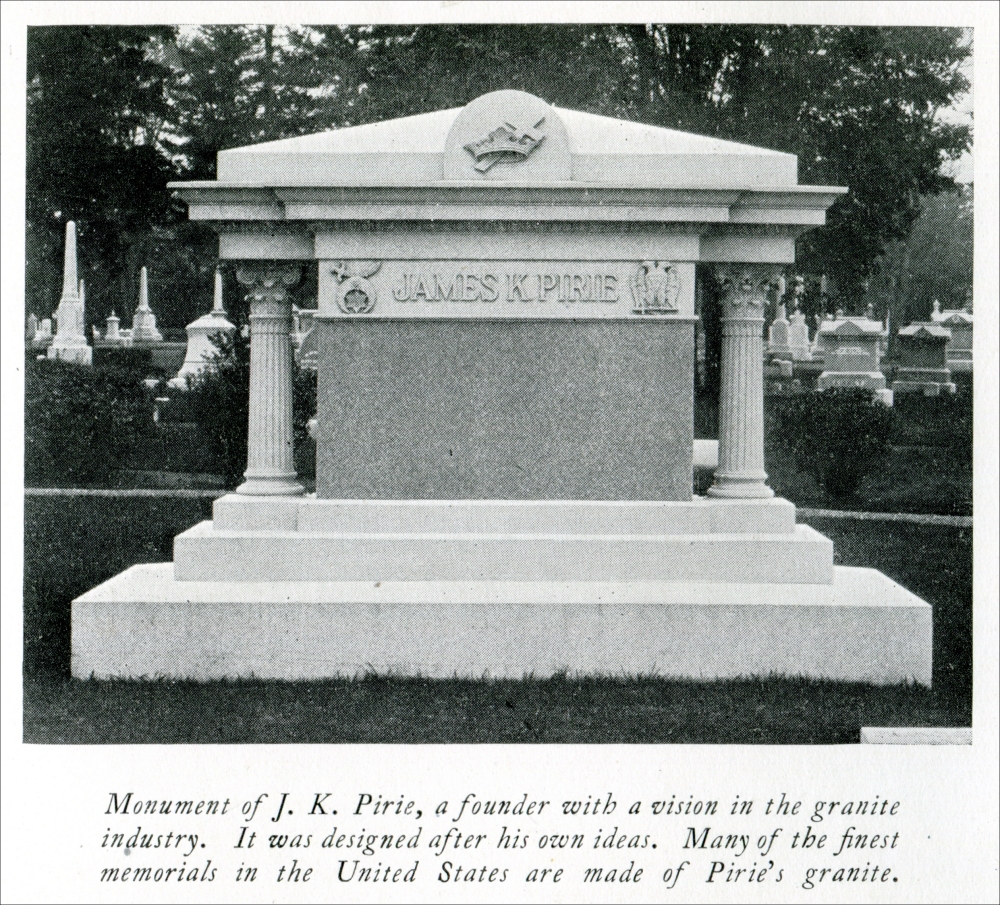
“Monument of J. K. Pirie, a founder with a vision in the granite industry. It was designed after his own ideas. Many of the finest memorials in the United States are made of Pirie’s granite.”


(Left side of photograph)
(Center portion of photograph) “Panorama of the Pirie quarry, 1926. The quarry is a deep bowl in the mountain top, giving clear stone on all sides. Grout is deposited clear of the quarry on the mountain sides, making room for development in any direction.”
(Right side of photograph)


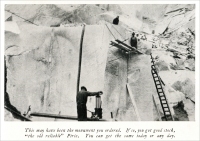
“A side wall of the Pirie quarry, and the men who have made it. Stone of the first quality is immediately available in any size at any time, and is delivered with the Pirie certificate, which guarantees it.”
“Pirie’s granite is part of the first rock formed by the cooling of the earth – the oldest rock formation of millions of years ago.”
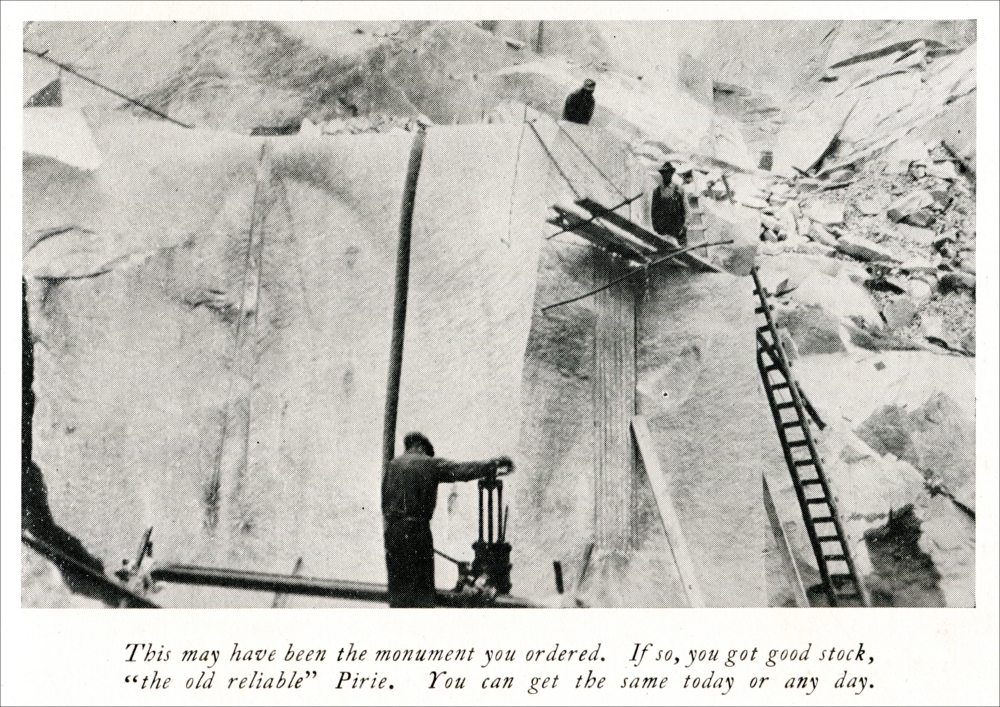
“This may have been the monument you ordered. If so, you got good stock, ‘the old reliable’ Pirie. You can get the same today or any day.”
-
Barre, Vermont – the J. K. Pirie Estate Quarries (Advertisement in The Monument and Cemetery Review, October 1926, pp. ix)
J. K. Pirie Estate – Quarries, Campbell Block, Depot Square, Barre, Vermont

J. K. Pirie Estate Quarries advertisement in The Monument and Cemetery Review, Oct. 1926
“One of the many carloads of granite which are continuously shipped from the Pirie quarries” (photo caption from ad for J. K. Pirie Estate Quarries in The Monument and Cemetery Review, Oct. 1926, pp. ix) 
“Pirie’s genuine Barre granite was used for the Mayer excedra. It was cut by Charles Bianchi & Sons for W. C. Laechle & Company, Chicago.” (photo caption from ad for J. K. Pirie Estate Quarries in The Monument and Cemetery Review, Oct. 1926, pp. ix) 
- Barre, Washington County, Vermont – the Pirie Granite Quarry Photographs, circa 1930s through 1950s. The photographs in this series were taken by Fred F. Pirie, owner of the Pirie granite quarry, during the 1930s, 1940s, and 1950s. (The quarry was located in Williamstown, Vermont; and the business office was located in Barre, Vermont.) They were contributed by and are used with the permission of Paul Wood of the Vermont Granite Museum.
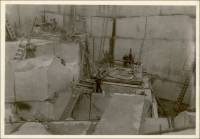
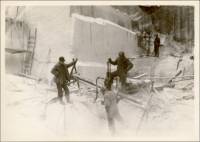
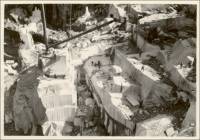
Pirie Granite Quarry, Williamstown, Vermont; Offices in Barre, Vermont
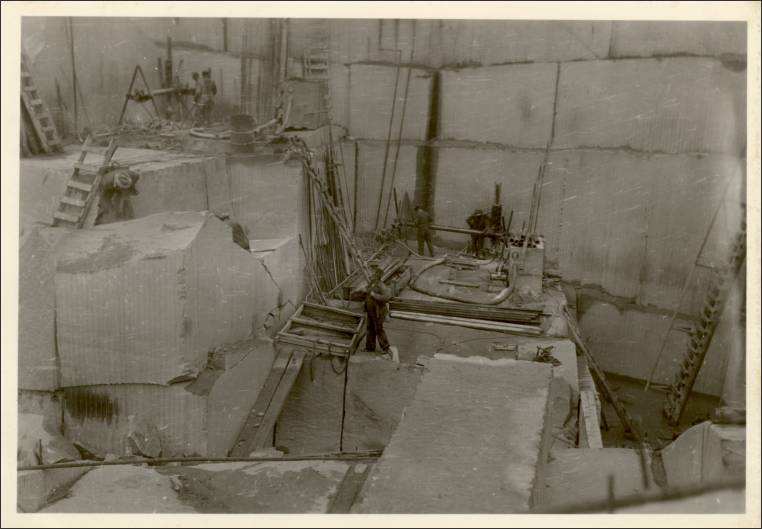
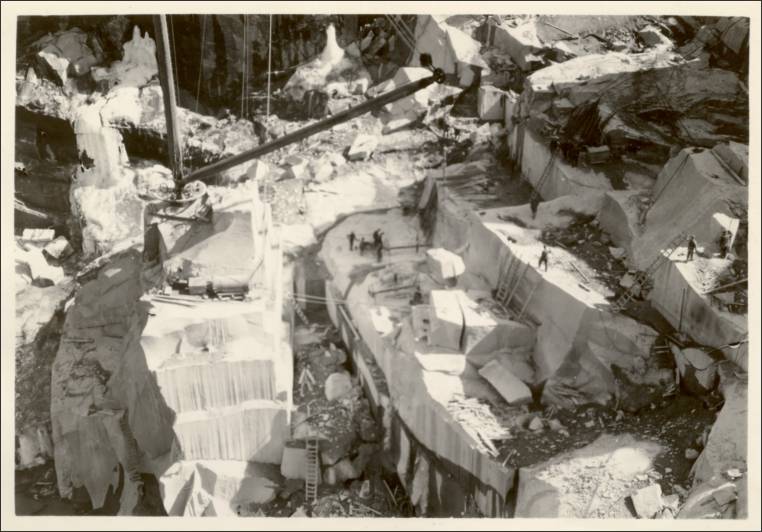
Pirie Granite Quarry, Williamstown, Vermont
Pirie Granite Quarry, Williamstown, Vermont
- Barre, Vermont – J. K. Pirie Granite Quarry (The photograph below was contributed by the Wisconsin Historical Society in March 2012. On the back of the photograph is written: “J. K. Pirie #3.” The date and the photographer of the photograph are unknown. The original of this photograph will be sent to Paul Wood of the Vermont Granite Museum. According to Paul Wood, this is a turn-of-the-century photograph taken by O. J. Dodge, a Barre granite industry photographer.)
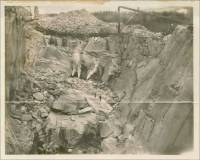
J. K. Pirie Granite Quarry, Williamstown, Vermont
- Barre, Orange/Washington County, Vermont - the Pirie
Granite Quarry (from The Commercial Granites of New
England, Bulletin 738, by T. Nelson Dale, Department of the
Interior, United States Geological Survey, Government Printing
Office, Washington, 1923.)
This quarry was located “in Williamstown (Orange County), nearly 1 ½ miles south-southwest of the top of Millstone Hill.” The operator was the James K. Pirie estate in Barre, Vermont. The granite is “dark Barre,” a slightly bluish-gray color of a fine to medium texture.
The Pirie Quarry opened in 1882. In 1907 the quarry measured 350 feet in a northeasterly direction by 100 and 250 feet across. It had a depth from 30 to 100 feet.
- Barre, Orange/Washington County, Vermont -
the Pirie Granite Quarry (AKA the Wells Lamson Co. Quarry) - “Story
of The Pirie Quarry,” in Monumental News:
Granite, Marble, Stone, Bronze Sculpture, June, 1923, pp.
343.
“A final decree of settlement was made yesterday in the estate of the late James K. Pirie, prominent Barre quarry owner, by which the extensive quarry is decreed in trust to James G. Pirie and Fred F. Pirie during their lives, to be operated for the benefit of the widow and ten children of the deceased. This trust is created after the bestowal of several private bequests. The order was signed by Judge G. L. Stow of Orange county probate court.
“The decree brings out in some detail an interesting chapter in the history of Barre granite as given in the Barre Times - a chapter which tells of the energy and initiative of a poor boy applied in a field of activity where there was great promise and where those efforts were crowned with such a degree of success that an estate of considerable proportions was left. The amount of the property left in trust is not revealed but it is known that the estate was one of the largest to go through the probate court of the district recently.
“When ‘Jim” Pirie came to Barre in 1880 from Aberdeen, Scotland, by way of Maine and Quincy, Mass., his worldly goods didn’t total very much but he had plenty of enthusiasm and a good working knowledge of granite. He hammered away in Barre stonesheds for a year or so and then, allying himself with George Lamson, he began prospecting on the Barre hill where Midas dreams were to come true in later years.
“‘Jim’ and George went up on S. W. Flint’s pasture, which was worthless as a farm proposition and so poor for pasturage that it couldn’t even be fenced. Their eyes lighted on a boulder that looked promising. So they approached the owner with a view to purchase. They found that while the owner realized he had a worthless pasture he nevertheless wasn’t going to let the land go for little or nothing what with the opening up of quarries in the region.
“So the granite prospectors were somewhat prepared when the owners (sic) asked them $1200 for his stony pasture of a dozen acres - and they readily snapped up the proposition. With eight acres added, Flint’s pasture has been turning out splendid dark Barre granite by the hundreds of thousands of dollars worth in the forty years since a cow couldn’t find a decent living on the property.
“Having gained title to the flint pasture, Messrs. Pirie and Lamson proceeded in 1882, to strip off what little soil there was and opened a quarry operating under the name of Wells Lamson Co. There they dug out some of the finest Barre granite, and the quarry has since been sending its product to all quarters of the continent. After the settlement of Mr. Lamson’s estate in 1900 Mr. Pirie became the sole operator of the quarry and was at the time of his death in 1921, probably the largest sole operator on the Barre hill.
“For nearly forty years Mr. Pirie was engaged in quarrying operations there. He combined business integrity with a good product and he gained an excellent standing with the trade, so good a standing, in fact, that the company retains on its list of customers today some people who were customers thirty years ago. Thus it will be seen that, starting with the first big rush of the Barre granite industry, Mr. Pirie contributed very largely to the enormous development of the last four decades, maintaining the good will of the trade, of his business associates and of his employees. The Pirie quarry is by no means the largest in the Barre district, but it has always been a prominent factor in the business. It employs under normal times approximately fifty men.
“Several of Mr. Pirie’s boys grew up with the business and two of them, James G. and Fred F., to whom the quarry is left in trust, have been closely associated in the conduct of the business of late. James G. Pirie, has indeed, been actively engaged in the management of the quarrying end of the business for ten years.
“In keeping with the development of the business, a town office of the concern was located in Barre City, being in the Quarry Bank building and being in charge of James G. Pirie, who, a year ago, took up his residence in Barre City and who has since become prominently identified with various affairs of the community. Fred F. Pirie will manage the quarry end of the business and will reside at the quarries where he at present resides. All the eleven heirs to the Pirie estate reside in this vicinity with the exception of one daughter, who is in the south.
“The J. K. Pirie estate on May 5 signed an agreement with the Quarry Workers’ union similar to the agreements made by other quarry companies on the Barre hill which have settled with the union.”
- Barre / Williamstown, Vermont – Pirie’s
Select Barre Granite Quarries, Barre, Vermont (PDF) undated
booklet published by the Pirie Granite Company. (Based on
the information in the booklet, it appears the booklet was
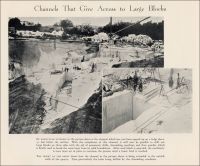
published between 1933 and 1940. More photos of the quarries, stone works, and equipment are included in the pdf booklet link above.)
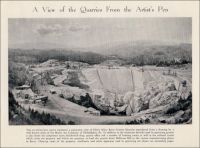
Panoramic view of Pirie’s Select Barre Granite Quarries sketch
Pirie’s Select Barre Granite Quarries
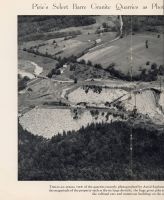
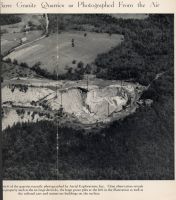
Left side of Pirie’s Select Barre Granite Quarries (aerial view)
Right side of Pirie’s Select Barre Granite Quarries (aerial view)
- Barre, Vermont - the
J. K. Pirie Quarry, Barre, (postcard photograph, #41; early 1900s; unmailed)
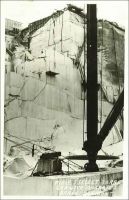
- Barre, Vermont – “At the J. K. Pirie Estate Quarry 1924” (postcard photo; 1924; unmailed) (I’ve been told by a Vermont quarry researcher that this Wells Lamson Co. quarry was located in Websterville.)

-
Barre, Vermont – J. K. Pirie Estate – Quarriers of Pirie’s Select Barre Granite (Advertisement from The Monument and Cemetery Review, March, 1949, pp. 3)
A Barre Guild Contest Winner
The Selby Design, an entry in a 1942 competition among members of the Barre Chapter of the Society of Memorial Draftsmen & Designers, sponsored by the Barre Granite Association, won one of the fifteen merited awards….”
The Hess monument was manufactured of Pirie’s Select Barre Granite by Anderson-Friberg Co., Inc., of Barre for their popular Ohio Representative, Bert Hess, who chose the Selby design for his own family memorial in Belleville, Ohio. This monument was featured in the Barre Guild Exhibit at the 1946 National Convention in Cleveland.
J. K. Pirie Estate – Barre, VT.
Quarriers of Pirie’s Select Barre Granite










| The Bert Hess family memorial monument in Belleville, Ohio (J. K. Pirie Estate advertisement in The Monument and Cemetery Review, March 1949, pp. 3) |  |
Commercial use of material within this site is strictly prohibited. It is not to be captured, reworked, and placed inside another web site ©. All rights reserved. Peggy B. and George (Pat) Perazzo.