

Structures and Monuments in Which Missouri Stone was Used
- Finished Products from Missouri Stone in Arizona
-
Ft. Smith, Arkansas – the City Public Library (from Stone:
An Illustrated Magazine, April 1908, Vol. XXXVII, No. 11, “Limestone
and Sandstone” section, pp. 610)
Carthage Limestone in a Library Building.
“The Fort Smith Times, in describing the recent dedication of the new public library at Fort Smith, Ark., describes the ceremony minutely as well as the successful completion of the building. Regarding the building material used the paper says: ‘Not all of the beauty of the Carnegie City Library is contained inside its walls, for the building presents a handsome exterior view, chiefly because of the large amount of stone used in its construction. The latter was furnished by the Carthage Superior Limestone Company of Carthage, Mo. This is known as Carthage limestone or marble, and is noted for its great strength, it small ratio of absorption, and is practically impervious to all atmospheric influences. This stone has an exceptional white appearance, which it retains, and, in fact, bleaches whiter in the course of time. The rock face ashler (sic) and stone trimmings are natural stone from the quarry of this company, while the massive columns were cast in place out of Carthage crushed limestone.”
- Phoenix, Arizona – the Luhrs Building – the Floor, Base, Treads & Risers (Salomone-O’Brien
Marble Co., Knoxville, Tenn. advertisement from Throvgh The Ages Magazine,
January 1926, Vol. 3, No. 9, pp. 56. The same advertisement was published
in the following issue of Throvgh The Ages Magazine: December
1925, Vol. 3, No. 8, pp. 58.)
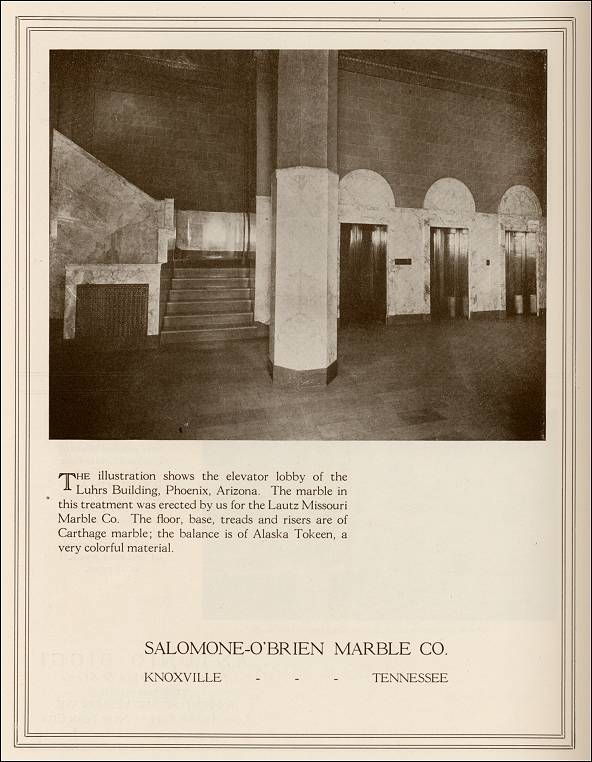
The illustration shows the elevator lobby of the Luhrs Building, Phoenix, Arizona. The marble in this treatment was erected by us for the Lautz Missouri Marble Company. The floor, base, treads and risers are of Carthage marble; the balance is of Alaska Tokeen, a very colorful marble. 
Salomone-O’Brien Marble Co., Knoxville, Tennessee
- Springerville, Arizona - the Madonna of the Trail Statue in Springerville, Arizona,
dedicated on September 29, 1928 (photographs)
The following quotation is from Wikipedia, the free encyclopedia.
“Madonna of the Trail is a series of monuments dedicated to the spirit of pioneer women in the United States. The monuments were commissioned by the National Society of Daughters of the American Revolution (NSDAR). They were placed along the National Old Trails Highway and extended from Bethesda, Maryland, to Upland, California, in each of the 12 states the road passed through.
“Created by sculptor August Leimbach and funded by contributions, the Madonna of the Trail monuments were intended to provide a symbol of the courage and faith of the women whose strength and love aided so greatly in conquering the wilderness and establishing permanent homes.
“Dedicated in 1928 and 1929, with each of the 12 located in a different state, they became a source of local pride. Through the continuing efforts of local and national groups, all are currently in good condition and on display....”
“The figure stands 10 feet high with a weight of 5 tons. The figure and the base are made of algonite stone (a poured mass) of which Missouri granite is used as the main aggregate, thus giving the monument a warm, pink shade. With the base, the monuments are about 18 feet high. The inscriptions on the east and west sides of each base are the same, but the north and south sides of each monument usually include local information as well.”
-
Ft. Smith, Arkansas – the City Public Library (from Stone:
An Illustrated Magazine, April 1908, Vol. XXXVII, No. 11, “Limestone
and Sandstone” section, pp. 610)
- Finished Products from Missouri Stone in
Arkansas
- Ft. Smith, Arkansas – the Ex-Confederate Monument (from The Quarrying Industry of Missouri, by Ernest Robertson Buckley and H. A. Buehler, 1904, pages 133-134.)
Limestone quarried from the Carthage, Missouri, area was used with wholly or in part in the construction of the monument. The color of the Carthage limestone ranges from brown and gray to white. Some of the stone has a faint blue tint.
- Ft. Smith, Arkansas – the Reynolds Davis & Co. Building – the Front and Trimmings (from The Quarrying Industry of Missouri, by Ernest Robertson Buckley and H. A. Buehler, 1904, pages 133-134.)
Limestone quarried from the Carthage, Missouri, area was used on the front and as trimmings on the building. The color of the Carthage limestone ranges from brown and gray to white. Some of the stone has a faint blue tint.
- Ft. Smith, Arkansas – the St. Agnes Academy (from The Quarrying Industry of Missouri, by Ernest Robertson Buckley and H. A. Buehler, 1904, pages 133-134.)
Limestone quarried from the Carthage, Missouri, area was used wholly or in part in the construction of the Academy. The color of the Carthage limestone ranges from brown and gray to white. Some of the stone has a faint blue tint.
- Ft. Smith, Arkansas – the W. J. Echols Building - the Piers and Trimmings (from The Quarrying Industry of Missouri, by Ernest Robertson Buckley and H. A. Buehler, 1904, pages 133-134.)
Limestone quarried from the Carthage, Missouri, area was used for the piers and trimmings of the building. The color of the Carthage limestone ranges from brown and gray to white. Some of the stone has a faint blue tint.
- Jonesboro, Arkansas – the Frisco Depot (from The Quarrying Industry of Missouri, by Ernest Robertson Buckley and H. A. Buehler, 1904, pages 133-134.)
Limestone quarried from the Carthage, Missouri, area was used with wholly or in part in the construction of the depot. The color of the Carthage limestone ranges from brown and gray to white. Some of the stone has a faint blue tint.
- Jonesboro, Arkansas – St. L. & S. W. & St. L. & S. F. Depot - the Trimmings (from The Quarrying Industry of Missouri, by Ernest Robertson Buckley and H. A. Buehler, 1904, pages 133-134.)
Limestone quarried from the Carthage, Missouri, area was used as trimmings on the depot. The color of the Carthage limestone ranges from brown and gray to white. Some of the stone has a faint blue tint.
- Little Rock, Arkansas - the Little Rock Post Office (from “Notes on The Building Stones, Clays and Sands of Iron, St. Francois and Madison Counties, ” by G. E. Ladd, Assistant Geologist, in Bulletin 1, Geological Survey of Missouri, Jefferson City, April 1890.)
Granite quarried from Ozark Mountain granite quarry located a quarter of a mile south of Graniteville, Iron County, Missouri, was used in the construction of the Little Rock Post Office building. “The stone taken out was, however, inferior to what can be obtained, as it was mostly surface rock.”
- Little Rock, Arkansas – the Little Rock Courthouse (constructed in 1881) (photograph)
“It was constructed of stone and brick with a Cabin Creek Arkansas sandstone foundation, a red Missouri granite base and water table, and buff Berea Ohio sandstone upper stories. The roof was slate with an iron frame….The north courtroom was added in 1897 and features Tennessee gray marble with Tennessee pink marble borders. Restoration included faux marble veining to match the existing marble.” Today the building is used by the bankruptcy courts.
- Texarkana, Arkansas – the Cotton Belt R. R. Hospital - the Trimmings (from The Quarrying Industry of Missouri, by Ernest Robertson Buckley and H. A. Buehler, 1904, pages 133-134.)
Limestone quarried from the Carthage, Missouri, area was used as trimmings on the building. The color of the Carthage limestone ranges from brown and gray to white. Some of the stone has a faint blue tint.
- Ft. Smith, Arkansas – the Ex-Confederate Monument (from The Quarrying Industry of Missouri, by Ernest Robertson Buckley and H. A. Buehler, 1904, pages 133-134.)
- Finished Products from Missouri Stone in
California
- Felicity, California - the Museum of History in Granite Building, presented on the Museum of History in Granite web site.
- How a Granite Museum Wall is Built
According to this web site, “The wall is faced with 60 panels of Missouri Red granite, each weighing 477 pounds and two triangular granite end pieces each weighing 351 pounds....”
- Los Angeles, California - the Los Angeles City Hall Building (from Missouri Marble,
by Norman S. Hinchey, Report of Investigations No. 3, Missouri Geological
Survey and Water Resources, Rolla, Missouri, 1946. Used with permission
of the Missouri Department of Natural Resources.)
Ste. Genevieve Golden Vein Marble, quarried in Ste. Genevieve County, Missouri, was used in the construction of the City Hall building.
Marble quarried from the Phenix Marble Company’s “Old West Quarry” at Phenix, Greene County, Missouri, was used in the construction of the City Hall building prior to 1942.
-
Los Angeles, California – the Pershing Square Building – Interior Walls (from “Greater Profits with the Use of Marble,” from Through the Ages, Vol. 5, No. 8, December 1927, pp. 24-26)
- Los Angeles, California - the South California Edison Building (from Missouri
Marble, by Norman S. Hinchey, Report of Investigations No. 3,
Missouri Geological Survey and Water Resources, Rolla, Missouri, 1946.)
Ste. Genevieve Rose Marble, quarried in Ste. Genevieve County, Missouri, was used in the construction of the So. California Edison building.
Marble quarried from the Phenix Marble Company’s “Old West Quarry” at Phenix, Greene County, Missouri, was used in the construction of the South California building prior to 1942.
- Oroville, California - the Court House Building (from Missouri Marble, by Norman S. Hinchey, Report of Investigations No. 3, Missouri Geological Survey and Water Resources, Rolla, Missouri, 1946.)
Marble quarried from the Phenix Marble Company’s “Old West Quarry” at Phenix, Greene County, Missouri, was used in the construction of the U.S. Post Office or Court House buildings prior to 1942.
- Oroville, California - the U.S. Post Office Building (from Missouri Marble, by Norman S. Hinchey, Report of Investigations No. 3, Missouri Geological Survey and Water Resources, Rolla, Missouri, 1946.)
Marble quarried from the Phenix Marble Company’s “Old West Quarry” at Phenix, Greene County, Missouri, was used in the construction of the U.S. Post Office or Court House buildings prior to 1942.
- Palo Alto, California - the Stanford University Building (from Missouri Marble, by Norman S. Hinchey, Report of Investigations No. 3, Missouri Geological Survey and Water Resources, Rolla, Missouri, 1946)
Ozark Fleuri Marble (a limestone) quarried at Carthage, Missouri, was used in the construction in the interior of one of the Stanford University buildings constructed prior to 1946.
- San Francisco, California - the Flood Building - the Columns (from Building Stones and Clay-Products: A Handbook For Architects, by Heinrich Ries, Ph.D., 1912)
“Graniteville. The largest and most important quarries in the state are here. The stone is a red granite of pleasing red color, medium to coarse grained....” Granite quarried at Graniteville, Missouri, was used in the construction of the columns of the Flood building.
- San Francisco, California – the Flood Building – the Twelve Polished Columns (from The Quarrying Industry of Missouri, by E. R. Buckley, Director and State Geologist, and H. A. Buehler, Missouri Bureau of Geology and Mines Vol. II, 2nd Series, 1904.)
“The twelve polished columns in the Flood building in San Francisco, which are sixteen feet long by two feet six inches in diameter, were quarried from the lower portion of this opening.” The granite is a deep red-color, and it was quarried from the Schneider Granite Company’s quarry located about three-fourths of a mile north of Graniteville, Missouri.
- San Francisco, California – the Flood Building – the Twelve Polished Columns (from The Quarrying Industry of Missouri, by E. R. Buckley, Director and State Geologist, and H. A. Buehler, Missouri Bureau of Geology and Mines Vol. II, 2nd Series, 1904.)
- San Francisco, California – the F. E. Knowles & Company
Building – (from The Quarrying Industry of Missouri,
by Ernest Robertson Buckley and H. A. Buehler, 1904, page 74)
Deep red colored granite quarried in the Graniteville, Missouri, quarries was used with wholly or in part in the construction of the F. E. Knowles & Co. building.
- San Francisco, California - the Federal Reserve Bank
Building (from Missouri Marble, by Norman S. Hinchey,
Report of Investigations No. 3, Missouri Geological Survey and Water
Resources, Rolla, Missouri, 1946.)
Marble quarried from the Phenix Marble Company’s “Old West Quarry” at Phenix, Greene County, Missouri, was used in the construction of the Federal Reserve Bank building prior to 1942.
- San Francisco, California - Golden Gate Park - Statues of Goethe and Schiller - the Base (The following information is presented on the VLN web site on San Francisco Public Art.)
The statues of poets Goeth and Schiller are located east of the Morrison Planetarium in Golden Gate Park in San Francisco. According to this web site, red Missouri granite was used to construct the base for the statues.
Part of the VLN entry reads: “1901, Golden Gate Park, Goethe and Schiller E. of Morrison Planetarium, San Francisco. Ernst Reitschel....”
- San Francisco, California – the Palace of the Legion of Honor Building (from Stone Magazine, April 1925–Vol. XLVI, No. 4, pp. 227)
Legion of Honor Building
“There was erected in Lincoln Park, San Francisco, last year a beautiful and lasting memorial building of classical design, the gift to that city of Mr. and Mrs. A. B. Spreckles. The building is the highest type construction, designated in San Francisco as Class A. This same quality construction was maintained throughout as was shown in the specification of marble for the interior decorations. For this work Napoleon Gray Marble, furnished by the Tompkins-Kiel Marble Company, was specified. The accompanying view of one of the halls shows this marble in a setting in which only a natural material could be used to maintain the desired effect of stately grandeur. Another view on another page shows columns of Napoleon Gray marble in the main rotunda of the building. The hall was erected at a cost of $500,000. The architect was G.A. Applegarth.”
California Palace of Legion of Honor, Lincoln Park, San Francisco. Interior Gallery Finished in Napoleon Gray Marble. Joseph Musto Sons - Keenan Co., Marble Contractors. Architect: George A. Applegarth. 
Section of Entrance Lobby, California Palace of Legion of Honor, Lincoln Park, San Francisco, showing Columns and Trim of Napoleon Gray Marble. Joseph Musto Sons - Keenan Co., Marble Contractors. Architect: George A. Applegarth. 
- San Francisco, California - the Palace of the Legion
of Honor Building - Interior (from Through The Ages Magazine,
the April 1925, Vol. 2, No. 12, article entitled, “The
California Palace of The Legion of Honor,” two photographs
are included that show the use of Napoleon Gray marble in the
Rotunda.)
The Rotunda was executed in Napoleon Gray Marble. 
Rotunda, California Legion of Honor Building. 
- San Francisco, California -
the Palace of the Legion of Honor Building -
Rotunda (from Throvgh The Ages Magazine,
April 1925, Vol. 2, No. 12, pp. 62.)
Rotunda, California Palace of the Legion of Honor, Geo. A. Applegarth, architect. All visible marble Napoleon Gray. Columns and pilasters, monoliths approximately 15’ x 2’. Marble manufacturer, Jos. Musto Sons-Keenan Co. 
Phenix Marble Company, Kansas City, Missouri - Napoleon Gray Marble
Where beauty and dignity must keep an eye on cost, Napoleon Gray Marble is a natural choice. In the great buildings where it has been used - The Missouri State Capitol, New York Stock Exchange, American Telephone and Telegraph Building and the one shown above, it has met every practical as well as artistic requirement of both architects and owners. Write us for samples and information.
- San Francisco, California – the California Palace
of the Legion of Honor (from Throvgh
The Ages Magazine,
July 1925, Vol. 3, No. 3, pp. 57)
Upper Picture - California Palace of the Legion of Honor, Geo. A. Applegarth, Architect. Columns and Pilasters by American Marble and Mosaic Co.; all the other marble by Jos. Musto Sons-Keenan Company.
Lower Picture - Greely Arcade, New York City. Geo. and Edw. Blum, Architects.

Napoleon Gray: A Marble That Is Seemingly Without Limitation
Is there a wide gap between the rare beauty of the columned halls of the California Palace of The Legion of Honor and the severe business-like walls of the Greeyly Arcade Building, New York City? Obvious as the answer is, still isn’t it strange that both Mr. Applegarth in the West and George and Edward Blum in the East, found in Napoleon gray Marble for ideal material for their different problems.
Phenix Marble Company, Kansas City, Missouri
- San Francisco, California - the California Palace of
the Legion of Honor (Interior) (from Throvgh
The Ages Magazine, January 1926, Vol. 3, No. 9, pp. 65)
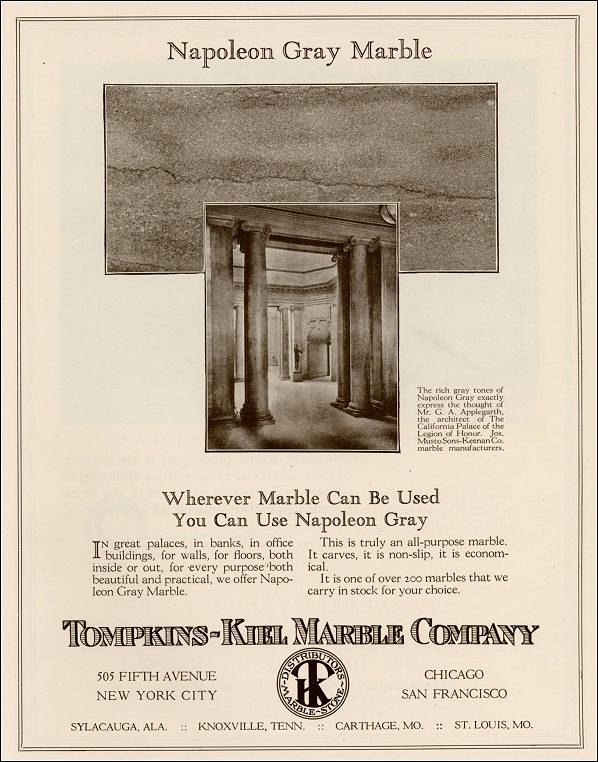
The rich gray tones of Napoleon Gray exactly express the thought of Mr. G. A. Applegarth, the architect of the California Palace of the Legion of Honor. Jos. Musto Sons-Keenan Co. marble manufacturers. 
Napoleon Gray Marble
Wherever Marble Can Be Used You can Use Napoleon Gray
In great palaces, in banks, in office buildings, for walls, for floors, both inside or out, for every purpose both beautiful and practical, we offer Napoleon Gray Marble. This is truly an all-purpose marble. It carves, it is non-slip, it is economical. It is one of over 200 marbles that we carry in stock for your choice
Tompkins-Kiel Marble Company, 505 Fifth Avenue, New York City - Chicago - San Francisco - Sylacauga, Ala. - Knoxville, Tenn. - Carthage, Mo. - St. Louis Mo.
The rich gray tones of Napoleon Gray exactly express the thought of Mr. G. A. Applegarth, the architect of The California Palace of the Legion of Honor. Jos. Musto Sons-Keenan Co. marble manufacturers.
-
San Francisco, San Francisco County, California – California Palace of the Legion of Honor (from Napoleon Gray, An Adaptable Marble, Phenix Marble Company, Kansas City, Missouri, Producers, and Tompkins-Kiel Marble Company, New York City, New York, Distributors, 1926, frontispiece)
- San Francisco, California - the Palace of the Legion
of Honor Building (from Missouri Marble, by
Norman S. Hinchey, Report of Investigations No. 3, Missouri Geological
Survey and Water Resources, Rolla, Missouri, 1946.)
Marble quarried from the Phenix Marble Company’s “Old West Quarry” at Phenix, Greene County, Missouri, was used in the construction of the Palace of the Legion of Honor building prior to 1942.
“The rotunda of the California Palace of the Legion of Honor, San Francisco. The columns and pilasters are monoliths approximately 15 feet 2 inches high. All visible marble was executed in Napoleon Gray. George A. Applegarth, of San Francisco, was the architect. Marble Manufacturers, Jos. Musto Sons-Keenan Co. and American Marble and Mosaic Co., both of San Francisco.” 
- San Francisco, California - the Palace of the Legion
of Honor Building - Interior (from Through The Ages Magazine,
the April 1925, Vol. 2, No. 12, article entitled, “The
California Palace of The Legion of Honor,” two photographs
are included that show the use of Napoleon Gray marble in the
Rotunda.)
- San Francisco, California - the Standard Oil Company
Building (from Missouri Marble, by Norman S. Hinchey,
Report of Investigations No. 3, Missouri Geological Survey and Water
Resources, Rolla, Missouri, 1946.)
Marble quarried from the Phenix Marble Company’s “Old West Quarry” at Phenix, Greene County, Missouri, was used in the construction of the Standard Oil Company building prior to 1942.
- San Francisco, California – the Star King Monument (from The Quarrying Industry of Missouri, by Ernest Robertson Buckley and H. A. Buehler, 1904, page 74)
Deep red colored granite quarried in the Graniteville, Missouri, quarries was used with wholly or in part in the construction of the Star King Monument.
- Upland, California - the Madonna of the Trail Statue in Upland, California, dedicated on February 1, 1929 (photographs) The following quotation is from Wikipedia, the free encyclopedia.
The statue in Albuquerque, New Mexico, was dedicated on September 27, 1928.
The following quotation is from Wikipedia, the free encyclopedia.
“Madonna of the Trail is a series of monuments dedicated to the spirit of pioneer women in the United States. The monuments were commissioned by the National Society of Daughters of the American Revolution (NSDAR). They were placed along the National Old Trails Highway and extended from Bethesda, Maryland, to California, in each of the 12 states the road passed through.
“Created by sculptor August Leimbach and funded by contributions, the Madonna of the Trail monuments were intended to provide a symbol of the courage and faith of the women whose strength and love aided so greatly in conquering the wilderness and establishing permanent homes.
“Dedicated in 1928 and 1929, with each of the 12 located in a different state, they became a source of local pride. Through the continuing efforts of local and national groups, all are currently in good condition and on display....”
“The figure stands 10 feet high with a weight of 5 tons. The figure and the base are made of algonite stone (a poured mass) of which Missouri granite is used as the main aggregate, thus giving the monument a warm, pink shade. With the base, the monuments are about 18 feet high. The inscriptions on the east and west sides of each base are the same, but the north and south sides of each monument usually include local information as well.”
“Lobby entrance of the Ulmer Building, Cleveland, (Ohio), was originally called the Mohawk Building. It was remodeled in 1919. C. F. Sweinfurth, Architect.” 
“Pershing Square Building, Los Angeles, California. The walls are of St. Genevieve marble, the floor Travertine. Curlet and Beelman, architects.” 
- Finished Products from Missouri Stone in
Colorado
- Denver, Colorado - East Denver High School - Lobby (F. W. Steadley &: Co., Inc., Carthage, Missouri, advertisement from Throvgh The Ages Magazine, January 1926, Vol. 3, No. 9, pp. 67)
Lobby of East Denver High School, Denver, Colorado. Geo. Williamson, Architect. Denver Mantel & Tile Co., Marble Contractors. 
F. W. Steadley & Company, Inc.
“The Big Quarry”
Producers of Colonial Grey Veined - Colonial Grey Veinless, Carthage, Missouri
Representatives for New York City: Michael Cohen & Co., 8 West 4th Street, New York City. Representatives for Pacific Coast: John M. Fabbris, Sharon Building, San Francisco. All of the standing marble is Colonial Grey Veined - a material that is as attractive in appearance as it is in price. These qualities make it especially appealing to both architects and owners.
- Denver, Colorado - the East Denver High School - Lobby (The
following advertisement is from Stone Magazine, Vol. XLVII,
No. 2, February, 1926, Stone Publishing Company, pp. 113. The photograph
used in this advertisement is the same one that was used in the
January 1926 issue above.)
Colonial Grey Marble
F. W. Steadley & Co., Inc.
“The Big Quarry”
Producers of Colonial Grey Veined - Colonial Grey Veinless, Carthage, MO.
Representatives for New York City : Michael Cohen & Co., 8 West 40th St., New York City
Representative for Pacific Coast : John M. Fabbris, Sharon Bldg., San Francisco
(Photo caption) “Lobby of East Denver High School, Denver, Colorado. Denver Mantel & Tile Co., Marble Contractors. George Williamson, Architect.
“All of the standing marble is Colonial Grey Veined, which is attractive in appearance as well as being inexpensive, and therefore meets with the approval of the architects and owners where these two qualities are desired.”)
- Denver, Colorado -
the Republic Building -
the Interior of the Main Lobby, the Elevator Lobbies, all Corridors,
Stairways and all Toilet Rooms (F. W. Steadley &: Co., Inc., Carthage, Missouri, advertisement from Throvgh The
Ages Magazine, April 1927, Vol. 4, No. 12, pp. 58.)
Republic Bldg., Denver, Col. Mr. G. Meredith Musick, Architect. Marble work installed by Scheffer-Nicoll & Co. When the architect and owners considered marble for this building, they took into consideration beauty, durability and cost and then decided on Colonial Grey Veined Marble for all wall work, which consisted of the main lobby, the elevator lobbies, all corridors, stairways and all toilet rooms. Colonial Grey Veinless Marble was used for the floor and treads. 
F. W. Steadley & Company, Inc., Carthage, Missouri
“The Big Quarry”
Producers of Colonial Grey Veined - Colonial Grey Veinless
Representatives for New York City: C. D. Jackson & Co., 140th Street and Locust Avenue, New York City.
Representative for Pacific Coast: John M. Fabbris, Sharon Building, San Francisco.
- Denver, Colorado - the East Denver High School - Lobby (The
following advertisement is from Stone Magazine, Vol. XLVII,
No. 2, February, 1926, Stone Publishing Company, pp. 113. The photograph
used in this advertisement is the same one that was used in the
January 1926 issue above.)
- Lamar, Colorado - the Madonna of the Trail Statue in Lamar, Colorado, dedicated on September 24, 1928 (photographs) The following quotation is from Wikipedia, the free encyclopedia.
The statue in Albuquerque, New Mexico, was dedicated on September 27, 1928.
The following quotation is from Wikipedia, the free encyclopedia.
“Madonna of the Trail is a series of monuments dedicated to the spirit of pioneer women in the United States. The monuments were commissioned by the National Society of Daughters of the American Revolution (NSDAR). They were placed along the National Old Trails Highway and extended from Bethesda, Maryland, to Upland, California, in each of the 12 states the road passed through.
“Created by sculptor August Leimbach and funded by contributions, the Madonna of the Trail monuments were intended to provide a symbol of the courage and faith of the women whose strength and love aided so greatly in conquering the wilderness and establishing permanent homes.
“Dedicated in 1928 and 1929, with each of the 12 located in a different state, they became a source of local pride. Through the continuing efforts of local and national groups, all are currently in good condition and on display....”
“The figure stands 10 feet high with a weight of 5 tons. The figure and the base are made of algonite stone (a poured mass) of which Missouri granite is used as the main aggregate, thus giving the monument a warm, pink shade. With the base, the monuments are about 18 feet high. The inscriptions on the east and west sides of each base are the same, but the north and south sides of each monument usually include local information as well.”
- Denver, Colorado - East Denver High School - Lobby (F. W. Steadley &: Co., Inc., Carthage, Missouri, advertisement from Throvgh The Ages Magazine, January 1926, Vol. 3, No. 9, pp. 67)
- Finished Products from Missouri Stone in
Connecticut
- Bridgeport, Connecticut - the Post Office Building (from Missouri Marble, by Norman S. Hinchey, Report of Investigations No. 3, Missouri Geological Survey and Water Resources, Rolla, Missouri, 1946.)
Ste. Genevieve Golden Vein Marble, quarried in Ste. Genevieve County, Missouri, was used in the construction of the Post Office building.
- Hartford, Connecticut - the Court House Building (from Missouri
Marble, by Norman S. Hinchey, Report of Investigations No. 3,
Missouri Geological Survey and Water Resources, Rolla, Missouri, 1946.)
Marble quarried from the Phenix Marble Company’s “Old West Quarry” at Phenix, Greene County, Missouri, was used in the construction of the U.S. Post Office or Court House buildings prior to 1942.
- Hartford, Connecticut - the Phoenix Mutual Life Insurance Company Building - the Bathrooms (from article entitled, “A Connecticut Replica of The Saragossa ‘Longa’: The Phoenix Mutual Life Insurance Company Building at Hartford Was Modelled (sic) after the Spanish Exchange,” by E. B. Redfield, in Throvgh The Ages Magazine, October 1926, Vol. 4, No. 6, pp. 20-24.)
“...All toilets throughout are finished with Napoleon Gray in combination with the regular white tile so common today....”
- Hartford, Connecticut - the U.S. Post Office Building (from Missouri
Marble, by Norman S. Hinchey, Report of Investigations No. 3,
Missouri Geological Survey and Water Resources, Rolla, Missouri, 1946.)
Marble quarried from the Phenix Marble Company’s “Old West Quarry” at Phenix, Greene County, Missouri, was used in the construction of the U.S. Post Office or Court House buildings prior to 1942.
- Bridgeport, Connecticut - the Post Office Building (from Missouri Marble, by Norman S. Hinchey, Report of Investigations No. 3, Missouri Geological Survey and Water Resources, Rolla, Missouri, 1946.)
- Finished Products from Missouri Stone in Florida
- Miami, Florida - the Post Office Building (from Missouri Marble, by Norman S. Hinchey, Report of Investigations No. 3, Missouri Geological Survey and Water Resources, Rolla, Missouri, 1946.)
Ste. Genevieve Rose Marble and Golden Vein Marble, quarried in Ste. Genevieve County, Missouri, were used in the construction of the Post Office building.
- Miami, Florida - the Post Office Building (from Missouri Marble, by Norman S. Hinchey, Report of Investigations No. 3, Missouri Geological Survey and Water Resources, Rolla, Missouri, 1946.)
- Finished Products from Missouri Stone in
Georgia
- Atlanta, Georgia - Loews Theatre Building (from Missouri Marble, by Norman S. Hinchey, Report of Investigations No. 3, Missouri Geological Survey and Water Resources, Rolla, Missouri, 1946.)
Ste. Genevieve Rose Marble, quarried in Ste. Genevieve County, Missouri, was used in the construction of the Loews Theatre building.
- Atlanta, Georgia - Loews Theatre Building (from Missouri Marble, by Norman S. Hinchey, Report of Investigations No. 3, Missouri Geological Survey and Water Resources, Rolla, Missouri, 1946.)
- Finished Products from Missouri Stone in
Hawaii
- Honolulu, Hawaii - the Bank of Hawaii Building (from Missouri Marble, by Norman S. Hinchey, Report of Investigations No. 3, Missouri Geological Survey and Water Resources, Rolla, Missouri, 1946.)
Ste. Genevieve Golden Vein Marble, quarried in Ste. Genevieve County, Missouri, was used in the construction of the Bank of Hawaii building.
- Honolulu, Hawaii - the Bank of Hawaii Building (from Missouri Marble, by Norman S. Hinchey, Report of Investigations No. 3, Missouri Geological Survey and Water Resources, Rolla, Missouri, 1946.)
- Finished Products from Missouri Stone in
Idaho
- Pocatello, Idaho - the Court House Building (from Missouri
Marble, by Norman S. Hinchey, Report of Investigations No.
3, Missouri Geological Survey and Water Resources, Rolla, Missouri,
1946.)
Marble quarried from the Phenix Marble Company’s “Old West Quarry” at Phenix, Greene County, Missouri, was used in the construction of the U.S. Post Office or Court House buildings prior to 1942.
- Pocatello, Idaho - the U.S. Post Office Building (from Missouri
Marble, by Norman S. Hinchey, Report of Investigations No.
3, Missouri Geological Survey and Water Resources, Rolla, Missouri,
1946.)
Marble quarried from the Phenix Marble Company’s “Old West Quarry” at Phenix, Greene County, Missouri, was used in the construction of the U.S. Post Office or Court House buildings prior to 1942.
- Pocatello, Idaho - the Court House Building (from Missouri
Marble, by Norman S. Hinchey, Report of Investigations No.
3, Missouri Geological Survey and Water Resources, Rolla, Missouri,
1946.)




Commercial use of material within this site is strictly prohibited. It is not to be captured, reworked, and placed inside another web site ©. All rights reserved. Peggy B. and George (Pat) Perazzo.