
Quarries in Missouri & Quarry Links, Photographs, and
Articles
St. Louis – Heine thru Johannes
- St. Louis, Missouri - the Heine Safety Boiler Company (Advertisement) (from Mines and Minerals, A Mining and Metallurgical Journal, June, 1902, Vol. XXII, No. 11, pp. 21.)

Heine Safety Boiler Company, 421 Olive Street, St. Louis, MO
Water-Tube Boilers. - Safe, Economical, Durable.
Shops at Phoenixville, Pa. - St. Louis, Mo. - Chicago, Ill.
- St. Louis, Missouri - C. C. Helmers’ Quarry (listed in The Mine, Quarry and Metallurgical Record of the United States, Canada, and Mexico, The Mine and Quarry News Bureau, Chicago, Ill., 1897)
- St. Louis City, Missouri - Heman Bros. Limestone Quarry located near Main Street and Brooklyn (Limestone) (from “The Clay, Stone, Lime and Sand Industries of St. Louis City and County,” by G. E. Ladd, Assistant Geologist, in Geological Survey of Missouri, Bulletin No. 3, Supplement, Missouri, December 1890.)
Location and product.
“Heman Bros. (O, 10): - This firm has a quarry which is situated in the block west of Main Street and south of Brooklyn. Stone for most all the common uses is produced. Following is the columnar section made at the quarry, in descending series: -
Section.
“The following section, in descending series, was obtained here: -
- Soil, loess and decomposing limestone - 4-12 inches.
- Limestone, in thin layers - 4 feet.
- Limestone, in two beds (inaccessible) - 8-9 feet.
- Shale, greenish, alternating with limestone - 1 foot, 8 inches.
- Limestone, gray to bluish, fine grained - 1 foot, 8 inches.
- Limestone, gray, vary-grained, cherty in upper part - 2 feet.
- Shale, greenish, with nodules of limestone - 4 inches.
- Limestone, dark gray, rather coarse grained - 3 feet, 10 inches.
- Limestone, light gray, shaly - 2 feet.
- Limestone, light gray, fine grained, occasional concretions of chert - 1 foot, 9 inches.
- Limestone, gray, fine grained - 1 foot, 6 inches.
- Limestone, gray, coarse grained, crystalline - 1 foot.
- Limestone, drab, shaly - 3 inches.
- Limestone, gray to white, fine grained, cherty - 2 feet, 1 inch.
- Limestone, gray and brownish, in beds from one to six inches thick - 7 feet, 6 inches.
Total thickness of rock - 38 feet, 7 inches.”
- St. Louis, Missouri - the Heman Construction Co. Quarry (listed in The Mine, Quarry and Metallurgical Record of the United States, Canada, and Mexico, The Mine and Quarry News Bureau, Chicago, Ill., 1897)
- St. Louis, Missouri - the Heman Construction Company’s Limestone Quarry (Limestone) (The following information is from The Quarrying Industry of Missouri, by E. R. Buckley, Director and State Geologist, and H. A. Buehler, Missouri Bureau of Geology and Mines Vol. II, 2nd Series, 1904.)
“This company operates two quarries, located respectively at Spring avenue and Forest Park boulevard and at Ashland and Marcus avenues. The company is incorporated and consists of August and J. C. Heman. Both quarries are in the St. Louis limestone and the produce of each is chiefly crushed stone and rubble.
“The quarry located at the northeast corner of Spring avenue and Forest Park boulevard has been opened about ten years, and is about 250 feet by 150 feet square. It is a sunken quarry and the following is a section from top to bottom. The stripping of loess has been removed for the manufacture of brick.
“10 ft. - Crystalline, gray limestone in beds from six inches to two feet in thickness.
2 ft. - Decomposed, yellowish limestone. Chiefly waste.
1 ft. - Crystalline, yellow limestone.
3 ft. - Compact, crystalline, dark gray limestone.
2 ft. - Stone similar to bed above.
3 ft. 9 in. - Medium grained, gray limestone containing scattered chert nodules. Splits along bedding planes six and twelve inches from top.
6 ft. 6 in. - Very fine grained, compact, dark gray limestone, in beds from six to ten inches in thickness.
2 ft. 3 in. - Yellowish gray limestone, containing calcite geodes. At the west end of the quarry, this bed contains pockets filled with soil.
10 in.-14 in. - Fine grained, soft, dark gray limestone.
3 ft. 10 in. - Finely crystalline, gray limestone. Splits into beds of various thicknesses, in different parts of the quarry.
9 in. - Dark gray limestone. Two inch layer of shale occurs between this and the ledge below.
2 ft. 7 in. - Fine grained, gray limestone. In the west part of the quarry, the ledge splits into several beds.
6 ft. 10 in. - Argillaceous, fine grained heavily bedded magnesian limestone. The fresh stone has a light gray color. Will split into beds of almost any desired thickness.
4 ft. - Drab limestone. Stone in lower part of this bed is more finely crystalline than that above. Contains short dry seams and joints which carry bitumen.
3 ft. 3 in. - Fine grained, gray limestone. This ledge splits into beds of different thicknesses, depending upon their position in the quarry. The stone breaks with an irregular fracture.
5 ft. 9 in. - Finely crystalline, dark gray limestone. In some parts of the quarry eighteen inches can be capped from the upper portion of this bed. Two small suture joints were observed near the middle of the ledge. The stone exhibits a white efflorescence after being weathered for some time in the quarry.
“This quarry produces chiefly rubble and crushed stone. It is equipped with a No. 3 Austin crusher and accessories. The crushed stone is separated into screenings one and one-half and two and one-half inch sizes. About twenty men are employed.
“The quarry which is located between Ashland and Loraine avenues, west of Marcus avenue, is located just west of the Mound City Construction Co.’s quarry. In 1902 a complete crushing plant was being installed, and it is expected to operate the quarry more extensively than it has been at any time in the past.
“This quarry has a vertical face of about sixty feet and the stone is essentially of the same quality as that in the quarry of the Hill-O’Mera Construction Co. Owing to a gentle northeast dip to the strata, the lower beds worked at the Hill-O’Mera quarry have not been reached. The quarry contains some very good stone. The lower portion of the face could not be examined on account of water which had accumulated since the opening was last operated.”
- St. Louis, Missouri - Henry Monument Association (from Stone: An Illustrated Magazine, December 1892, Vol. VI., No. 1, pp. 84)
Monumental Notes: “Rev. M. S. Brennan of St. Louis, Mo., is president of the Henry Monument Association, organized for the purpose of erecting a monument to the late Rev. James Henry. The efforts of the association are being encouraged.”
- St. Louis, Missouri – Henry Wilson (Stone Dealer) (The following advertisement is from The
Reporter: Devoted To The Interests of Marble and Granite Workers, Vol. XVII, No. 6, published by Nichols & Co., Chicago, Illinois, June, 1884, pp. 11.)

Henry Wilson
Wholesale and Retail Dealer in Marble and Granite. The business of the late Henry Wilson, will be continued as usual at the old place. Finished Work for the Trade a specialty. Prices and sheets of designs sent on application. Wilson ’s Portfolio of Designs, $3.00 post-paid.
905 Market Street, St. Louis, MO. - Address All Orders to Henry Wilson
- St. Louis, Missouri - J. J. Hetley Monumental Shop (from American Stone Trade, Vol. XXXIII, No. 11, pp. 11)
“J. J. Hetley, 6244 Wagner Avenue, St. Louis, Mo., announces that he has opened a new retail monumental establishment at that address. In the past Mr. Hetley has been engaged in the selling department of different dealers in the St. Louis territory. He reports his business developing nicely and has confidence in its continuance.”
- St. Louis, Missouri - the Hill & O’Meara Construction Co. Quarry (listed in The Mine, Quarry and Metallurgical Record of the United States, Canada, and Mexico, The Mine and Quarry News Bureau, Chicago, Ill., 1897)
St. Louis, Missouri - the Hill-O’Mera Construction Company’s Limestone Quarry (Limestone) (The following information is from The Quarrying Industry of Missouri, by E. R. Buckley, Director and State Geologist, and H. A. Buehler, Missouri Bureau of Geology and Mines Vol. II, 2nd Series, 1904.)
“This quarry, which is owned and operated by J. B. O’Mera and John Hill, under the firm name of Hill-O’Mera Construction Co., is one of the best equipped in the city. The quarry, which is located at the corner of Ashland and Euclid avenues, is a deep, sunken opening having a rather irregular, circular outline, about 400 feet in diameter. It has been in operation since 1876, and a large quantity of stone has been quarried. The following is a description of the beds from top to bottom:
15-18 ft. - Loess stripping.
15-20-ft. - Fine grained, gray limestone. Thinly bedded. These beds are broken into boulders at the west end.
7 ft. - Finely crystalline, gray limestone. Thinly bedded. Flint nodules occur in the lowest bed.
3 ft. 8 in. - Dark colored limestone. A bed of dark colored chert nodules occurs one foot from top. The stone is porous and soft and contains calcite geodes and pockets filled with soil.
5 ft. 6 in. - Finely crystalline, fossiliferous, gray limestone. Splits into four or more beds. Contains short tight seams.
7 ft. 6 in. - Fine grained, compact gray limestone in beds from two to six inches in thickness.
9 ft. - Fine grained, dark gray limestone. Splits into beds from six to ten inches in thickness.
2 ft. 8 in. - Porous, soft, dark colored limestone.
4 ft. 4 in. - Finely crystalline, gray limestone. A dark suture occurs fourteen inches from the top. Small dark flint nodules are scattered throughout the bed. The upper foot of the ledge is darker than that below.
4 ft. - Fine grained, compact, gray limestone. Contains a thin bed of black flint one foot from the top, and small, black flint nodules throughout the mass.
5 ft. 2 in. - Finely crystalline, compact, dark gray limestone, in thin beds from four to six inches in thickness. Upper portion contains small, black chert nodules.
7 ft. - This ledge consists of two beds of finely crystalline, gray limestone which saws and dresses nicely. With the exception of the lower two and one-half feet the stone contains dark stratification planes. The upper six inches is not cut or dressed. The stone is quarried with a channeling-machine.
4 ft. - Consists of limestone, having a somewhat finer grain than the bed above. Dark stratification planes occur near the base. The stone is very light colored when dressed. This ledge is worked with a channeling-machine.
4 ft. - Fine grained, gray limestone.
1 ft. 8 in. - Stone similar to bed above.
1 ft. 9 in. - Compact, very fine grained, dark gray limestone in beds from six to ten inches in thickness. Contains dark flint nodules.
4 ft. 4 in. - Fine grained, brittle, dark gray limestone, in beds from six to ten inches in thickness.
3 in. - Blue shale.
3 ft. 4 in. - Fine grained, compact, gray limestone.
5 ft. 6 in. - Stone similar to bed above.
1 ft. 4 in. - Shelly limestone.
4 ft. 2 in. - Finely crystalline, dark gray limestone. Breaks with an irregular fracture.
“The beds have an apparent dip to the northeast. The best stone in the quarry occurs in the two ledges which are channeled. That from the remaining beds is used for rubble and crushed stone. The stone, which is channeled, has a very pleasing white color and is very durable, when free from stratification planes. Owing to the presence of these planes, the stone should not be laid on edge, if one desires the greatest strength.
“With the exception of the Stolle Stone Co., this is the only company in St. Louis which uses channeling machines, in quarrying, and gang-saws in cutting the St. Louis limestone. The quarry is equipped with a channeler, a crushing plant, a pumping outfit, steam drills, steam hoist and derricks. The stone saws with about the same rapidity as the Carthage limestone, viz., at the rate of two inches per hour. That which is channeled is used chiefly for caps, sills and coursing. About thirty men are employed in the quarry.”
- St. Louis, Missouri - Hodges & McCarthy (Monument Dealer) The following information is from The Monumental News, “Photographs - Trade Literature, Etc., Received” section, August, 1895, Vol. 7, No. 8, Chicago, Illinois, pp. 518.
(pp. 502) “Two illustrations of work done by Hodges & McCarthy of St. Louis, Mo., appear in this issue of the Monumental News. This firm does a fine class of work which they always aim to finish to its highest possibilities. Everything large and small, excepting markers is rubbed to a true surface before bush hammering. Full size models of carved sections are always furnished for the accurate guidance of the workmen. This necessarily entails expense, but it ensures satisfactory execution.”
(pp. 518) “‘Memorials’ is the title of a handsomely illustrated brochure gotten out by Hodges & McCarthy of St. Louis, Mo. A long list of patrons and half-tone illustrations of a dozen of the more important memorial structures designed and erected by the firm, make an attractive as well as a telling advertisement.”
- St. Louis, Missouri - the Hodges & McCarthy Quarry (listed in The Mine, Quarry and Metallurgical Record of the United States, Canada, and Mexico, The Mine and Quarry News Bureau, Chicago, Ill., 1897)
- St. Louis, Missouri - the Hoffman Limestone Quarry (Limestone) (The following information is from The Quarrying Industry of Missouri, by E. R. Buckley, Director and State Geologist, and H. A. Buehler, Missouri Bureau of Geology and Mines Vol. II, 2nd Series, 1904.)
“This quarry, which is owned and operated by Fred Hoffmann, is located on the river bluff at 2718 Wyandotte street. It was opened in 1891 and has a working face of about 150 feet. The following is a section from top to bottom:
0-15 ft. - Stripping.
1 ft. 6 in. - 5 ft. - Gray limestone, having a sandy texture.
10 ft. - Flinty, gray limestone, usually crushed for macadam.
5 ft. - White limestone, in beds from four to five inches in thickness. This is known as the ‘glass ledge,’ on account of the brittle character of the stone. Thins veins of calcite occur in these beds.
3 ft. - Dark gray limestone, containing some flint and occasional calcite nodules. From one to fourteen inches of the upper portion of this ledge has a brown color.
3 ft. 10 in. - A twenty-eight inch and an eighteen inch bed of finely crystalline, white limestone, used for footing and dimensional purposes.
5 ft. - Crystalline, gray limestone in thin layers. Used for rubble and footing.
“The beds in this quarry have a dip of 15° W. When operated, this quarry employs from two to three men.”
- St. Louis City, Missouri - E. W. Hogan Limestone Quarry located at Eleventh Street (Limestone) (from “The Clay, Stone, Lime and Sand Industries of St. Louis City and County,” by G. E. Ladd, Assistant Geologist, in Geological Survey of Missouri, Bulletin No. 3, Supplement, Missouri, December 1890.)
Location and product.
“Hogan, E. W. (K, 6): - Mr. Hogan has a quarry which adjoins the Perkinson Second Quarry on the eleventh street side. The product consists of macadam, building stone and paving. Stone is hoisted from the quarry by derricks.
“The section is the same here as that at the latter quarry. (The Heman Bros. quarry located in the block west of Main Street and south of Brooklyn.)”
- St. Louis, Missouri - C. W. Hogan’s Quarry (listed in The Mine, Quarry and Metallurgical Record of the United States, Canada, and Mexico, The Mine and Quarry News Bureau, Chicago, Ill., 1897)
- St. Louis City, Missouri - M. Hogan Limestone Quarry located on Penrose (Limestone) (from “The Clay, Stone, Lime and Sand Industries of St. Louis City and County,” by G. E. Ladd, Assistant Geologist, in Geological Survey of Missouri, Bulletin No. 3, Supplement, Missouri, December 1890.)
Location and product.
“Hogan, M. (L, 7): - Mr. Hogan has a quarry on Penrose south of Blair avenue. The product consists of macadam.
“Following is the section in descending series: -
Section.
“The following section, in descending series, was obtained here: -
- Loess - 20 inches.
- Limestone, gray, fine grained, compact, in three thirty-six inches (sic) layers - 9 feet.
- Shale - 1-3 inches.
- Limestone, gray, fine grained - 1 foot.
- Limestone, thin beds, in some places two to three feet thick, in others two to six inches thick - 15 feet.
Total thickness of rock - 25 feet, 10 inch.”
- St. Louis City, Missouri - the Hogan and Moran Limestone Quarry located at Magazine Street & Garrison Avenue (Limestone) (from “The Clay, Stone, Lime and Sand Industries of St. Louis City and County,” by G. E. Ladd, Assistant Geologist, in Geological Survey of Missouri, Bulletin No. 3, Supplement, Missouri, December 1890.)
Location - product.
“Hogan and Moran (J, 9): - This firm has a quarry which is situated at the north-east corner of Magazine street and Garrison avenue. It was opened fifty-one years ago (circa 1839), and was worked by R. Kingen for seventeen years. Mr. Hogan then worked it for twenty-five years when it went into the hands of the present firm which has since operated it continuously. The product consists of macadam, building stone and paving. Stone is loaded, in the quarry, into movable wag beds, hoisted to the surface and delivered to the wheels of the truck.
“The upper part of the section is the same as that at Cavanaugh’s*...The entire section is as follows, in descending series: -
Section.
- Limestone, same as at Cavanaugh’s - 39 feet, 4 inches.
- Limestone, gray to drab, hard, crystalline - 3 feet.
- Limestone, full of chert concretions - 10 inches.
- Limestone, light gray, hard, considerably faulted - 4 feet.
- Limestone, drab, lithographic, considerably faulted - 2 feet, 6 inches.
- Limestone, light gray, cherty, lithographic, in three layers - 6 feet.
- Limestone, dark gray, siliceous, splits easily in three layers - 2 feet, 10 inches.
- Shale, greenish, very persistent - 2-4 feet.
- Limestone, gray, hard, fine grained, compact, in two layers - 5 feet.
Total thickness of rock - Total thickness of rock - 63 feet, 9 inches.”
- St. Louis, Missouri - the Hogan & Morgan Quarry (listed in The Mine, Quarry and Metallurgical Record of the United States, Canada, and Mexico, The Mine and Quarry News Bureau, Chicago, Ill., 1897)
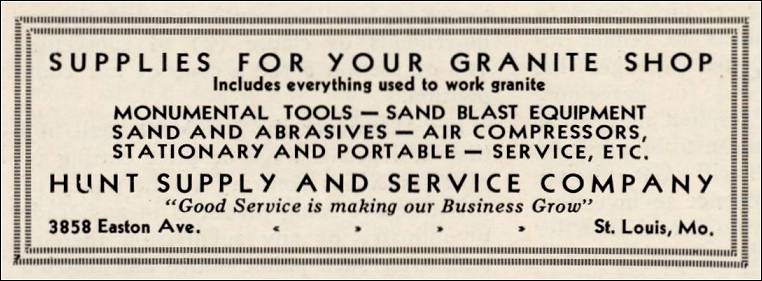
- St. Louis, Missouri - the Hunt Supply and Service Company, (advertisement) (from American Stone Trade, XXXIII, No. 11, pp. 21. The same advertisement ran in the following issues of American Stone Trade: August, 1933, XXXIV, No. 1, pp. 27; November, 1933, XXXIV, No. 4, pp. 16; July, 1934, XXXIV, No. 12, pp. 28; December, 1934, XXXIV, No. 5, pp. 27.)

Supplies for Your Granite Shop
Includes everything used to work granite. Monumental Tools - Sand Blast Equipment - Sand and Abrasives - Air Compressors, Stationary and Portable - Service, Etc.
Hunt Supply and Service Company, 3858 Easton Ave., St. Louis, Mo.
“Good Service is making our Business Grow”
- St. Louis, Missouri - the Ingersoll-Rand Co. (Advertisement) (from Granite, Marble & Bronze Magazine, September 1906, Vol. XVI, No. 9, pp. 44)
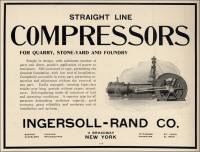
Straight Line Compressors For Quarry, Stone-Yard and Foundry
Simple in design, with minimum number of parts and direct, positive application of power to resistance. Self-contained in type, permitting the simplest foundation, with low cost of installation. Completely accessible in every part, permitting inspection and adjustment without the removal of any part. Easily managed, insuring high-class results over long periods without expert attendance. Self-regulating under all variations of load and operation conditions. A superior type for all purposes demanding moderate capacity, good economy, great reliability and moderate cost of installation and up-keep.
Ingersoll-Rand Co., 11 Broadway, New York
Boston - Cleveland - Chicago - Philadelphia - Pittsburg - Houghton - St. Louis - El Paso
- St. Louis, Missouri – the
Interstate Contracting and Supply Company (Advertisement) (from Stone:
An Illustrated Magazine, February 1916, Vol. XXXVII, No. 2, pp.
66. This advertisement was also publishing in the following editions
of Stone: April 1916, Vol. XXXVII, No. 4, pp. 176; May 1916,
Vol. XXXVII, No. 5, pp. 230; June 1916, Vol. XXXVII, No. 6, pp.
286; July 1916, Vol. XXXVII, No. 7, pp. 342; August 1916, Vol.
XXXVII, No. 8, pp. 402; October 1916, Vol. XXXVII, No. 10, pp.
570; and December 1916, Vol. XXXVII, No. 12, pp. 626.)

Interstate Contracting & Supply Co.
Contractors of Stone, Granite, Marble and Tile Work
St. Louis Office and Showroom: 109 North 9th Street, St. Louis, MO.
East St. Louis Office and Work: 19th St. and Illinois Ave., East St. Louis, Ill.
- St. Louis, Missouri - the Interstate Stone and Marble Works
- Member of the St. Louis Marble Credit Association and the National
Association of Marble Dealers (from Throvgh
The Ages Magazine, January 1932, Vol. 9, No. 9, pp. 50.)
Miniature of a Banking Room in marble, one of eight models now on display in the Building Industries Exhibit Bureau, St. Louis. 
In a spirit of co-operation for the promotion of Marble this page has been subscribed for by the members of the St. Louis Marble Manufacturers Credit Association who are also members of the National Association of Marble Dealers, and whose names are listed below:
In keeping with the very desirable policy of this magazine it is our intention to show from time to time installations of marble work by various members.
- St. Louis, Missouri - the Iron Mountain Co. Quarry (listed in The Mine, Quarry and Metallurgical Record of the United States, Canada, and Mexico, The Mine and Quarry News Bureau, Chicago, Ill., 1897)
- St. Louis, Missouri – J. A. Lohrum Quarry (from The Quarrying Industry of Missouri, by Ernest Robertson Buckley and H. A. Buehler, 1904, Plate XXXV.)
Fig. 2. J. A. Lohrum Quarry (St. Louis Limestone), illustrating typical bluff quarry. 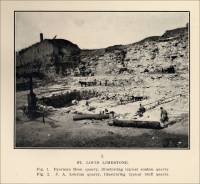
- St. Louis, Missouri - the Jefferson Stone Company (from Stone Magazine, June 1898, Vol. XVII, No. 1)
(pp. 68) “St. Louis, Mo. - Cyrus H. Jones was appointed receiver for the Jefferson Stone Company, by Judge Fisher, on application of Jannie J. Loughran and Alfred Berkey. The receiver was required to give bond in the sum of $10,000.”
(pp. 70) “St. Louis. - Richard H. Stevens began suit against the Jefferson Stone Company on a note for $3,500.”
- St. Louis, Missouri - the Johannes Lime and Cement Company (from Stone: An Illustrated Magazine, May 1899, Vol. XVIII., No. 6, pp. 350)
“The Johannes Lime and Cement Company, of St. Louis, has increased its capital stock from $17,000 to $75,000.”




Commercial use of material within this site is strictly prohibited. It is not to be captured, reworked, and placed inside another web site ©. All rights reserved. Peggy B. and George (Pat) Perazzo.