
Quarries in Missouri & Quarry Links, Photographs, and
Articles
St. Louis – Columbia thru Eyerman
- St. Louis, Missouri – the
Columbia Quarry Company (from Stone: An Illustrated
Magazine, March 1916, Vol. XXXVII, No. 3, pp. 149)
“The Columbia Quarry Company, of St. Louis, Mo., has increased its capital stock from $100,000 to $300,000.”
- St. Louis, Missouri - Comolli & Company, Inc. - A. Park,
Representative Comolli & Co., Inc., Barre, Vermont (from American
Stone Trade,
August, 1934, Vol. XXXV, No. 1, pp. 25.)
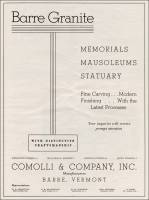
Barre Granite
Memorials - Mausoleums - Statuary - Fine Carving - Modern Finishing - With the Latest Processes
Your inquiries will receive prompt attention With Distinctive Craftsmanship
Comolli & Company, Inc., Manufacturers, Barre, Vermont
Armando Comolli - William A. Murray - Adolfo Comolli - Rigo Comolli
Representatives:
W. H. Johnston, Baltimore, MD. - H. B. Whitehead, New York, N.Y.
G. M. Johnson, Mendham, N.J. - Ivan Johnson, Marion, Ohio
A. Park, St. Louis, MO.
- St. Louis City, Missouri - Crystal Spring Quarry Co. Limestone Quarries located near Vigus Station (Limestone) (from “The Clay, Stone, Lime and Sand Industries of St. Louis City and County,” by G. E. Ladd, Assistant Geologist, in Geological Survey of Missouri, Bulletin No. 3, Supplement, Missouri, December 1890.)
Location - product.
“Crystal Spring Quarry Co. (47): - This firm quarries stone, which is probably of the St. Louis Limestone, in an old bluff of the Missouri river, near Vigus Station, on the St. Louis, Kansas City, and Colorado railway. Work was begun in 1889. The product consists of building stone, riprap, etc., but is soon to include dimension stone which the company intends to produce on a large scale. The quarry is connected with the railway by a switch about one half of a mile long. The company controls several hundred yards face of workable stone. There are three openings in the bluff from each of which stone is removed by the use of derricks to freight cars on which it is shipped.
Section.
“The section here is the same as given below for the quarry of the Watson Construction Co., which is close at hand. A sample for analysis was collected here from beds numbers 4 to 10 (inclusive) of this section.”
- St. Louis, Missouri - the Crystal Springs Quarry Co. Quarry (listed in The Mine, Quarry and Metallurgical Record of the United States, Canada, and Mexico, The Mine and Quarry News Bureau, Chicago, Ill., 1897)
- St. Louis, Missouri - the Crystal Springs Quarry Golf Club (photographs and history - commercial web site)
The Crystal Springs Quarry Golf Club was created from the site of an old limestone quarry
-
St. Louis, Missouri – the Curtis & Co. Manufacturing Company (Crane Advertisement from Stone, an Illustrated Monthly Magazine devoted to Stone, Marble Granite, Slate, Cement, Contracting and Building, December 1903, p. 107)

Curtis & Co. Mfg. Co., St. Louis, Curtis Double I Beam Crane, Air Hoists, Air Compressors, Pneumatic Appliances advertisement,
St. Louis, Missouri - St. Louis, Missouri - the Curtis Pneumatic Machinery Co. (from The Monument Reporter, June 1919, The Reporter Publishing Company (Not Inc.), Chicago, Illinois, pp. 6)

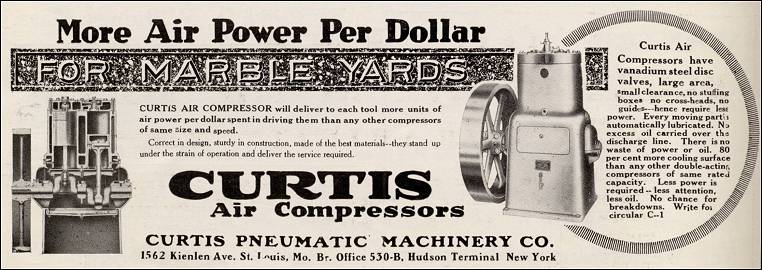
More Air Power Per dollar - For Marble Yards
Curtis Air Compressor will deliver to each tool more units of air power per dollar spent in driving them than any other compressors of same size and speed. Correct in design, sturdy in construction, made of the best materials - they stand up under the strain of operation and deliver the service required.
Curtis Air Compressors have vanadium steel disc valves, large area, smallclearance, no stuffing boxes no cross-heads, no guides - hence require less power. Every moving part is automatically lubricated. No excess oil carried over the discharge line. There is no waste of power or oil. 80 per cent more cooling surface than any other double-acting compressors of same rated capacity. Less power is required - less attention, less oil. No chance for breakdowns. Write for circular C-1.
Curtis Air Compressors - Curtis Pneumatic Machinery Co.
1562 Kienlen Ave. St. Louis, Mo. - Br. Office 530-B, Hudson Terminal New York
- St. Louis, Missouri – Curtis
Pneumatic Machinery Co. (The following information
is an advertisement in Pit and Quarry: Sand – Gravel – Stone,
magazine, December 1921, pp. 118.)
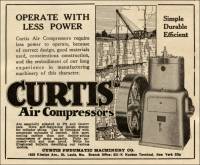
Curtis Pneumatic Machinery Co., 1628 Klenlon Ave., St. Louis, Mo.
Branch Office: 531-K Hudson Terminal, New York City
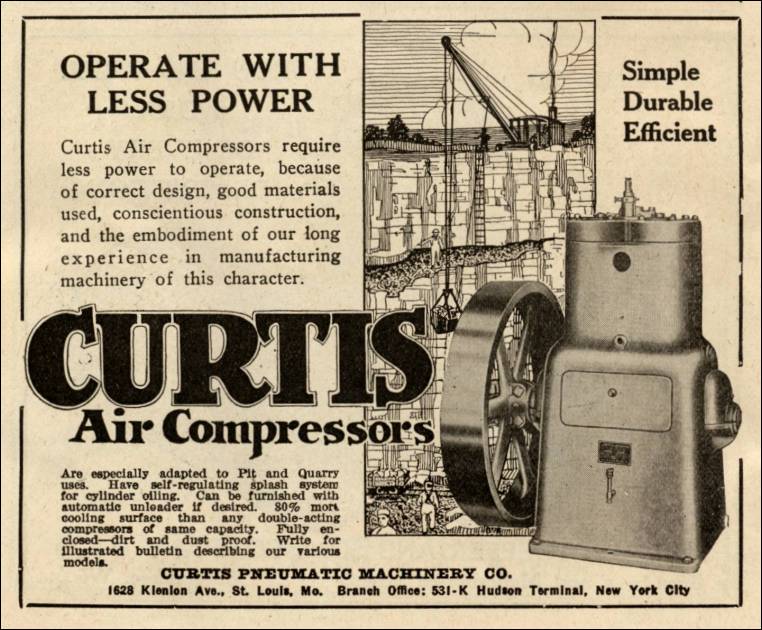
Curtis Air Compressors - Operate with Less Power
Simple - Durable – Efficient Curtis Air Compressors require less power to operate, because of correct design, good materials used, conscientious construction, and the embodiment of our long experience in manufacturing machinery of this character.
Curtis Air Compressors are especially adapted to Pit and Quarry uses. Have self-regulating splash systems for cylinder oiling. Can be furnished with automatic unloader if desired. 80% more cooling surface than any double-acting compressors of same capacity. Fully enclosed – dirt and dust proof. Write for illustrated bulletin describing our various models.
- St. Louis, Missouri – Curtis
Pneumatic Machinery Co. (The following information
is an advertisement in Pit and Quarry: Sand – Gravel – Stone,
magazine, December 1921, pp. 118.)
- St. Louis City, Missouri - Devereux and Sons Limestone
Quarry located on Marcus Avenue (Limestone) (from “The
Clay, Stone, Lime and Sand Industries of St. Louis City and
County,” by
G. E. Ladd, Assistant Geologist, in Geological Survey of Missouri,
Bulletin No. 3, Supplement, Missouri, December 1890.)
Location and product.
“Devereux and Sons (G, 7): - The quarry operated by this firm is situated on Marcus avenue, between Osage and Loraine streets. Building stone is the chief product. The quarry was opened in 1870. It is about one hundred and twenty-five feet long, seventy-five feet wide, and exposes the following columnar section, in descending series: -
Section.
- Loess, drift, residuary clay and decomposing limestone - 5-20 feet.
- Limestone, light gray, even grained, in three to five layers, of which the upper ones are very fossiliferous - 4 feet.
- Limestone, drab, fine-grained, brittle, fossiliferous, in layers from three to ten inches thick - 5 feet.
- Limestone, drab, fine grained, brittle, calcite veins, fossiliferous, several layers - 4 feet.
- Limestone, banded gray and brown, coarse grained - 2 feet.
- Limestone, drab, fine grained, dark colored chert concretions and layers - 1 foot, 2 inches.
- Limestone, very dark gray, calcite patches, chert concretions - 2 feet, 1 inch.
- Limestone, lavender, very fine grained and compact, brittle, lithographic, in four layers two to seven inches thick - 1 foot, 6 inches.
- Limestone, gray rather coarse grained - 1 foot, 2 inches.
- Limestone, gray, fine grained - 1 foot, 2 inches.
- Limestone, dark gray, in three to five layers - 2 feet, 4 inches.
Total thickness of rock - 24 feet, 5 inches.”
- St. Louis, Missouri – Dixie Machinery Manufacturing
Company (Crushers and Pulverizers) (The following information
is an advertisement in Pit
and Quarry: Sand – Gravel – Stone, magazine,
December 1921, pp. 40.)
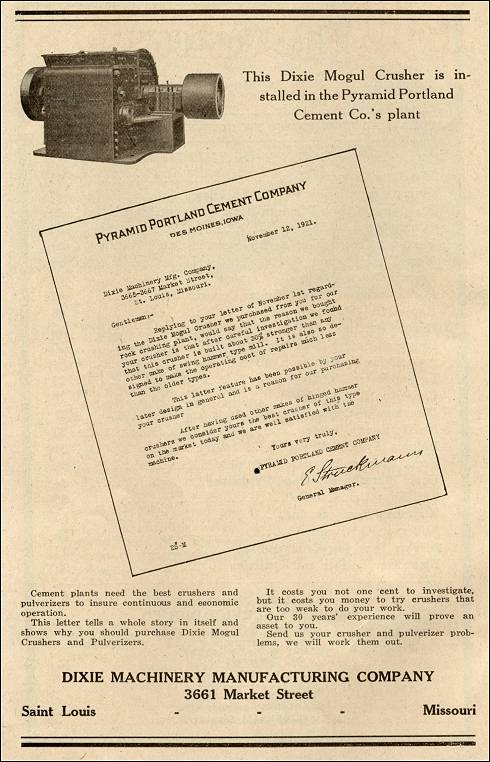
This Dixie Mogul Crusher is installed in the Pyramid Portland Cement Co.’s plant. 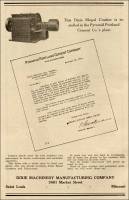
Dixie Machinery Manufacturing Company, 3661 Market Street, Saint Louis, Missouri.
Cement plants need the best crushers and pulverizers to insure continuous and economic operation.
This letter* tells a whole story in itself and shows why you should purchase Dixie Mogul Crushers and Pulverizers. It costs you not one cent to investigate, but it costs you money to try crushers that are too weak to do your work. Over 30 years’ experience will prove an asset to you. Send us your crusher and pulverizer problems, we will work them out.
(* Click on the advertisement image above to read the letter of recommendation by the Pyramid Portland Cement Company.)
- St. Louis City, Missouri - J. H. Doering Limestone Quarry located
southwest of Bobring (Limestone) (from “The
Clay, Stone, Lime and Sand Industries of St. Louis City and County,” by
G. E. Ladd, Assistant Geologist, in Geological Survey of Missouri,
Bulletin No. 3, Supplement, Missouri, December 1890.)
Location.
“Doering, J. H. (51): - Mr. Doering has a quarry situated on the Carondelet Branch railway, southwest of Bobring, in the St. Louis Limestone. It is connected with the railway by a half mile switch. The quarry has a workable face about eight hundred feet long. The product consists of dimension stone, macadam and riprap.”
- St. Louis, Missouri - the East St. Louis Stone
Company (from Stone: An Illustrated Magazine,
May 1899, Vol. XVIII., No. 6, pp. 335)
Stone Trade Notes: “The East St. Louis Stone Company has been incorporated. Capital, $20,000. Incorporators: W. E. Jonston, John Niemo and Peter R. Reiman.”
- St. Louis City, Missouri - A. O. Engleman Limestone Quarry located
at the foot of North Trudeau Street (Limestone) (from “The
Clay, Stone, Lime and Sand Industries of St. Louis City and County,” by
G. E. Ladd, Assistant Geologist, in Geological Survey of Missouri,
Bulletin No. 3, Supplement, Missouri, December 1890.)
Location.
“Engleman, A. O. (M, 15): - Mr. Engleman has a quarry which is situated at the foot of North Trudeau street, west of the Missouri Pacific railway tracks. It was opened in 1870, and for ten years was quarried for the purpose of producing lime. It is about two hundred and fifty feet long and one hundred and twenty-five feet wide. The product now consists of dimension and building stone, macadam and paving. Two Ingersoll drills and a channeling machine are in use. Stone is handled by derricks.
Section.
“The following section, in descending series, was obtained here: -
- Clay and decomposing limestone - 16 feet.
- Limestone, thin weathered beds - 17 feet.
- Limestone, gray, hard, compact - 2 feet, 3 inches.
- Limestone in thin layers - 10 inches.
- Limestone, gray, hard, concretionary - 10 inches.
- Limestone, greenish, soft, chloritic - 2 feet, 6 inches.
- Limestone, grayish, in thin layers - 10 inches.
- Shale - 4-6 inches.
- Limestone, dark gray, fine grained - 8 inches.
- Limestone, light gray, fine grained, stylolites at top - 3 feet, 6 inches.
- Limestone, white, coarse grained, semi-crystalline - 2 feet.
- Limestone, white, lithographic - 2 feet.
- Limestone, gray, rather coarse grained, much jointed - 1 foot.
- Limestone, gray, fine grained, hard, compact - 4 feet.
- Limestone, light gray, fine grained - 1 foot, 8 inches.
- Limestone, yellowish - 4 inches.
- Limestone, very light gray, fine grained, compact - 1 foot, 6 inches.
- Limestone, gray, fine grained, compact, in two two foot layers - 4 feet
- Limestone, light gray, chert concretions - 4 feet.
- Limestone, light gray, lithographic, much jointed - 1 foot.
- Limestone, light gray, lithographic - 6 inches.
Total thickness of rock - 50 feet, 10 inches.”
- St. Louis City, Missouri - Eureka Quarry Co. Limestone
Quarry located on Gravois Road (Limestone) (from “The
Clay, Stone, Lime and Sand Industries of St. Louis City and County,” by
G. E. Ladd, Assistant Geologist, in Geological Survey of Missouri,
Bulletin No. 3, Supplement, Missouri, December 1890.)
Location and product.
“Eureka Quarry Co. (57): - This company has a quarry which is situated on the Gravois road about an eighth of a mile northeast of Afton, in the St. Louis Limestone. Work was begun in 1889. The product consist of building stone and macadam.
“The following section, in descending series, was obtained here: -
Section.
- Stripping, residuary clay and decomposing limestone - 5 feet.
- Limestone, lavender, lithographic - 1 foot, 1 inch.
- Limestone, gray, crystalline - 1 foot, 10 inches.
- Limestone, same as last but fossiliferous - 2 feet.
- Limestone, light gray, crystalline, calcite veins, fossiliferous, in several layers - 3 feet.
- Limestone, light gray, crystalline, in four layers - 3 feet, 6 inches.
- Limestone, gray, coarse grained, crystalline, calcite, in thin layers - 2 feet, 3 inches.
- Limestone, gray, fine grained, crystalline - 6+ inches.
Total thickness of rock - 14 feet, 2 inches.”
- St. Louis, St. Louis County, Missouri - the
Tim Evans Quarry (Limestone) (from Report on The
Building Stones of The United States, and Statistics of the Quarry
Industry for 1880, by George W. Hawes, Curator of the Department
of Mineralogy and Lithology at the National Museum, and by F.
W. Sperr and Thomas C. Kelly, Joint production of the Census Office
and the National Museum, 1883)
The following information was taken from the table entitled, “Table IV. Tables indicating the Amount and Kinds of Rock in the Different States”: The Tim Evans Quarry, City of St. Louis, Saint Louis County, Limestone/Dolomite, color: drab; quarry opened in 1879.
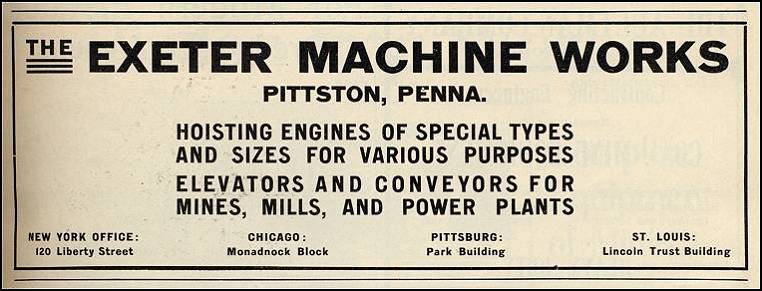
- St. Louis, Missouri - the Exeter Machine Works (Advertisements) (from Mines
and Minerals, A Mining and Metallurgical Journal, June, 1902,
Vol. XXII, No. 11, pp. 27)

The Exeter Machine Works, Pittston, Penna.
Hoisting engines of special types and sizes for various purposes. Elevators and conveyors for mines, mills, and power plants.
New York Office: 120 Liberty Street - Chicago: Monadnock Block
Pittsburg: Park Building - St. Louis: Lincoln Trust Building
- St. Louis, Missouri - the Eyerman Bros. Quarry (listed in The Mine, Quarry and Metallurgical Record of the United States, Canada, and Mexico, The Mine and Quarry News Bureau, Chicago, Ill., 1897)
- St. Louis, Missouri - the Eyerman Bros. Limestone Quarries
(Limestone) (The following information is from The
Quarrying Industry of Missouri, by E. R. Buckley, Director
and State Geologist, and H. A. Buehler, Missouri Bureau of Geology
and Mines Vol. II, 2nd Series, 1904.)
“Gottlieb and George Eyerman, of Pestalozzi street and Iowa avenue, own and operate two quarries, the stone from which is mainly used in their business as contractors.
“The quarry near Maeder street and Virginia avenue is a large, rectangular, sunken pit which has been opened 350 feet east and west and 175 feet north and south. The following is a section of the quarry from top to bottom:
20-30 ft. - Clay and loess stripping.
8 ft. - Crystalline, gray limestone. Consists of three beds 2 feet 8 inches, 3 feet, and 2 feet 4 inches in thickness. The uppermost bed is decomposed and shelly.
7 ft. - Medium grained, arenaceous, gray limestone, showing cross-bedding throughout the quarry. This stone is difficult to work.
9 in. - Finely crystalline, compact, gray limestone.
3 ft. 6 in. - Rough, spotted, bluish gray limestone. Difficult to work.
1 ft. 6 in.-2 ft. 6 in. - Grayish colored limestone, with dark spots. Contains considerable calcite and pyrite. Upper surface is rough. Stone is of inferior quality.
3 ft. 6 in. - Fine grained, mottled, gray limestone. The lower eight inches contains seams of bluish shale.
6 ft. 6 in. - Fossiliferous, gray limestone. At the south side of the quarry it splits into four or five thick beds. In other parts of the quarry it splits into thinner beds.
17 ft. - Fine grained, compact, fossiliferous, white limestone, in beds from one to four inches in thickness. Two feet from the top, about three feet of this ledge contains abundant small, black chert nodules. Fine veins of calcite are of common occurrence.
4 ft. - Fine grained, compact, white limestone. Tight sutures occur about six inches apart. In the upper part of the ledge there are small nodules and a two inch layer of black flint.
3 ft. 10 in. - Gray, arenaceous limestone having a somewhat oölitic appearance, exhibits cross-bedding and small suture joints.
1 ft. - Compact, crystalline, gray limestone.
10 in. - Two five inch beds of fine grained, compact, gray limestone, containing thin veins of calcite.
2 ft. 3 in. - Similar to the above bed. Splits into three beds of eight inches, fifteen inches and four inches.
7 in. - Finely crystalline, gray limestone. This stone is used mainly for sewer caps.
22 in. - Similar to the bed above. Caps along bedding plane two inches from top.
2 ft. - Medium grained, crystalline gray limestone. Splits into beds from two to six inches in thickness.
“This quarry is in the St. Louis limestone and most of the stone has a fine grained, compact texture, which is evidence of its durability. The output is mainly rubble. Some of the stone is broken by hand for macadam. Sewer intakes are constructed out of the stone from one ledge in the quarry.
“The beds dip slightly to the west, affording a natural drainage in this direction. The water is pumped from the quarry and discharged into the city sewer.
“The stone is hauled by team, up an inclined roadway at the north side of the quarry. From six to eight men are employed at this place. The only machinery used is one steam drill.
Plate XXXV. Fig. 1. St. Louis Limestone. Eyerman Bros. quarry, illustrating typical sunken quarry. 
“The quarry at Grand avenue and Hickory streets has been opened for a distance of 250 feet north and south extending between Car lane on the east and Grand avenue on the west. The beds in this quarry dip northeast, in which direction the water is drained. The following is a section from top to bottom:
10-15 ft. - Clay and loess stripping.
24 ft. - Compact, gray limestone, in beds from six inches to three feet in thickness.
7 ft. 6 in. - Granular, gray limestone. Splits near the middle into two beds. This ledge is thinner on the east and north sides of the quarry.
2 ft. 7 in. - Finely crystalline, gray limestone. Contains thin veins of calcite.
7 ft. 6 in. - Medium to fine grained, gray limestone. Splits in the middle into two beds.
2 ft. 2 in. - Medium to fine grained, gray limestone. Caps six inches from the top. At the east end of the quarry, this bed is about twelve inches thick.
2 in. - Dark shale.
4 ft. - Dark colored limestone, having an irregular bed of blue shale one foot from the bottom.
3 ft. 6 in. - Fine grained, compact, gray limestone. Containing an occasional thin vein of calcite.
3 ft. - Argillaceous, yellow limestone. Very soft.
7 ft. - Fine grained, drab limestone. Splits along a suture joint one foot from the top, and also along a bedding plane six inches below this. A layer of flint occurs three feet from the top. Along the jointing planes the stone has a yellowish color. Can be worked easily with plug and feathers and breaks with an even fracture. The stone is somewhat argillaceous and contains occasional thin seams of dark colored calcite.
7 ft. - Consists of eighteen inches of dark gray, flinty limestone; twenty inches of limestone having thin shaly seams; fifteen inches of dark gray limestone; and thirty inches of dark, bluish colored limestone, containing nodules of flint in the upper part. The stone from this horizon is only used for crushing.
6 ft. - Fine grained, compact, gray limestone. Contains a number of bedding planes, the principal one being two feet from the bottom. The beds are distinctly ripple marked. The upper one foot is shelly and shows dark stratification planes. The stone is soft and argillaceous and has been altered to a yellowish color along the joints.
3 ft. 9 in - Soft, argillaceous, medium grained, gray limestone. A layer of chert occurs two feet from the top. stone is rather stop for rubble.
3 ft. 6 in. - Finely crystalline, compact, gray limestone. Somewhat difficult to work.
“In general, the lower beds of this quarry are argillaceous and soft. The stone cannot be quarried during freezing weather, owing to the danger of disintegration. After the stone is seasoned, it takes on a lighter color than when first quarried. The major joints strike n. 25-30° E.
“The quarry is equipped with a derrick, steam hoist, steam, drill, pumps and crushing plant. The stone is hoisted in movable wagon boxes, as is the practice at many of the sunken quarries in St. Louis.”
- St. Louis City, Missouri - G. Eyerman Estate - First Quarry located east of Virginia Avenue (Limestone) (from “The Clay, Stone, Lime and Sand Industries of St. Louis City and County,” by G. E. Ladd, Assistant Geologist, in Geological Survey of Missouri, Bulletin No. 3, Supplement, Missouri, December 1890.)
Location and product.
“Eyerman, G., Estate, First Quarry (I, 20): - This quarry is situated east of Virginia avenue, near Maeder. The product is mostly building stone, but a little dimension stone, macadam and paving stone, is quarried. The quarry has been worked since 1882 (in circa 1890). It is about ninety feet side and three hundred and twenty feet long.
“The following section, in descending series, was obtained here: -
Section.
- Loess - 6-18 feet.
- Residuary clay, mined with the gravel of the drift - 1 foot.
- Limestone, partially decomposed - 2 feet.
- Limestone, light gray, fine grained - 3 feet, 6 inches.
- Limestone, gray, coarse and fine grained, few fossils, several layers - 5 feet, 6 inches.
- Limestone, gray, compact, siliceous - 5 feet.
- Limestone, gray, numerous concretions of chert - 1 foot, 4 inches.
- Limestone, dark gray, fine grained, compact and hard in two layers - 4 feet, 4 inches.
- Limestone, lavender, very fine grained, and compact, brittle, calcite veins - 1 foot.
- Limestone, very dark gray, sub-crystalline - 1 foot, 10 inches.
- Limestone, gray and yellow, fine grained, siliceous - 2 feet, 5 inches.
- Limestone, light and dark gray, cherty - 9 inches.
- Limestone, drab, very fine grained - 1 foot, 1 inch.
- Shale, greenish blue, sandy - 3-5 inches.
- Limestone, gray and bluish, fine grained - 1 foot, 2 inches.
- Limestone, light gray, fine and coarse grained - 3 feet, 4 inches.
- Limestone, light gray, fine grained - 1 foot.
- Limestone, white and grayish, fine grained - 2 feet, 10 inches.
- Like number 18, but contains much chert - 3 feet, 2 inches.
Total thickness of rock - 40 feet, 7 inches.”



Commercial use of material within this site is strictly prohibited. It is not to be captured, reworked, and placed inside another web site ©. All rights reserved. Peggy B. and George (Pat) Perazzo.