

Structures and Monuments in Which Indiana Stone was Used
-
Finished Products from Indiana Stone in Iowa
- Bedford, Iowa – the Court House (pre-1900) (from
A Glimpse of the Celebrated Stone Quarries at Bedford, Indiana.)
Bedford Oolitic Limestone quarried at Bedford, Indiana, was used in the construction of the Court House in Bedford, Iowa, constructed prior to 1900.
- Cedar Rapids,
Iowa –the West Minster Church (photographs) Photographs
of the church is presented in the Indiana Limestone section of the
Weber Stone Company, Inc., Stone
City Quarries (SCQ) (present-day company) in Anamosa, Iowa. (The link from which the following information was obtained is no longer available.)
<http://www.weberstone.com/indiana.html>This web site presents information on the geological aspects of Indiana Limestone and includes photographic samples of the stone. The web site stated in the past that Indiana Liimestone was used on the exterior of the West Minster Church.
- Council Bluffs, Iowa – the Court House (pre-1900) (from
A Glimpse of the Celebrated Stone Quarries at Bedford, Indiana.)
Bedford Oolitic Limestone quarried at Bedford, Indiana, was used in the construction of the Court House in Council Bluffs constructed prior to 1900.
- Davenport, Iowa – the Anderson Residence (pre-1900) (from
A Glimpse of the Celebrated Stone Quarries at Bedford, Indiana.)
Bedford Oolitic Limestone quarried at Bedford, Indiana, was used in the construction of the Anderson residence.
- Davenport, Iowa – the Beddenage Building (pre-1900) (from
A Glimpse of the Celebrated Stone Quarries at Bedford, Indiana.)
Bedford Oolitic Limestone quarried at Bedford, Indiana, was used in the construction of the Beddenage building.
- Davenport, Iowa – the Schmidt Building (pre-1900) (from
A Glimpse of the Celebrated Stone Quarries at Bedford, Indiana.)
Bedford Oolitic Limestone quarried at Bedford, Indiana, was used in the construction of the Schmidt building.
- Davenport, Iowa – the Turner Hall (pre-1900) (from
A Glimpse of the Celebrated Stone Quarries at Bedford, Indiana.)
Bedford Oolitic Limestone quarried at Bedford, Indiana, was used in the construction of Turner Hall.
- Des Moines,
Iowa – the Catholic Church (pre-1900) (from
A Glimpse of the Celebrated Stone Quarries at Bedford, Indiana.)
Bedford Oolitic Limestone quarried at Bedford, Indiana, was used in the construction of the Catholic Church in Des Moines constructed prior to 1900.
- Des Moines, Iowa – the National Starch Co. Building (pre-1900) (from
A Glimpse of the Celebrated Stone Quarries at Bedford, Indiana.)
Bedford Oolitic Limestone quarried at Bedford, Indiana, was used in the construction of the National Starch Company building.
- Des Moines, Iowa – the Youngerman Block (pre-1900) (from
A Glimpse of the Celebrated Stone Quarries at Bedford, Indiana.)
Bedford Oolitic Limestone quarried at Bedford, Indiana, was used in the construction of the Youngerman Block.
- El Dora, Iowa – the Court House (pre-1900) (from
A Glimpse of the Celebrated Stone Quarries at Bedford, Indiana.)
Bedford Oolitic Limestone quarried at Bedford, Indiana, was used in the construction of the Court House in El Dora, Iowa, constructed prior to 1900.
- Grinnell, Iowa - the Methodist Church, from Grinnell in Vintage Postcards, Iowa, by Bill Menner, Arcadia Publishing, Jan. 1, 2004, 128 pp., ISBN 0738532274, pp. 36, excerpt from Google Book Search)
According to this excerpt, the Methodist Church in Grinnell was designed by “architect/mason/builder R. G. Coutts” in 1895. The church was constructed of Indiana limestone. (Two photographs of the church are included.)
- Iowa City, Iowa - the University of Iowa - Levitt Center, from Gwathamy & Siegel, by Sofia Cheviakoff, Rockport Publishers, Jan. 1, 2003, 80 pp., ISBN 1564969843, pp. 64, excerpt from Google Book Search)
According to this excerpt, the building is clad in Indiana limestone.
- Keokuk, Iowa – the
Court House (pre-1900)
(from
A Glimpse of the Celebrated Stone Quarries at Bedford, Indiana.)
Bedford Oolitic Limestone quarried at Bedford, Indiana, was used in the construction of the Court House in Keokuk, Iowa, constructed prior to 1900.
- The Levitt Center for University of Advancement Web Site (photograph and history)
- Montezuma, Iowa – the First National Bank (pre-1900) (from
A Glimpse of the Celebrated Stone Quarries at Bedford, Indiana.)
Bedford Oolitic Limestone quarried at Bedford, Indiana, was used in the construction of the First National Bank building.
- Monticello, Iowa – the Monticello State Bank Building (The following information is from the section “Contracts and Building – Business Buildings, Theaters, Hotels, Society Halls, Etc.” in Stone: An Illustrated Magazine Devoted to Stone, Marble, Granite, Slate, Cement, Contracting and Building, Vol. XXIV, No. 1, January, 1902, Stone Publishing Co., New York, pp. 84.)
Monticello, Ia. – The Monticello State Bank will erect a bank and office building of pressed brick and Bedford Stone, after plans by Netcott & Donnan, of Independence.
- Ottumwa, Iowa – St. Mary’s Catholic Church and Rectory (The link from which this information was obtained is no longer available.)
<http://www.extension.iastate.edu/wapello/walktour/church.html>According to this web site, the church and rectory were were constructed of Bedford Limestone from Indiana over brick.
- Bedford, Iowa – the Court House (pre-1900) (from
A Glimpse of the Celebrated Stone Quarries at Bedford, Indiana.)
Finished Products from Indiana Stone in Kansas
- Kansas City, Kansas – the Lyric
Opera Theater Building (The link from which the following information is no longer available, although you can still visit the Lyric Opera web site.)
<http://www.kcopera.org/S/about_us/history.htm>The building in which the Lyric Opera Theater occupies today was dedicated in 1926 with a seating capacity of 3,000. The building has a Greek Corinthian facade of Indiana limestone.
- Marion, Kansas –
Marion Cemetery – Cemetery Monument of Rueben Riggs (photograph
and history)
The Riggs monument was carved from Bedford, Indiana, limestone by two Marion stone workers. The monument is a "sturdy oak tree about nine feet tall and two feet in diameter. The tree's branches are truncated, a lily blossom in a stone urn rests at the base, and a clinging vine wraps around the tree to the highest branch." (To view a photograph of the cemetery and monument, click on the link above to reach the LASR web site, select "Attractions" and then select "Marion Cemetery.")
- Wichita, Kansas - the Farm Credit Banks of Whicita Building (photograph and diagrams) (from Indiana Limestone Handbook, 19th edition, Indiana Limestone Institute of America, Inc., Bedford, Indiana, pp. 102)
Indiana limestone was used in the construction of the Farm Credit Banks of Wichita.
-
Wichita, Kansas – St. Mary’s Cathedral Group Buildings (from “Cathedral Group in Stone,” in Stone, August 1925, pp. 481)
(Excerpts from the article) “A building programme covering a period of more than fifteen years…has resulted in the completion of the St. Mary’s Cathedral Group of buildings at Wichita, Kansas. The group consists of the Cathedral…of Buff Indiana Limestone exterior…The Buff Indiana Limestone for the rectory was furnished by the Cuthbert Cut Stone Company of Wichita. The architects for the high school, the gymnasium and the other rectory buildings were Schmidt, Boucher and Overend of Wichita.”


“Cathedral Group in Stone,” in Stone, August 1925, pp. 481
“St. Mary’s Cathedral Group, Wichita, Kansas, consisting of the Cathedral, High School, Gymnasium and Rectory, constructed in buff Indiana limestone. Architects: Masqueray and Schmidt, Boucher & Overend.”
- Wichita, Kansas – the U. S. Government Buildings (pre-1900) (from
A Glimpse of the Celebrated Stone Quarries at Bedford, Indiana.)
Bedford Oolitic Limestone quarried at Bedford, Indiana, was used in the construction of the U. S. government buildings in Wichita, Kansas, constructed prior to 1900.
- Kansas City, Kansas – the Lyric
Opera Theater Building (The link from which the following information is no longer available, although you can still visit the Lyric Opera web site.)
Finished Products from Indiana Stone in Kentucky
- Berea, Kentucky - the Kentucky Artisan Center (The link on the Indiana Monument & Cut Stone Inc., web site from which the following information was obtained is no longer available.)
<http://www.indystone.com/photogallery1.html>According to the Indiana Monument & Cut Stone, Inc. web site, Indiana limestone was used in building the Kentucky Artisan Center.
- Frankfurt, Kentucky – Government Buildings at Frankfort, Kentucky – “The Bedford Stone Quarries,” in The Manufacturer and Builder, Vol. 16, No. 12, December 1884.
“Within the past decade, however, the industry has been powerfully revived, and the reputation of the Bedford stone has been fully established. Within this period it has been employed in some of the most costly and imposing structures in America, in the Court House at Chicago, the State House at Indianapolis, the government buildings at Frankfort, Ky., and at New Orleans, the Olympic theater at St. Louis, the Nevada flats in New York, in the piers of the bridges across the Ohio at Henderson and New Albany, and elsewhere. The Wm. K. Vanderbilt mansion in this city is also built of this stone….”
- Frankfort, Kentucky - the Kentucky State Capitol Building
- The Kentucky State Capitol Building (The following information is from Stone: An Illustrated Magazine, Vol. XLVI, No. 3, March, 1925, Stone Publishing Co., New York, advertisement for Indiana Quarries Company.)
“The State Capitol Building at Frankfort, Kentucky, is one of the finest Public Buildings in the United States. It is built entirely of Buff Bedford Indiana Limestone from the quarries of the Indiana Quarries Company (Branch of the Cleveland Stone Co.). General Offices: 112 W. Adams St., Chicago. Quarries and Mills: Bedford, Indiana.” The architect of the Kentucky State Capitol Building was F. M. Andrews, Cincinnati, Ohio.
- The Kentucky State Capitol Building (history and photographs) (More information about this subject is available on: “Kentucky State Capitol” on Wikipedia.
- The Kentucky State Capitol Building (The following information is from Stone: An Illustrated Magazine, Vol. XLVI, No. 3, March, 1925, Stone Publishing Co., New York, advertisement for Indiana Quarries Company.)
- Henderson, Kentucky – the Henderson Bridge, Ohio River
(pre-1900) (from
A Glimpse of the Celebrated Stone Quarries at Bedford, Indiana.)
Bedford Oolitic Limestone quarried at Bedford, Indiana, was used in the construction of the Henderson Bridge over the Ohio River.
-
Independence, Kentucky – the S. C. Brink Cemetery Monument (from “A Marble Cutter’s Monument,” in The Monumental News, Vol. IV, No. 10, October 1892, pp. 363)
A Marble Cutter’s Monument.
“The accompanying cuts represent the front and side ends of a monument cut by S. C. Brink of Independence, Kentucky, for himself. The design is original with him and will no doubt interest the trade. The monument is of select Bedford Oolitic limestone. The base is 4 x 5 x 1 foot 2 inches. The die is of one piece being 4 x 4 x 3 feet. The front of the top and the right end where the tools are shown is left in an unfinished state. The tools are all cut full size and properly shaped, and when one laps upon another they are relieved by cutting through. Mr. Brink has had the monument erected on his lot in the cemetery. Another unique monument of his execution in the same cemetery was made for the county surveyor. It represents a survor’s transit instrument on a tripod astride a monument with a rustic cross, and bird’s nests, squirrels and other accessories suggestive of the out-door life of the surveyor.”


Front view of the S. C. Brink monument, who was a marble cutter in Independence, Kentucky (1892)
Side view of the S. C. Brink monument, who was a marble cutter in Independence, Kentucky (1892)
- Lexington, Kentucky – the Court House (pre-1900) (from
A Glimpse of the Celebrated Stone Quarries at Bedford, Indiana.)
Bedford Oolitic Limestone quarried at Bedford, Indiana, was used in the construction of the Court House in Lexington, Kentucky, constructed prior to 1900.
- London, Kentucky - the Whitley Company Court House Limestone Sign (The link on the Indiana Monument & Cut Stone Inc., web site from which the following information was obtained is no longer available.)
<http://www.indystone.com/customsignwork.html>According to the Indiana Monument & Cut Stone, Inc. web site, Indiana limestone was used in building the Whitley Company Court House sign.
- Louisville, Kentucky – Cave Hill Cemetery – the Superintendent’s Office & Waiting Rooms (from “Cave Hill Cemetery, Louisville, Ky.,” The Monumental News, November 1892)
- Louisville, Kentucky – the Fonda Block (pre-1900) (from
A Glimpse of the Celebrated Stone Quarries at Bedford, Indiana.)
Bedford Oolitic Limestone quarried at Bedford, Indiana, was used in the construction of the Fonda Block.
- Louisville, Kentucky – the German Insurance Bank (pre-1900) (from
A Glimpse of the Celebrated Stone Quarries at Bedford, Indiana.)
Bedford Oolitic Limestone quarried at Bedford, Indiana, was used in the construction of the German Insurance Bank.
- Louisville, Kentucky – the Kentucky and Indiana Bridge,
Ohio River (pre-1900)
(from
A Glimpse of the Celebrated Stone Quarries at Bedford, Indiana.)
Bedford Oolitic Limestone quarried at Bedford, Indiana, was used in the construction of the Kentucky and Indiana Bridge over the Ohio River.
- Louisville, Kentucky – the Kentucky National Bank
(pre-1900) (from
A Glimpse of the Celebrated Stone Quarries at Bedford, Indiana.)
Bedford Oolitic Limestone quarried at Bedford, Indiana, was used in the construction of the Kentucky National Bank.
- Louisville, Kentucky – the Louisville Bridge, Ohio River (pre-1900) (from
A Glimpse of the Celebrated Stone Quarries at Bedford, Indiana.)
Bedford Oolitic Limestone quarried at Bedford, Indiana, was used in the construction of the Louisville Bridge over the Ohio River.
- Louisville, Kentucky – the Louisville and Jeffersonville
Bridge, Ohio River (pre-1900) (from
A Glimpse of the Celebrated Stone Quarries at Bedford, Indiana.)
Bedford Oolitic Limestone quarried at Bedford, Indiana, was used in the construction of the Louisville and Jeffersonville Bridge over the Ohio River.
- Louisville, Kentucky – Louisville Medical College (pre-1900) (from
A Glimpse of the Celebrated Stone Quarries at Bedford, Indiana.)
Bedford Oolitic Limestone quarried at Bedford, Indiana, was used in the construction of the Louisville Medical College.
- Louisville, Kentucky - Louisville Water company Gate House Stairs (photographs and diagrams) (from Indiana Limestone Handbook, 19th edition, Indiana Limestone Institute of America, Inc., Bedford, Indiana, pp. 93)
Indiana limestone was used in the construction of the Gate House stairs.
- Louisville, Kentucky – the H. Strater Residence
(pre-1900) (from
A Glimpse of the Celebrated Stone Quarries at Bedford, Indiana.)
Bedford Oolitic Limestone quarried at Bedford, Indiana, was used in the construction of the residence of H. Strater.
- Louisville, Kentucky – the U. S. Custom House and Post Office (pre-1900) (from
A Glimpse of the Celebrated Stone Quarries at Bedford, Indiana.)
Bedford Oolitic Limestone quarried at Bedford, Indiana, was used in the construction of the U. S. Custom House and Post Office in Louisville, Kentucky, constructed prior to 1900.
- Louisville, Kentucky – Old U. S. Custom House (built ca. 1840/1850) (from
A Glimpse of the Celebrated Stone Quarries at Bedford, Indiana.)
Bedford Oolitic Limestone quarried at Bedford, Indiana, was used in the construction of the old U. S. Custom House constructed about 1840/1850.
- Louisville, Kentucky - Union Station, Transit Authority of River City (from The Louisville Guide, by Dennis Domer, Gregory A. Luhan, and David Mohoney, Princeton Architectural Press, Aug. 1, 2004, 288 pp., ISBN 1568984510, pp. 75-76, excerpt from Google Book Search)
According to this excerpt, F. W. Mobrary was the company architect at the time Union Station was designed. Kentucky and Indiana limestone were used for the façade of Union Station. (A photograph of Union Station is included.)
- Mt. Vernon, Kentucky - the Rockcastle Technology Center (The link on the Indiana Monument & Cut Stone Inc., web site from which the following information was obtained is no longer available.)
<http://www.indystone.com/photogallery4.html>According to the Indiana Monument & Cut Stone, Inc. web site, Indiana limestone was used in building the Rockcastle Technology Center.
- Richmond, Kentucky - East Kentucky State University - Classroom Building - Panel & Window Units (photograph and elevation diagrams) (from Indiana Limestone Handbook, 19th edition, Indiana Limestone Institute of America, Inc., Bedford, Indiana, pp. 89)
Indiana limestone was used for the panel and window units in a classroom building located at the East Kentucky State University.
- Shelbyville, Kentucky – the “Chapel in Grove Hill Cemetery, Shelbyville, Ky.” (from The Monumental News, July 1893, pp. 324)


Superintendent’s Office and Waiting Rooms, Cave Hill Cemetery (1892)
Entrance to Cave Hill Cemetery, Louisville, KY. Secretary and Treasurer’s Office and Director’s Room and Waiting Rooms (1892)
“Beautifully situated in the midst of a grove of grand old forest trees is the recently completed chapel in Grove Hill Cemetery, Shelbyville, Ky. The building is 24 x 48 feet, and is constructed of Bedford, Ind., limestone. The exterior walls are rock-faced, with cut stone trimmings of the same material. On the inside the walls are finished in sawn stone smooth rubbed, and pointed with black mortar.”
- Berea, Kentucky - the Kentucky Artisan Center (The link on the Indiana Monument & Cut Stone Inc., web site from which the following information was obtained is no longer available.)


 |
 |
Chapel in Grove Hill Cemetery, Shelbyville, KY, 1893 |
Floor plan of the Chapel in Grove Hill Cemetery, Shelbyville, KY, 1893 |
Finished Products from Indiana Stone in Louisiana
- Baton Rouge, Louisiana - Civic Center Government
Building (photograph and diagrams) (from Indiana Limestone
Handbook, 19th edition, Indiana Limestone Institute of America,
Inc., Bedford, Indiana, pp. 98)
Indiana limestone was used in the construction of the Civic Center Government Building
- Monroe, Louisiana – the U. S. Government Buildings (pre-1900)
(from
A Glimpse of the Celebrated Stone Quarries at Bedford, Indiana.)
Bedford Oolitic Limestone quarried at Bedford, Indiana, was used in the construction of the U. S. government buildings in Monroe, Louisiana, constructed prior to 1900.
- New Orleans, Louisiana – the Cotton Exchange
Building (pre-1900) (from
A Glimpse of the Celebrated Stone Quarries at Bedford, Indiana.)
Bedford Oolitic Limestone quarried at Bedford, Indiana, was used in the construction of the Cotton Exchange building.
- New Orleans, Louisiana – Government Buildings in New Orleans – “The Bedford Stone Quarries,” in The Manufacturer and Builder, Vol. 16, No. 12, December 1884.
“Within the past decade, however, the industry has been powerfully revived, and the reputation of the Bedford stone has been fully established. Within this period it has been employed in some of the most costly and imposing structures in America, in the Court House at Chicago, the State House at Indianapolis, the government buildings at Frankfort, Ky., and at New Orleans, the Olympic theater at St. Louis, the Nevada flats in New York, in the piers of the bridges across the Ohio at Henderson and New Albany, and elsewhere. The Wm. K. Vanderbilt mansion in this city is also built of this stone….”
- New Orleans, Louisiana – the Metairie Cemetery – Granite
Monuments from the 1890s through the mid-1900s (From Going
Out in Style: The Architecture of Eternity, by Douglas Keister,
Facts On File, Inc., 1997, pp. 5)
The author indicates that one of the Stone Mountain, Georgia, granite quarries was leased from the “1890s through the first half of the twentieth century…” by Albert Weiblen, of New Orleans. The quarry produced granite for many of the monuments in the Metairie Cemetery during this time period.
- New Orleans, Louisiana (?) - the Ruskin Cross (from Stories
in Stone: A Field Guide to Cemetery Symbolism and Iconography,
by Douglas Kester, Gibbs Smith, April 1, 2004, 288 pp., ISBN 158685321X,
excerpt from Google Book Search)
According to an excerpt of this book, Albert Weiblen, a New Orleans tomb contractor, fabricated the Ruskin Cross an “18-foot, 15-ton block of Indiana limestone. The cross was designed by Charles L. Lawhon. (The portion of the book that is available on Google Book Search does not indicate where the Ruskin Cross is located.)
- New Orleans, Louisiana - Tulane University - Gibson, Dinwiddie, Tilton Halls, & the Entrance Marker (photograph and history), information from Inside Tulare, Tulane University, May 1, 2004.
Tilton Hall and Dinwiddie Hall were in the process of being constructed at the time of this article in 2004. The halls were designed to blend in with Gibson Hall, and was constructed from limestone quarried in southern Indiana. In 1894 the same stone was used in the construction of Gibson Hall.
- Gibson Circle Monuments, Tulane University Entrance. According to this web site, the limestone used for the bronze marker placed on a limestone pylons located at the entrances of Gibson Circle was quarried from the same Indiana limestone quarry as the stone used in Gibson Hall, Tilton-Memorial Hall, and Dinwiddie hall, which were designed in the Richardsonian Romanesque style.
- Opelousas, Louisiana – the U. S. Government Buildings (pre-1900) (from
A Glimpse of the Celebrated Stone Quarries at Bedford, Indiana.)
Bedford Oolitic Limestone quarried at Bedford, Indiana, was used in the construction of the U. S. government buildings in Opelousas, Louisiana, constructed prior to 1900.
- Shreveport, Louisiana - the Louisiana State Exhibit Museum - the Floor & Walls behind the Fresco Panels at the Museum’s North Portico, from Franklin D. Roosevelt and the Shaping of American Political Culture, edited by Nancy Beck Young, William D. Pederson, and Byron W. Daynes, M. E. Sharpe, March 22, 2001, 224 pp., ISBN 0765606216, pp. 82, excerpt from Google Book Search)
According to this excerpt, the walls located behind the fresco panels/murals mounted on the museum’s north portico are surrounded pink Texas granite and walls of Indiana limestone.
- Shreveport, Louisiana – the U. S. Government Buildings (pre-1900) (from
A Glimpse of the Celebrated Stone Quarries at Bedford, Indiana.)
Bedford Oolitic Limestone quarried at Bedford, Indiana, was used in the construction of the U. S. government buildings in Shreveport, Louisiana, constructed prior to 1900.
-
Finished Products from Indiana Stone in Maryland
- Baltimore, Maryland - Emmanuel Episcopal Church - the Reredos in the Chancel, 811 Cathedral Street from Noble Powell and the Spiscopal Establishment in the Twentieth Century, by David Hein, University of Illinois Press, June 1, 2001, 232 pp., ISBN 0252026438, pp. 64, excerpt from Google Book Search)
According to this excerpt, a reredos of Indiana limestone was placed in the chancel.
The Emmanuel Episcopal Church web site once included “A Walking Tour of Emmanuel Episcopal Church” and a diagram of the church. (The information below was obtained from this tour, although it appears that the tour is no longer available.)
<http://www.emmanuelepiscopalchurch.org/floorplan.html>No. 13 on the tour indicated the following: The reredos is located below the window. It is noted that the reredos “depicts personalities from both the Hebrew and Christian Scriptures.” These reredos were carved by John Kirchmayer
- Wikipedia, the Free Encyclopedia, defines reredos as: "A reredos is a screen or decoration behind the altar in a church, usually depicting religious iconography or images. It can be made of stone, wood, metal, ivory, or a combination of materials."
- Baltimore, Maryland - the IMI Training Center (The link on the Indiana Monument & Cut Stone Inc., web site from which the following information was obtained is no longer available.)
<http://www.indystone.com/photogallery3.html>According to the Indiana Monument & Cut Stone, Inc. web site, Indiana limestone was used in building the IMI Training Center.
- Baltimore, Maryland –
the Museum of Art (completed in 1929) The Museum
of Art, completed in 1929, was constructed of Indiana limestone.
- Baltimore, Maryland - the Baltimore Museum of Art, from Maryland: A New Guide to the Old Line State, by Earl Arnett, Robert J. Brugger, and Edward C. Papenfuse, Johns Hopkins University Press, May 1, 1999, 672 pp., ISBN 0801859808, pp. 372, excerpt from Google Book Search)
According to this excerpt, John Russell Pope designed the neoclassical Baltimore Museum of Art, which opened in 1929. Indiana limestone was used in the construction of the museum.
- Baltimore Museum of Art Web Site
- Baltimore, Maryland - the Baltimore Museum of Art, from Maryland: A New Guide to the Old Line State, by Earl Arnett, Robert J. Brugger, and Edward C. Papenfuse, Johns Hopkins University Press, May 1, 1999, 672 pp., ISBN 0801859808, pp. 372, excerpt from Google Book Search)
- Baltimore, Maryland – the National Union Bank Building (from Indiana Limestone: The Aristocrat of Building Materials (pdf), Vol. 1, June 1920, Sixth Edition, Indiana Limestone Quarrymen’s Association, Bedford, Indiana, pp. 26.
“‘Before and After.’ The National Union Bank Building withstood the terrible test of the great Baltimore fire so well that the Indiana Limestone front was afterward put into first-class condition for a few hundred dollars. As you see, the principal damage was caused by the fall of adjacent buildings. Here is conclusive proof of high fire-resistance.” 
-
Baltimore, Maryland - the War Memorial Building (from “War Memorial in Stone and Marble,” Stone Magazine, Vol. XLVI, No. 9, September 1925, pp. 546)
- Urbana, Maryland - Urbana Regional Library (The link on the Indiana Monument & Cut Stone Inc., web site from which the following information was obtained is no longer available.)
<http://www.indystone.com/photogallery3.html>According to the Indiana Monument & Cut Stone, Inc. web site, Indiana limestone was used in building the Urbana Regional Library building.


“War Memorial in Stone and Marble,” Stone Magazine, September 1925, pp. 546
“New War Memorial Erected by the State of Maryland and the City of Baltimore. Exterior of Indiana Limestone. Napoleon Gray and Red Ark Fossil Among Several Marbles Used in Interior Decorations. Architect: Laurence Hall Fowler.”
- Baltimore, Maryland - Emmanuel Episcopal Church - the Reredos in the Chancel, 811 Cathedral Street from Noble Powell and the Spiscopal Establishment in the Twentieth Century, by David Hein, University of Illinois Press, June 1, 2001, 232 pp., ISBN 0252026438, pp. 64, excerpt from Google Book Search)
-
Finished Products from Indiana Stone in Massachusetts
- Ayre, Massachusetts – the Ayre Public Library
(pre-1900) (from
A Glimpse of the Celebrated Stone Quarries at Bedford, Indiana.)
Bedford Oolitic Limestone quarried at Bedford, Indiana, was used in the construction of the Ayre Public Library.
- Boston, Massachusetts
– the Algonquin Club (pre-1900) (from
A Glimpse of the Celebrated Stone Quarries at Bedford, Indiana.)
Bedford Oolitic Limestone quarried at Bedford, Indiana, was used in the construction of the Algonquin Club.
- Boston, Massachusetts – the Beaconsfield Terrace (pre-1900) (from
A Glimpse of the Celebrated Stone Quarries at Bedford, Indiana.)
Bedford Oolitic Limestone quarried at Bedford, Indiana, was used in the construction of Beaconsfield Terrace.
- Boston, Massachusetts - the First Church of Christ, Scientist Rotunda Addition (photographs) (from Indiana Limestone Handbook, 19th edition, Indiana Limestone Institute of America, Inc., Bedford, Indiana, pp. 85)
Indiana limestone was used in the construction of the Scientist Rotunda Addition of the First church of Christ.
- Boston, Massachusetts – Harvard University – Widener Library (1913-1915) (history) Lessons in Stone – Harvard’s Building Blocks Teach
Natural and Cultural History, text by David B. Williams, photographs
by Jim Harrison, (Harvard Magazine)
Buff limestone from Indiana quarries for the foundation and columns.
- Boston,
Massachusetts – the International Trust Company Building (pre-1900) (from
A Glimpse of the Celebrated Stone Quarries at Bedford, Indiana.)
Bedford Oolitic Limestone quarried at Bedford, Indiana, was used in the construction of the International Trust Company building.
- Boston, Massachusetts - the International Trust Company Building, 45 Milk Street, from Great Buildings of Boston: A Photographic Guide, by George M. Cushing, Courier Dover Publications, May 1, 1982, 160 pp., ISBN 0486242196, pp. 12, excerpt from Google Book Search)
According to this excerpt, Indiana limestone was used in the construction of the International Trust Company building. The building was designed by William G. Preston and built about 1892-93. (Photographs of the International Trust Company Building are included.)
- Boston, Massachusetts - the International Trust Company Building, 45 Milk Street, from Great Buildings of Boston: A Photographic Guide, by George M. Cushing, Courier Dover Publications, May 1, 1982, 160 pp., ISBN 0486242196, pp. 12, excerpt from Google Book Search)
- Boston, Massachusetts – the Jordan Building (pre-1900) (from
A Glimpse of the Celebrated Stone Quarries at Bedford, Indiana)
Bedford Oolitic Limestone quarried at Bedford, Indiana, was used in the construction of the Jordan building.
- Boston, Massachusetts – the Shreve Building (from
A Glimpse of the Celebrated Stone Quarries at Bedford, Indiana.)
Bedford Oolitic Limestone quarried at Bedford, Indiana, was used in the construction of the Shreve building.
- Boston, Massachusetts – the Pope Manufacturing Co. Building
(pre-1900) (from
A Glimpse of the Celebrated Stone Quarries at Bedford, Indiana.)
Bedford Oolitic Limestone quarried at Bedford, Indiana, was used in the construction of the Pope Manufacturing Company building.
- Ayre, Massachusetts – the Ayre Public Library
(pre-1900) (from
A Glimpse of the Celebrated Stone Quarries at Bedford, Indiana.)
-
Finished Products from Indiana Stone in Michigan
- Ann Arbor, Michigan - the University of Michigan Law School - the John P. Cook Memorial Room Fireplace, from The Michigan Law Quadrangle: Architecture and Origins, by Kathryn Horste, University of Michigan Press, June 15, 1997, 160 pp., ISBN 0472107496, pp. 109, excerpt from Google Book Search)
According to this excerpt, the fireplace in the Cook Memorial Room was constructed of white Indiana limestone.
- The University of Michigan Alumni Center (photograph) (from Indiana Limestone Handbook, 19th edition, Indiana Limestone Institute of America, Inc., Bedford, Indiana, pp. 79)
Indiana limestone was used in the construction of the Alumni Center building at the University of Michigan.
- The University of Michigan Alumni Center (photograph) (from Indiana Limestone Handbook, 19th edition, Indiana Limestone Institute of America, Inc., Bedford, Indiana, pp. 79)
- Bay City, Michigan – the Custom House (pre-1900) (from
A Glimpse of the Celebrated Stone Quarries at Bedford, Indiana.)
Bedford Oolitic Limestone quarried at Bedford, Indiana, was used in the construction of the Custom House at Bay City, Michigan..
- Bay City, Michigan – the Post Office (pre-1900) (from
A Glimpse of the Celebrated Stone Quarries at Bedford, Indiana.)
Bedford Oolitic Limestone quarried at Bedford, Indiana, was used in the construction of the Post Office in Bay City, Michigan.
- Bay City, Michigan – the U. S. Court House (pre 190) (from
A Glimpse of the Celebrated Stone Quarries at Bedford, Indiana.)
Bedford Oolitic Limestone quarried at Bedford, Indiana, was used in the construction of the U. S. Court House.
- Brownstown, Michigan - the Brownstown Police Station (The link on the Indiana Monument & Cut Stone Inc., web site from which the following information was obtained is no longer available.)
<http://www.indystone.com/photogallery1.html>According to the Indiana Monument & Cut Stone, Inc. web site, Indiana limestone was used in building the Brownstown police station.
- Caro, Michigan - the Tuscalosa County Courthouse, 440 North State Street, from Traveling Through Time: A Guide to Michigan’s Historical Markers, edited by Laura Rose Ashlee, University of Michigan Press, May 27, 2005, 544 pp., ISBN 0472030663, pp. 420, excerpt from Google Book Search)
According to this excerpt, the Courthouse was designed by William H. Kuni, a Detroit architect, and built by Cecil M. Kelly. Indiana limestone was used to face the Courthouse.
- Tuscola County Courthouse, presented by the Michigan Historical Markers Web site. (photographs and history)
- Charlotte, Michigan – the Michigan Central Railroad Passenger Depot (The following information is from the section “Contracts and Building – Business Buildings, Theaters, Hotels, Society Halls, Etc.” in Stone: An Illustrated Magazine Devoted to Stone, Marble, Granite, Slate, Cement, Contracting and Building, Vol. XXIV, No. 1, January, 1902, Stone Publishing Co., New York, pp. 88.)
Charlotte, Mich. – The Michigan Central Railroad will building an $18,000 passenger depot here, of Bedford limestone and Roman pressed brick. Plans by Spier & Rohns.
-
Detroit, Michigan – the Book Tower Building (Advertisement from Stone, Vol. XLVII, No. 12, October 1920, pp. 737)
-
Detroit, Michigan – Building Faced with Indiana Limestone (from Stone, Vol. XLVI, No. 9, September 1925, pp. 550)
- Detroit, Michigan – the Col. Hecker Residence
(pre-1900) (from
A Glimpse of the Celebrated Stone Quarries at Bedford, Indiana.)
Bedford Oolitic Limestone quarried at Bedford, Indiana, was used in the construction of the residence of Colonel Hecker.
- Detroit, Michigan – Democrat Publishing Company Building (The following information is from an advertisement in Stone: An Illustrated Magazine, Vol. XLVI, No. 3, March, 1925, “University Trains Apprentices for Marble Industry,” Stone Publishing Co., New York, pp. 161.)
Democrat Publishing Company Building, Davenport, Ia., Select Grey Indiana Limestone furnished by the Consolidated Stone Company. Clausen & Kruse, Architects.
-
Detroit, Michigan – Marygrove College – Monument (Photograph from Stone, Vol. XLIX, No. 1, January 1928, pp. 51)
- Detroit,
Michigan – the Post Office (pre-1900) (from
A Glimpse of the Celebrated Stone Quarries at Bedford, Indiana.)
Bedford Oolitic Limestone quarried at Bedford, Indiana, was used in the construction of the Post Office in Detroit.
- Detroit, Michigan – Skyscraper Building at 5057 Woodward – known as the Maccabees Building, the Detroit Public Schools headquarters, the Schools Center Building, and more recently the Wayne State University Building, from “5057 Woodward: A landmark: Exquisite details and materials make building a standout,” by Jennifer Charney, Vol. 2 Issue 8, April 15th 2004, in Life@Wayne. (This link is no longer available, although you can view the site on the Internet Archive Wayback Machine.)
<http://life.wayne.edu/article.php?id=435>Originally, this 15-story building was known as the Maccabees Building, and it was constructed in 1927. The architect of the building was German-born architect Albert Kahn. It served as the world headquarters for the Order of the Maccabees, an insurance organization. It was next known as the Detroit Public Schools headquarters, the Schools Center Building from 1960 to 2002. The building was acquired by Wayne State University prior to this April 2004 article. Bill Morgan, an employee, researched the building and found that Indiana limestone panels were used to clad the exterior of the building.
-
“Maccabees Building,” presented on Wikipedia.
- Detroit, Michigan – Trinity Methodist Episcopal Church (The following information is from an advertisement in Stone: An Illustrated Magazine, Vol. XLVI, No. 3, March, 1925, “University Trains Apprentices for Marble Industry,” Stone Publishing Co., New York, pp. 160.)
Trinity Methodist Episcopal Church, Detroit, Mich., a Beautiful Example of Ripple-faced Ashlar Indiana Limestone for Exterior Work.
- Detroit, Michigan - the WWJ Broadcast Building, on West Lafayette, from Art Deco in Detroit, Michigan, by Rebecca Binno Savage and Greg Kowalski, Arcadia Publishing, Jan. 20, 2004, 128 pp., ISBN 0738532282, pp. 62, excerpt from Google Book Search)
According to this excerpt, the WWJ Broadcast building was built about 1936 and designed in the Art Deco style by the firm of Albert Kahn. The building has a façade of buff-colored Indiana limestone. (A photograph of the building is included.)
- Detroit, Michigan - the Younis Medical Building (The link on the Indiana Monument & Cut Stone Inc., web site from which the following information was obtained is no longer available.)
<http://www.indystone.com/photogallery1.html>According to the Indiana Monument & Cut Stone, Inc. web site, Indiana limestone was used in building the Younis Medical Building.
- Fraser, Macomb County, Michigan – the State
Bank of Fraser. (The link from which the above information was obtained is no longer available.) <http://www.ci.fraser.mi.us/about/strawberry-12-4.html>.
In July 1910 the bank was established at the intersection of Utica and Townline (now 14 Mile) roads. In 1930 the current building was constructed of Bedford limestone. Tennessee marble, Botticino marble from Italy, antique Vermont marble were all used in the interior in addition to walnut woodwork
- Jackson, Michigan – the Post Office (pre-1900) (from
A Glimpse of the Celebrated Stone Quarries at Bedford, Indiana.)
Bedford Oolitic Limestone quarried at Bedford, Indiana, was used in the construction of the Post Office in Jackson, Michigan, constructed prior to 1900.
- Lowell, Massachusetts - Memorial Auditorium. The following information is from Mill and Mansion: Architecture and Society in Lowell, Massachusetts, 1820-1865, by John Coolidge, Univ of Massachusetts Press, 2nd ed. July 1, 1993, 336 pp., ISBN: 0870238191, pp. xxii, from Google Book Search)
According to this book, the Memorial Auditorium in Lowell was designed by Blackall, Clapp, and Whitemore and was built in 1921. Indiana limestone was used for the exterior of the building. Indiana limestone was also used on the exterior of the Beaux Arts style federal building that adjoined the Memorial Auditorium. The federal building was from 1932 to 1938.
- Muskegon, Michigan – the John Forrest Residence (pre-1900) (from
A Glimpse of the Celebrated Stone Quarries at Bedford, Indiana.)
Bedford Oolitic Limestone quarried at Bedford, Indiana, was used in the construction of the residence of John Forrest.
- Sault Ste Marie, Michigan –
River of History Museum Building.
The old post office in Sault Ste Marie was constructed of limestone quarried at Bedford Indiana. The building now houses the River of History Museum.
“Book Tower building, Detroit, one of the outstanding architectural achievements of the decade. Exterior of Indiana Limestone. Architect: Louis Kamper.” 
“A facing of stone, in this instance Indiana Limestone, has served to transform this building into one of the most attractive moderate size commercial structures of Detroit. Architects: Donaldson & Meier.” 
“Monument of Carved Indiana Limestone of the Select Buff Variety from the quarries of the Indiana Limestone Company. It stands on the campus of the Marygrove College, Detroit, Michigan. Architects: D. A. Bohlen & Son. Carved and Set by The Wolverine Stone Company.” 
- Ann Arbor, Michigan - the University of Michigan Law School - the John P. Cook Memorial Room Fireplace, from The Michigan Law Quadrangle: Architecture and Origins, by Kathryn Horste, University of Michigan Press, June 15, 1997, 160 pp., ISBN 0472107496, pp. 109, excerpt from Google Book Search)
-
Finished Products from Indiana Stone in Minnesota
- Duluth, Minnesota – the U. S. Custom House and Post Office
(pre-1900) (from
A Glimpse of the Celebrated Stone Quarries at Bedford, Indiana.)
Bedford Oolitic Limestone quarried at Bedford, Indiana, was used in the construction of the U. S. Custom House and Post Office.
- Hibbing, Minnesota – the Blessed
Sacrament Church.
- Construction of the church was completed in 1940 with seating for 800 people. Indiana limestone and Wyandotte brick were used on the exterior of the “Romanesque basilica style church.” Polished Mankato limestone and Springfield brick were used on the interior of the build. Montana travertine marble was used for the sanctuary, and Siena and Montana marbles were used for the main altar.
- Martin County, Minnesota – the Martin
County Courthouse (The link from which the following information was obtained is no longer available.)
<http://www.fairmont.org/docs/fmtsites.htm>The Courthouse was dedicated in 1907. Marquette rain-drop sandstone from Michigan was used to construct the first story. Buff-colored Bedford limestone from Indiana was used to construct the second and third stories.
- Minneapolis, Minnesota – the Business Blocks (pre-1900) (from
A Glimpse of the Celebrated Stone Quarries at Bedford, Indiana.)
Bedford Oolitic Limestone quarried at Bedford, Indiana, was used in the construction of the Business Blocks.
- Minneapolis, Minnesota - the Minneapolis Auditorium and Convention Center, Grant Street at Stevens Avenue, from Lost Minnesota: Stories of Vanished Places, by Jack El-Hai, University of Minnesota Press, Sept. 10, 2000, 160 pp., ISBN 0816635153, pp. 36, excerpt from Google Book Search)
According to this excerpt, brick and Indiana limestone were used to face the exterior of the Minneapolis Auditorium.
- Minneapolis, Minnesota – St. Boniface's Catholic Church. (history and photograph) St. Boniface Church is trimmed with white Bedford stone.
- Murdock, Minnesota - the Sacred Heart Catholic Church, from Swift County, Minnesota, by the Swift County Historical Society, Arcadia Publishing, Nov. 1, 2000, 128 pp., ISBN 0738507962, pp. 75, excerpt from Google Book Search)
According to this excerpt, the Sacred Heart Catholic Church was opened for Christmas in 1925 and was designed in the Gothic style. It was built with Springfield brick and “stone from Indiana quarries” used for the trim. (A photograph of the church is included.)
- Saint Paul, Minnesota – American National Bank. This material is from the Saint Paul, Minnesota, Geology Walking Tour
web site presented by Jeremy D. Johnson. (The link from which the following information was obtained is no longer available.)
<http://www.isd.net/jjohnso6/tour1/american_national.html>One of the statues at the bank was carved from Indiana limestone.
- Saint Paul, Minnesota – the Business Blocks (pre-1900) (from
A Glimpse of the Celebrated Stone Quarries at Bedford, Indiana.)
Bedford Oolitic Limestone quarried at Bedford, Indiana, was used in the construction of the business block in Saint Paul.
- Saint Paul, Minnesota – City Hall/County Courthouse. This material is from the Saint Paul, Minnesota, Geology Walking Tour
web site presented by Jeremy D. Johnson. (The link from which this information was obtained is no longer available.)
<http://www.isd.net/jjohnso6/tour1/city_hall.html>Indiana limestone was used in the construction of the city hall/courthouse.
- Saint Paul, Minnesota – the Department of
Employment Services Building. This material is from the
Saint Paul, Minnesota, Geology Walking Tour web site presented by
Jeremy D. Johnson. (The link from which this information was obtained is no longer available.)
<http://www.isd.net/jjohnso6/tour2/dept_employment.html>Indiana limestone, in addition to Mahogany granite and aggregate, was used in the construction of the exterior of the building.
- Saint Paul, Minnesota – First National Bank.
This material is from the Saint Paul, Minnesota, Geology Walking Tour
web site presented by Jeremy D. Johnson. (The link from which this information was obtained is no longer available.)
<http://www.isd.net/jjohnso6/tour1/firstnational.html>Indiana Limestone; Rockville granite quarried in Rockville, Minnesota; and Diamond Pink granite were used in the construction of the bank.
- Saint Paul, Minnesota – Minnesota Arts And
Science Center This material
is from the Saint Paul, Minnesota, Geology Walking Tour web site presented
by Jeremy D. Johnson.
(The link from which this information was obtained is no longer available.)
<http://www.isd.net/jjohnso6/tour1/science_museum.html>Indiana limestone was one of the stones used in the construction of the center.
- Saint Paul, Minnesota – Saint Paul Companies This material is from the Saint
Paul, Minnesota, Geology Walking Tour web site presented by Jeremy
D. Johnson. (The link from which this information was obtained is no longer available.)
<http://www.isd.net/jjohnso6/tour1/paul_companies.html>Some of the stones used in construction of the building are Indiana limestone; Morton gneiss from Morton, Minnesota; and black granite quarried near Larvik, Norway.
- Saint Paul, Minnesota – Saint Paul Hotel This material is from the Saint Paul, Minnesota,
Geology Walking Tour web site presented by Jeremy D. Johnson. (The link from which this information was obtained is no longer available.)
<http://www.isd.net/jjohnso6/tour1/saint_paul_hotel.html>The base of the building is constructed with Indiana limestone.
- Saint Paul, Minnesota – the Union Depot,
currently Lee Ann Chin's Restaurant (1998) This material is from the Saint Paul, Minnesota, Geology
Walking Tour web site presented by Jeremy D. Johnson. (The link from which this information was obtained is no longer available.)
<http://www.isd.net/jjohnso6/tour2/union_depot.html>Several types of stone were used in the construction of the building: Indiana limestone, Kasota dolostone from southern Minnesota, pink marble from Tennessee, and gray marble from Missouri.
- Saint Paul, Minnesota – Wilder Foundation This material is from the Saint Paul, Minnesota,
Geology Walking Tour web site presented by Jeremy D. Johnson. (The link from which this information was obtained is no longer available.)
<http://www.isd.net/jjohnso6/tour1/wilder.html>Indiana limestone was used to construct the walls and gate posts, and the steps were constructed of Rockville, Minnesota, granite.
- Duluth, Minnesota – the U. S. Custom House and Post Office
(pre-1900) (from
A Glimpse of the Celebrated Stone Quarries at Bedford, Indiana.)
-
Finished Products from Indiana Stone in Mississippi
- Jackson, Mississippi – the Mississippi Capitol Building (from Indiana Limestone: The Aristocrat of Building Materials (pdf), Vol. 1, June 1920, Sixth Edition, Indiana Limestone Quarrymen’s Association, Bedford, Indiana, pp. 28.
“The Capitol of the State of Mississippi at Jackson. Theodore C. Link, Architect. One of a number of splendid state capitols built of Indiana Limestone.” 
- Jackson, Mississippi – the Mississippi Capitol Building (from Indiana Limestone: The Aristocrat of Building Materials (pdf), Vol. 1, June 1920, Sixth Edition, Indiana Limestone Quarrymen’s Association, Bedford, Indiana, pp. 28.
-
Finished Products from Indiana Stone in Missouri
- Bellefontaine, Missouri – the Bellefontaine Bluffs Bridge,
Missouri River (pre-1900) (from
A Glimpse of the Celebrated Stone Quarries at Bedford, Indiana.)
Bedford Oolitic Limestone quarried at Bedford, Indiana, was used in the construction of the Bellefontaine Bluffs Bridge over the Missouri River.
- Columbia, Missouri – the Missouri State University Buildings
(pre-1900) (from
A Glimpse of the Celebrated Stone Quarries at Bedford, Indiana.)
Bedford Oolitic Limestone quarried at Bedford, Indiana, was used in the construction of the Missouri State University buildings constructed prior to 1900.
- Columbia, Missouri – the
Missouri United Methodist Church Building, 204 S. Ninth Street, presented on the Missouri United Methodist Church web site.
According to this web site: “The historic Missouri United Methodist Church building was dedicated in 1929. It is one of several downtown church buildings occupied in the long history of this congregation dating back to 1837. The exterior of the church is Indiana Bedford limestone....”
- Missouri - Grant City Cemetery - the GAR Memorial (photograph and History) presented by the Worth County RIII School District.
According to this web site, this memorial was created from a rough block of stone quarried in Bedford, Indiana. “The memorial was erected in 1896 to honor those Union soldiers who had given their lives in the Civil War.”
- Hannibal, Missouri – Public Buildings (pre-1900) (from
A Glimpse of the Celebrated Stone Quarries at Bedford, Indiana.)
Bedford Oolitic Limestone quarried at Bedford, Indiana, was used in the construction of public buildings in Hannibal, Missouri, constructed prior to 1900.
- Independence, Missouri - the President Truman Museum and Library (from Encyclopedia of Library and Information, by Kent, CRC Press, Oct. 1, 1973, 508 pp., ISBN 0824721101, pp. 311, excerpt from Google Book Search)
According to this excerpt, a large block of Indiana limestone faces the building. Carved into the block is the philosophy of the Harry S. Truman Library. (Photographs of the building are included.)
- Kansas City, Missouri - the Liberty Memorial Museum, 100 W. 26th Street, from Pretty Boy, by Michael Wallis, St. Martin’s Press, June 15, 1994, 396 pp., ISBN 0312110464, pp. 167, excerpt from Google Book Search)
According to this excerpt, the Liberty Memorial Museum, a “21-story shaft,” was constructed of Indiana limestone.
- Springfield, Missouri – the Court House (pre-1900) (from
A Glimpse of the Celebrated Stone Quarries at Bedford, Indiana.)
Bedford Oolitic Limestone quarried at Bedford, Indiana, was used in the construction of the Court House in Springfield, Missouri, constructed prior to 1900.
- Springfield, Missouri – the Post Office (pre-1900) (from
A Glimpse of the Celebrated Stone Quarries at Bedford, Indiana.)
Bedford Oolitic Limestone quarried at Bedford, Indiana, was used in the construction of the Post Office in Springfield, Missouri, constructed prior to 1900.
- St. Joseph, Missouri – the S. S. Allen Residence
(pre-1900) (from
A Glimpse of the Celebrated Stone Quarries at Bedford, Indiana.)
Bedford Oolitic Limestone quarried at Bedford, Indiana, was used in the construction of the residence of S. S. Allen.
- St. Joseph, Missouri – the James McCord Residence
(pre-1900) (from
A Glimpse of the Celebrated Stone Quarries at Bedford, Indiana.)
Bedford Oolitic Limestone quarried at Bedford, Indiana, was used in the construction of the residence of James McCord.
- St. Joseph, Missouri – the Y.M.C.A. Building (pre-1900) (from
A Glimpse of the Celebrated Stone Quarries at Bedford, Indiana.)
Bedford Oolitic Limestone quarried at Bedford, Indiana, was used in the construction of the Y.M.C.A. building.
- St. Louis, Missouri – the Allen Residence (pre-1900) (from
A Glimpse of the Celebrated Stone Quarries at Bedford, Indiana.)
Bedford Oolitic Limestone quarried at Bedford, Indiana, was used in the construction of the Allen residence.
- St. Louis, Missouri - the Christ Church Cathedral, 1210 Locust at 13 th Street (The following information was obtained from the Mound City on the Mississippi : A St. Louis History web site.)
“‘The large Gothic Revival church was constructed between 1859 and 1867 of Illinois sandstone, with a tower and porch added in 1910-1912 of Indiana limestone. Attached to the south of the church is a smaller sandstone chapel; attached to the east elevation is the Bishop Tuttle Memorial Building, a six -story structure with limestone facade designed in a late-Gothic Style.’ [from the nomination to the National Register of Historic Places as prepared by Esley Hamilton, March, 1989.]”
-
St. Louis, Missouri – Lake Charles Cemetery – Rearview View of Entrance (from Stone, Vol. XLVII, No. 12, November 1926, pp. 668)
- St. Louis, Missouri – the Merchants’ Bridge across
the Mississippi at St. Louis (pre-1900) (from
A Glimpse of the Celebrated Stone Quarries at Bedford, Indiana.)
Bedford Oolitic Limestone quarried at Bedford, Indiana, was used in the construction of the Merchants Bridge across the Mississippi at St. Louis.
- St. Louis, Missouri – the Olympic Theater – “The Bedford Stone Quarries,” in The Manufacturer and Builder, Vol. 16, No. 12, December 1884.
“Within the past decade, however, the industry has been powerfully revived, and the reputation of the Bedford stone has been fully established. Within this period it has been employed in some of the most costly and imposing structures in America, in the Court House at Chicago, the State House at Indianapolis, the government buildings at Frankfort, Ky., and at New Orleans, the Olympic theater at St. Louis, the Nevada flats in New York, in the piers of the bridges across the Ohio at Henderson and New Albany, and elsewhere. The Wm. K. Vanderbilt mansion in this city is also built of this stone….”
- St. Louis, Missouri – the Olympic Theater (pre-1900) (from
A Glimpse of the Celebrated Stone Quarries at Bedford, Indiana.)
Bedford Oolitic Limestone quarried at Bedford, Indiana, was used in the construction of the Olympic Theater.
- St. Louis, Missouri – the Olympic Theater (The following information is from an advertisement in Stone: An Illustrated Magazine, Vol. XLVI, No. 3, March, 1925, Stone Publishing Co., New York, pp 157.)
“Preserving Old Limestone Carvings
“Sculptured stone faces that adorned the famous old Olympic theatre in St. Louis are to be preserved in memory of actors of bygone days.
“The four stone faces of the dismantled playhouse have been purchased and will be placed over the entrance of the old Southern hotel, which is to be remodeled into a modern office building. The faces are said to be the first sculptured Indiana limestone used in architectural construction in Missouri.”
- St. Louis, Missouri – the Olympic Theater (The following information is from an advertisement in Stone: An Illustrated Magazine, Vol. XLVI, No. 3, March, 1925, Stone Publishing Co., New York, pp 157.)
-
St. Louis, Missouri – the Shell Oil Company Building (from Stone, Vol. XLVII, No. 12, December 1926, pp. 741-742)
- St. Louis, Missouri – the "New" Union Depot (pre-1900) (from
A Glimpse of the Celebrated Stone Quarries at Bedford, Indiana.)
Bedford Oolitic Limestone quarried at Bedford, Indiana, was used in the construction of the Union Depot in St. Louis, Missouri, constructed prior to 1900.
- St. Louis Union Station (information from Great American Railroad Stations, by Janet Greenstein Potter, John Wiley and Sons, April 12, 1996, 576 pp., ISBN 0471143898, pp. 368, excerpt from Google Book Search)
According to the excerpt from this book, the two principal facades of the “head house walls” were clad in Indiana limestone. Tan Roman brick and gray brick covered the back.
- St. Louis Union Station Web Site - You can visit this web site for further history and photographs of the St. Louis Union Station.
- Another book available that includes information on the St. Louis Union Station is: Classic American Railroad Terminals, by Kevin J. Holland, MBI Publishing Company, May 27, 2001, 156 pp., ISBN 0760308322, pp. 62.
- St. Louis Union Station (information from Great American Railroad Stations, by Janet Greenstein Potter, John Wiley and Sons, April 12, 1996, 576 pp., ISBN 0471143898, pp. 368, excerpt from Google Book Search)
- St. Louis, Missouri - Washington University - the Francis Gymnasium at the Washington University Athletic Complex. The following information is presented on the Washington University in St. Louis News & Information, University News section of the Washington University web site.
Background on the Washington University Athletic Complex: Site of first world Olympics in Western Hemisphere and the first three-candidate presidential debate
Francis Field & Gymnasium: Home to America's first-ever Olympic Games
“Washington University's Francis Field and Francis Gymnasium, registered historical landmarks, were the sites of the 1904 Olympic Games - the first Olympics ever held in the Western Hemisphere....”
“The 1904 games made use of the university's castle-like Francis Gymnasium, constructed of Indiana limestone and Missouri red granite. Built in 1902, Francis Field's permanent stands represented one of the first applications of reinforced concrete technology....”
“Rear view of the beautiful entrance to Lake Charles Cemetery, St. Louis, Missouri, in which the entrance gates have been combined with the cemetery office building in a monumental design. The stone is Indiana Limestone. Architects: Ferrand & Fitch.” 
“The exterior of the new Shell Oil Company building, St. Louis, is of variegated Indiana limestone furnished by the Indiana Limestone Company. Architects: Jamieson & Spearl.” 
- Bellefontaine, Missouri – the Bellefontaine Bluffs Bridge,
Missouri River (pre-1900) (from
A Glimpse of the Celebrated Stone Quarries at Bedford, Indiana.)
-
Finished Products from Indiana Stone in Montana
- Missoula, Montana – the University
of Montana – the Music Building
The red brick building has louvered walls of Indiana Limestone on the west side.
- Missoula, Montana – the University
of Montana – the Music Building
-
Finished Products from Indiana Stone in Nebraska
- Lincoln, Nebraska – the Nebraska
State Capitol Building: Limestone quarried in Indiana was used in the construction of the Nebraska State Capitol building.
- “Nebraska’s New State Capitol,” in Stone, An Illustrated Magazine, August 1920.
- “The Nebraska State Capitol,” in Stone, An Illustrated Magazine, August 1922.
- “Stone Upon Stone, Nebraska’s Capitol Rises in Massive Grandeur,” in Stone, An Illustrated Magazine, October 1925.


“North Elevation of New Capitol Building, Lincoln, Nebraska, showing main entrance portal and detail of stonework of this first section of structure that eventually will be the base feature of a massive tower to rise to a height of 434 feet. Architect: The late Bertram G. Goodue. Indiana Limestone furnished by the Indiana Quarries Company. Cut Stone Contractors: The Henry Struble Cut Stone Company, Chicago.”
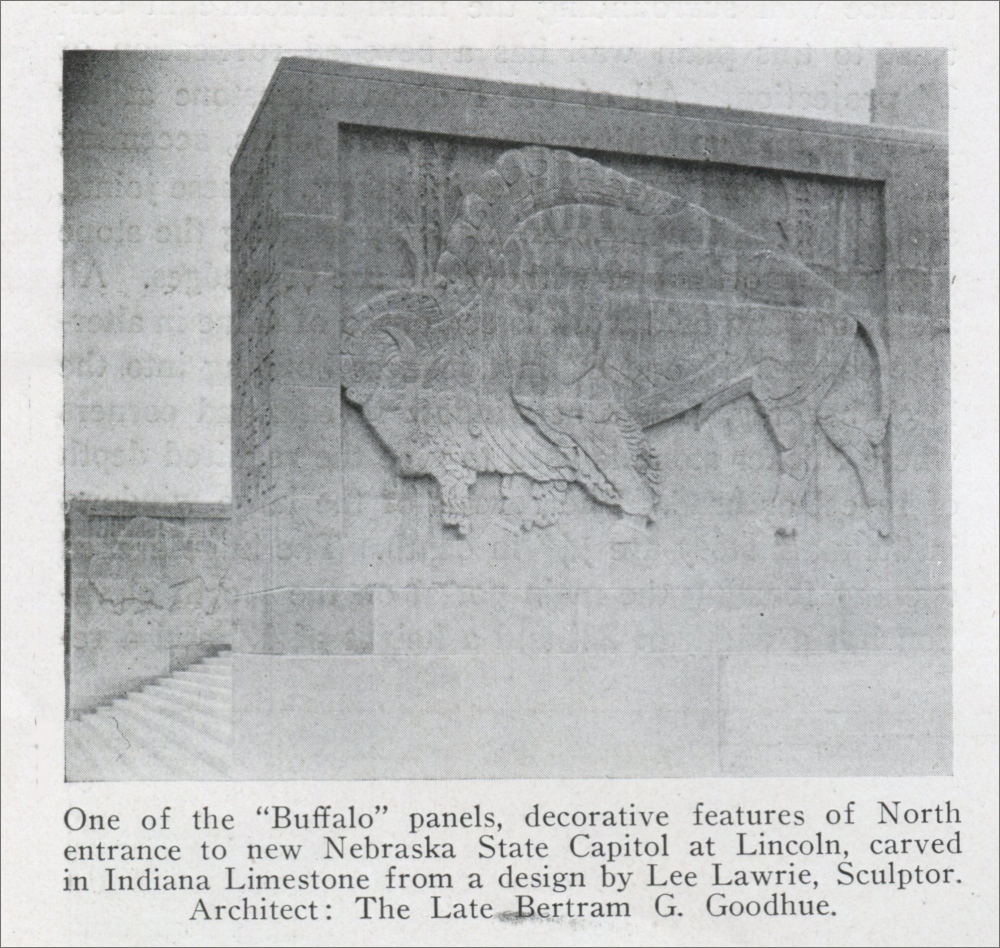
“One of the ‘Buffalo’ panels, decorative features of North entrance to new Nebraska State Capitol at Lincoln, carved in Indiana Limestone from a design by Lee Lawrie, Sculptor. Architect: The Late Bertram G. Goodhue.”
- History of the Nebraska State Capitols
- Omaha, Nebraska – the First National Bank Building (pre-1900) (from
A Glimpse of the Celebrated Stone Quarries at Bedford, Indiana.)
Bedford Oolitic Limestone quarried at Bedford, Indiana, was used in the construction of the First National Bank building.
- Lincoln, Nebraska – the Nebraska
State Capitol Building: Limestone quarried in Indiana was used in the construction of the Nebraska State Capitol building.
-
Finished Products from Indiana Stone in New Jersey
- Morristown, New Jersey - the Dumont Place Office (photograph and diagrams) (from Indiana Limestone Handbook, 19th edition, Indiana Limestone Institute of America, Inc., Bedford, Indiana, pp. 94)
Indiana limestone was used in the construction of the Dumont Place office building.
-
Newark, New Jersey – the Prudential Insurance Company General Office Building (from “Carved Stone for Prudential Building,” Stone, Vol. XLVI, No. 8, August 1925, pp. 490)
“The construction of the new Prudential Insurance Company general office building, Newark, N. J., calls for a large quantity of carved Variegated Indiana Limestone, for the most part decorative panels, keystones, eagles and symbolical figures. This work was done in the stone carving department of the Monahan Stone Company’s Hoboken plant from models after plans by Cass Gilbert, architect for the building….”
- Newark, New Jersey – the Prudential Building (pre-1900) (from
A Glimpse of the Celebrated Stone Quarries at Bedford, Indiana.)
Bedford Oolitic Limestone quarried at Bedford, Indiana, was used in the construction of the Prudential building.
- Newark, New
Jersey – the U. S. Court House and Post Office
(pre-1900) (from
A Glimpse of the Celebrated Stone Quarries at Bedford, Indiana.)
Bedford Oolitic Limestone quarried at Bedford, Indiana, was used in the construction of the U. S. Court House and Post Office.
- Princeton, New Jersey – Princeton University – Bedford Limestone Trim on Buildings.
Bedford Limestone from Indiana was used extensively as trim
on the college buildings. This information is taken from the
“Stones of Princeton” web site, by J.I. Merritt '66.
- The Princeton Battle Monument, Stockton Street and Nassau Street, from A Guide to New Jersey’s Revolutionary War Trail for Families and History Buffs..., by Mark Di Ionno, Rutgers University Press, April 1, 2000, 224 pp., ISBN 0813527708, pp. 75, excerpt from Google Book Search)
According to this excerpt, the Princeton Battle Monument was unveiled in 1922. It was created from a block of Indiana limestone by sculptor Frederick W. MacMonnies.
- The Princeton Battle Monument is the work of Frederick W. MacMonnies. The monument is a 50-foot block of Indiana limestone which commemorates the famous 1777 battle when George Washington's troops defeated the British. A photograph of the Princeton Battle Monument is available on the Heritage Preservation web site.
- University Chapel Trim, from Princeton University Prowler Off the Record, by Alison Fraser, College Prowler, Inc., Jan 1, 2005, 160 pp., ISBN 159658100X, pp. 15, excerpt from Google Book Search)
According to this excerpt, the Chapel was designed by Ralph Adams Cram in the Gothic Revival style. Matthews Construction Company employed Italian stonemasons to work on the building. Pennsylvania sandstone trimmed with Indiana limestone were used to build the Chapel.
- Princeton University Chapel - More information and photographs can be obtained regarding the Chapel in the book: Princeton University: The Campus Guide, by Raymond Rhinehart, Princeton Architectural Press, March 1, 2000, 188 pp., ISBN 1568982097, pp. 50.
- The Princeton Battle Monument, Stockton Street and Nassau Street, from A Guide to New Jersey’s Revolutionary War Trail for Families and History Buffs..., by Mark Di Ionno, Rutgers University Press, April 1, 2000, 224 pp., ISBN 0813527708, pp. 75, excerpt from Google Book Search)
“Carved Stone for Prudential Building” in Newark, New Jersey, from Stone, Vol. XLVI, No. 8, August 1925, pp. 490. 
“Section of carving department of Hoboken plant of the Monahan Stone Company, cut stone contractors of Newark and Hoboken, Jew Jersey.” 
- Morristown, New Jersey - the Dumont Place Office (photograph and diagrams) (from Indiana Limestone Handbook, 19th edition, Indiana Limestone Institute of America, Inc., Bedford, Indiana, pp. 94)




Commercial use of material within this site is strictly prohibited. It is not to be captured, reworked, and placed inside another web site ©. All rights reserved. Peggy B. and George (Pat) Perazzo.