
Structures and Monuments in Which
California Stone was Used
Finished Product from California Stone in California (Continued)
- San Francisco, San Francisco County, California – Fort Mason (The following information is from “Projects Utilizing Rocklin Granite,” compiled by members of the Rocklin Historical Society from various sources, 2011.)
“1855 Fort Mason, San Francisco (earliest reported use of Rocklin granite for building) (ref. History of Rocklin, by Roy Ruhkala.)
- San Francisco, San Francisco County, California – Fort
Point Buildings in the San Francisco Presidio (The
following information is from The
Quarries (Alcatraz History),
presented by the Angel Island Association.)
According to this web site, the stone used to construct the Fort Point buildings in the San Francisco Presidio was quarried on the east side of Angel Island.
- San Francisco, San Francisco County, California – the
French-American Bank Building (10 Stories) (From Report
XIV of the State Mineralogist – Mines and Mineral Resources
of Portions of California, Chapters of State Mineralogist’s
Report – Biennial Period 1913-1914,
Part II. “The Counties of Colusa, Glenn, Lake, Marin, Napa,
Solano, Sonoma, Yolo,” by
Walter W. Bradley, Field Assistant (field work in October, 1913),
California State Mining Bureau, San Francisco, California, 1916,
pp. 173-370.)
“…(sandstone quarried by the Colusa Sandstone Company Quarry east of Sites in Colusa County, California) for the following prominent buildings in San Francisco was furnished by the Colusa Company: Butler (corner Geary and Stockton streets); French-American Bank; Monadnock (ten stories); Metropolis (now Merchants) National Bank; Aronson (corner Third and Mission streets); and the Gunst on the opposite corner; Kamm, above the Call Building; three Home Telephone buildings and the Spreckels band stand in Golden Gate Park….”
- San Francisco, San Francisco County, California – the
French Bank Building (originally Bullock and Jones),
108-110 Sutter Street, San Francisco (photographs and history)
The following information is from the Vernacular Language
North (VLN): San Francisco Architecture web site. (While the link below, from which the following information was obtained, is no longer available, the Internet Archive Wayback Machine has a link to the page from 2013.)
<http://www.verlang.com/sfbay0004ref_19thc_020.html#108-10_sutter>According to this web site, the French Bank building is described as an early San Francisco skyscraper constructed in 1902. During the 913 remodeling and enlarging of the building, “…Piers were clad in gray Colusa sandstone….”
- San Francisco, San Francisco County, California – the
French Bank Building (originally Bullock and Jones),
108-110 Sutter Street, San Francisco (photographs and history)
The following information is from the Vernacular Language
North (VLN): San Francisco Architecture web site. (While the link below, from which the following information was obtained, is no longer available, the Internet Archive Wayback Machine has a link to the page from 2013.)
- San Francisco, San Francisco County, California – Goldberg & Bowen’s
Store on Sutter Street. (From The Structural and
Industrial Materials of California, Bulletin No. 38, San
Francisco, California, 1906.)
Marble quarried from the Antelope Valley Marble Quarry, located near Neenach on the south slope of the Tehachapi range in Kern County, California, was used in Spreckels band stand in Golden Gate Park and in the Goldberg & Bowen’s store, Sutter Street, San Francisco.
- San Francisco, San Francisco County, California – Golden Gate Park – the Entrance to the Park – the Robert Burns Statue, & the Father Junipero Serra Statue placed at the original San Diego Mission Site (From “Sculpture and Monument News of San Francisco” (PDF), in The Monumental News, Vol. XVIII, No. 4, April 1909, pp. 314)
“Entrance to Golden Gate Park, San Francisco, M. Earl Cummings. Sc.” 
“Junipero Serra. Arthur Putnam, Sc.” (left) “Robert Burns Monument. M. Earl Cummings, Sc.” (middle) “A Restored Venus. Golden Gate Park.” (right) 
Sculpture and Monument News of San Francisco
“A statue of Robert Burns stands just south of the North Boulevard in Golden Gate park. It was modeled by M. Earl Cummings, of San Francisco. The bronze figure stands nine feet high, on a California granite pedestal, 6 ½ feet high and 4 ½ feet square.
“The total cost of the statue as it stands was $5,000, which was contributed by the Scottish residents of San Francisco.
“Sculptor Cummings began work on the model more than four years ago. At the time of the great disaster of April, 1906, the plaster model was just ready to go to the foundry, but the work was so badly damaged that the whole statue had to be practically remodeled. The statue was formally dedicated and unveiled with very appropriate ceremonies in which many of the leading Scotchmen of San Francisco took part. The casting was done at L. De Rome’s Bronze, Brass & Bell Foundry, of San Francisco. On the front side of the pedestal is cut a garland and the simple name ‘Burns.’
“The handsome and substantial improvement has been completed at one of the main northern entrances to Golden Gate park. On each side of the broad driveway a huge pillar of rough California sandstone, 12 feet high and five feet in diameter, has been erected. Surmounting one of them is a California lion, crouching, in the act of making a leap; the one on the left supports a bear, posing in an angry, fighting attitude. These figures are life size. Extending outward from the base of each pillar, in a circular form, is a broad stone bench 18 feet long.
“The stone came from the McGilvray quarry in Madera county, and the animal figures were modeled by M. Earl Cummings, the young San Francisco sculptor, who is also a park commissioner. The bronze was cast at the DeRome foundry. The total cost was about $2,000.
“Repairs from the earthquake damage to Sutro Heights in this park, have been completed. Many of the statues here were badly damaged. The Venus shown in the illustration is one of those that had to be treated to an extensive restoring process which the picture shows has been well done.
“The second of a series of portrait sculptures embodying the early history of California has lately been completed by Sculptor Arthur Putnam, and the bronze cast was recently exhibited in the Studio building. It is a noble and impressive figure of the priest, Father Junipero Serra, whose name all California loves and honors. He stands with bent head and sandaled feet, his brown robe cast loosely about him, confined only by its knotted girdle; the nailed limbs of the Jesu pictured on the cross hanging at his side. The modeling of the tall, gaunt body calls for keen appreciation. Powerful in limb and in pose, the impenetrable countenance, half concealed, wears an expression of deep gentleness and solemnity. The man looks through the priest, despite the attitude of contemplative humility, and the modeling of the head, the dignity, strength and repression which stamp the features have been accorded much praise. The figure itself is eight feet high. It will be mounted on a pedestal of brick taken from the old Mission in San Diego, Cal. The pedestal will be about 7 ft. high and 10 ft. square. The statue will stand on the site of the first mission built near San Diego. The ground was purchased by residents of San Diego and the statue which cost $5,000 donated by Mr. E. W. Scripps.”
-
San Francisco, California – Golden Gate Park – the Bronze & Stone Drinking Fountain (from “Work of Two San Francisco Sculptors,” in The Monumental News, August 1905, pp. 547)
The drinking fountain in Golden Gate park includes a figure of a boy in bronze. “The statue is four feet high, and the total height including pedestal is twelve feet. The pedestal is seven feet in diameter, and is of Madera County (Cal.) granite. The square column is 3 ½ x 2 ½ feet, 7 feet high, and of fine Colusa County (Cal.) sandstone. The stone work was done by the Raymond Granite Co. of San Francisco.” (Photo captions in article: “A California Puma. Arthur Putnam, Sc.” “Man and Lions Struggling, Arthur Putnam, Sc.” “Drinking Fountain, Golden Gate Park, San Francisco, M. Earl Cummins, Sc.”)
- San Francisco, San Francisco County, California – Golden Gate Park – the California Academy of Sciences – Interior Decoration – Excerpt from “California Marble” (pdf), in Stone Magazine, Vol. VIII, No. 3, February 1894, pp. 254-257. (You can visit the California Academy of Sciences for more information about the academy.)
“Here again we have an immense deposit of marble very different in character from that of Inyo or Amador counties, at the same time it is a very fine material of different varieties. There is black, dark gray and blue, these are variegated; also pure white. The deposit is situated about one mile from the town of Colton...Their principal marble job was done in the interior of the new Academy of Sciences in this city (San Francisco).
“The California Architect and Building News.”
- San Francisco, San Francisco County, California – Golden
Gate Park Band Stand. (From The Structural and Industrial
Materials of California, Bulletin No. 38, San Francisco,
California, 1906.)
Marble quarried from the Antelope Valley Marble Quarry, Kern County, California, located near Neenach on the south slope of the Tehachapi range, was used in Spreckels band stand in Golden Gate Park and in the Goldberg & Bowen’s store, Sutter Street, San Francisco.
- San Francisco, San Francisco
County, California - Golden Gate Park - the Music Temple (from “Colusa
County Sandstone Builds Some of The World’s Most Famous
Buildings,” by John
L. Morton, Colusa County Historian and Colusa County
CAGenWeb Project Coordinator.
Many fine buildings are attributed to the McGilvray sandstone quarry located at Sites, Colusa County, California, including the Music Temple in Golden Gate Park.
-
San Francisco, San Francisco County, California – Golden Gate Park – the Sharon Gate (from Sixth Annual Report of the State Mineralogist, Part I, For the Year Ending June 1, 1886, 1886, California Journal of Mines and Geology, California State Mining Bureau, Division of Mines, Volume 6, 1886, pp. 25-26. This book is available on Google Books.)
“The so called Inyo marble has been selected for the building material to be used in construction of the Sharon Gate of Golden Gate Park, and of which I am quite sure the people of San Francisco and California will be proud. It is my opinion that no use of the generous bequest could be more appropriate, or more likely to give general satisfaction….”
- San Francisco, San Francisco County, California – the Golden Gate Park – the Spreckels Band Stand (From Report XIV of the State Mineralogist – Mines and Mineral Resources of Portions of California, Chapters of State Mineralogist’s Report – Biennial Period 1913-1914, Part II. “The Counties of Colusa, Glenn, Lake, Marin, Napa, Solano, Sonoma, Yolo,” by Walter W. Bradley, Field Assistant (field work in October, 1913), California State Mining Bureau, San Francisco, California, 1916, pp. 173-370.)
“Drinking Fountain, Golden Gate Park, San Francisco, M. Earl Cummins, Sc.” in “Work of Two San Francisco Sculptors,” in The Monumental News, August 1905, pp. 547 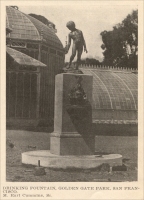
“Mr. Israel Luce, a marble cutter of Sacramento, has given the following information as to the quarry from which the Inyo marble is to be taken to build the Sharon gate to the park: It lies a few miles from Keeler and near the lake. The exact locality is the southwest quarter of section fourteen, township sixteen south, and range thirty-seven east. It is owned by the Inyo Marble Company, incorporated last September in the State of Nevada.”
“…(sandstone quarried by the Colusa Sandstone Company Quarry east of Sites in Colusa County, California) for the following prominent buildings in San Francisco was furnished by the Colusa Company: Butler (corner Geary and Stockton streets); French-American Bank; Monadnock (ten stories); Metropolis (now Merchants) National Bank; Aronson (corner Third and Mission streets); and the Gunst on the opposite corner; Kamm, above the Call Building; three Home Telephone buildings and the Spreckels band stand in Golden Gate Park….”
-
- San Francisco, San Francisco County, California – the
Golden Gate Theater Interior (From “Mines and Mineral
Resources of Tuolumne County, California,” by Clarence A.
Logan, California Journal of Mines and Geology, Vol.
45, No. 1, January 1949, pp. 47-83.)
“Marble from the Bell Columbia Marble Quarry* was used before 1928 in San Francisco in the interior of the 22-story Standard Oil Building, in the Golden Gate Theater, Loews Warfield Theater, and the Metropolitan Life Building. (* This quarry was also known as the Bell Marble Quarry.)
- San Francisco, San Francisco County, California – the Government Appraisers Store - the Foundation (The following information is from “Projects Utilizing Rocklin Granite,” compiled by members of the Rocklin Historical Society from various sources, 2011.)
“1874 Government Appraisers Store Foundation, San Francisco”
- San Francisco, San Francisco County, California – Granite used for Building, Curbing, and Street Paving (Excerpts from Ninth Annual Report of The State Mineralogist For The Year Ending December 1, 1889 (pdf), California State Mining Bureau, Sacramento: California State Printing Office, 1890.
“The St. John’s Quarry, half a mile south of Victor, owned by the Hesperia Land and Water Company, of Los Angeles, furnishes a good quality of granite for building purposes. It is of a grayish-blue color, very hard and compact, straight and smooth cleavage, dresses well, and takes a fine polish. The granite formation in which it is found rises to a height of two hundred feet above the Mojave River. Stone from this quarry is used in San Francisco for building, curbing, and street paving; also in Los Angeles, San Bernardino, and other cities and towns in the State. It lies in strata of great thickness....”
- San Francisco, San Francisco County, California – the
Gunst Building on the opposite corner from the Aronson Building
at Third and Mission Streets (From Report XIV of
the State Mineralogist – Mines and Mineral Resources of
Portions of California, Chapters of State Mineralogist’s
Report – Biennial Period 1913-1914, Part II. “The
Counties of Colusa, Glenn, Lake, Marin, Napa, Solano, Sonoma,
Yolo,” by Walter W. Bradley, Field Assistant (field work
in October, 1913), California State Mining Bureau, San Francisco,
California, 1916, pp. 173-370.)
“…(sandstone quarried by the Colusa Sandstone Company Quarry east of Sites in Colusa County, California) for the following prominent buildings in San Francisco was furnished by the Colusa Company: Butler (corner Geary and Stockton streets); French-American Bank; Monadnock (ten stories); Metropolis (now Merchants) National Bank; Aronson (corner Third and Mission streets); and the Gunst on the opposite corner; Kamm, above the Call Building; three Home Telephone buildings and the Spreckels band stand in Golden Gate Park….”
-
San Francisco, San Francisco County, California – the Hall of Justice (from “To Use Colusa Stone in Hall of Justice,” San Francisco Call, Aug. 2, 1909, pp. 12)
To Use Colusa Stone in Hall of Justice
Quarry Gets Contract for New San Francisco Structure[Special Dispatch to the Call]
“Marysville, Aug. 1 – The stone quarry at Colusa has received the contract to furnish the building material for the new hall of justice in San Francisco.
“The selection of this stone was made after that of several quarries had been tested. The work of getting out the material will commence at once.
- San Francisco, San Francisco County, California – the Hall of Records (The following information is from “Projects Utilizing Rocklin Granite,” compiled by members of the Rocklin Historical Society from various sources, 2011.)


“The stone from this particular quarry is reputed to be absolutely earthquake proof and has stood fire tests that all other building materials have failed in.”
- San Francisco, San
Francisco County, California – the Hayward Building (history)
The following information is from “Willis
Polk in San Francisco,” on the Vernacular Language
North (VLN) web site.
(While the link below from which the following information was obtained is no longer available, the Internet Archive Wayback Machine has a link to the page from 2014.)
<http://www.verlang.com/sfbay0004ref_slideshow_wp_sf_02.html>According to this article, the Hayward building was one of the early skyscrapers in San Francisco; and “Its brick curtain walls are clad in Colusa sandstone, the favored building material for pre-fire prestige buildings.”
- San Francisco, San Francisco County, California – the
Health Services Library, located at Health Sciences
Library, located at 2395 Sacramento Street (photographs and
history) (While the link from which the below information was obtained is no longer available, the Internet Archive Wayback Machine has a 2013 link available.)
<http://www.cpmc.org/professionals/hslibrary/collections/archives/pissis.html>The California Pacific Health Services Library web site section about the architect, Albert Pissis (1852-1914), indicates that the Health Sciences Library Building “was built from local materials: Colusa sandstone, Columbia (Tuolumne County) marble, local cement and steel from a San Francisco steelworks.” The color of the Colusa sandstone used for the exterior of the building is described as “soft gray Colusa sandstone.”
- San Francisco, San Francisco County, California – Hibernia
Bank
- Hibernia Bank – Loomis Station Granite Quarry was located 3 miles south of Penryn, about midway between Penryn and Rocklin.
The quarry operated by Rocklin Granite Co., San Francisco. In 1906
granite was being shipped to San Francisco to be used in building
the Hibernia Bank building. (from "The Structural and Industrial
Materials of California, Bulletin No. 38,"1906.)
- Hibernia Bank – Granite from the Rocklin Quarry, Placer County, California was used in the construction of the Hibernia Bank and Crocker building, San Francisco. (from The Structural and Industrial Materials of California, Bulletin No. 38, San Francisco, California, 1906.
- San Francisco, San Francisco County, California – the Hibernia Bank Building (The following information is from “Projects Utilizing Rocklin Granite,” compiled by members of the Rocklin Historical Society from various sources, 2011.)
http://www.rocklinhistory.org/“1890 Hibernia Bank, San Francisco”
“1906 Hibernia Bank, San Francisco”
- Hibernia Bank – Loomis Station Granite Quarry was located 3 miles south of Penryn, about midway between Penryn and Rocklin.
The quarry operated by Rocklin Granite Co., San Francisco. In 1906
granite was being shipped to San Francisco to be used in building
the Hibernia Bank building. (from "The Structural and Industrial
Materials of California, Bulletin No. 38,"1906.)
-
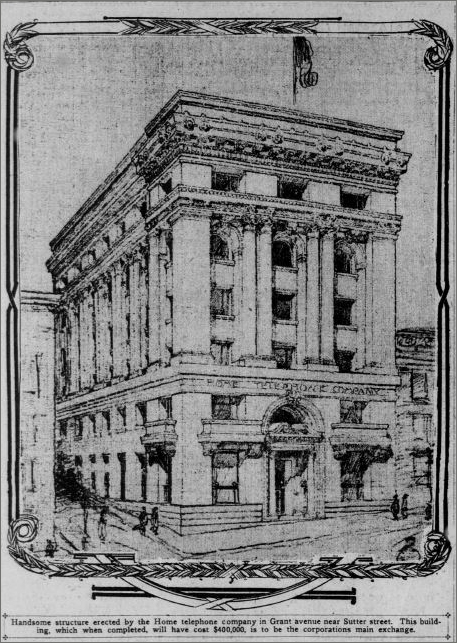
San Francisco, San Francisco County, California – the Home Telephone Exchange Building (from “Home Telephone Has Costly Office Main Exchange, Now Nearing Completion, Represents Outlay of $400,000” (from the San Francisco Call, October 9, 1909, pp. 20)
“The main exchange building of the Home telephone company, now in construction, in the west line of Grant avenue and just north of Sutter street, represents a cost of $400,000. It is built of Colusa sandstone on a steel frame. The entrance is in the center of the façade and opens into the lobby or public space, which has the appearance of a large banking room.
“The lobby measures 60 x 66:9 feet in floor area and has a height of two full stories, with coiffured ceiling.
“The entire structure will be occupied by the Home telephone company. All above the administration offices will be devoted to the operating departments. The structure is seven stories high. Coxhead & Coxhead are the architects. The building is one of the handsome ones of late construction and one of the costliest.”
“Handsome structure erected by the Home telephone company in Grant avenue near Sutter street. This building, which when completed, will have cost $400,000, is to be the corporations main exchange.” (from the San Francisco Call, October 9, 1909, pp. 20) 
- San Francisco, San Francisco County, California – the
Home Telephone Buildings (From Report XIV of the
State Mineralogist – Mines and Mineral Resources of Portions
of California, Chapters of State Mineralogist’s Report – Biennial
Period 1913-1914, Part II. “The Counties of Colusa,
Glenn, Lake, Marin, Napa, Solano, Sonoma, Yolo,” by Walter
W. Bradley, Field Assistant (field work in October, 1913), California
State Mining Bureau, San Francisco, California, 1916, pp. 173-370.)
“…(sandstone quarried by the Colusa Sandstone Company Quarry east of Sites in Colusa County, California) for the following prominent buildings in San Francisco was furnished by the Colusa Company: Butler (corner Geary and Stockton streets); French-American Bank; Monadnock (ten stories); Metropolis (now Merchants) National Bank; Aronson (corner Third and Mission streets); and the Gunst on the opposite corner; Kamm, above the Call Building; three Home Telephone buildings and the Spreckels band stand in Golden Gate Park….”
- San Francisco, San Francisco County, California – the
Home Telephone Buildings (From Report XIV of the
State Mineralogist – Mines and Mineral Resources of Portions
of California, Chapters of State Mineralogist’s Report – Biennial
Period 1913-1914, Part II. “The Counties of Colusa,
Glenn, Lake, Marin, Napa, Solano, Sonoma, Yolo,” by Walter
W. Bradley, Field Assistant (field work in October, 1913), California
State Mining Bureau, San Francisco, California, 1916, pp. 173-370.)
- San Francisco, San Francisco County, California -
Homes and Monuments in San Francisco. The following information
is from “The Collection of Building and Ornamental Stones
In The U. S. National Museum: A Hand-book and Catalogue,” By
George P. Merrill, Curator, Department Lithology and Physical
Geology, in Report of the United States National Museum Under
the Direction of the Smithsonian Institutions For the Year Ending
June 30, 1886, pp. 411-412.
Granite from the Rocklin and/or Penryn granite quarries in Placer County was used in the construction of “several private residences, and many monuments….”
- San Francisco, San Francisco County, California - the Italian-American
Bank (From The Structural and Industrial Materials of California,
Bulletin No. 38, California, State Mining Bureau, San Francisco,
California, 1906.)
Sandstone from the McGilvray Stone Company sandstone quarry, located three fourths of a mile east of Sites, Colusa County, was used in the construction of the Italian-American Bank, Montgomery street.
- San Francisco, San Francisco County, California – Kamm,
above the Call Building (From Report XIV of the State
Mineralogist – Mines and Mineral Resources of Portions of
California, Chapters of State Mineralogist’s Report – Biennial
Period 1913-1914, Part II. “The Counties of Colusa,
Glenn, Lake, Marin, Napa, Solano, Sonoma, Yolo,” by Walter
W. Bradley, Field Assistant (field work in October, 1913), California
State Mining Bureau, San Francisco, California, 1916, pp. 173-370.)
“…(sandstone quarried by the Colusa Sandstone Company Quarry east of Sites in Colusa County, California) for the following prominent buildings in San Francisco was furnished by the Colusa Company: Butler (corner Geary and Stockton streets); French-American Bank; Monadnock (ten stories); Metropolis (now Merchants) National Bank; Aronson (corner Third and Mission streets); and the Gunst on the opposite corner; Kamm, above the Call Building; three Home Telephone buildings and the Spreckels band stand in Golden Gate Park….”
- San Francisco, San Francisco County, California - the Kohl
Building (formerly the Haywards Building) (From The Structural
and Industrial Materials of California, Bulletin No. 38, California,
State Mining Bureau, San Francisco, California, 1906.)
Sandstone from the McGilvray Stone Company sandstone quarry located three fourths of a mile east of Sites, Colusa County, was used in the construction of the Kohl Building located at the corner of California and Montgomery streets.
Ill. No. 50. Kohl Building, corner of California and Montgomery streets, San Francisco. Built of Colusa Sandstone. 
- San Francisco, San Francisco County, California
- the Kohl Building (from “Colusa County Sandstone
Builds Some of The World’s Most Famous Buildings,” by John
L. Morton, Colusa County Historian and Colusa County CAGenWeb
Project Coordinator.
Many fine buildings are attributed to the McGilvray sandstone quarry located at Sites, Colusa County, California, including the Kohl building.
- San Francisco, San
Francisco County, California – the Kohl Building Exterior (from
The
Building Database web site, presented by Rick Evans) (The link from which the following information was obtained is no longer available, although you can visit Rick Evan’s San Francisco Architecture Walking Tour is available online.)
<http://www.architecturesf.com/blog/page0/page0.html>In this short article about the Kohl building, the author describes the stone used on the exterior as “a handsome greenish-gray Colusa sandstone.”
- San Francisco, San
Francisco County, California – the Kohl Building Exterior (from
The
Building Database web site, presented by Rick Evans) (The link from which the following information was obtained is no longer available, although you can visit Rick Evan’s San Francisco Architecture Walking Tour is available online.)
“1881 Hall of Records, San Francisco”

Commercial use of material within this site is strictly prohibited. It is not to be captured, reworked, and placed inside another web site ©. All rights reserved. Peggy B. and George (Pat) Perazzo.