
Stone Types
Granite
- Bibliography from The Commercial Granites of New England
- The Building Stones - Granite (July 1885) Quarrying Notes - The Manufacturer and Builder, Vol. 17, Issue 7, July 1885, pgs. 154-155. (Article in digital images viewed at American Memory, Library of Congress.)
- The Constructional, Monumental, Sculptural, and Rusty-Faced Granites of New England Grouped by Dominant Colors and Shades - 1923 Geologic Factors in Granite Quarrying from The Commercial Granites of New England.
- Discussion of Granites from Commercial Granites of Massachusetts, New Hampshire, and Rhode Island, written by T. Nelson Dale, published 1908.
- Granite, presented on Wikipedia.
- “Granite” (circa 1923), in The Mining Catalog 1923 - Metal - Quarry Edition: A Consolidation of Condensed Catalog Information Relating to the Metallic and Non-Metallic Mining Industries, Quarries and Cement Mills (Third Issue 1923), Keystone Consolidated Publishing Co., Inc., pp. 531.
“Granite paving blocks are manufactured in a great variety of sizes. Eleven varieties, sold under trade names, were reported to the United States Geological Survey in 1917, and many other varieties were sold by sizes only. The State of Maine reported 7 different sizes, New York 7, Massachusetts 10, and other states a varying number. Undoubtedly some latitude should be allowed in paving block dimensions, particularly in length, but too great a complexity is involved both in manufacturing and in street construction, where every state or city writes its specifications without regard to the requirement of other localities.”
- Granite – National Mall and Memorials Washington D.C. – Klondike Gold Rush National Historical Park. This article discusses the history and geology of the large stone monuments and memorials in the National Mall in Washington, D.C.
“Welcome to the National Mall, a National Park in Washington, D.C. where large stone monuments and memorials honor important historical people and events. The National Mall is a good place to visit if you want to learn about American history and be a historian. Because of all the different stones used in the construction of the memorials, it is also a good place to visit if you want to learn about rocks and be a geologist.
“Historians and Geologists actually have many similarities. They both look at past events to better understand the present, and guess what will happen in the future. They both use tools to help them in their research. They both make timelines to keep track of events. The biggest difference is that Historians study the events of humans while Geologists study the events of the earth….”
- “Granite Quarrying” in the United States & Foreign Countries up through 1939 in The Stone Industries: Dimension Stone, Crushed Stone, Geology, Technology, Distribution, Utilization, by Oliver Bowles (Supervising Engineer, Building Materials Section, United States Bureau of Mines), New York: 2nd ed., New York: McGraw-Hill, 1939. (You can view a copy of this book on Internet Archive web site, and you can download a copy of the book to your computer at the link above.)
Granite. General Character – Mineral Composition – Chemical Composition – Physical Properties Varieties – Related Rocks – Structural Features – Uses – Distribution of deposits – Industry by States – Quarry Methods and Equipment – Milling Methods and Equipment – Market Range – Imports, Exports, and Tariffs – Prices – Bibliography (Chapter VIII.)
Boulders as Building Materials. Origin and Nature of Boulders – Stone Fences – The Use of Boulders in Buildings (Chapter XII.)
- Granite Rock (January 1880) The Manufacturer and Builder, Vol. 12, Issue 1, January 1880, pg. 22. (Article in digital images viewed at American Memory, Library of Congress.)
-
“Granites and Gneisses” circa 1886, including Granites of the various States and Territories, starting on pp. 411 (circa 1886), from Part II. “The Rocks, Quarries, and Quarry Regions of the United States,” in The Collection of Building and Ornamental Stones in the U.S. National Museum: A Hand-book and Catalogue, by George P. Merrill, Curator, Department Lithology and Physical Geology. From Annual Report of the Board of Regents of the Smithsonian Institution…Year ending June 30, 1886, 1887.
- Granites and Sandstones (May 1891) The Manufacturer and Builder, Vol. 23, Issue 5, May 1891, pg. 104. May 1891. (Article in digital images viewed at American Memory, Library of Congress.)
- The Granite Industry of Barre, Vermont, written by George H. Gilman of Claremont, New Hampshire, from Mine and Quarry Magazine, Sullivan Machinery Co., Publisher, Chicago, Illinois, Vol. IV. No. 3 - January, 1910, pgs. 358 - 366. (The article discusses the equipment at the Barclay Brothers facilities.)
- Quincy Granite - Quarrying and Mining (December 1893) The Manufacturer and Builder, Vol. 25, Issue 12, December 1893, pg. 278. (Article in digital images viewed at American Memory, Library of Congress.)
- Rob's Granite Page, presented by Robert M. Reed, Structural Geology Ph.D., The University of Texas at Austin.
- "The Rocks" (June 1885) (Includes the beginning of the article on the Granites) Quarrying Notes - The Manufacturer and Builder, Vol. 17, Issue 6, June 1885, pg. 130-131. Article in digital images viewed at American Memory, Library of Congress)
- “Stone Pavements” (on Broadway in New York City, New York), in The Manufacturer and Builder, Vol. 1, No. 7, July 1869. (Discusses the history and different types of stones and brick-shaped granite used for pavement on Broadway in New York City.)
- “Tools and Machinery of the Granite Industry,” by Paul Wood (Part I.: Vol. 59, No. 2, June 2006. Part II.; Vol. 59, No. 3, September 2006. Part III.; Vol. 59, No. 4, December 2006; and Part IV: Vol. 60, No. 1, March 2007, in The Chronicle of the Early American Industries Association, Inc.)
 |
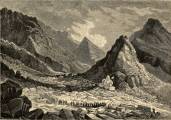
“Granite Quarry, Hallowell, Maine. Drawn from a photograph.” (from The Collection of Building and Ornamental Stones in the U. S. National Museum: A Hand-book, 1866, pp 416 |
Limestone/Dolomite/Dolostone
- "A New "Duplex" Channeler for Oölitic Limestone," by C. J. Levey, from Mine and Quarry Magazine, Sullivan Machinery Co., Publisher, Chicago, Illinois, Vol. VII. No. 2, January, 1913.
- Facts About Lime and Limestones (September 1891) The Manufacturer and Builder, Vol. 23, Issue 9, September 1891, pg. 207. (Text of article in digital images viewed at American Memory, Library of Congress.)
- Facts About Lime and Limestone (March 1892) The Manufacturer and Builder, Vol. 24, Issue 3, March 1892, pg. 63. (Article in digital images viewed at American Memory, Library of Congress.)
- Fun Facts about Limestone for Students and Teachers, presented by the Missouri Limestone Dealers Association.
- Indiana Oölitic Limestone: Geology, Quarries, Methods, by George D. Hunter of Bloomington, Indiana, Mine and Quarry Magazine, Sullivan Machinery Co., Publisher, Chicago, Illinois, Vol. V. No. 4 - July, 1910, pgs. 410 - 421.
- Lime – “How Lime is Prepared,” in The Rural New-Yorker: A Journal for the Suburban and Country Home, New York, July 25, 1908.
 |
 |
 |
The Limestone in the Quarry, Montour County, Pennsylvania |
The Tunnel from Quarry and the Kilns, Montour County, Pennsylvania |
Drawing off the Liime from the Kilns, Montour County, Pennsylvania |
- Limestone, presented on Wikipedia.
- “Limestone and Dolomite,” Information Circular 7738,” O. Bowles, U.S. Bureau of Mines, 29 pp., 1956b. (U.S. government publication)
- “Limestone: Dependable and Adaptable,” by Cory Sekine-Pettite, Building Stone Magazine, Spring 2007.
The following subjects are discussed on this web site: Quarries, Colors, Interesting Facts, including two photographs with the following photo captions: (1) “The University of Alabama, Birmingham, Shelby Interdisciplinary Biomedical Research Building was constructed using Vetter Stone’s Alabama Silver Shadow oolitic limestone. The architect was CUH2A, Princeton , N.J.” (2) “Egypt is a country rich in stone, particularly limestone, which occurs in many varieties there.”
- Limestone – the National Mall and Memorials Washington DC - Klondike Gold Rush National Historical Park. This article discusses the history and geology of the large stone monuments and memorials in the National Mall in Washington, D.C.
“Welcome to the National Mall, a National Park in Washington, DC where large stone monuments and memorials honor important historical people and events. The National Mall is a good place to visit if you want to learn about American history and be a historian. Because of all the different stones used in the construction of the memorials, it is also a good place to visit if you want to learn about rocks and be a geologist.
“Historians and Geologists actually have many similarities. They both look at past events to better understand the present, and guess what will happen in the future. They both use tools to help them in their research. They both make timelines to keep track of events. The biggest difference is that Historians study the events of humans while Geologists study the events of the earth….”
- Limestone – Structural Materials (circa 1923), in The Mining Catalog 1923 - Metal - Quarry Edition: A Consolidation of Condensed Catalog Information Relating to the Metallic and Non-Metallic Mining Industries, Quarries and Cement Mills (Third Issue 1923), Keystone Consolidated Publishing Co., Inc., pp. 531.
“During the war period production, greater and more intense production, was the key-note of commercial activity, and other manufacturing problems were submerged beneath this dominating impulse. Industry has suffered from the effects of such unbalanced development and an effort is now being made to rectify the errors of the past.
“The present business depression has permitted operators to direct their attention toward phases of industry other than volume of output, and one of the notable results is the tendency to analyze and seek a remedy for the present undesirable industrial condition. Many operators have concluded that a cure may be effected in large part by correcting defects in the producing industries themselves. Thus a period of commercial house-cleaning has set in, the chief object of which is to eliminate non-essentials both in products and equipment, and to reduce production cost through simplification of processes. This movement is quite pronounced in the mineral product industries....”
“Structural Materials
“Similar tendencies may be noted in the structural block, sand, gravel and crushed stone industries. Limestone quarrymen have found it advantageous to establish a standard size 8 x 4 x 4 feet, for mill blocks, and large piles of such blocks are stored for seasoning before shipment to stone-cutters. Concrete blocks, artificial stone, terra cotta, and similar types of molded building blocks are gradually being standardized in size and shape.”
- “Limestone Quarrying” in the United States & Foreign Countries up through 1939 in The Stone Industries: Dimension Stone, Crushed Stone, Geology, Technology, Distribution, Utilization, by Oliver Bowles (Supervising Engineer, Building Materials Section, United States Bureau of Mines), New York: 2nd ed., New York: McGraw-Hill, 1939. (You can view a copy of this book on Internet Archive web site, and you can download a copy of the book to your computer at the link above.)
Limestone. Definition – Origin – Physical Properties – Varieties – Qualities on Which Use Depends – Uses – Industry by States – Occurrences of Travertine – Quarry Methods – Milling Methods – Limestone Products – Cost of Quarrying and Manufacture – Waste in Quarrying and Manufacture – Utilization of Waste – Limestone Marketing – Bibliography (Chapter VI.)
Crushed and Broken Limestone. Types of Stone Included – Extent of Industry – Uses of Crushed and Broken Limestone – Uses for Which Physical Properties are Most Important – Uses for Which Chemical Properties are Most Important – Uses of Dolomite and High-magnesian Limestone – Industry by States – Quarry Methods and Equipment; Bibliography (Chapter XVII.)
- The Limestones as Building and Ornamental Stones (1890) by Dr. Alexis A. Julien, The Manufacture and Builder, Vol. 22, Issue 9, September 1890 (Viewed at American Memory, Library of Congress.)
-
“Limestones, Dolomites, and Marbles” – Including Limestones, Dolomites, and Marbles of the various States and Territories (two separate lists starting on pp. 374 and 392), circa 1886. (From Part II. “The Rocks, Quarries, and Quarry Regions of the United States,” in The Collection of Building and Ornamental Stones in the U.S. National Museum: A Hand-book and Catalogue by George P. Merrill, Curator, Department Lithology and Physical Geology, from Annual Report of the Board of Regents of the Smithsonian Institution…Year ending June 30, 1886, 1887.
- The Limestones of Wisconsin (January 1886) The Manufacturer and Builder, Vol. 18, Issue 1, January 1886, pgs. 10-11. (Text of article in digital images viewed at American Memory, Library of Congress.)
- Ohio Dolostone (?) – from Ohio or a near by State (?) The following 2 dolostone samples were contributed by Jason Reinhold of Land and Stone Inc., in Cincinnati, Ohio. Jason is trying to identify the quarry from which this light chocolate brown dolostone shown below originated. (His company salvages stone from old Cincinnati buildings to use in modern projects.) If you have any information on the possible location of the old quarry from which the dolostone described in this section originated, please contact me, Peggy B. Perazzo, and Jason Reinhold of Land and Stone Inc.
 |
 |
Front of 2 light chocolate brown dolostone samples contributed by Jason Reinhold of Land and Stone, Inc., Cincinnati, Ohio |
Back of the 2 light chocolate brown dolostone samples to the left - We're trying to find out where these stones were quarried - Ohio or a nearby state? |
 |
 |
 |
Front of light chocolate brown dolostone sample |
Closeup photo of dolostone |
Back of light chocolate brown dolostone sample to left |
 |
 |
 |
Front of another light chocolate brown dolostone sample |
Closeup of light chocolate brown dolostone sample to the left |
Back of light chocolate brown dolostone sample to the left |
-
Jason Reinhold (of Land and Stone, Inc., in Cincinnati) states that this light chocolate brown dolostone does not contain fossils like the indigenous Ohio field stone, although sometimes there are small white pockets of crystals about the size of a thumbnail. He said that the dolostone fractures in line with the black bands/strips of organic material.
He thinks that the dolostone was probably transported to Cincinnati via railroad, and he estimates that about 15,000 to 20,000 tons of the dolostone were used in Ohio. He estimantes there were about 22 buildings were constructed of this stone from the late 1800s through the 1920s.
Some of the structures in Cincinnati in which the dolostone was used include: (1) The Cincinnati Street Railway Company building and the Chester Park building. (2) The Spring Grove Cemetery fence, gate houses, and water tower. Jason states that the dolostone was used for 2 miles of cemetery fence, gate houses, and water tour. (3) The Edward R. Stearns mansion in the Wyoming, Ohio. (4) The dolostone is one of many Ohio stones used in the construction of Orton Hall at the Ohio State University, in Columbus, Ohio. (5) The Mansfield Ohio Reformatory building (today known as the Ohio State Reformatory).
- You can read more about Jason Reinhold’s business of salvaging old stone from Cincinnati buildings in the following article: “Salvaging: New Fascias From Old Places,” by K. Schipper, on Stone Business Online.
- Magnesian Limestone (October 1893) The Manufacturer and Builder, Vol. 25, Issue 10, October 1893, pg. 231. (Article in digital images viewed at American Memory, Library of Congress.)
- The Presence of Magnesia in Limestones (September 1882) The Manufacturer and Builder, Vol. 14, Issue 9, September 1882, pg. 207. (Article in digital images viewed at American Memory, Library of Congress.)
Marble
- Algerian Marbles (November 1887) The Manufacturer and Builder, Vol. 19, Issue 11, November 1887, pg. 253. (Article in digital images viewed at American Memory, Library of Congress.) (This article includes a sketch: "Salem (Ind.) Quarry Yards, Mills and Kilns, and Cars Loaded with Monoliths for the Georgia State Capitol.")
- American Marbles (January 1857) "The Living Age...", Vol. 52, Issue 660, January 17, 1857, pgs. 148-149. (Article in digital images viewed at American Memory, Library of Congress.)
- American Marbles (November 1888) The Manufacturer and Builder, Vol. 20, Issue 11, November 1888, pgs. 250-251. (Article in digital images viewed at American Memory, Library of Congress.)
- Antique Marbles, presented on the McMarmilloyd Ltd. web site.
The following antique marbles are listed in the “Antique Marbles” section of the McMarmilloyd Ltd. web site. (Some of these stones are described and/or include a colored image of the stone.) Grand Antique (Classic), Breccia Di Sciro (Sette Bassi), Frosterley, Petit Antique (Noir Pompéen), Verde Antico Chiaro Classico, Alabastro Egitto, Breccia Frutti Colosa (no further info. or image), Lapis Hecatontalithos (Uadi Hammámát) (no further info. or image), Ashburton, Castracane Dorato, Bréche D'Alet, Porta Santa, North African Skyros, Marmor Caristium (Euboea), Nero Grande Antico D'Italia, and Aligua Antica.
- Australian Marble (June 1894) The Manufacturer and Builder, Vol. 26, Issue 6, June 1894, pg. 135. (Article in digital images viewed at American Memory, Library of Congress.)
- California Marble (May 1894) The Manufacturer and Builder, Vol. 26, Issue 5, May 1894, pgs. 108-109. (Text of article in digital images viewed at American Memory, Library of Congress.)
- Families of Marble, by Walter S. Arnold, Sculptor/Stone Carver, Chicago, Illinois
- The Geology of the Marble Deposits (December 1884) The Manufacturer and Builder, Vol. 16, Issue 12, December 1884, pg. 274. (Article in digital images viewed at American Memory, Library of Congress.)
- Georgia Marble (January 1889) The Manufacturer and Builder, Vol. 21, Issue 1, January 1889, pgs. 14-15. (Article in digital images viewed at American Memory, Library of Congress.)
- Georgia Marble (December 1891) The Manufacturer and Builder, Vol. 23, Issue 12, December 1891, pg. 278. (Article in digital images viewed at American Memory, Library of Congress.)
- Georgia - Extensive Marble Belt in Georgia (October 1894) The Manufacturer and Builder, Vol. 26, Issue 10, October 1894, pg. 230. (Article in digital images viewed at American Memory, Library of Congress.)
- Inyo Marble (California) (March 1889) The Manufacture and Builder, Vol. 21, Issue 3, March 1889, pgs. 59-60. (Article in digital images viewed at American Memory, Library of Congress.)
- Maintenance of Interior Marble (pdf), by D. W. Kessler, Research Associate, National Bureau of Standards, Compliments of Carthage Marble Corporation, Carthage, Missouri, Published by National Association of Marble Dealers, 648 Rockefeller Building, Cleveland, Ohio (no date of publication in the booklet – possibly early 1900s) W. D. Carol, Sales Representative, P.O. Box 945, Columbus, Ohio.
The following sections are included in this booklet:
Part I. Cleaning: 1. “Description of Trade Cleaning Preparations,” 2. “Choice of Cleaning Preparation,” 3. “Effects of Scouring Grits,”
4. “Effects of Various Salts in Marble Cleaning Preparations,” 5. “How to Determine the Presence of Salts in a Cleaning Preparation,” 6. The Use of Soap for Cleaning Marble,” 7. “Ammonia Water,” 8. “Javelle Water,” 9. “Oxalic Acid,” 10. “Soap Powders,” 11. “Soap Flakes,” 12. “Oxygenated Soap,” 13. “Liquid Soap,” 14. “Rinsing,” 15. “Discolorations from Cleaning Preparations,” 16. “How to Soften Water,” 17. “Frequency of Cleaning.”Part II. Treatment of Stains: 1. Iron, 2. Copper or Bronze, 3. Ink, 4. Tobacco, 5. Urine, 6. Fire, 7. Lubricating Oil, 8. Linseed Oil, 9. Rotten Wood, 10. Coffee, 11. Iodine, 12. Barium Sulphide, 13. Perspiration, 14. General Service Stains.
Part III. Special Treatments for Marble: 1. “Polishing Marble,” 2. “To Prevent Stains from Iron,” 3. “To Prevent Stains from Putty,”
4. “To Waterproof Marble,” 5. “Treatments for Exterior Polished Marble.” & General Recommendations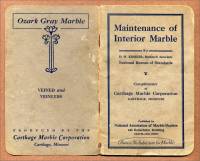
Maintenance of Interior Marble, Carthage Marble Corp., Carthage, Missouri
- Marble, presented on Wikipedia.
- Marble and Dimensional Stones in the United States, by Jeffrey Matthews (1995), Trade International Inc.
- “Marble in America, Part 1: The Industry,”
by Eva Schwartz, in “Focal Points” on the Barbara Israel Garden Antiques web site. Part 2, “Marble in America: Part II, Marketing & Perception.” Companies mentioned in the article include: Vermont Marble Company; Sutherland Falls Marble Company, Proctor, Vermont; and Producers Marble Company – all of Proctor, Vermont; and Colorado Yule Marble Quarry, Marble, Colorado.
Companies mentioned in the article include: Vermont Marble Company; Sutherland Falls Marble Company, Proctor, Vermont; and Producers Marble Company – all of Proctor, Vermont; and Colorado Yule Marble Quarry, Marble, Colorado.
- Marble in Oregon (October 1890) The Manufacture and Builder, Vol. 22, Issue 10, October 1890, pgs. 225-226. (Article in digital images viewed at American Memory, Library of Congress.)
- “Marble,” Information Circular 7829, O. Bowles, U.S. Bureau of Mines, 31 pp., 1958. (U.S. government publication)
- Marble – the National Mall and Memorials Washington D.C. - Klondike Gold Rush National Historical Park. This article discusses the history and geology of the large stone monuments and memorials in the National Mall in Washington, D.C.
“Welcome to the National Mall, a National Park in Washington, DC where large stone monuments and memorials honor important historical people and events. The National Mall is a good place to visit if you want to learn about American history and be a historian. Because of all the different stones used in the construction of the memorials, it is also a good place to visit if you want to learn about rocks and be a geologist.
“Historians and Geologists actually have many similarities. They both look at past events to better understand the present, and guess what will happen in the future. They both use tools to help them in their research. They both make timelines to keep track of events. The biggest difference is that Historians study the events of humans while Geologists study the events of the earth….”
- “Marble Quarrying in America, a Cautious Revolution,” Dimensional Stone, Vol. 5, No. 8, pp. 27-29, 1989.
- Marble Quarrying in the United States & Foreign Countries up through 1939 in The Stone Industries: Dimension Stone, Crushed Stone, Geology, Technology, Distribution, Utilization, by Oliver Bowles (Supervising Engineer, Building Materials Section, United States Bureau of Mines), New York: 2nd ed., New York: McGraw-Hill, 1939. (You can view a copy of this book on Internet Archive web site, and you can download a copy of the book to your computer at the link above.)
Marble. History – Definition – Composition – Origin and Varieties – Physical Properties – Jointing or Unsoundness – Chief Impurities of Marble – Uses – Distribution of Deposits – Production – Industry by States – Quarry Methods and Equipment – Transportation; Equipment and Operation in Mills and Shops – Waste in Quarrying and Manufacture – Marketing Marble – Imports and Exports – Tariff – Prices – Bibliography (Chapter IX.)
Boulders as Building Materials. Origin and Nature of Boulders – Stone Fences – The Use of Boulders in Buildings (Chapter XII.)
- Marble Samples from Utah on the Marble Sphere Corner Site. Samples shown of marbles of various colors from many countries.
-
Marbles in the United States circa 1886 – “Limestones, Dolomites, and Marbles” – Including Limestones, Dolomites, and Marbles of the various States and Territories (two separate lists starting on pp. 374 and 392), circa 1886. (From Part II. “The Rocks, Quarries, and Quarry Regions of the United States,” in The Collection of Building and Ornamental Stones in the U.S. National Museum: A Hand-book and Catalogue by George P. Merrill, Curator, Department Lithology and Physical Geology, from Annual Report of the Board of Regents of the Smithsonian Institution…Yearending June 30, 1886, 1887.
- The Marbles of Vermont (September 1888) The Manufacturer and Builder, Vol. 20, Issue 9, September 1888, pg. 203. (The article includes a sketch: "Interior View of Marble Quarry at West Rutland, Vermont"; article in digital images viewed at American Memory, Library of Congress.)
- The Marbles of Vermont (December 1890) The Manufacture and Builder, Vol. 22, Issue 12, December 1890, pgs. 272-273. (Article in digital images viewed at American Memory, Library of Congress.)
- Oregon Marble (January 1890) The Manufacture and Builder, Vol. 22, Issue 1, January 1890, pgs. 8-9. (Article in digital images viewed at American Memory, Library of Congress.)
- Selecting and Purchasing Marble, by FlooringGuide.com (This site includes a full discussion of marble and travertine marble.)
- Southern Marble (June 1887) The Manufacturer and Builder, Vol. 19, Issue 6, June 1887, pgs. 130-131. (Article in digital images viewed at American Memory, Library of Congress.)
- Statuary Marble in (Inyo) California (May 1886) The Manufacturer and Builder, Vol. 18, Issue 5, May 1886, pgs. 107-108. (Article in digital images viewed at American Memory, Library of Congress.)
- Tennessee Marble (June 1886) The Manufacturer and Builder, Vol. 18, Issue 6, June 1886, pgs. 130-131. (Article in digital images viewed at American Memory, Library of Congress.)
- Texas Marble (July 1887) The Manufacturer and Builder, Vol. 19, Issue 7, July 1887, pg. 156. (Article in digital images viewed at American Memory, Library of Congress.) (The article states that pure white marble was discovered when the Antonio and Arkansas Pass Railway was being built toward Boerne near San Antonio, Texas. Arrangements were being made (in 1887) to open quarries at that location.)
- Travertine, presented on Wikipedia.
- Vermont Marble (May 1891) The Manufacturer and Builder, Vol. 23, Issue 5, May 1891, pgs. 105-106. May 1891. (Article in digital images viewed at American Memory, Library of Congress.)
-
Vermont - Marble Quarry (The Philadelphia Museums)
This photograph shows a corner of one of the great
quarries in what is the most important marble producing section of
the United States.
 There are in
this country other deposits of limestones, some of which are now being
worked and others which will produce very largely in the future, but
the quarries lying in the neighborhood of Rutland and Proctor, Vermont,
produce annually more handsome marble many times over than is taken
out in all the rest of America. This is due to the fine quality of
stone in the quarries, the improved and efficient methods of working
and the convenient transportation facilities which enable the stone
to be easily put on the market.
There are in
this country other deposits of limestones, some of which are now being
worked and others which will produce very largely in the future, but
the quarries lying in the neighborhood of Rutland and Proctor, Vermont,
produce annually more handsome marble many times over than is taken
out in all the rest of America. This is due to the fine quality of
stone in the quarries, the improved and efficient methods of working
and the convenient transportation facilities which enable the stone
to be easily put on the market. Old-fashioned and laborious methods of quarrying and handling the stone have been entirely displaced by the most modern machinery. The stone is too easily cracked and broken to allow of blasting. It is therefore cut out of the beds, in which it lies, by machines called "channelers". These consist of rows of long chisels, set in a strong travelling framework. This gang of chisels is arranged so that it is worked by machinery and vibrates up and down cutting a channel or groove in any desired direction. When the groove is sufficiently long and deep the channeler is set at work in another place cutting a cross channel and the bottom is also perforated. The block can then be easily split away by means of wedges. Blocks of marble thus dislodged are lifted by cranes and derricks worked by steam or electricity and carried rapidly and easily to the railroad cars for transportation. The picture shows one large block of marble being thus lifted to the surface of the ground. The clean-cut steps in the sides of the quarry show plainly how the machines have cut away the marble in great blocks. In the bottom of the quarry are some portable engines which furnish power for the quarrying machinery. A few laborers have been engaged in cleaning away the snow.
At Proctor, Vermont, there are very extensive works where large amounts of this marble are dressed to size for building purposes before being shipped away. Much of it is sawed into slabs and polished for ornamental work. Vermont produces some pure white marble, a great deal of which is somewhat bluish in color, some which is variegated and some which is almost jet black.
- "Vermont Marble, Part I, Quarries of the Norcross-West Marble Co., Dorset Vermont," by Ernest H. West, Mine and Quarry Magazine, Sullivan Machinery Co., Publisher, Chicago, Illinois, March 1909, pgs. 271 - 275.
- "Vermont Marble, Part II, Quarries of the Vermont Marble Company," Written for Mine and Quarry by H. J. Markolf and D. J. O'Rourke, from the Mine and Quarry magazine, Sullivan Machinery Co., Publisher, Chicago, Illinois, Vol. IV. No. 1 - June 1909, pgs. 286-297.
- "Vermont Marble (Part III), Recent Models of Channeling Machines; Quarries of the Clarendon Marble Company, Clarendon, Vermont," by H. H. Mercer and H. J. Markolf, Mine and Quarry Magazine, Sullivan Machinery Co., Publisher, Chicago, Illinois, Vol. VI. No. 4 - June 1912, pgs. 612 - 621.
- White Marble, presented byEric Gyllenhaal on Neighborhood Rocks, a part of the Salt and Sandbox web site.


Millstones & Millstone Quarries
- Millstones, An Introduction - Notes by Charles Howell and presented by Theodore R. Hazen & Pond Lily Mill Restorations (Mill Restorations) (The following quote is used with the permission of Theodore R. Hazen.) "The granite from the well known quarries at Westerly in Rhode Island and from quarries in New Hampshire provided many of the stones used in New England mills. One of the largest collections of millstones in New England, can be seen at Millstone Manor, a private house in Shore Road, Ogunquit, Maine. Here, there are reputed to be more than seventy stones as used for grain grinding and other industrial processes. A type of stone similar to the French Burr was discovered in Arkansas in about 1870 but does not appear to have been extensively used. There were millstone quarries at Bowmanstown, Carbon County, Lancaster County and Berkshire County, all in Pennsylvania. Near Marietta in Ohio, a suitable kind of stone for milling purposes was quarried for many years. Quarries were also worked to produce millstones in Virginia and a quartz bearing granite was used for millstones from quarries in Rowan County, North Carolina."
- Millstone Dressing Tools
- Millstone Dressing, by Theodore R. Hazen.
-
The Art of the Millstones, How They Work
- Mills - TIMS - The International Molinological Society - TIMS was founded in 1973 and is the only organization dedicated to mills at a worldwide scale.
Pipestone (Catlinite)
- Pipestone (Catlinite), presented on Wikipedia.
-
Pipestone
Quarry Site (photograph), presented by the National Park Service.
All tribes hold the pipestone in considerable reverence and many legends concern its mythical origin. A general belief American Indians hold, is that the stone was formed from the flesh and blood of their ancestors. They did not camp near the quarry sites as they held the area sacred.
- “Catlinite” up through 1939 in The Stone Industries: Dimension Stone, Crushed Stone, Geology, Technology, Distribution, Utilization, by Oliver Bowles (Supervising Engineer, Building Materials Section, United States Bureau of Mines), New York: 2nd ed., New York: McGraw-Hill, 1939. (You can view a copy of this book on Internet Archive web site, and you can download a copy of the book to your computer at the link above.)
Miscellaneous Rocks and Minerals Used for Building and Ornamental Purposes. Catlinite (Chapter XIV.)
Quartzite
- Quartzite, presented on Wikipedia.
Sandstone
- The Berea and Amherst Sandstone (May 1887) The Manufacturer and Builder, Vol. 19, Issue 5, May 1887, pg. 107. (The article includes a sketch: "The Cleveland Co.'s Quarry No. 4."; text of article in digital images viewed at American Memory, Library of Congress)
- Berea Sandstone (March 1893) The Manufacturer and Builder, Vol. 25, Issue 3, March 1893, pg. 60. (The article includes a sketch of: "Berea Sandstone Quarry No. 6, North Amherst, Ohio."; article in digital images viewed at American Memory, Library of Congress)
- Brownstone, presented on Wikipedia.
- Brown-Stone (The end of an era) (November 1869) The Manufacturer and Builder, Vol. 1, Issue 11, November 1869, pgs. 332-333. (Article in digital images viewed at American Memory, Library of Congress.)
- The Building Stones in the United States (October 1884) The Manufacturer and Builder, Vol. 16, Issue 10, October 1884, pgs. 229-230. (Article in digital images viewed at American Memory, Library of Congress.)
- "The Building Stones - The Sandstones" (September 1885) Quarrying Notes - The Manufacturer and Builder, Vol. 17, Issue 9, September 1885, pgs. 202-203. (Article in digital images viewed at American Memory, Library of Congress)
- Concerning Building Stones (June 1890) The Manufacture and Builder, Vol. 22, Issue 6, June 1890, pgs. 129-130. (Article in digital images viewed at American Memory, Library of Congress.) (This article describes: rock face, pointed face, aze-hammered face, patent hammered, bush hammered, square drove, tooth chiseled, sawed face, fine sand finish, pumice finish, polished surface, and includes a few diagrams of some of these.)
- Granites and Sandstones (May 1891) The Manufacturer and Builder, Vol. 23, Issue 5, May 1891, pg. 104. May 1891. (Article in digital images viewed at American Memory, Library of Congress)
- The Great Industries of the United States Being an Historical Summary of the Origin, Growth, and Perfection of the Chief Industrial Arts of This Country - Quarries (1872)
- Ohio Sandstone (December 1892) The Manufacturer and Builder, Vol. 24, Issue 12, December 1892, pg. 279. (The article includes a sketch: "Cleveland Stone Co.'s Quarry No. 3, Columbia, Ohio."; text of article in digital images viewed at American Memory, Library of Congress)
- Ohio Sandstone Samples: The following 2 Ohio sandstone / field stone samples were contributed by Jason Reinhold of Land and Stone, Inc., in Cincinnati, Ohio. His company salvages stone from old Cincinnati buildings to use in modern projects. (Peggy B. Perazzo; photographs from Jason Reinhold of Land and Stone Inc.)
 |
Two samples of Ohio Sandstone/ Fieldstone contributed by Jason Reinhold of Land and Stone, Inc., Cincinnati, Ohio |
 |
 |
 |
Front of a sample of Ohio Sandstone/Fieldstone |
Back of a sample of Ohio Sandstone/ Fieldstone |
Closeup photo of the back of a sample of Ohio Sandstone/Fieldstone to the left |
 |
 |
 |
Front of another sample of a piece of Ohio Sandstone/ Fieldstone |
Back of another sample of a piece of Ohio Sandstone/ Fieldstone to the left |
Closeup photo of the back of the sample of Ohio Sandstone/Fieldstone to the left |
- You can read more about Jason Reinhold’s business of salvaging old stone from Cincinnati buildings in the following article: “Salvaging: New Fascias From Old Places,” by K. Schipper, in Stone Business Online,
- The Portland Sandstone Quarries (February 1888) The Manufacturer and Builder, Vol. 20, Issue 2, February 1888, pg. 35. (The article includes a sketch: "Portland Sandstone Quarries - Splitting Out the Stone With Wedges"; article in digital images viewed at American Memory, Library of Congress)
- Potsdam Red Sandstone as a Building Material (April 1890) The Manufacture and Builder, Vol. 22, Issue 4, April 1890, pgs. 80-81. (Article in digital images viewed at American Memory, Library of Congress.)
- Potsdam Sandstone - Potsdam Sandstone as a Building Material (1890), by Dr. Alexis A. Julien, The Manufacture and Builder, Vol. 22, Issue 9, September 1890 (Viewed at American Memory, Library of Congress) Click here to view the end of the "Potsdam Sandstone as a Building Material" article.
- Potsdam Red Sandstone (April 1891) The Manufacturer and Builder, Vol. 23, Issue 4, April 1891, pg. 90. (Article in digital images viewed at American Memory, Library of Congress.)
- Potsdam Red Sandstone as a Building Material (May 1891) The Manufacturer and Builder, Vol. 23, Issue 5, May 1891, pg. 104. May 1891. (Article in digital images viewed at American Memory, Library of Congress.)
- Potsdam Red Sandstone (The Potsdam Red Sandstone Co. of Potsdam, N.Y.) (July 1892) The Manufacturer and Builder, Vol. 24, Issue 7, July 1892, pg. 158. (Article in digital images viewed at American Memory, Library of Congress.)
- The Potsdam Red Sandstone (January 1893) The Manufacturer and Builder, Vol. 25, Issue 1, January 1893, pgs. 9-12. (The article includes six sketches: (1) "Bird's-Eye View of the Potsdam Sandstone Quarries"; (2) "Quarry No. 2."; (3) "Quarry No. 2 - Under Development."; (4) "Quarry No. 3 (Dark Red) - Under Development."; (5) "Quarry No. 4."; and (6) "Selecting Large Blocks of Stone."; article in digital images viewed at American Memory, Library of Congress)
- Potsdam Sandstone (as a building material) (July 1893) The Manufacturer and Builder, Vol. 25, Issue 7, July 1893, pg. 158. (Article in digital images viewed at American Memory, Library of Congress.)
- Quarry-Related Articles from the Manufacturer and Builder Magazine (Articles from the 1850s through the 1890s.
- Sandstone, presented on Wikipedia.
- Sandstone - Popularity of Sandstone in the Boston of To-Day (December 1884) The Manufacturer and Builder, Vol. 16, Issue 12, December 1884, pg. 274. (Article in digital images viewed at American Memory, Library of Congress.)
- “Sandstone as Dimension Stone,” Information Circular 8182, O. Bowles, U.S. Bureau of Mines, 30 pp., 1963. (U.S. government publication)
- Sandstone Quarrying in the United States & Foreign Countries up through 1939 in The Stone Industries: Dimension Stone, Crushed Stone, Geology, Technology, Distribution, Utilization, by Oliver Bowles (Supervising Engineer, Building Materials Section, United States Bureau of Mines), New York: 2nd ed., New York: McGraw-Hill, 1939. (You can view a copy of this book on Internet Archive web site, and you can download a copy of the book to your computer at the link above.)
Sandstone. Varieties – Composition – Size and Shape of Grains – Cementation – Color – Porosity – Uses – Production – Industry by States – Quarry Methods – Quarry Processes – Yard Service – Sandstone Sawmills and Finishing Plants – The Bluestone Industry – Waste in Sandstone Quarrying and Manufacture – Bibliography (Chapter VII.)
- Sandstones of New York from Building Stones of New York (July 1891) The Manufacturer and Builder, Vol. 23, Issue 7, July 1891, pgs. 158-159. (Article in digital images viewed at American Memory, Library of Congress.)
- The Wisconsin Sandstones (December 1885) The Manufacturer and Builder, Vol. 17, Issue 12, December 1885, pg. 274. (Article in digital images viewed at American Memory, Library of Congress.)
Bluestone (Sandstone)
-
About Bluestone - by Bob
Vila Bluestone, a type of sandstone, is quarried New York,
Pennsylvania, and Vermont. Bluestone is usually a gray-blue,
but it ranges from shades from brown to purple. (The link
from which this information was obtained, is no longer available.)
<http://homearts.com/bvah/a7patb6.htm> - Hudson River Bluestone (Industry History) (June 1889) The Manufacture and Builder, Vol. 21, Issue 6, June 1889, pgs. 130-131. (Article in digital images viewed at American Memory, Library of Congress.)
- Our Bluestone Sidewalks (Bluestone Industry History - Graywacke) (October 1879) The Manufacturer and Builder, Vol. 11, Issue 10, October 1879, pg. 226. (Article in digital images viewed at American Memory, Library of Congress.)
- New York - Bluestone Sidewalks in New York (Hudson River Bluestone Industry History) (April 1891) The Manufacturer and Builder, Vol. 23, Issue 4, April 1891, pgs. 80-81. (Article in digital images viewed at American Memory, Library of Congress.)
- Ulster Blues - Bluestone Industry in Ulster County, New York, by Professor Robert Titus, Hartwick College, The Catskill Geologist, Summer 1995 (The following is abstracted from the above site, which is no longer available. The following quote is used with Professor Titus' permission.) "The Catskill Front, at Overlook, was the birthplace of the famous Catskill bluestone industry, and for a long time the area was the center of that industry. This was back during the last third of the 19th Century. Since then, cement has eclipsed bluestone, and what's left of the industry is centered off to the west. Go to Hancock and its environs if you want to see bluestone being quarried today. The days of commercial exploitation of the Catskill Front are over and the Overlook Mountain Road is now part of the forest preserve of the Catskill Park.Back then, most of the quarry stone actually was blue, or, at least, it was colored something you could convince yourself was blue.Whatever its color, the stone is always made of well-laminated, horizontally bedded sandstone and that is its key trait..You won't have to go to a quarry to see bluestone. In fact, you don't even have to come to the Catskills to see the stone. You will find bluestone sidewalks throughout the eastern United States..Today the word bluestone is mostly a misnomer. Not much of the quarry stone currently marketed from the Catskills is actually blue. The word is now applied to a number of different types of sandstone, and they are found in various colors besides blue: green, brown, yellow, purple and red are known."
Serpentine/Verdantique Marbles
- “Serpentine, Ophicalcite, and Verdantique Marbles” circa 1886 – Including “Serpentines of the various States and Territories” beginning on pp. 362 (From Part II. “The Rocks, Quarries, and Quarry Regions of the United States,” in The Collection of Building and Ornamental Stones in the U.S. National Museum: A Hand-book and Catalogue, by George P. Merrill, Curator, Department Lithology and Physical Geology, pp. 357-361. From Annual Report of the Board of Regents of the Smithsonian Institution…Year ending June 30, 1886, 1887.)
- About Soapstone, presented by Canadian artist Jim Cosgrove on Jim's Soapstone Carvings web site.
- Soapstone, presented on Wikipedia.
- Soapstone Quarrying in the United States & Foreign Countries up through 1939 in The Stone Industries: Dimension Stone, Crushed Stone, Geology, Technology, Distribution, Utilization, by Oliver Bowles (Supervising Engineer, Building Materials Section, United States Bureau of Mines), New York: 2nd ed., New York: McGraw-Hill, 1939. (You can view a copy of this book on Internet Archive web site, and you can download a copy of the book to your computer at the link above.)
Soapstone. Composition and Properties – History – Uses – Origin and Occurrence – Quarry Methods – Milling Processes – Marketing – Rocks Related to Soapstone – Bibliography (Chapter XI.)
- “Steatite & Soapstones” (circa 1886) – Including “Soapstones of the various States and Territories” beginning on pp. 358. (From Part II. “The Rocks, Quarries, and Quarry Regions of the United States,” in The Collection of Building and Ornamental Stones in the U.S. National Museum: A Hand-book and Catalogue, by George P. Merrill, Curator, Department Lithology and Physical Geology, pp. 357-361. From Annual Report of the Board of Regents of the Smithsonian Institution…Year ending June 30, 1886, 1887.)
- The Building-Stone and Slate of Virginia (February 1869) The Manufacturer and Builder, Vol. 1, Issue 2, February 1869, pgs. 46-47. (Article in digital images viewed at American Memory, Library of Congress.)
- The Building Stones - Serpentine & Slate (November 1885) The Manufacturer and Builder, Vol. 17, Issue 11, November 1885, pg. 250. (Article in digital images viewed at American Memory, Library of Congress.)
- Echeguren Slate, Inc. - Beautiful slate samples.
- Glossary of Slate Quarry Terms
- “History
of the Slate Industry” (PDF), excerpt from
Hower’s
Lightning Slate Reckoner (PDF)
on 33 Practical Sizes Roofing Slate, by F. M. Hower, Proprietor of
the Peach Hill Slate Quarry and President of the Eagle Slate Company,
Cherryville, Pennsylvania, 1884.
(Keywords from the above history: Conway Castle; England; Wales; Castle of Caernarvon; slate roofs; roofing slate; North Wales; Llanderis slate district; Nantlle; Festiniog slate district; Corris slate district; Llangollen slate district; Cilgwyn slate quarry; Penrhyn slate quarries; Bethesda; Richard Pennant; Delabole slate quarries; Cornwall; Turner; Diphwys-Casson slate quarry; Rhiwbryfdir; Welsh Slate Company; Castle of Angers; Angers slate quarries, France; Maine; Michigan; Canada; Georgia; Green Mountain slate; Benson, Rutland County, Vermont; Salem, Washington County, New York; Castleton; Hyderville; Fair Haven; Poultney; Pawlett; West Pawlett; Middle Granville; Granville; Hampton, New York; Col. Alonzo Allen; M. F. W. Whitlock; Deacon Ranwey; Scotch Hill; William Williams; John R. Williams; John Humphrey; Welshmen; Cookville; Newel Sturtevent; Boston, Massachusetts; Slate Company; slate mantels; marbleizing slate; Eagle Slate Company; Gibson slate quarry; Sea Green slate; Kittatinny Mountains; Blue Mountains; Bath district; Chapman district; Whitehall; Lynn, Lehigh County, Pennsylvania; Bangor slate district; Pen Argyl slate district; Delaware slate district; Robert McDowell; Slatington; Heimbach slate quarry; Owen Jones; William Roberts; Washington slate quarry; Douglas slate quarry; Mantel slate quarry; George and Nelson Labar; Joy slate quarry; J. Weise; Slatesdale; Locke slate quarries; Diamond slate quarry; Schall and Balliett; Williamstown slate quarry; Danielsville slate quarry; Owen Williams; Chapman slate quarries; Peach Hill slate quarry; F. M. Hower’s slate quarries; Northampton County; R. M. Jones.)
- "Peach-Bottom" Slate (York County, Pennsylvania) (October 1890) The Manufacture and Builder, Vol. 22, Issue 10, October 1890, pg. 225. (Article in digital images viewed at American Memory, Library of Congress.)
- Red Slate (August 1885) The Manufacturer and Builder, Vol. 17, Issue 8, August 1885, pgs. 181-182. (Article in digital images viewed at American Memory, Library of Congress.)
- Red Slate (November 1893) The Manufacturer and Builder, Vol. 25, Issue 11, November 1893, pg. 253. (Article in digital images viewed at American Memory, Library of Congress.)
- The Repair, Replacement & Maintenance of Historic Slate Roofs, by Jeffrey S. Levine, presented by the National Park Service (Preservation Briefs).
- Slate (July 1878) The Manufacturer and Builder, Vol. 10, Issue 7, July 1878, pg. 166. (Article in digital images viewed at American Memory, Library of Congress.)
- Slate, presented on Wikipedia.
- Slate and its Uses (December 1852) Harper’s New Monthly Magazine, Vol. 6, Issue 31, December 1852.
- Slate and Its Uses (May 1885) The Manufacturer and Builder, Vol. 17, Issue 5, May 1885, pg. 109. (Article in digital images viewed at American Memory, Library of Congress.)
- Slate Channeling by Machinery (November 1891) The Manufacturer and Builder, Vol. 23, Issue 11, November 1891, pgs. 254-255. (Article in digital images viewed at American Memory, Library of Congress.)
- Slate – History of Slate Use, by Jeffrey S. Levine, presented by the National Park Service (Preservation Briefs).
- Slate in Vermont (July 1892) The Manufacturer and Builder, Vol. 24, Issue 7, July 1892, pg. 158. (Article in digital images viewed at American Memory, Library of Congress)
- Slate Production of the United States (March 1894) The Manufacturer and Builder, Vol. 26, Issue 3, March 1894, pgs. 62-63 according to the American Slate Trade Journal, 1893. (Text of article in digital images viewed at American Memory, Library of Congress.)
- “Slate,” in The Mining Catalog 1923 - Metal - Quarry Edition: A Consolidation of Condensed Catalog Information Relating to the Metallic and Non-Metallic Mining Industries, Quarries and Cement Mills (Third Issue 1923), Keystone Consolidated Publishing Co., Inc., pp. 530-531.
Slate (circa 1923)
“...It is customary for manufacturers of structural slate to prepare it in sizes specified by builders and architects. Thus the material cannot be manufactured in advance. This results in irregular activity of mills, delays in filling orders, and may force manufacturers to use raw materials that might be better adapted for products than those called for in the orders. To improve this condition the Structural Slate Company of Penn Argyle, Pa., through the Structural Service Bureau of Philadelphia, has issued a series of pamphlets giving complete specifications of structural slate for various purposes. Architects find it so much easier to order slate from these sheets that, in preparing plans for new structures, standard sizes are specified. There is evidence, therefore, of a definite movement toward elimination of odd sizes. The new specifications have been in effect so short a time that results cannot yet be measured, but it would appear that slate producers will shortly be enabled to build up a reserve stock of standard sizes. Such a reserve will be advantageous both in marketing and in manufacturing.
“Slate switchboards are likewise usually manufactured after the order has been received. The most serious objection to the filling of orders directly from the quarry is that, according to tests recently made on Pennsylvania slate, freshly quarried slabs have only about half the resistance in ohms of the same slabs after drying out for three months. One Chicago manufacturer claims that 80 per cent. of all switchboards are of standard sizes, and he keeps such sizes in stock. The facility with which orders may be filled from stock, and the improved quality of seasoned switchboards, will undoubtedly influence electrical companies toward a more uniform standardization in size. Simplicity could be further attained by the elimination of minor irregularities in style, as for example in the beveled edges. Some companies now demand a bevel one-half inch wide, and others one-fourth inch wide. It would seem that uniformity in this detail could be easily adjusted.”
- Slate Quarry Terms, by C. F. Derven, Poultney, Vermont, November 22, 1938.
- Slate Quarrying in the United States & Foreign Countries up through 1939 in The Stone Industries: Dimension Stone, Crushed Stone, Geology, Technology, Distribution, Utilization, by Oliver Bowles (Supervising Engineer, Building Materials Section, United States Bureau of Mines), New York: 2nd ed., New York: McGraw-Hill, 1939. (You can view a copy of this book on Internet Archive web site, and you can download a copy of the book to your computer at the link above.)
Slate. Definition – Origin – Mineralogical Composition – Chemical Composition – Physical Properties – Structural Features – Imperfections – Uses – History of Industry – General Distribution – Production – Industry by States – General Plan of Quarrying – Quarry Operations – Quarry Methods – Yard Transportation – Manufacture of Roofing Slate – Storage of Roofing Slate – The Art of Roofing with Slate – Manufacture of School slates – Manufacture of Mill Stock – Slate Floors – Walks, and Walls – Crushed and Pulverized Slate Products – Waste in Quarrying and Manufacturing – Tests and Specifications – Marketing – Imports and Exports – Tariff – Prices – Bibliography (Chapter X.)
- Slate – The Repair, Replacement & Maintenance of Historic Slate Roofs by Jeffrey S. Levine presented by the National Park Service (Preservation Briefs). (A couple of the topics are below.)
- Slate Reckoner – Hower’s
Lightning Slate Reckoner (1884/1904) (PDF)
on 33 Practical Sizes Roofing Slate, being a complete and most
convenient system of computing the amount in “squares” of
any given number of slate…a very convenient ratio on each
of the thirty-three different sizes for each two, three and four
inches lap, mapping ninety-nine different ratios, together with rules
and practical information, To Quarrymen, Operators on Slate,
Slate-roofers and others, by F. M. Hower, Proprietor of
the Peach Hill Slate Quarry and President of the Eagle Slate Company,
Cherryville, Pennsylvania, 1884, 99 pp.
Contents of this book include: “History of the Slate Industry,” “As to Cost of Maintenance and Repairs,” “How Slate are Put On,” “How to Measure a Roof,” “Punching,” “Slate as Siding,” “Weight of Slate,” “Slate” (dimensions), “Table of Ratios,” “How to Use the Tables,” and “Number of Squares in a plane Roof.” 
- Slate Valley Museum, Granville, New York
- Slated for Preservation - Marshall, Philip Cryan and Collins,
Allison Brooks. "Slated for Preservation," presented at The
Roofing Conference and Exposition for Historic Buildings, Philadelphia,
Pennsylvania, March 17-19, 1999.
-
The Story on Slate - A Brief History of American Rooftops
- A History of Slate Roofing in America (Summary & Detailed Accounts)
- American Traditions (Slate Industry)
-
Slate Sources
- Slate Quarries, Suppliers, and Service-Providers
- Annotated Bibliography
- Slate Museums
- Additional Slate Deposits (U. S.)
- Glossary
-
The Story on Slate - A Brief History of American Rooftops
-
The Stone Roofing
Association - Sandstone & Limestone Roofing, by Terry
Hughes.
- "Stone Roofing in England," English Heritage Research Transactions, Volume 9, 2003 (covers the following subjects: Region, Geology, Stone Slates, Slate Making, Roof Details, Figure Pages, Gazeteer)
- Bibliography of Slate and Stone Roofing
- Historical Aspects of the Welsh Industry, by D. Dylan Pritchard, MA FSS.
- The Slate Industry - Historical Records
-
A Study in Slate: Welsh Immigration: Its Effects on the Slate
Valley (1840-1870), The Slate Industry from 1901-1930, and Environmental
Impacts of Slate Quarries, A Project by Scott Carpenter, in partial
fulfillment of a BS - Environmental Studies, December 9, 2002. (The
"Abstract" below is used with permission of the author.
You can view the entire document at the following PDF link.)
[PDF]
"The Slate Valley of Vermont and New York is an area that covers approximately 300 square miles and is home to about 10 towns. Slate from this area is highly valued for its many different colors. Many Welsh people immigrated to Vermont in the 1850's from quarrying villages in North Wales. They changed the face of quarrying in the Slate Valley because of mining techniques and tools brought with them from Wales. They also changed the towns due to social and economic impact. This study focused on the correlation between the increase in Welsh immigration between 1840 and 1870, the increase in the slate business over the same time span, the slate industry from 1901 to 1930, and the environmental impact that quarries have on the surrounding landscape. The research has been historical, from libraries (University of Vermont, Green Mountain College), the Slate Valley Museum, and from the State of Vermont Census and business materials from the Building and General Services Department in Montpelier Vermont."
- The Vermont Slate Industry (March 1869) The Manufacturer and Builder, Vol. 1, Issue 3, March 1869, pgs. 83-86. (Article in digital images viewed at American Memory, Library of Congress.)
Soapstone
Slate

Commercial use of material within this site is strictly prohibited. It is not to be captured, reworked, and placed inside another web site ©. All rights reserved. Peggy B. and George (Pat) Perazzo.