

Structures and Monuments in Which Missouri Stone was Used
- Finished Products from Missouri Stone
in Virginia
- Alexandria, Virginia – Memorial
Hall - the Walls, web site presented by the Free
Masons.
According to this web site in the “Memorial Tour” of Memorial Hall section, Missouri marble was used to face the walls and Tennessee marble was for the floors. Memorial Hall is the location of the George Washington Masonic National Memorial.
- Richmond, Virginia - the State-Planters Bank and Trust Company
Building, located at Ninth and Main Streets(from article
entitled, “The Home of The State-Planters Bank and Trust Co.,
In Richmond: The Largest Financial Institution in the City Was the
Result of a Recent Merger,” in Throvgh The Ages Magazine,
December 1926, Vol. 4, No. 8, pp. 31-34.)
A typical upper elevator hall in the State-Planters Building, Richmond, Virginia. The 4-foot wainscot is Napoleon Gray marble. Clinton and Russell, New York, architects. (pp. 34) 
“On March 1, 1926, there was consummated a merger of these two oldest and largest of Richmond’s banks - the Planters National and the State and City Bank and Trust Company. The new building at Ninth and Main Streets furnishes ample space to house the increased force. The architectural style of this structure is an adaptation of classic renaissance to modern commercial requirements; it was designed by the New York firm of Clinton and Russell....”
“...The elevator halls on the upper stories have floors of marble terrazzo with simple borders, and wainscots 4 feet high of Napoleon Gray marble. This latter material has also been used in the toilets throughout the building....”
- Richmond, Virginia – the Title Insurance Company’s
Offices (Phenix Marble Company Advertisement from Throvgh
The Ages Magazine, January 1932, Vol. 9, No. 9, pp. 61.)
Napoleon Gray Marble was used for the counters in the Title Insurance Company’s Offices, Richmond Trust Building, Richmond, Virginia. W. T. Stoddart, Architect. 
Phenix Marble Company, Suite 609, Scarritt Building , Kansas City, Missouri
Here is a typical example of “one of the everyday uses of marble” - in the interests of both Economy and Fine Appearance. The selection of Napoleon Gray gives the major advantages desired in marble - rich tones, exceptional durability and ready availability - at very reasonable price, consistent with quality. The full benefits of a marble treatment are always enjoyed whenever Napoleon Gray is specified.
- Alexandria, Virginia – Memorial
Hall - the Walls, web site presented by the Free
Masons.
- Finished Products from Missouri Stone
in Washington State
- Seattle, Washington - the Bank of California - the Interior
Floor (from article entitled, “Banks - And Marble,” by
Alfred C. Bossom, in Throvgh The Ages Magazine, September
1926, Vol. 4, No. 5, pp. 31-37.)
In the Bank of California, at Seattle, the floor is Napoleon Gray marble with Black Belgian border. The screens, check desks, settees and counters are of Escalette marble with Belgian Black Base. John Graham, Seattle, architect. (pp. 37) 
- Tacoma, Washington - the W. R. Rust Building (from “New
Missouri Marble Mill,”in Stone Magazine, November 1925,
Vol. XLVI, No. 11, pp. 674-676)
Colonial Grey Marble quarried by F. W. Steadley & Co., Inc., of Carthage, Missouri, was used in the construction of the W. R. Rust building prior to 1926.
- Seattle, Washington - the Bank of California - the Interior
Floor (from article entitled, “Banks - And Marble,” by
Alfred C. Bossom, in Throvgh The Ages Magazine, September
1926, Vol. 4, No. 5, pp. 31-37.)
- Finished Products from Missouri Stone
in Washington, D.C.
- Washington, D.C. - the Catholic Shrine (from “New
Missouri Marble Mill,”in Stone Magazine, November 1925,
Vol. XLVI, No. 11, pp. 674-676)
Colonial Grey Marble quarried by F. W. Steadley & Co., Inc., of Carthage, Missouri, was used in the construction of the Catholic Shrine prior to 1926.
- Washington, D.C.– the
Department of Commerce Building (photograph)
The interior was built using Georgia marble and marble from the Carthage district in Jasper County, Missouri.
- Washington, D.C. - the Department of Commerce Building (from Missouri
Marble,
by Norman S. Hinchey, Report of Investigations No. 3, Missouri Geological
Survey and Water Resources, Rolla, Missouri, 1946. Used with permission
of the Missouri Department of Natural Resources..)
Ste. Genevieve Golden Vein Marble, quarried in Ste. Genevieve County, Missouri, was used in the construction of the Department of Commerce building.
- Washington, D.C. - the Department of Commerce Building (from Missouri
Marble,
by Norman S. Hinchey, Report of Investigations No. 3, Missouri Geological
Survey and Water Resources, Rolla, Missouri, 1946. Used with permission
of the Missouri Department of Natural Resources..)
- Washington, D.C. - the Earle Theater (from Stone magazine,
April 1925, Vol. XLVI, No. 4, pp. 220)
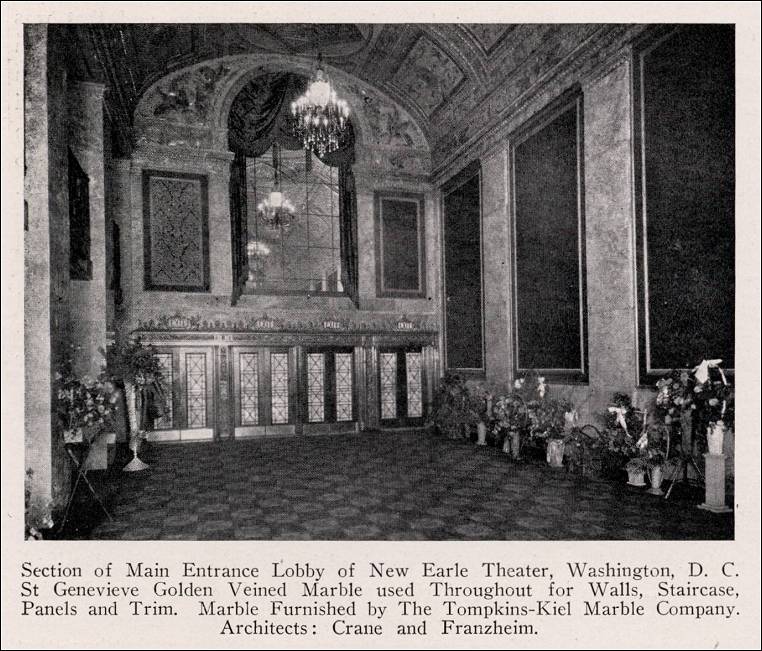
Section of Main Entrance Lobby of New Earle Theater, Washington, D.C. St. Genevieve Golden Veined Marble used throughout for Walls, Staircase, Panels and Trim. Marble Furnished by The Tompkins-Kiel Marble Company. Architects: Crane and Franzheim. 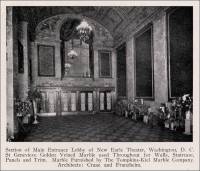
Marble in New Washington Theater
“The City of Washington is so magnificant (sic), so resplendant (sic) in its display of architecture and interior decorations of both public and private buildings, that visitors to the capital expect the same brilliancy everywhere in the district. Naturally a theater designed on the latest principles of comfort and in conformity with other buildings in the capital must of necessity be beautiful in its interior. To assure an effect of richness and attractiveness combined St. Genevieve Golden Veined Marble was selected for the chief decorative material throughout the theater. The beautiful effects obtained may be seen in the accompanying view of a section of the main lobby looking towards the entrance. St. Genevieve Golden Veined Marble is another of the beautiful Missouri marbles. It was little known until 1920 and very little of it has been in the East until within the past two or three years. It has already been used in scores of public and private buildings. The deposit at Ozora, Missouri, also produces two other varieties of marble known to the trade as St. Genevieve Rose and St. Genevieve Clear. All are fine grained limestones that take a high polish and are enriched by fossils, shells and corals, all of which show distinct (sic) after finishing. The Earle Theater in Washington was designed by C. Howard Crane and Kenneth Franzheim, architects.”
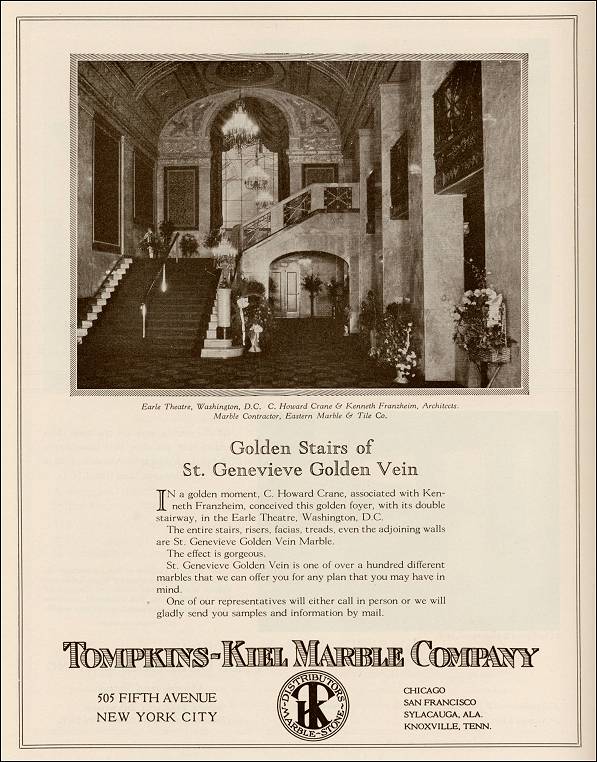
- Washington, D.C. - the Earle Theater - Interior Foyer & Staircase (Tompkins-Kiel
Marble Co. advertisement from Throvgh
The Ages Magazine, April 1925, Vol. 2, No. 12, pp. 52.)
Earle Theatre, Washington, D.C. C. Howard Crane & Kenneth Franzheim, Architects. Marble Contractor, Eastern Marble & Tile Co. 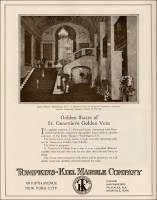
Tompkins-Kiel Marble Company, 505 Fifth Avenue, New York City
Chicago - San Francisco - Sylacauga, Ala. - Knoxville, Tenn.
Golden Stairs of St. Genevieve Golden Vein
In a golden moment, C. Howard Crane, associated with Kenneth Franzheim, conceived this golden foyer, with its double stairway, in the Earle Theatre, Washington, D.C.
The entire stairs, risers, facias, treads, even the adjoining walls are St. Genevieve Golden Vein Marble. The effect is gorgeous. St. Genevieve Golden Vein is one of over a hundred different marbles that we can offer you for any plan that you may have in mind. One of our representatives will either call in person or we will gladly send you samples and information by mail.
- Washington, D.C. - the Earle Theater - Interior Foyer & Staircase (Tompkins-Kiel
Marble Co. advertisement from Throvgh
The Ages Magazine, April 1925, Vol. 2, No. 12, pp. 52.)
- Washington, D.C. - the Interstate Commerce Commission
Building (from Missouri Marble,
by Norman S. Hinchey, Report of Investigations No. 3, Missouri Geological
Survey and Water Resources, Rolla, Missouri, 1946. Used with permission
of the Missouri Department of Natural Resources.)
Ozark Tavernelle Marble (a limestone) quarried at Carthage, Missouri, was used in the construction of the interior of the Interstate Commerce Commission building.
- Washington, D.C. - the Library of Congress Building (from Missouri
Marble, by Norman S. Hinchey, Report of Investigations No. 3,
Missouri Geological Survey and Water Resources, Rolla, Missouri, 1946.
Used with permission of the Missouri Department of Natural Resources.)
Adorado or Ste. Genevieve Botticino Marble quarried from the Inkley Marble Quarries Company quarry located southwest of Ste. Genevieve, Missouri, was used in the construction of the Library of Congress building.
- Washington, D.C. - Mantel-Pieces in the Capitol at Washington (from “Notes
on The Building Stones, Clays and Sands of Iron, St. Francois and
Madison Counties, ” by G. E. Ladd, Assistant
Geologist, in Bulletin 1, Geological Survey of Missouri,
Jefferson City, April 1890.)
Some of the mantel-pieces in the Capitol at Washington are said to have been taken from beds of Sarah P. Childers’ marble quarries, which were located in township 34 north, range 3 east, section 35, southwest quarter, Iron County, Missouri.
- Washington, D.C. - the Mayflower Hotel - Interior (from
the article entitled, “The Mayflower: Washington’s Largest
and Latest Hostelry,” by Robert F. Beresford, in Throvgh The
Ages Magazine, August 1925, Vol. 3, No. 4, pp. 8-18.)
(The Mayflower is located between Seventeenth and De Sales Streets, midway between the White House and Dupont Circle.)
The Main Lobby: “...The stairs leading from the lobby upward to the mezzanine and downward to the garden are of St. Genevieve Golden Vein Marble.”
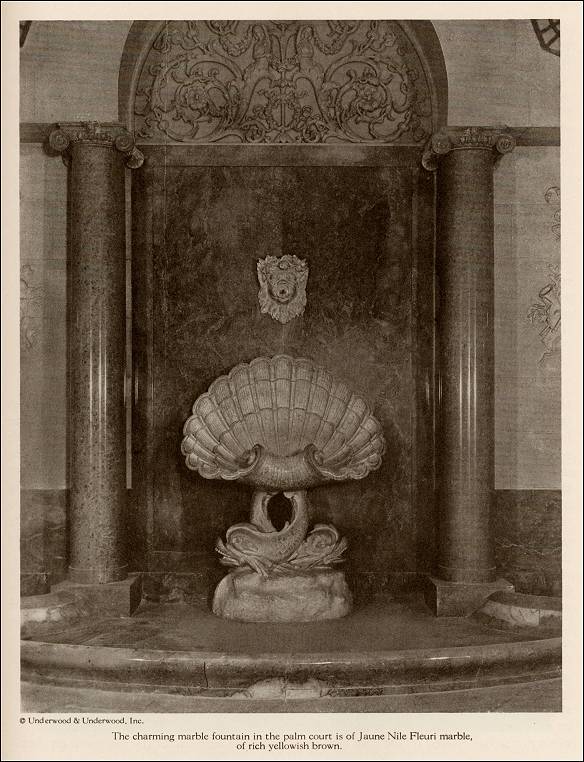
The Palm Court: “The palm court is 76 feet wide by 86 feet long, truly a room of abounding spaces. The center portion of the ceiling is a great dome of green latticed glass, through which the daylight streams in generous measure. Surrounding the court is a wainscot 3 feet high of St. Genevieve Golden Vein marble...To the middle of the south wall of the palm court the eye and ear are at once attracted by the cool splash of water in a charming wall fountain, a large and beautifully shaped sea shell of Jaune Nile Fleuri supported by two dolphins, while above it a mask spouts into it a tinkling stream of water...The fountain base is of St. Genevieve Golden Vein marble....”
The beautiful palm court is a large room with walls of Caen stone and a wainscot of St. Genevieve Golden Vein Marble. The floor is of Biesanz American Travertine. Underwood & Underwood, Inc. (pp. 11) 
The charming marble fountain in the palm court is of Jaune Nile Fleuri marble, of rich yellowish brown. Underwood & Underwood, Inc. (pp. 13) 
The Ballroom: “The ballroom has a richly ornamented vaulted ceiling. This ornament is carried down the sides of the columns until it reaches the top of the wainscot of St. Genevieve Golden Vein marble. Below the wainscot the base is of Italian Black and Gold marble. These two marbles form a very rich and effective color combination....”
The ballroom wainscot is St. Genevieve Golden Vein with a Black and Gold Base. (pp. 14) 
The Garden: “...the garden (is) a spacious room situated beneath the main lobby...At the farther end of the garden a latticed colonnade encloses a charming figure fountain of St. Genevieve Golden Vein marble....”
The garden, though below the street level, has an out-of-door aspect. Underwood & Underwood, Inc. (pp. 15) 
- Washington, D.C. - the National Academy of Science
Building (from Missouri Marble,
by Norman S. Hinchey, Report of Investigations No. 3, Missouri Geological
Survey and Water Resources, Rolla, Missouri, 1946. Used with permission
of the Missouri Department of Natural Resources.)
Marble quarried from the Phenix Marble Company’s “Old West Quarry” at Phenix, Greene County, Missouri, was used in the construction of the National Academy of Science building prior to 1942.
- Washington, D.C. - the
National Archives Building (photograph)
The interior of the building was built with golden vein marble from Missouri, and the foyer was built with Tennessee marble.
- Washington, D.C. - the National Archives Building (from Missouri
Marble,
by Norman S. Hinchey, Report of Investigations No. 3, Missouri Geological
Survey and Water Resources, Rolla, Missouri, 1946. Used with permission
of the Missouri Department of Natural Resources.)
Ste. Genevieve Golden Vein Marble, quarried in Ste. Genevieve County, Missouri, was used in the construction of the National Archives building.
- Washington, D.C. - the National Archives - Display Cases (from Missouri
Marble,
by Norman S. Hinchey, Report of Investigations No. 3, Missouri Geological
Survey and Water Resources, Rolla, Missouri, 1946. Used with permission
of the Missouri Department of Natural Resources.)
In the National archives, the cases which hold the Declaration of Independence, the Constitution, and the Bill of Rights are Golden Vein Marble from the Ozora County.”
- Washington, D.C. - the National Archives Building (from Missouri
Marble,
by Norman S. Hinchey, Report of Investigations No. 3, Missouri Geological
Survey and Water Resources, Rolla, Missouri, 1946. Used with permission
of the Missouri Department of Natural Resources.)
- Washington, D.C. - the National Art Gallery Building - the
Fountains at each end (from Missouri Marble,
by Norman S. Hinchey, Report of Investigations No. 3, Missouri Geological
Survey and Water Resources, Rolla, Missouri, 1946. Used with permission
of the Missouri Department of Natural Resources.)
Ozark Tavernelle Marble (a limestone) quarried at Carthage, Missouri, was used in the construction of the fountains at each end in the interior of the National Art Gallery building.
Adorado or Ste. Genevieve Botticino Marble quarried from the Inkley Marble Quarries Company quarry located southwest of Ste. Genevieve, Missouri, was also used in the construction of the National Art Gallery.
- Washington, D.C. - the
National Gallery of Art West Building (photograph)
The exterior of the building was built using light-pink marble from Tennessee. The floors were verde antique marble from Vermont. The columns in the rotunda were built using brecciated marble from Carrara, Italy. The restrooms were built with marble from Missouri. The fountains at each end were built with travertine marble from Jasper County, Missouri. The walls of the galleries were built with fossil-bearing limestone from Alabama.
- Washington, D.C. - the
National Gallery of Art West Building (photograph)
- Washington, D.C. - the Red Cross Bureau Building (from Missouri
Marble,
by Norman S. Hinchey, Report of Investigations No. 3, Missouri Geological
Survey and Water Resources, Rolla, Missouri, 1946. Used with permission
of the Missouri Department of Natural Resources.)
Marble quarried from the Phenix Marble Company’s “Old West Quarry” at Phenix, Greene County, Missouri, was used in the construction of the Red Cross Bureau building prior to 1942.
- Washington, D. C. - the Missouri Stone contributed to the
Washington Monument (photoraph & history), presented by
the National Park Service.
A few years ago, the Washington Monument redesigned their web site. Below is an description that was available on the National Park Service web site in January 2008 that describes the Memorial Stones in the Washington Monument at the following web address. This web address is no longer available.
“A unique feature of the Washington Monument is the 193 memorial stones that adorn the interior of the monument. Starting in July 1848 the Washington National Monument Society invited states, cities and patriotic societies to contribute Memorial Stones. The Society listed some requirements to be followed. They asked that the stone be durable, a product of the state’s soil, and meet the following dimensions; four feet long, two feet high and 18 inches thick. These stones pay tribute to the character and achievements of George Washington. These traits are not only admired by Americans but by people the world over as seen by the number of stones donated by foreign countries. Below is a list of stones donated by state. In the near future all the stones will be online.
“While viewing the stones please keep in mind that the Washington Monument has undergone extensive renovation over the last three years. A key component of the project has been the restoration of the memorial stones. Over the years the stones have been damaged by moisture and vandalism. The pictures that follow show the condition of the stones before their restoration. In the upcoming months new images will be added highlighting the restored stones.”
The following entry for the Missouri state stone is from WAMO Stone Section 2: (A photograph of the Missouri stone is included in the entry.)
Name: Missouri
Level: 90-ft. (The former description stated the stone is located on the: “90-Foot Level, East Wall, 7th Landing.”)
Donor: State of Missouri
Dates: 1851/1850s
Original material: marble
Dimensions: 2’ x 4’
Sculptor/Carver: James Keogle, Cape Girardeau, Mo. [stone]
Original inscription: The Tribute of Missouri to the Memory of Washington, and a Pledge of her Fidelity to the Union of the States.
Documented material history:
• 1851: “A letter from the Governor, Austin A. King stating that he ‘had engaged a block of marble to be prepared from the quarry at Cape Girardeau.’ March 3, 1851, an Act of the Legislature caused the inscription as stated to be used...” [MR]
• 1850s: “Missouri , has presented a block of native white marble....” [RW]
• 1909: “A bill for repairing the stone was introduced in the Legislature in 1909.” [MR]
• 1909: “Some of the lettering mutilated.” [ICE]
Images:
• 1850s Wilcox drawing
• 1880 Gedney drawing
• 1957 Allen photograph
• 1974 photograph
• 1980 photograph
• 2000 NPS slides
The previous entry from a few years ago, included the following section:
More Information: Through an Act of the Missouri Legislature on March 3, 1851, it was determined that the inscription on the stone was to remain and be used, because the cost of procurement did not exceed $500.00. The State Auditor of 1851-52, stated that the cost of the stone was $359.79, plus $38.59 for what appears to be freight charges. In a letter from Governor Austin A. King, he referred to it as a block of marble to be prepared from the quarry at Cape Girardeau .
The lettering is unique in that the carver first incised suitable sized frames for each of the appropriate letters. He then inserted larger thicker letters so that they appear in relief. The lettering is 2 feet tall and highly ornate. The openings in the face are 1/8 inch, and the letters themselves protrude 3/8 inch.
- Washington, D.C. - the Catholic Shrine (from “New
Missouri Marble Mill,”in Stone Magazine, November 1925,
Vol. XLVI, No. 11, pp. 674-676)
- Finished Products from Missouri Stone in West Virginia





- Wheeling, West Virginia - the Madonna of the Trail Statue in Wheeling, West Virginia, dedicated July 7, 1928 (photographs) The following quotation is from Wikipedia, the free encyclopedia.
The following quotation is from Wikipedia, the free encyclopedia.
“Madonna of the Trail is a series of monuments dedicated to the spirit of pioneer women in the United States. The monuments were commissioned by the National Society of Daughters of the American Revolution (NSDAR). They were placed along the National Old Trails Highway and extended from Bethesda, Maryland, to Upland, California, in each of the 12 states the road passed through.
“Created by sculptor August Leimbach and funded by contributions, the Madonna of the Trail monuments were intended to provide a symbol of the courage and faith of the women whose strength and love aided so greatly in conquering the wilderness and establishing permanent homes.
“Dedicated in 1928 and 1929, with each of the 12 located in a different state, they became a source of local pride. Through the continuing efforts of local and national groups, all are currently in good condition and on display....”
“The figure stands 10 feet high with a weight of 5 tons. The figure and the base are made of algonite stone (a poured mass) of which Missouri granite is used as the main aggregate, thus giving the monument a warm, pink shade. With the base, the monuments are about 18 feet high. The inscriptions on the east and west sides of each base are the same, but the north and south sides of each monument usually include local information as well.”
- Finished Products from Missouri Stone in Wyoming
- Sheridan, Wyoming – Trail End (photograph and history)
Trail End was the house built by John and Mary Kendrick in 1914. “Building materials include beige Roman-style brick from Kansas (held together with specially tinted red mortar), white Indiana limestone and red Missouri roofing tiles. The house sits atop a foundation made of granite quarried in Montana.”
- Sheridan, Wyoming – Trail End (photograph and history)
- Finished Products from Missouri Stone in Canada
- Montreal, Quebec, Canada - the Court House Building (from Missouri Marble,
by Norman S. Hinchey, Report of Investigations No. 3, Missouri Geological
Survey and Water Resources, Rolla, Missouri, 1946. Used with permission
of the Missouri Department of Natural Resources.)
Ste. Genevieve Golden Vein Marble, quarried in Ste. Genevieve County, Missouri, was used in the construction of the Court House building.
-
Montreal, Canada – the Mechanics Institute (from Napoleon Gray, An Adaptable Marble, Phenix Marble Company, Kansas City, Missouri, Producers, and Tompkins-Kiel Marble Company, New York City, New York, Distributors, 1926, pp. 27)
- Ottawa, Canada - the Bank of Nova Scotia - Banking Room (from Stone Magazine, Vol. XLVI, No. 6, June 1925, pp. 350.)
Corner of Banking Room of the Bank of Nova Scotia, Ottawa, Canada, showing stairway to Deposit Vaults and Walls and Counter in Pink Kasota Veine and Pink Kasota Fleuri Marble, and Counter tops and Door Trim in St. Genevieve Golden Vein Marble, Furnished by the Tompkins Marble Company. Architect: J. M. Lyle. 
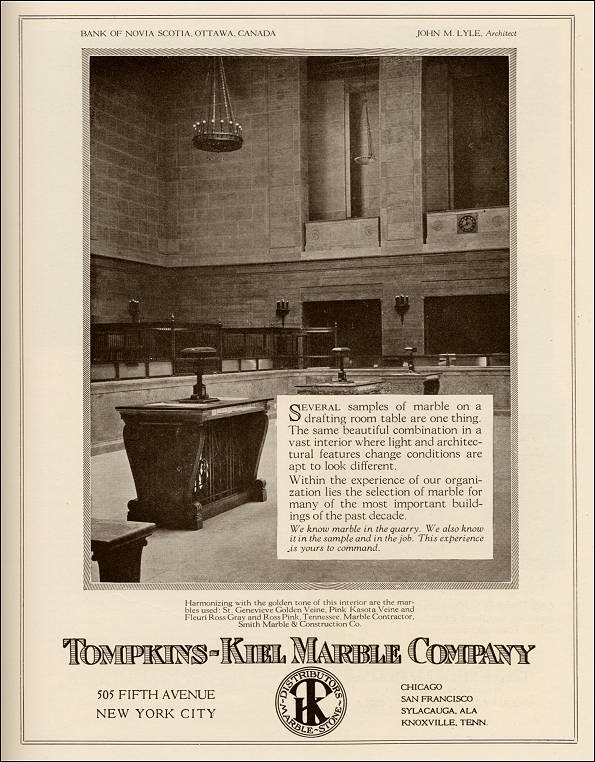
- Ottawa, Canada - the Bank of Nova Scotia (Tompkins-Kiel Marble Co., New York City, New York, advertisement from Throvgh The Ages Magazine, July 1925, Vol. 3, No. 3, pp. 47)
Bank of Nova Scotia, Ottawa, Canada, John M. Lyle, Architect. Harmonizing with the golden tone of this interior are the marbles used: St. Genevieve Golden Veine, Pink Kasota Vein and Fleuri Ross Gray and Ross Pink, Tennessee. Marble Contractor, Smith Marble & Construction Co. 
Tompkins-Kiel Marble Company, 505 Fifth Avenue, New York City
Chicago - San Francisco - Sylacauga, Ala. - Knoxville, Tenn.
Several samples of marble on a drafting room table are one thing. The same beautiful combination in a vast interior where light and architectural features change conditions are apt to look different. Within the experience of our organization lies the selection of marble for many of the most important buildings of the past decade. We know marble in the quarry. We also know it in the sample and in the job. This experience is yours to command.
- Ottawa, Canada - the Bank of Nova Scotia (from the
article entitled, “The Bank of Nova Scotia At Ottawa, Canada,” by
John M. Lyle, in Throvgh The Ages Magazine, January 1926, Vol.
3, No. 9, pp. 19-24.)
Main Entrance Door to Banking Room. (pp. 23) 
“Entering through large mahogany doors, one comes first to a marble-walled vestibule...The floor is Pink Tennessee; the counter base, tops, check desks, marble seat and trim around main entrance door are St. Genevieve....”
- Toronto, Canada - Toronto Union Station - the Elevator Hall (from Stone Magazine, September 1925, Vol. XLVI, No. 9, pp. 539)
Elevator Hall in the new Toronto Union Station, Toronto, Canada, a Beautiful Example of the Use of Napoleon Gray Marble. Ross & MacDonald, Montreal, and John Lyle, Toronto, architects. Marble furnished by the Tompkins-Kiel Marble Co., to George Oakley & Son, Ltd., Toronto Marble Contractors. 
- Toronto, Canada - the Toronto Union Station - the Vestibule Walls in the Office Section (from the article entitled, “The Union Station in Toronto: The New Building is Owned Jointly by the Canadian Pacific Railway and the Dominion of Canada,” by John M. Lyle, Associate Architect, in Throvgh The Ages Magazine, December 1925, Vol. 3, No. 8, pp. 21.)
“The vestibule walls of the office section, as also those of the cab stand, together with the floors, are of Pink Tennessee. The vestibule of the post office section is of Napoleon Gray, as are the lavatory partitions of this section.”
-
Toronto, Canada – Union Station – the Public Space & Walls (from Napoleon Gray, An Adaptable Marble, Phenix Marble Company, Kansas City, Missouri, Producers, and Tompkins-Kiel Marble Company, New York City, New York, Distributors, 1926, pp. 28 and 36)
“The Post Office and public space in the Union Station, Toronto. All standing marble is Napoleon Gray. Ross & MacDonald, Montreal, Architects, and Jno. M. Lyle, Toronto, and Hugh G. Jones, Montreal, Associates; Marble Contractor, George Oakley & Son, Ltd., Toronto.” (pp. 28) 
“Napoleon Gray marble in the walls of the Union Station, Toronto, Canada. Ross & McDonald, Montreal, Architects, and John M. Lyle, Toronto, and Hugh G. Jones, Montreal, Associates; Marble Contractor, George Oakley & Son, Ltd., Toronto.” (pp. 36) 
- Toronto, Canada - the Toronto Union Station - the Vestibule Walls in the Office Section (from the article entitled, “The Union Station in Toronto: The New Building is Owned Jointly by the Canadian Pacific Railway and the Dominion of Canada,” by John M. Lyle, Associate Architect, in Throvgh The Ages Magazine, December 1925, Vol. 3, No. 8, pp. 21.)
“A Napoleon Gray treatment in the Mechanics Institute at Montreal, Canada. Hutchinson, Wood & Miller, Montreal, Architects; Marble Contractors, Smith Marble Company, and Construction Company, Ltd., Montreal.” (pp. 27) 
- Montreal, Quebec, Canada - the Court House Building (from Missouri Marble,
by Norman S. Hinchey, Report of Investigations No. 3, Missouri Geological
Survey and Water Resources, Rolla, Missouri, 1946. Used with permission
of the Missouri Department of Natural Resources.)




Commercial use of material within this site is strictly prohibited. It is not to be captured, reworked, and placed inside another web site ©. All rights reserved. Peggy B. and George (Pat) Perazzo.