

Structures and Monuments in Which Missouri Stone was Used
- Finished Products from Missouri Stone in Illinois
- Chicago, Illinois – the Buckingham Memorial Fountain in Grant Park (A. J. Sheahan Granite Co., Graniteville, Missouri, advertisement from American Stone Trade, April, 1932, Vol. XXXII, No. 9, pp. 4.)
The Famous Buckingham Memorial Fountain in Grant Park, Chicago (Illinois). The polished columns of the Buckingham Fountain were cut in our granite. 
Missouri Red Granite - Unequaled for Memorials
The most resplendent red when polished, and when fine axed it is the warm pink most desired for art expressions. Known to the trade as Sheahan’s Missouri Red, it is always the best choice for Vaults and Public Monuments, as well as Family Memorials. Quarry facilities for prompt shipment were never better than at the present time. We supply rough stock only. Any size - any quantity.
A.J. Sheahan Granite Co. - Quarriers, Graniteville, Missouri
- Chicago, Illinois - the Building on Adams Street between Fifth Avenue and Franklin - the Window Sills (from “Notes on The Building Stones, Clays and Sands of Iron, St. Francois and Madison Counties,” by G. E. Ladd, Assistant Geologist, in Bulletin 1, Geological Survey of Missouri, Jefferson City, April 1890.)
Granite quarried from one of the quarries at Graniteville, Iron County, Missouri, operated by the Syenite Granite Company, was used in the construction of the window sills on this building, “which are each 3 feet square by 17 feet 4 inches long.” “The color of this stone is red or dark pink, mottled with gray and black, the red shades being due to feldspar, the others to a more or less smoky quartz. The rock takes a high, lustrous and handsome polish....”
-
Chicago, Illinois – the Capitol Building – Lobby Floor (from Napoleon Gray, An Adaptable Marble, Phenix Marble Company, Kansas City, Missouri, Producers, and Tompkins-Kiel Marble Company, New York City, New York, Distributors, 1926, pp. 32)
- Chicago, Illinois - the City State Bank - the Interior (from Stone Magazine,
February 1926, Vol. XLVII, No. 2, pp. 94.)
Interior City State Bank, 128 N. Wells St., Chicago, finished in Napoleon Gray Marble. Designed and installed by the Peerling Marble Company. 
- Chicago, Illinois - the Cook County Court House
Building (from Missouri Marble, by Norman S. Hinchey,
Report of Investigations No. 3, Missouri Geological Survey and Water
Resources, Rolla, Missouri, 1946.)
Marble quarried from the Phenix Marble Company’s “Old West Quarry” at Phenix, Greene County, Missouri, was used in the construction of the Cook County Court House building prior to 1942.
- Chicago, Illinois - the Cook County Criminal Court
Building (from Missouri Marble, by Norman S. Hinchey,
Report of Investigations No. 3, Missouri Geological Survey and Water
Resources, Rolla, Missouri, 1946.)
Marble quarried from the Phenix Marble Company’s “Old West Quarry” at Phenix, Greene County, Missouri, was used in the construction of the Cook County Criminal Court building prior to 1942.
- Chicago, Illinois - the Cook County Jail Building (from Missouri
Marble, by Norman S. Hinchey, Report of Investigations No. 3,
Missouri Geological Survey and Water Resources, Rolla, Missouri, 1946.)
Marble quarried from the Phenix Marble Company’s “Old West Quarry” at Phenix, Greene County, Missouri, was used in the construction of the Cook County Jail building prior to 1942.
- Chicago, Illinois - the Edgewater Beach Hotel Outdoor Marble Dance Floor (Phenix Marble Co., Kansas City, Missouri, advertisement from Throvgh The Ages Magazine, January 1926, Vol. 3, No. 9, pp. 50)

A Marble Dance Floor
Phenix Marble Company, Kansas City, Missouri.
So far as we know, this is the only outside marble dance floor in the country. In 1920 The Edgewater Beach Hotel, on Lake Michigan, Chicago, decided to build an uncovered dance floor directly on the beach, a few feet from the water. As it would be subject to summer suns as well as winter snows, it necessarily had to be of some material not affected by the elements. Napoleon Gray Marble in tiles 8 inches by 16 inches was the choice. The floor has stood up so well that lately another section has been added.
-
Chicago, Illinois – the Edgewater Beach Hotel – the Outdoor Dan Floor (from Napoleon Gray, An Adaptable Marble, Phenix Marble Company, Kansas City, Missouri, Producers, and Tompkins-Kiel Marble Company, New York City, New York, Distributors, 1926, pp. 22)
“The outdoor dance floor of Napoleon Gray marble owned by the Edgewater Beach Hotel, of Chicago. The hotel is the year-round home of a number of the well-to-do people of Chicago, and the dance floor was erected for their convenience directly on the beach. As it would be open to summer suns and winter snows, it was necessary to use some material that would withstand the elements and maintain its smooth surface. The floor is 40 by 140 feet, the tiles of Napoleon Gray being 8 inches wide by 16 inches long. Marshall & Fox, Chicago, Architects; Marble Contractor, Naughton Marble Company, Chicago.” - Chicago, Illinois - the Edgewater Beach Hotel
Outdoor Marble Dance Floor (Phenix Marble
Company Advertisement) (from Throvgh The Ages Magazine,
September 1928, Vol. 6, No. 5, pp. 58)
The Edgewater Beach Hotel, Chicago, owns the dance floor: Marshall & Fox, Chicago, were the Architects; and Naughton Marble Co., Chicago, was the Marble Contractor. 
Phenix Marble Company, Suite 609, Scarritt Building
Napoleon Gray - Exceptional Durability
The severe conditions imposed upon this outdoor dance floor by summer suns and winter snows...and the scuffing of thousands of dancing feet...have been satisfactorily met by the use of Napo leon Gray marble. The surface, after several years of wear, is as good as new!! The Edgewater Beach Hotel, Chicago, owns the dance floor: Marshall & Fox, Chicago, were the Architects; and Naughton Marble Co., Chicago, was the Marble Contractor. Napoleon Gray may be procured in sound large-sized blocks and slabs in any quantity and without delay. May we send you a copy of our book containing views of various installations of Napo leon Gray? Marble samples sent upon request.
Outdoor dance floor of Napoleon Gray marble owned by the Edgewater Beach Hotel, of Chicago, 1926 (pp. 22) 
-
- Chicago, Illinois - the Elks National Memorial Headquarters Building (from article entitled, “The Elks National Memorial Headquarters Building in Chicago: A Year and a Half was Required to Select and Prepare the Colored Marbles Used in the Interior,” in Throvgh The Ages Magazine, August 1926, Vol. 4, No. 4, pp. 24-32.)
The floor of the Rotunda is of Pink Tennessee, with Carthage borders and strips, and insets of vari-colored marbles. E. L. Fowler. 
“The entire floor in the main rotunda is made out of Pink Tennessee and Carthage marble borders and strips, and large square and round dots or plaques of various colored marbles similar to those used in the large columns The circles and square tiles in the floor are 3 feet 4 inches in width. The floors in the corridors are of Napoleon Gray marble, from Missouri. “It required a year and a half to secure, select and prepare all of the colored marbles used in the Elks Memorial. Both color and soundness had to be carefully considered, as well as the size of the blocks and the veining. This marble installation affords a striking illustration of a fact that is frequently over-looked by the architect; that where any large work is in prospect, the marble should be ordered at least a year ahead, in order to allow time for the special quarrying necessary.”
- Chicago, Illinois - the Federal Reserve Bank Building (from “New
Missouri Marble Mill,” in Stone Magazine, November 1925,
Vol. XLVI, No. 11, pp. 674-676)
Colonial Grey Marble quarried by F. W. Steadley & Co., Inc., of Carthage, Missouri, was used in the construction of the Federal Reserve Bank building prior to 1926.
-
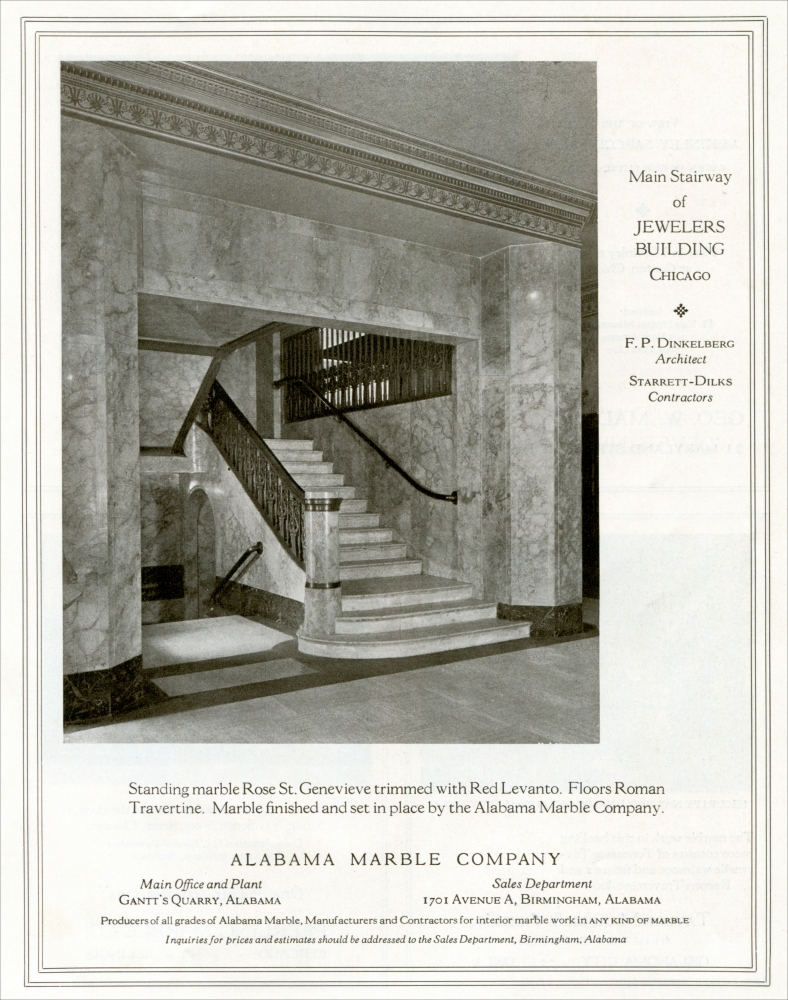
Chicago, Illinois – the Jewelers Building (Advertisement from Through The Ages, Vol. 5, No 8, December 1927, pp. 49)
Alabama Marble Company
Main office and plant: Gantt’s Quarry, Alabama
Sales Department: 1701 Avenue A, Birmingham, AlabamaProducers of all grades of Alabama Marble, Manufacturers and Contractors for interior marble work in any kind of marble.
“Main Stairway of Jewelers Building, Chicago, Illinois. F. P. Dinkelberg, Architect. Starrett-Dilks, Contractors. Standing marble Rose St. Genevieve trimmed with Red Levanto. Floors Roman Travertine. Marble finished and set in place by the Alabama Marble Company.” 
- Chicago, Illinois – the KearsargeBuilding (from The Quarrying Industry of Missouri, by Ernest Robertson Buckley and H. A. Buehler, 1904, page 74)
Deep red colored granite quarried in the Graniteville, Missouri, quarries was used with wholly or in part in the construction of the Kearsarge building.
- Chicago, Illinois - the Marshal Field Building (from “Notes on The Building Stones, Clays and Sands of Iron, St. Francois and Madison Counties,” by G. E. Ladd, Assistant Geologist, in Bulletin 1, Geological Survey of Missouri, Jefferson City, April 1890.)
Granite quarried from one of the quarries at Graniteville, Iron County, Missouri, operated by the Syenite Granite Company, was used in the construction of the Marshall Field Building. “The color of this stone is red or dark pink, mottled with gray and black, the red shades being due to feldspar, the others to a more or less smoky quartz. The rock takes a high, lustrous and handsome polish....”
- Chicago, Illinois – the
Marshall-Field Building (26
lintels of 8 tons each were used in the Marshall Field building)
(from The Quarrying Industry of Missouri, by Ernest Robertson
Buckley and H. A. Buehler, 1904, page 74)
Deep red colored granite quarried in the Graniteville, Missouri, quarries was used in the 26 lintels of 8 tons each in the Marshall-Field building.
- Chicago, Illinois – the
Marshall-Field Building (26
lintels of 8 tons each were used in the Marshall Field building)
(from The Quarrying Industry of Missouri, by Ernest Robertson
Buckley and H. A. Buehler, 1904, page 74)
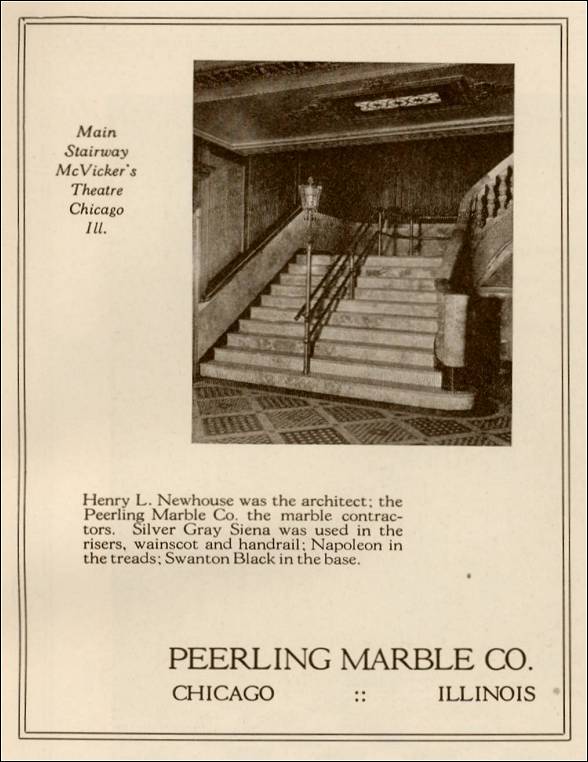
- Chicago, Illinois - the McVicker’s Theatre (Peerling
Marble Co., Chicago, Illinois, advertisement from Throvgh
The Ages Magazine, April 1924, Vol. 1, No. 12, pp. 65. This
advertisement is from a bound book of many issues of Throvgh
The Ages Magazine at the back of the book.)
Main Stairway McVicker’s Theatre, Chicago, Ill. Henry L. Newhouse was the architect; the Peerling Marble Co. the marble contractors. Silver Gray Siena was used in the risers, wainscot and handrail; Napoleon in the treads; Swanton Black in the base. 
Peerling Marble Co., Chicago, Illinois
- Chicago, Illinois - the Merchandise Mart Building - Lavatories (from Missouri Marble, by Norman S. Hinchey, Report of Investigations No. 3, Missouri Geological Survey and Water Resources, Rolla, Missouri, 1946)
Ozark Veined Marble (a limestone) quarried at Carthage, Missouri, was used in the construction of the lavatories in the interior of the Merchandise Mart building.
- Chicago, Illinois – the Monadnock Building (from The Quarrying Industry of Missouri, by Ernest Robertson Buckley and H. A. Buehler, 1904, page 74)
Deep red colored granite quarried in the Graniteville, Missouri, quarries was used with wholly or in part in the construction of the Monadnock building
- Chicago, Illinois - the Rialto Building (from “Notes
on The Building Stones, Clays and Sands of Iron, St. Francois and
Madison Counties,” by G. E. Ladd, Assistant
Geologist, in Bulletin 1, Geological Survey of Missouri,
Jefferson City, April 1890)
Granite quarried from one of the quarries at Graniteville, Iron County, Missouri, operated by the Syenite Granite Company, was used in the construction of the Rialto Building. “The color of this stone is red or dark pink, mottled with gray and black, the red shades being due to feldspar, the others to a more or less smoky quartz. The rock takes a high, lustrous and handsome polish....”
- Chicago, Illinois – the Rialto (from The
Quarrying Industry of Missouri, by Ernest Robertson Buckley
and H. A. Buehler, 1904, page 74)
Deep red colored granite quarried in the Graniteville, Missouri, quarries was used with wholly or in part in the construction of the Rialto.
- Chicago, Illinois – the Rialto (from The
Quarrying Industry of Missouri, by Ernest Robertson Buckley
and H. A. Buehler, 1904, page 74)
- Chicago, Illinois - the Rookery Building (from “Notes on The Building Stones, Clays and Sands of Iron, St. Francois and Madison Counties,” by G. E. Ladd, Assistant Geologist, in Bulletin 1, Geological Survey of Missouri, Jefferson City, April 1890.)
Granite quarried from one of the quarries at Graniteville, Iron County, Missouri, operated by the Syenite Granite Company, was used in the construction of the Rookery Building. “The color of this stone is red or dark pink, mottled with gray and black, the red shades being due to feldspar, the others to a more or less smoky quartz. The rock takes a high, lustrous and handsome polish....”
- Chicago, Illinois – the Rookery (from The Quarrying Industry of Missouri, by Ernest Robertson Buckley and H. A. Buehler, 1904, page 74)
Deep red colored granite quarried in the Graniteville, Missouri, quarries was used with wholly or in part in the construction of the Rookery.
- Chicago, Illinois – the Rookery (from The Quarrying Industry of Missouri, by Ernest Robertson Buckley and H. A. Buehler, 1904, page 74)
- Chicago, Illinois - the Rosenwald Museum Building, University of Chicago - Floors (from Missouri Marble, by Norman S. Hinchey, Report of Investigations No. 3, Missouri Geological Survey and Water Resources, Rolla, Missouri, 1946)
Ozark Tavernelle Marble (a limestone) quarried at Carthage, Missouri, was used in the construction of the floors in the interior of the Rosenwald Museum building at the University of Chicago.
- Chicago, Illinois - the St. Thomas Acquinas Church - Interior (from Stone Magazine, January 1926, Vol. XLVII, No. 1, pp. 34)
Section of Interior of St. Thomas Acquinas Church, Chicago. Finished in Napoleon Gray Marble. Enterprise Marble Co., Marble Contractors. K.M. Vitzhun Company, Architects. 
-
Chicago, Illinois – the St. Thomas Aquinas Church – the Interior (from Napoleon Gray, An Adaptable Marble, Phenix Marble Company, Kansas City, Missouri, Producers, and Tompkins-Kiel Marble Company, New York City, New York, Distributors, 1926, pp. 35)
- Chicago, Illinois -
the St. Thomas Acquinas Church -
the Interior Walls (Advertisement) (from Throvgh The
Ages Magazine, April 1926, Vol. 3, No. 12, pp. 44.)
Napoleon Gray walls in St. Thomas Acquimas (sic) Church, Chicago, Ill. K. M. Vitzthum and Co., Architects. Enterprise Marble Co. Contractors. 
Phenix Marble Company, Suite 609, Scarritt Bldg., Kansas City, Missouri
A Marble of Extraordinary Qualities
In color gray, but a gray that has life and charm and distinction. In use impervious to moisture, non-slip and carvable. For exterior or interior in any size or quantity you require. In price so low that you too will join the great army of architects and contractors who use it steadily. Samples on request.
- Chicago, Illinois - the Stevens Hotel (from Missouri Marble, by Norman S. Hinchey, Report of Investigations No. 3, Missouri Geological Survey and Water Resources, Rolla, Missouri, 1946.)
Ste. Genevieve Golden Vein Marble, quarried in Ste. Genevieve County, Missouri, was used in the construction of the Stevens Hotel building.
- Chicago, Illinois - the Straus Building (from “New
Missouri Marble Mill,” in Stone Magazine, November 1925,
Vol. XLVI, No. 11, pp. 674-676)
Colonial Grey Marble quarried by F. W. Steadley & Co., Inc., of Carthage, Missouri, was used in the construction of the Straus building prior to 1926.
- Chicago, Illinois - the StudebakerBuilding - the Columns in Front (from “Notes on The Building Stones, Clays and Sands of Iron, St. Francois and Madison Counties,” by G. E. Ladd, Assistant Geologist, in Bulletin 1, Geological Survey of Missouri, Jefferson City, April 1890.)
Granite quarried from one of the quarries at Graniteville, Iron County, Missouri, operated by the Syenite Granite Company, was used in the construction of “the columns in the front of the Studebaker building, in Chicago, which are ten in number and are each 18 feet high and 4 ½ feet in diameter, and weigh about 18 tons...The color of this stone is red or dark pink, mottled with gray and black, the red shades being due to feldspar, the others to a more or less smoky quartz. The rock takes a high, lustrous and handsome polish....”
- Chicago, Illinois – the Studebaker Building (Two
polished columns, 14 tons each, were used in the Studebaker
building) (from The Quarrying Industry of Missouri,
by Ernest Robertson Buckley and H. A. Buehler, 1904, page 74)
Deep red colored granite quarried in the Graniteville, Missouri, quarries was used in the two polished columns in the Studebaker building.
- Chicago, Illinois – the Studebaker Building (Two
polished columns, 14 tons each, were used in the Studebaker
building) (from The Quarrying Industry of Missouri,
by Ernest Robertson Buckley and H. A. Buehler, 1904, page 74)
- Chicago, Illinois - Union Station built circa 1925 (from “New
Missouri Marble Mill,” in Stone Magazine, November 1925,
Vol. XLVI, No. 11, pp. 674-676)
Colonial Grey Marble quarried by F. W. Steadley & Co., Inc., of Carthage, Missouri, was used in the construction of the Union Station building prior to 1926.
- Chicago, Illinois - World’s Columbian Exposition of 1893 - the Missouri State Section of the Exposition - the Pavilion Granite Base, presented on “World’s Columbian Exposition of 1893, Paul V. Galvin Library Digital History Collection, Illinois Institute of Technology. (The Missouri state section of the exposition is described in Chapter 16. - The Book of The Fair: Chapter the Sixteenth.” Scroll down to the entry.)
The granite used for the base of the Missouri Pavilion was quarried from the syenite quarries of southeastern Missouri.
- Chicago, Illinois - the Wrigley Building - Interior (from Throvgh
The Ages Magazine, October 1925, Vol. 3, No. 6, pp. 34-38.)
“One of the chief features of the interior of the Wrigley Building is the extensive marble treatment. The floors of the entrance vestibule, lobbies and elevator halls of both sections are of Clear Face Carthage marble....”
- Chicago, Illinois - the Wrigley Building - Interior (from Throvgh
The Ages Magazine, October 1925, Vol. 3, No. 6, pp. 34-38.)
“One of the chief features of the interior of the Wrigley Building is the extensive marble treatment. The floors of the entrance vestibule, lobbies and elevator halls of both sections are of Clear Face Carthage marble....”
- Chicago, Illinois - the Wrigley Building - Interior (from Throvgh
The Ages Magazine, October 1925, Vol. 3, No. 6, pp. 34-38.)
- Chicago, Illinois - the
Wrigley Building (from
article entitled, “Marble Floors: Suggestions About the Proper
Method for Laying Them,” in Throvgh The Ages Magazine,
March 1927, Vol. 4, No. 11, pp. 38-39.)
The floors of the entrance vestibule, lobbies and elevator halls of the WrigleyBuilding, in Chicago, are of Carthage marble. The corridor floors throughout are of Alabama marble. Graham, Anderson, Probst & White, architects. (pp. 39) 
- Decatur, Illinois – the Chas. T. Johnston Residence
Limestone quarried from the Carthage, Missouri, area was used with wholly or in part in the construction of the residence. The color of the Carthage limestone ranges from brown and gray to white. Some of the stone has a faint blue tint. (from The Quarrying Industry of Missouri, by Ernest Robertson Buckley and H. A. Buehler, 1904, pages 133- 134.)
- Des Plaines, Illinois - the United States Post Office (from Missouri Marble, by Norman S. Hinchey, Report of Investigations No. 3, Missouri Geological Survey and Water Resources, Rolla, Missouri, 1946. Used with permission of the Missouri Department of Natural Resources.)
Adorado or Ste. Genevieve Botticino Marble quarried from the Inkley Marble Quarries Company quarry located southwest of Ste. Genevieve, Missouri, was used in the construction of the United States Post Office building in Des Plaines.
- East. St. Louis, Illinois - the Elevated Railroad Tops of Piers (from A Report on Mine La Motte Sheet, including Portions of Madison, St. Francois and Ste. Genevieve Counties, by Charles Rollin Keyes, State Geologist, Missouri Geological Survey, Reports on Areal Geology (Sheets 1-4) Volume IX, 1896)
Quarried granite dimension stone from the Berry Quarry, which was located three miles northwest of Knob Lick, Missouri, was used in the construction of the tops of the piers of the elevated railroad at East St. Louis, Illinois.
- Elmwood, Illinois - the J. P. Bourgoin & Co. - Diamond Quality Monumental Work (Advertisement)
Missouri Red Granite
The Diamond Trade Mark Denotes Quality
J.P. Bourgoin & Co. Elmwood, Ill. Diamond Quality Monumental Work
When you order Red Granite for your Monumental, Building and Turned Work, be sure to specify Missouri Red. It is used by particular dealers everywhere. Missouri Red is the red granite par excellence and is demanded in many cases where a colored granite is desired. Whether a monument, marker or roll, the excellent quality and fine texture wins public approval.
The best of workmanship and prompt delivery is guaranteed.
J. P. Bourgoin & Co., Elmwood, Ill.
Long Distance Phone 52
-
Evanston, Illinois – the Westmoreland Country Club (from Napoleon Gray, An Adaptable Marble, Phenix Marble Company, Kansas City, Missouri, Producers, and Tompkins-Kiel Marble Company, New York City, New York, Distributors, 1926, pp. 38)
- Lake Forest, Illinois - the U.S. Post Office or
Court House Buildings (from Missouri Marble, by
Norman S. Hinchey, Report of Investigations No. 3, Missouri Geological
Survey and Water Resources, Rolla, Missouri, 1946.)
Marble quarried from the Phenix Marble Company’s “Old West Quarry” at Phenix, Greene County, Missouri, was used in the construction of the U.S. Post Office or Court House buildings prior to 1942.
- Macomb, Illinois – the State Normal Building - the Steps
(from The Quarrying Industry of Missouri,
by Ernest Robertson Buckley and H. A. Buehler, 1904, pages 133-134.)
Limestone quarried from the Carthage, Missouri, area was used for the steps at the building. The color of the Carthage limestone ranges from brown and gray to white. Some of the stone has a faint blue tint.
- Manteno, Illinois - the State Hospital Building (from Missouri Marble, by Norman S. Hinchey, Report of Investigations No. 3, Missouri Geological Survey and Water Resources, Rolla, Missouri, 1946)
Ozark Veined Marble (a limestone) quarried at Carthage, Missouri, was used in the construction in the interior of the State Hospital building.
- Rock Island, Illinois - the Denkman Memorial Library (from Building Stones and Clay-Products: A Handbook For Architects, by Heinrich Ries, Ph.D., 1912)
“This state does not produce any true marble, but the dense, light cream white limestone quarried near Carthage is often classed as such in the trade. This stone takes a polish and might be classed as a monotone marble.” Limestone quarried near Carthage, Missouri, was used in the construction of the Denkman Memorial Library.
- Rock Island, Illinois - the Senior High School Building (from Missouri Marble, by Norman S. Hinchey, Report of Investigations No. 3, Missouri Geological Survey and Water Resources, Rolla, Missouri, 1946)
Ozark Fleuri Marble (a limestone) quarried at Carthage, Missouri, was used in the construction in the interior of the Senior High School building constructed prior to 1946.
- Rock Island, Illinois - the United States Rock Island Arsenal Building (from “Notes on The Building Stones, Clays and Sands of Iron, St. Francois and Madison Counties,” by G. E. Ladd, Assistant Geologist, in Bulletin 1, Geological Survey of Missouri, Jefferson City, April 1890.)
Granite quarried from the Milne and Gordon quarry located in township 34 north, range 6 east, section 5, near the center, St. Francois County, Missouri, was used in the construction of the United States Rock Island Arsenal building.
- Quincy, Illinois - the Granite Bank Gallery, 428 Maine (photograph and history) (The following information is from the Granite Bank Gallery web site.)
According to this web site, “The Granite Bank Gallery was named for the pink Missouri granite used for the building’s façade and for its long-reaching roots in Quincy’s history.” The bank was built in 1892 by the Bull brothers, and it closed in 1932.
-
South Park, Chicago – the McKinley Park Bath – the Shower Walls (from Napoleon Gray, An Adaptable Marble, Phenix Marble Company, Kansas City, Missouri, Producers, and Tompkins-Kiel Marble Company, New York City, New York, Distributors, 1926, pp. 32)
- Springfield, Illinois - the Abraham Lincoln Tomb (from Missouri Marble, by Norman S. Hinchey, Report of Investigations No. 3, Missouri Geological Survey and Water Resources, Rolla, Missouri, 1946.)
Ste. Genevieve Golden Vein Marble, quarried in Ste. Genevieve County, Missouri, was used in the construction of the Abraham Lincoln Tomb.
- Springfield, Illinois - the Illinois State House (from “Notes on The Building Stones, Clays and Sands of Iron, St. Francois and Madison Counties, ” by G. E. Ladd, Assistant Geologist, in Bulletin 1, Geological Survey of Missouri, Jefferson City, April 1890.)
Granite quarried from Ozark Mountain granite quarry located a quarter of a mile south of Graniteville, Iron County, Missouri, was used in the construction of the Illinois State house. “The stone taken out was, however, inferior to what can be obtained, as it was mostly surface rock.”
- Springfield, Illinois – the State House (from The Quarrying Industry of Missouri, by Ernest Robertson Buckley and H. A. Buehler, 1904, page 74)
Deep red colored granite quarried in the Graniteville, Missouri, quarries was used with wholly or in part in the construction of the State House.
- Springfield, Illinois – the State House (from The Quarrying Industry of Missouri, by Ernest Robertson Buckley and H. A. Buehler, 1904, page 74)
- Thebes, Illinois - the Thebes Bridge (from The Quarrying Industry of Missouri, by E. R. Buckley, Director and State Geologist, and H. A. Buehler, Missouri Bureau of Geology and Mines Vol. II, 2nd Series, 1904.)
“Two quarries are located near the Mississippi river at this place, both of which are operated to supply crushed stone used in the erection of the Thebes bridge, at Thebes, Illinois. The land on which the quarries is located is owned by Mr. Gray, to whom a royalty of 5 cents per cubic yard is paid.
“The stone is obtained from the Trenton-Kimmswick formation. It is a very coarsely crystalline, light gray limestone, similar to that at Ste. Genevieve. It is fossiliferous, contains an occasional fine suture joint and occurs in thick beds. It is very pure and makes an excellent grade of quicklime.
“(The McDonald Company’s limestone) quarry, which was opened in January, 1903, will probably be operated only until the completion of the Thebes bridge....”
“Thirty men are employed and the plant has a capacity of from 600 to 700 cubic yards of crushed stone per day.”
“(The Patterson Construction Company’s limestone) quarry joins the McDonald quarry on the west and the stone is, in all respects, similar....”
“The quarry is equipped with a crushing plant, consisting of a No. 6 crusher and accessories. The stone is loaded on barges and transported to Thebes where it is used for concrete work in the Thebes bridge.”
- Urbana-Champaign, Illinois – the University of Illinois
- the Natural Resources Building (photographs and history)
The Natural Resources Building Architecture
The Natural Resources Building Architecture – East Entrance Exterior
The Natural Resources Building Architecture – Sources
“The light gray, faintly mottled limestone that frames the door contains whole fossils, fossil fragments, and pellets. This stone, called the Ozark Tavernelle Marble, and three others used inside the building, were supplied by the Carthage Marble Corporation of Carthage, southwestern Missouri. The stone industry gives the name Ozark Tavernelle Marble to limestones that take a high polish and to marbles - the white and varicolored metamorphic carbonate rocks used to make gravestones, statues, and buildings. Tavernelle is an old building stone term that means spotted or mottled.
“The floor and stairs at the east entrance interior are built with “…the brown to dark brown limestone that contains very light brown speckles is Nerobi Marble. It came from a bed in the Warsaw Formation at Carthage quarry.
“Marble was used for the rest room partitions and wall veneer as “…polished limestone panels (of) Ozark Veined Marble from the Carthage Marble Corporation Quarry in Missouri. The light gray and light olive gray limestone contains wispy, dark gray figures. It comes from the same quarry ledge as the Ozark Tavernelle stone. The veined rock comprises about the upper three-fourths of the ledge and the Tavernelle the lower one-fourth. The veins in the stone are stylolites.”
- Urbana, Illinois - the University of Illinois - the Natural Science Building (from Missouri Marble, by Norman S. Hinchey, Report of Investigations No. 3, Missouri Geological Survey and Water Resources, Rolla, Missouri, 1946)
Warrensburg sandstone quarried from the Pickel Sandstone Quarry located north of Warrensburg, Missouri, was used in the construction of the Natural Science building prior to 1904.
- Urbana, Illinois - the University of Illinois - the Natural Science Building (from Missouri Marble, by Norman S. Hinchey, Report of Investigations No. 3, Missouri Geological Survey and Water Resources, Rolla, Missouri, 1946)
- Vandalia, Illinois - the
Madonna of the Trail Statue in Vandalia, Illinois,
dedicated on October 26, 1928 (photographs) (The following quotation
is from Wikipedia, the free encyclopedia.)
The statue in Albuquerque, New Mexico, was dedicated on September 27, 1928.
The following quotation is from Wikipedia, the free encyclopedia.
“Madonna of the Trail is a series of monuments dedicated to the spirit of pioneer women in the United States. The monuments were commissioned by the National Society of Daughters of the American Revolution (NSDAR). They were placed along the National Old Trails Highway and extended from Bethesda, Maryland, to Upland, California, in each of the 12 states the road passed through.
“Created by sculptor August Leimbach and funded by contributions, the Madonna of the Trail monuments were intended to provide a symbol of the courage and faith of the women whose strength and love aided so greatly in conquering the wilderness and establishing permanent homes.
“Dedicated in 1928 and 1929, with each of the 12 located in a different state, they became a source of local pride. Through the continuing efforts of local and national groups, all are currently in good condition and on display....”
“The figure stands 10 feet high with a weight of 5 tons. The figure and the base are made of algonite stone (a poured mass) of which Missouri granite is used as the main aggregate, thus giving the monument a warm, pink shade. With the base, the monuments are about 18 feet high. The inscriptions on the east and west sides of each base are the same, but the north and south sides of each monument usually include local information as well.”
“The lobby floor of the Capitol Building in Chicago is of Napoleon Gray marble. W. W. Ahschlager, Chicago, Illinois, Architect; Marble Contractor, Flavin Marble Mill, Chicago.” (pp. 32) 
“The interior of the St. Thomas Aquinas Church, Chicago, is of Napoleon Gray marble. K. M. Vitzthum Co., Chicago, Architects; Marble Contractor, Enterprise Marble Co., Chicago.” (pp. 35) 
“Napoleon Gray marble showers in the Westmoreland Country Club Evanston, Illinois. R. S. DeGolyer, Chicago, Architect; Marble Contractor, Flavin Marble Mill, Chicago.” (pp. 38) 
“The walls of the girls’ shower room in the McKinley Park Bath, South Park, Chicago, are of Napoleon Gray marble. J. F. Foster, of Chicago, Architect; Marble Contractor, Flavin Marble Mill, Chicago, Ilinois.” (pp. 32) 
- Chicago, Illinois – the Buckingham Memorial Fountain in Grant Park (A. J. Sheahan Granite Co., Graniteville, Missouri, advertisement from American Stone Trade, April, 1932, Vol. XXXII, No. 9, pp. 4.)




Commercial use of material within this site is strictly prohibited. It is not to be captured, reworked, and placed inside another web site ©. All rights reserved. Peggy B. and George (Pat) Perazzo.