Quarries & Quarry Links, Photographs and Articles
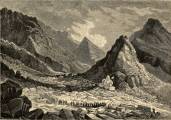
- Great Bend Area, Kansas - Pawnee Rock, one of the best known natural landmarks along
the Santa Fe Trail. Pawnee Rock was also referred to as the “Citadel
of the Prairie.” According to this web site, “some of the rock was
removed by settlers and the railroads for construction materials.” (The link to the above information is no longer available, although you view the information on the Internet Archive Wayback Machine.)
<http://www.lasr.net/leisure/kansas/barton/greatbend/att7.htm>- Click here for a photograph of Pawnee Rock and more history on the Pawnee Rock on the LASR web site. Once there, click on “Attractions,” then click on “Pawnee Rock State Landmark.” Click here for more information on the history of Pawnee Rock and about visiting the site, presented by the Kansas State Historical Society.
- Great Bend, Kansas - Pearl Sams, Marble Cutter. The following article is from “Some Women Marble Cutters,” in The Monumental News Magazine, the date of the original publication is unknown, although it was published some years after 1885, pp. 120 (?). This article was included as one of the past articles of the magazine in the December, 1939 issue of The Monumental News Magazine. (Scroll down to Pearl Sams’ section of the article below.)
Some Women Marble Cutters
“When Tennyson wrote, ‘Man for the field, and woman for the hearth; man for the sword and for the needle she,’ he could not have foreseen how soon this statement would need revision. Man has well nigh deserted the sword; woman’s needle is now driven by machinery, and in her search for new fields of action, she has invaded many trades and professions that were formerly regarded as the sole prerogative of man. Women in mercantile establishments and business offices no longer excite comment. Chicago has some women bank tellers, and every one of the professions has its women representatives, and the census strenuously announces that there are some women blacksmiths.
“‘Monumental News’ has recently been trying to discover how many women are identified with the arts and crafts tributary to the marble and granite industries, and while the returns have not been by any means complete, we present on this page some evidence of the fact that woman is deserting the needle and taking up the chisel. It is well-known that there are a number of women sculptors who have achieved national prominence in their art, and one of whom is a member of the National Sculpture Society. Consequently our efforts were directed toward discovering some women marble cutters and carvers, and we have thus far succeeded in finding only three. This leads us to believe that the women connected with the trade are either scarce, or are of a more retiring disposition than their sisters in other walks of life, and we urge the timid ones to send along their photographs at once.
“The young ladies introduced on this page are all experienced and reliable in the work of ornamental carving, lettering, and tracing, and express themselves as well satisfied with their work.
“Miss Lucy J. Daniel, of Executor, Mo., was born in Carter county, Ky.; and learned the marble business with her father, who was in business in Charleston, Ark., and at Springdale, Ark., before moving to Exeter, Mo. she has had a long experience in the trade, having taken full charge of the shop in 1885, when she also began lettering. She does all of the lettering and some of the cutting and rubbing, and reports a good and growing business. She has recently been investigating homestead claims in western Kansas, and contemplates retiring from business and moving out there.
“Miss Alice E. Rigg is a Canadian girl, and acquired her first experience in the shop of her father, Geo. Rigg, at Windsor, Ontario. She cut her first inscription seven years ago, and has since become a valued assistant in her father’s business, and it is sufficient testimony to her skill to say that customers continue to be pleased with her work. She does not do stone cutting or the heavier work of the shop, but is an adept at carving, tracing, lettering and all ornamental work on granite and marble. Miss Rigg does much of her carving from original designs of her own, and become so skilled in this line that her drawings for carved work are in demand by out of town workers, and she is reputed to be the most skillful marble carver in Windsor, where her work is in great demand. Our illustration shows an excellent likeness of her in working costume.
“Miss Pearl Sams, of Great Bend, Kansas, also learned to handle the mallet and chisel under the instruction of her father, W. J. Sams who is a veteran monument man of thirty years’ experience. She writes that she began at the age of seventeen, and has been at the trade over seven years, thereby revealing what is commonly supposed to be one of the secrets of the sex. She received a thorough training in the craft, beginning with frosting, lettering footstones and small slabs and proceeded gradually to the better class of work. For the past three years she has been doing the best of lettering and tracing, and can cut an inscription as quickly and as thoroughly as the average man in the trade. She does not do heavy cutting or polishing, but considers herself master of the other branches of marble cutting. She says: ‘I love my trade and expect to follow it as long as my name is Miss Pearl Sams.’
“There are a number of women who are successfully managing businesses formerly conducted by their husbands, but very few of them do the actual work of cutting.”
Photo captions: (1) Miss L. J. Daniel; (2) Miss Alice E. Rigg; and (3) Miss Pearl Sams.
- Greeley County, Kansas - Greeley County Industrial Mineral Producers (Active & Abandoned Quarries), Bibliography, Photos, Geologic Map, Bulletin: “Geology, Mineral Resources, and Ground-water Resources of Greeley County, Kansas,” & Other Resources. This information is presented by the Kansas Geological Survey.
- Greenwood County, Kansas - Greenwood County Limestone. From the Kansas State Board of Agriculture, First Biennial Report, Greenwood County, 1878, presented by Tom and Carolyn Ward on their KSGenWeb Project web site. “Building Stone, etc. – Sand and limestone is abundant in all parts of the county.”
- Greenwood County, Kansas - Greenwood County Industrial Mineral Producers (Active & Abandoned Quarries), Bibliography, Photos, Geologic Map, Bulletin: “Geology, Mineral Resources, and Ground-water Resources of Greenwood County, Kansas,” & Other Resources. This information is presented by the Kansas Geological Survey.
- Hamilton County, Kansas - Hamilton County Industrial Mineral Producers (Active & Abandoned Quarries), Bibliography, Photos, Geologic Map, Bulletin: “Geology, Mineral Resources, and Ground-water Resources of Hamilton County, Kansas,” & Other Resources. This information is presented by the Kansas Geological Survey.
- Harper County, Kansas - Harper County Industrial Mineral Producers (Active & Abandoned Quarries), Bibliography, Photos, Geologic Map, Bulletin: “Geology, Mineral Resources, and Ground-water Resources of Harper County, Kansas,” & Other Resources. This information is presented by the Kansas Geological Survey.
- Harvey County, Kansas - Harvey County Building Stone. From the Kansas
State Board of Agriculture, First Biennial Report, Harvey County,
1878, presented by Tom and Carolyn Ward on their KSGenWeb Project web site. The link from which this information was obtained is no longer available, although you can read it on the Internet Archive Wayback Machine.)
<http://skyways.lib.ks.us/genweb/archives/1878/harvey.shtml>"Building Stone, etc. – There is some, but not a very abundant quantity, of good building stone; the strata are thin...."
- Harvey County, Kansas - Harvey County Industrial Mineral Producers (Active & Abandoned Quarries), Bibliography, Photos, Geologic Map, Bulletin: “Geology, Mineral Resources, and Ground-water Resources of Harvey County, Kansas,” & Other Resources. This information is presented by the Kansas Geological Survey.
- Haskell County, Kansas - Haskell County Industrial Mineral Producers (Active & Abandoned Quarries), Bibliography, Photos, Geologic Map, Bulletin: “Geology, Mineral Resources, and Ground-water Resources of Haskell County, Kansas,” & Other Resources. This information is presented by the Kansas Geological Survey. (Scroll down to the “Industrial Mineral Producers” section.)
- Hayes (near), Ellis County, Kansas - Kansas National Cut Stone Co. (photograph)
-
Photograph courtesy of Grace Muilenburg. The source of this material is the Kansas Geological Survey web site at <http://www.kgs.ku.edu/kgs.html>. All Rights Reserved. (You can either view the photograph(s) on this web site or you can click on the caption name(s) to view them on the Kansas Geological Survey web site.) The following photograph is from the Kansas Geological Survey Photo Display System.

- Hickory
Creek, Crawford County, Kansas - Limestone Quarry (photographs
and history) (The link from which this information was obtained is no longer available, although you can read it on the Internet Archive Wayback Machine.)
<http://skyways.lib.ks.us/genweb/archives/1878/harvey.shtml>After the destruction of the first church building by a storm in 1877, the second St. Aloysius Church, Greenbush, building was built with limestone quarried from a ledge of limestone outcropping along Hickory Creek. A stonemason from France, Xavier LaFouge, helped in the construction of this second building. The church was completed in 1881. About 1900 a larger church building was planned, and the foundation was of limestone again quarried from a ledge along Hickory Creek and was dedicated in 1907.
- Hilltop, Kansas - Blue Limestone Quarry (Selections From Meade's Manual) Santa Fe Railway Historical & Modeling Society, pg. 160: "At Hilltop, there is a fine stone quarry, operated by L. W. Lewis & Sons, of Emporia. The Benedict Branch was ballasted from this quarry in 1907. The rock is of a fine, durable quality of hard blue lime stone. All tracks are now removed and quarry abandoned." (This web site is presented by Russell Crump.)
- Hodgeman County, Kansas - Hodgeman County Industrial Mineral Producers (Active & Abandoned Quarries), Bibliography, Photos, Geologic Map, Bulletin: “Geology, Mineral Resources, and Ground-water Resources of Hodgeman County, Kansas,” & Other Resources. This information is presented by the Kansas Geological Survey.
- Humboldt, Kansas
- the Monarch Cement
Company. The Monarch Cement Company has been in production for
over nine decades. The company services to ".all or parts of Arkansas,
Iowa, Kansas, Missouri, Nebraska, and Oklahoma from the Humboldt plant
as well as Monarch's terminals in Des Moines, Iowa and Dodge City,
Kansas."
- History of the Monarch Portland Cement Company. The company was founded in 1908 and reorganized in 1913 under the name of "The Monarch Cement Company."
- Hutchinson, Kansas -
M. Charnock (from Design Hints For Memorial Craftsmen,
May 1930, Vol. 6, No. 11, pp. 27)
M. Charnock was listed as one of the customers of the Mount Brothers of Memphis Missouri, who sold their Air Take-off Device used in carving cemetery stones.
-
Independence (near), Montgomery County, Kansas - Atlas Cement Co. Quarry, near Independence (photograph)
Photograph courtesy of Grace Muilenburg. The source of this material is the Kansas Geological Survey web site at <http://www.kgs.ku.edu/kgs.html>. All Rights Reserved. (You can either view the photograph(s) on this web site or you can click on the caption name(s) to view them on the Kansas Geological Survey web site.) The following photograph is from the Kansas Geological Survey Photo Display System.

- Independence (near), Kansas - the Heartland Cement Quarry (history and map) This is a part of the GPR Study of The Drum Limestone, presented by the Kansas Geological Survey.
- Independence, Kansas - the Went Quarries and Others.
(From Economic Geology of the Independence
Quadrangle, Kansas, Bulletin 296, by Frank C. Schrader and Erasmus
Haworth, Department of the Interior, United States Geological Survey,
Government Printing Office, Washington, D. C., 1906.)
"Stone of good quality for flagging, curbing, and paving is abundantly supplied from the thinner layers, 3 to 10 inches thick, in the quarries at Independence, Coffeyville, and elsewhere. The large slab in front of the Commercial Bank at Independence, taken from the Went quarry, is approximately 16 feet wide, 24 feet long, and 9 inches thick, and weighs about 18 tons. For paving the Independence sandstone is reported by Mr. J. Phelan, city engineer of Independence, to be cheaper than concrete, but not so good, since it wears unevenly, for which reason, together with its porosity, the stone would probably not last long in a moist climate subject to frequent extremes in cold and heat."
- Independence (2 miles north of ), Kansas - the West Sandstone Quarry
(From Economic Geology of the Independence
Quadrangle, Kansas, Bulletin 296, by Frank C. Schrader and Erasmus
Haworth, Department of the Interior, United States Geological Survey, Government
Printing Office, Washington, D. C., 1906.)
"The building stone used at Independence and Neodesha is almost wholly sandstone. The West quarry, 2 miles north of Independence, has been in active operation for many years, has a large output, and supplies most of the stone for Independence and the surrounding country. The quarry is on the level prairie land near the Missouri Pacific Railway, and two other quarries are located near by. The main pit of the quarry is about 225 feet square and 15 feet deep, its faces exposing 10 to 12 feet of good rock beneath a covering of 3 to 4 feet of surface soil and thin shaly sandstone. The beds lie nearly horizontal, the dip being gently north, with slight warping indicated at one or two points. The section of useful stone now being worked consists of layers varying from 3 or 5 inches in thickness at the top to 2 ½ feet at the bottom of the quarry. The rock is remarkably fine and even grained, slightly micaceous, and of pale brownish-gray color with often a greenish tinge. A prospect hole sunk in the bottom of the quarry encountered a bluish sandstone in two layers of 10 inches and 5 feet in thickness, respectively, each giving promise of economic value. These data, in connection with the log of a near-by well, indicate for this locality a total thickness of about 50 feet of a good grade of workable stone. The stone is easily quarried and dressed and is taken out in all sizes, the thicker blocks being used for foundation and building purposes and the thinner for sills, caps, steps, curbing, and paving. A number of handsome residences and churches are built of it, and in some of these it has been ornamentally cut, but the cutters report that owing to the fact that it is "plucky" in spots extra care is required in trimming it for fine work. It sells for $2.65 and upward per perch."
- Iola, Allen County, Kansas - Lehigh-Portland Cement Quarry, Iola (photographs) Photographs courtesy of Grace Muilenburg. The source of this material is the Kansas Geological Survey web site at <http://www.kgs.ku.edu/kgs.html>. All Rights Reserved. (You can either view the photograph(s) on this web site or you can click on the caption name(s) to view them on the Kansas Geological Survey web site.) The following photographs are from the Kansas Geological Survey Photo Display System.


Photograph captions
 |
 |
1. Lehigh-Portland Cement Quarry, Iola |
2. Lehigh-Portland Cement Co. |
- Iola, Allen County, Kansas - Monarch Limestone Quarry, Iola (photographs) Photographs courtesy of Grace Muilenburg. The source of this material is the Kansas Geological Survey web site at <http://www.kgs.ku.edu/kgs.html>. All Rights Reserved. (You can either view the photograph(s) on this web site or you can click on the caption name(s) to view them on the Kansas Geological Survey web site.) The following photographs are from the Kansas Geological Survey Photo Display System.
Photograph captions
 |
 |
1. Monarch Limestone Quarry, Iola |
2. Monarch Limestone Quarry |
 |
 |
3. Monarch Quarry, Iola |
4. Monarch Rock Drill |
- Iola, Allen County, Kansas - Portland Cement Co., Iola (photographs) Photographs courtesy of Grace Muilenburg. The source of this material is the Kansas Geological Survey web site at <http://www.kgs.ku.edu/kgs.html>. All Rights Reserved. (You can either view the photograph(s) on this web site or you can click on the caption name(s) to view them on the Kansas Geological Survey web site.) The following photographs are from the Kansas Geological Survey Photo Display System.
Photograph captions
 |
 |
 |
1. Portland Cement Co., Iola |
2. Portland Cement Quarry |
3. Portland Cement Quarry |
 |
 |
 |
4. Portland Cement Quarry |
5. Portland Cement Plant, Iola |
6. Portland Cement Plant, Iola |
- Iola, Kansas Quarries and Plant, Iola Portland Cement Co., Iola,
Kans.
(colorized postcard photograph, early 1900s; unmailed) 

Commercial use of material within this site is strictly prohibited. It is not to be captured, reworked, and placed inside another web site ©. All rights reserved. Peggy B. and George (Pat) Perazzo.