Madera County – List of Stone Quarries, Etc. *
(* Please note this list does not include sand or gravel quarries.)
- Raymond, Madera County, California – the
McGilvray Granite Quarry (present-day photos)
The following photographs were taken and contributed by Lynn Northrop.
She and her husband own and operate the Raymond
Museum.
(You can read more about the Raymond Museum on the online article, “Raymond
Museum now an historical place of interest,” by Elizabeth Gabriel,
May 30, 2008, on the Sierra Star web site.)
In late September 2010, Pat and I were given a tour of the old McGilvray quarry by Lynn Northrop, of the Raymond Museum, and Robert Casaurang, a local historian and proprietor of the Hills Pride Inn. Today, the quarry is located on private land behind locked gates. Please go to the “Photo Tour of the Inactive McGilvray Granite Quarry” to view the photographs of the quarry, the old quarry works location, and the residents and commercial area. Peggy B. Perazzo


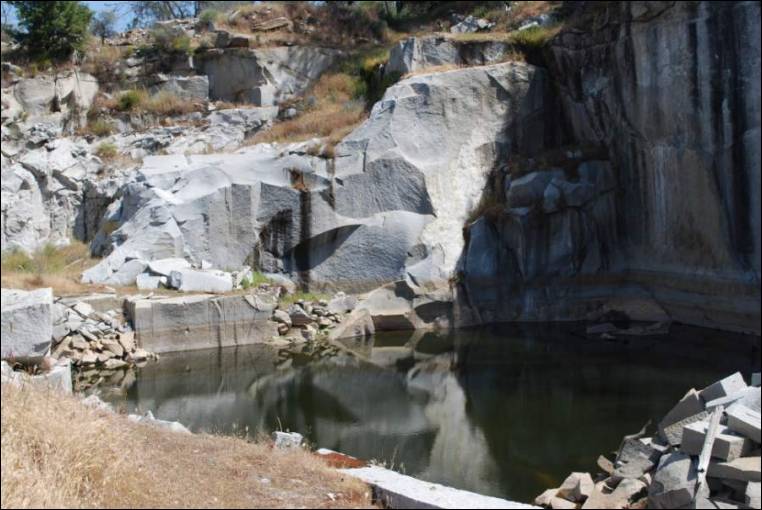
A part of the McGilvray Granite Quarry in Knowles, California
Another part of the McGilvray Granite Quarry
McGilvray Granite Quarry
(present-day photo)

Granite structures left in place
St. Anne’s Church, Knowles, CA, built by Peter Bisson of locally quarried granite
- Raymond & Knowles, Madera County, California, & Sites,
Colusa County, California – A.D. Knowles’ Raymond
Granite Quarry at Raymond, California, & Knowles
Sandstone Quarry at Sites, Colusa County, & John
D. McGilvray’s Granite Quarry at Knowles in Madera
County & his
Sandstone Quarry (AKA
Colusa County Sandstone Quarry & today
known as the Brownstone Quarry)
The following article was written and submitted by John L. Morton, Colusa County Historian. (I have condensed John’s article to reflect mainly the relationships between A. D. Knowles and John D. McGilvray and their quarries at Sites in Colusa County and Raymond and Knowles in Madera County. If you would like to read John’s entire article on the Colusa County sandstone quarries, you will find it at the following link: “Colusa County Sandstone Builds Some of the World’s Most Famous Buildings,” in the Colusa County quarry section of our web site.)
Colusa County Sandstone Builds Some of The World’s Most Famous Buildings, by John L. Morton, Colusa County Historian.
“Opened in 1886 the Knowles Quarry at Sites (Colusa County) supplied the stone that built some of the most beautiful buildings in San Francisco: the most famous of which is the Ferry Building, the work of architect Page Brown. ‘The world over, the Ferry Building stands for San Francisco the way the Campanile stands for Venice, the Eiffel Tower for Paris or the World Center for New York.’....”
“The Ferry Building was actually the swan song of the Knowles Quarry (at Sites, Colusa County, California) for in 1899, a year after the Ferry Building was opened the more aggressive John McGilvray Stone Co. came into existence. A.D. Knowles decided to move south to Raymond, California where he established a granite quarry. Interestingly enough, after bankruptcy of the Colusa Sandstone Quarries in 1913, the equipment was purchased for the Raymond Quarry at the bankruptcy in 1916. John McGilvray was known for his work with the Almaden stone of which Stanford University is constructed....”
“An interesting side-lite, after A.D. Knowles moved to Raymond, California; he awoke one morning to see that he had a new neighbor across the road - the John McGilvray Stone Co. These two companies were involved in the quarrying of Sierra White Granite. In this case, the Knowles Quarry is still being worked by the Cold Spring Granite Co. of Minnesota....”
- Raymond/Knowles, Madera County, California – Quarry at Knowles used to film the movie, “The Fountainhead” (1949), starring Gary Cooper and Patricia Neal, and directed by King Vidor.
After watching the 1949 film “The Fountainhead” (based on Ayn Rand’s book of the same title), I wanted to determine where the quarry in the film was located. Most of the online sources indicate that the quarry was located “near Fresno.” Upon further online research, I found that the quarry was located “in Knowles, California,” according to the Stephen Michael Shearer, author of Patricia Neal: An Unquiet Life (University Press of Kentucky, 2006, ISBN 0813123917, 9780813123912, pp. 63. Portions of this book are available on Google Books.) Peggy B. Perazzo
Gary Cooper
“The filming of The Fountainhead began with the quarry scene, shot on location in Knowles, California, between Fresno and Yosemite National Park in the state’s largest and oldest quarry. Director King Vidor rode out to Knowles with Patricia and Cooper in a studio limousine, and the three had dinner together….”
“Patricia and Cooper stayed at the California Hotel during the three-day location shoot….”
“The first scenes for the picture were shot in Knowles in July 12….”
Photographs of some of the filmed Knowles quarry scenes are available on a couple of blogs: Shadowplay Blog – “Hail to the King” & “The Fountainhead” (1949)
According to the book, Ayn Rand and the World She Made, by Anne Conover Heller,* the Knowles, California, quarry was filmed as a substitute for the Connecticut quarry described in Rand’s book, The Fountainhead. According to the author, Ayn Rand and her husband lived in Stony Creek, Long Island Sound, Connecticut 1937, known for its “famous pink-granite quarries” located near where they lived, although it is not known whether Rand visited these quarries or not. The following is an excerpt from pp. 209:
“Rand completed the screenplay in late June (1944). As the shooting began in a quarry near Fresno, she remained on the lot to fine-tune the dialogue and explain her characters’ motivations to the actors….”
* Ayn Rand and the World She Made, by Anne Conover Heller (Anchor Books, reprinted, illustrated Publisher Random House Digital, Inc., 2010, 608 pp., ISBN 1400078938, 9781400078936, portions of which are available on Google Books.)
You can read more about the film in Wikipedia’s “The Fountainhead (film),” although there is no mention in the article of the location of the quarry that was filmed for the movie.
-
Raymond/Knowles, Madera County, California – Fountainhead (movie) – Below is a photograph of the bus that was used to transport the crew to the Raymond quarry while filming the movie, Fountainhead, which starred Gary Cooper and Patricia Neal. (This photograph was contributed by Lynn Northrop of the Raymond Museum in Raymond, California.)
“Bus used by the film crew from Warner Brothers when they filmed Fountainhead in the Raymond/ Knowles quarry in 1949. The film starred Gary Cooper and Patricia Neal. Donated by Francis and Don Casaurang. The film crew stayed at the Coarsegold Inn that later burned down.” 
- Raymond Granite Quarries - Also see "Knowles & Raymond, Madera County, California - Granite Quarries.”
- Raymond, Madera County, California – The History
of Raymond. The following information originated from
a booklet entitled The History of Raymond, printed by
Karl H. Krohn, 1982. The original article was published in the Raymond
High School Tattler of March and April, 1933.
"In order to gain access to the granite deposits around Raymond, Frank Ducey, of Fresno, purchased a quarter section of land from Luke David. Later the latter was purchased by F. E. Knowles and Able Hosmer who developed the land. They had a railroad spur built to their quarrying, which enabled them to load the stone for shipment out of the area. The San Francisco Post Office was constructed with granite from Knowles.
Several granite companies operated in the area during the period 1890 to 1904. One of these quarries was the McLennan Granite Company. This quarry was eventually taken over by the Wilson-Lyons Construction Company who in turn sold the quarry to the McGilvray Company. Another granite quarry was opened 2 ½ miles south of Raymond about 1893, to provide granite for a contract for J. C. and I. N. Day Construction Company for the locks at Dalles, Oregon. A quarry was operated by Alex Mann in northeast Knowles in 1891-1892. During this time Wood, Johnny Milne, and Knudson quarried granite from another quarry near the Mann quarry. Eventually, the cost of machinery led to the elimination of the smaller quarries. Only two large companies were left at that time: the Raymond Granite Company and the McGilvray Company. These two companies consolidated in 1928.
- Raymond, Madera County, California - Raymond Granite Company, Raymond, Fresno County, Calif. - R. J. Waters & Company, photographic views available through the California Digital Library, MELVYL Catalog: 2 albums, views of quarry, stone cutting and transportation, and of buildings built with Raymond granite, ca 1924. (Information)
- Raymond, Madera County, California - Raymond Granite Company - Quarry of the Raymond Granite Company, Raymond, Fresno County, California, by I. W. (Isaiah West) Taber, photographed by I. W. Taber, publisher, ca. 1895, Restricted Originals. Use Viewing Prints Only, Shelved as BANC PIC 19xx.051-.052--PIC: Use of originals only by permission of the Curator of Pictorial Collections, The Bancroft Library, University of California Berkeley. (Information from California Digital Library, MELVYL Catalog.)
- Raymond (1/2 mile southeast of), Madera County, California – (Unnamed)
Granite Quarry (From The Structural and Industrial Materials
of California, Bulletin No. 38, California, State Mining
Bureau, San Francisco, California, 1906.)
"About one-half mile southeast of the village of Raymond there is a small quarry with a face of about 18 or 20 feet, of a spotted gray granite, with large black crystals of hornblende and biotite. In places it approaches a syenite in character. A few feldspar veins occur and numerous dark blotches of segregated mica. There are a number of joint planes, yet blocks of large dimensions can be obtained. The greatest drawback is the large dark blotches, which mar the beauty of the stone; but where it can be obtained free from blotches, it is one of the prettiest granites in the State.


Commercial use of material within this site is strictly prohibited. It is not to be captured, reworked, and placed inside another web site ©. All rights reserved. Peggy B. and George (Pat) Perazzo.