
Essential Properties of Building Stones* - II
Durability.
A property of stone is equally important with strength and which is more difficult to estimate is that of durability. Remembering that stone is rarely used except in buildings where permanence is an important desideratum, it will be at once apparent that whatever properties a building stone may lack, it must be durable.
The estimate of the durability of a stone is all the more perplexing because it depends on such a variety of factors both internal and external. It can not be said that these essential factors are well understood and there is probably no material which the architect uses about which he knows less than stone. Testing the strength of a stone may be done in accordance with well established rules; but estimates of durability can not as yet be made on any well formulated system. It is notorious that some of the worst failures of stone have been in cases where material of excellent appearance has been used. The problem is so large and so complex, and the factors which enter into it are so various that no single method of testing will apply.
Any estimate of the durability of a stone must take into account a wide range of factors both external and internal. Both the nature of the stone itself and the conditions under which it is used influence the degree with which it may respond to its environment without destructive effects. Both series of phenomena must be considered and the rejection of the stone may be necessary as a result of either of the two sets of conditions being unfavorable.
External Factors Affecting Durability
There are probably few laws better established in modern science than that organisms are influenced by their environment. This is a law which so far we know is fundamental. It applies alike to organic and inorganic bodies. Just as surely is it true that as the heavy-furred animals of the north come to inhabit a warmer climate they shed their heavier coverings, so granites and other crystalline rocks formed under one condition, upon being transferred to other conditions, slowly but surely adjust themselves to their new environment. It is well established that under the peculiar conditions present beneath the surface of the earth silicic acid tends to drive out and replace carbonic acid, and that the reverse is true in rocks at or near the surface. The forms and combinations which were staple (sic) in granite when it was formed as a deep-seated rock, became unstable and tend to break down when it is exposed. The same is true to a greater or less extent of all rocks. A deposit which was in a staple (sic) ncondition at the bottom of the sea becomes unstable when forming a portion of the land surface. Hence arises the widespread decay of rocks exposed at the surface, a process which if continued long enough must inevitably cause them to break down into loose beds of sand, gravel and clay.
The processes by which this change takes place are known collectively as weathering, which is not a simple process, but a series of processes. Stones when cut, dressed and used in a building are exposed to these processes for the same reasons and to the same extent that they are when in their native ledge. Often indeed they are subjected in an even greater degree to deleterious influences.
Weathering effects are due to both mechanical and chemical processes. The mechanical processes may be considered as due to three agencies: wind, moisture and heat.
The mechanical effects of the wind are not usually important in the consideration of building stones. That wind when loaded with sand, as it must always be to a greater or lesser extent, has an abrasive action is a well-known fact. Endlich has called attention to some of the more striking results of such action in Colorado. Merrill has noted the action of storm winds on the exposed glass of lighthouses. More recently Udden has reviewed the whole subject of wind erosion. Where buildings are exposed to the same conditions the action of the wind on the stone in the wall can not but be the same as in the native ledge. Eggleston noted the fact that in many of the New York churchyards, tombstones may be found which are worn nearly smooth by this agent alone. It very rarely happens, however, that stones in buildings are so exposed. They are usually protected from the direct action of the wind so that its influence is less in the work of abrasion and more in bringing in contact with the stone certain injurious gases or large amounts of moisture which may be present in the air. The action of the gases is chemical and will be later considered.
The erosive action of water is one of the most familiar effects seen in nature. The deep channels worn by the rivers and the general wearing away of the exposed land surface are marks of its power. It is not often, however, important from the present point of view. Except when used in bridge piers, dams and similar constructions, building stones are seldom exposed to erosive action. In large buildings certain cornice stones frequently serve for gutters, but in such cases they are usually protected by a metal surface, preferably copper.
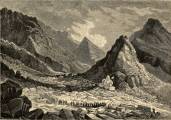
The principal mechanical effect of water is accomplished by the aid of temperature changes in what is known as frost action. All rocks are more or less porous, and hence are capable of absorbing a greater or less amount of water. This amount has been measured for a considerable number of rocks by Merrill, Hopkins, Winchell, Cutting, Heinreich, and others. In general the absorption is, for granites, from the nearest traces up to 1/140; for limestones the amount varies between 1/18 and 1/678; for sandstone from 1/8 to 1/37; dolomite shows about the same absorption as limestones, and quartzites average with the granites. When water freezes it expands with a force at 30º F. is over 1,900 pounds per square foot. For lower temperature this force is greater. If the water be inclosed the force becomes sufficient to break most stone. Indeed frost is probably the principal agent in breaking down large rock masses. Jordan speaks of the Matterhorn as but a wreck-"the core of a far greater mountain whose rocks have been hurled down the valley," and again says: "The whole outer coat of the mountain is loose, scarcely a rock anywhere on the Swiss side being firmly attached."
Water penetrates all the cracks of a rock and upon being frozen rends it apart. Certain of our building stones seem particularly susceptible to this action. Usually a fine-grained, compact stone will absorb less moisture and suffer less from frost than a more open-textured stone. As pointed out by Merrill this is not always true. In the case of the open-texture stone, though it takes up water rather readily, it parts with it equally readily and at the same time the whole force of the expansion need not necessarily be expended in pushing apart the particles of the stone. Instances of this may be seen in our own quarries. Certain portions of the St. Louis limestone occasionally quarried in the central portion of the state are particularly unable to withstand frost action. Yet the stone is to all appearance a very fine-grained, compact rock. In neighboring quarries a coarser textured Augusta stone stands the frost better.
The action of the frost is usually beneficial to the quarryman. In granite regions quarries are often worked for years merely in the overlying scattered boulders before the solid rock is reached. It would be impossible to quarry profitably the Sioux quartzite were it not for the aid of the frost and the joint cracks.
The principal effect of changes of temperature on stone is doubtless the frost effect just noted. Aside from any such subsidiary action temperature changes may have themselves important effects on the life of the stone. The expansion and contraction due to temperature changes has always been noticed. It is obvious that the frequent repetition of these changes in volume must affect the durability of the material. A strain which may be easily met once, if repeated often enough will cause rupture. The expansion of the different components of stone is different and thus they crowd unequally against each other. The different portions of a stone may be unequally heated, as when the outside temperature is 24º below and the inside temperature of a building 70º above. In all such cases the stone must be weakened. If stones be heated and then suddenly cooled they will break. Livingstone found that in Africa stones heated during the daytime cooled so rapidly at night as to throw off sharp angular fragments, and Stanley states that a cool rain falling upon the sun-heated rocks caused them to split. An interesting instance of the effect of heat was shown at the old North avenue viaduct in Baltimore. In 1892 an oil car burned at the foot of one of the abutments. The effect of the heat was to bring out in a few hours upon the masonry the characteristic spherical weathering shown on long exposed rock faces.
With the exception of frost action the most important agencies in the weathering of stone are chemical. The air is at all times charged with various gases some of which are destructive to stone. When the stone is exposed to water a larger number of chemical agents may be at the same time brought into play because of the substances which it may carry in solution. The attacks of these chemical agents are the most insidious because unseen, and yet they form a most important factor in the life of the stone.
The various chemical processes which take place during the weathering or decay of a stone may be summarized as follows: (1) Solution; (2) Oxidation; (4) (sic) De-oxidation; (4) Hydration; (5) Carbonization.
Solution is one of the most familiar chemical processes and one which is constantly taking place wherever rocks are exposed to rain water or moist air. Gypsum, which has been used at Fort Dodge to a very limited extent as a building stone, is readily soluble in a ratio of about 1 to 400 in water and is soon worn away. Of the stones ordinarily used for building purposes limestone suffers most from this process. It is soluble to the extent of about 1 to 1,000 parts in water charged with carbonic acid gas.
The air at all times contains more or less moisture and some carbonic acid. In cities the percentage of the latter may become relatively high. Pfaff has carried on experiments on the rate of weathering of limestone. The material used was the Solenhofen lithographic stone which is very similar in texture and appearance to white limestone found in the Pella beds of the Saint Louis. A plate of this rock was exposed to weathering influences for two years and from the loss in weight it was calculated that such a stone weathered away at a rate of 1 meter in 72,000 years, or about 1 foot in 21,200 years. Observations made on dressed stones in England, place the rate at from 1 foot in 240 years to 1 foot in 500 years. Dolomite is less soluble than limestone, which is one of the reasons why it usually gives better satisfaction as a building stone.
Julien has called attention to the greater weathering on the face of a building which is exposed to the greatest ranges in temperature, and Merrill has made similar observations.
Sandstone are only very slightly soluble. The principal constituent, quartz, is not affected by any of the solutions to which building stones are ordinarily exposed. The bond material may, however, suffer from a number of them. The great durability of quartzites and of silicious limestones is perhaps due more to the insoluble nature of the bond than to any other one factor. On the other hand an argillaceous sandstone may break down readily, and it is a very common thing to find around a sandstone boulder a little heap of loose sand grains which are the result of such weathering.
Oxidation is one of the most common and most active chemical processes. Oxygen is present in the atmosphere, and is also a very common constituent of rain-water. It is a very active chemical substance and has a great affinity for many of the minerals commonly occurring in rocks. In the crystalline rocks the ferromagnesian compounds especially tend to break up in its presence and to form new substances. In the clastic rocks its influence is also often felt. One of the most frequent impurities of limestones, for instance, is iron pyrites or sulphide of iron. The action of the oxygen upon this substance is first to form the sulphate of iron. In the presence of water this gives rise to iron-oxide and sulphuric acid. The former disagreeably stains the stone while the latter is an active solvent of limestone. Even in so impervious a stone as quartzite the action of oxygen upon the iron present may be detected.
De-oxidation may under certain circumstances result from rain-water charged with reducing agents. These usually come from the decay of organic matter. The tendency of these reducing agents is to take away the oxygen present; particularly from the iron oxides. This results in discoloration. If a limestone contains magnesia, it will tend in the presence of sulphuric acid, which may be present in the air as a result of the combustion of impure coal, to form a magnesian sulphate. This will manifest itself usually in the form of efflorescence. De-oxidation is an action not often seen on building stones though frequently observed on native ledges.
Hydration, while occasionally observed in quarry rocks, is not important in the consideration of building stones.
Carbonization is a common form of alteration among crystalline rocks. A familiar example is seen in the alteration of feldspar to kaolin. It is the expression of the general law that under surface conditions carbonic acid tends to drive out silicic acid. It is not usually an important factor in the alteration of sedimentary rocks as they rarely contain any great quantity of material subject to such action. In limestones the carbonization of the material has already taken place before the stone was formed. Sandstones rarely contain sufficient alkaline matter to be subject to attack, though certain arkose sandstones might suffer from this action. Such stones are commonly found in Iowa will suffer most chemically from solution and oxidation.
The influence of organic matter in hastening the decay of stone has been very frequently insisted upon. Robert has called attention in "Le Monde" to the action of Lepra antiquitatis, a small cryptogamic plant, in promoting decay of rocks. While it is undoubtedly true that the decay of lichens or other plant forms gives rise to organic acids which aid in breaking down a rock and reducing it to a soil, it is also true as has been suggested, that the lichens and similar plants often form a covering which preserves the rock by protecting it from undue temperature changes. On the whole it seems not improbably that the deleterious effects of plants on building stones have in the past been too strongly insisted upon.
* From Monthly Review Iowa Weather and Crop Service, Vol. VI, Nos. 8 and 9. August and September, 1895.
Commercial use of material within this site is strictly prohibited. It is not to be captured, reworked, and placed inside another web site ©. All rights reserved. Peggy B. and George (Pat) Perazzo.