

Structures and Monuments in Which Missouri Stone was Used
- Finished Products from Missouri Stone in
Kentucky
- Fort Knox, Kentucky – the Veterans Hospital Building (from Missouri Marble,
by Norman S. Hinchey, Report of Investigations No. 3, Missouri Geological
Survey and Water Resources, Rolla, Missouri, 1946. Used with permission
of the Missouri Department of Natural Resources.)
Ste. Genevieve Golden Vein Marble, quarried in Ste. Genevieve County, Missouri, was used in the construction of the Veterans Hospital building.
- Louisville, Kentucky – the Blatz & Krebs
Building (from The Quarrying Industry of Missouri,
by Ernest Robertson Buckley and H. A. Buehler, 1904, page 74)
Deep red colored granite quarried in the Graniteville, Missouri, quarries was used with wholly or in part in the construction of the Blatz & Krebs building.
- Louisville, Kentucky -
the Citizens Union National Bank (Peter & Burghard
Stone Co. advertisement from Throvgh
The Ages Magazine, July 1923, Vol. 1, No. 3, pp. 47. The same
advertisement was published in the following issues of Throvgh
The Ages Magazine:
May 1923, Vol. 1, No. 1, pp. 47; June 1923, Vol. 1, No. 2, pp. 42;
and August 1923, Vol. 1, No. 4, pp. 42.)
Citizens Union National Bank, Louisville, Kentucky. Architect York & Sawyer, N.Y. D. X. Murphy & Bro. Interior in Tavernelle marble, floors of Napoleon Gray tile with mosaic border of Belgian Black marble. Showing the main banking room with marble and bronze screen. 
Peter & Burghard Stone Company, Louisville, Kentucky
- Louisville, Kentucky – the Henry U. Krankel Building (from The Quarrying Industry of Missouri, by Ernest Robertson Buckley and H. A. Buehler, 1904, page 74)
Deep red colored granite quarried in the Graniteville, Missouri, quarries was used with wholly or in part in the construction of the Henry U. Krankel building.
-
Louisville, Kentucky – Speed Art Museum (Advertisement in Through the Ages, Vol. 5, No. 8, December 1927, pp. 44)
Peter & Burghard Stone Company, Louisville, Kentucky
Speed Art Museum, Louisville, Kentucky. Arthur Loomis, Architect.
These columns – eight in all – as well as the pilasters, are each 20 feet long, built solidly of single pieces of St. Genevieve Rose marble, and this same material was used for the caps and door trim; the bases are Westfield Green marble. The columns measure turned and finished at our plant recently.
- Louisville, Kentucky - St. Joseph’s Hospital (from“New Missouri Marble Mill,”in Stone Magazine, November 1925, Vol. XLVI, No. 11, pp. 674-676)
Colonial Grey Marble quarried by F. W. Steadley & Co., Inc., of Carthage, Missouri, was used in the construction of the St. Joseph’s Hospital building prior to 1926.
“Speed Art Museum, Louisville, Kentucky. Arthur Loomis, Architect.” (Advertisement in Through the Ages, December 1927, pp. 44) 
- Fort Knox, Kentucky – the Veterans Hospital Building (from Missouri Marble,
by Norman S. Hinchey, Report of Investigations No. 3, Missouri Geological
Survey and Water Resources, Rolla, Missouri, 1946. Used with permission
of the Missouri Department of Natural Resources.)
- Finished Products from Missouri Stone in
Louisiana
- New Orleans, Louisiana - the Morris Building (from “Notes
on The Building Stones, Clays and Sands of Iron, St. Francois and
Madison Counties,” by G. E. Ladd, Assistant
Geologist, in Bulletin 1, Geological Survey of Missouri,
Jefferson City, April 1890.)
Granite quarried from one of the quarries at Graniteville, Iron County, Missouri, operated by the Syenite Granite Company, was used in the construction of the Morris building. “The color of this stone is red or dark pink, mottled with gray and black, the red shades being due to feldspar, the others to a more or less smoky quartz. The rock takes a high, lustrous and handsome polish....”
- New Orleans, Louisiana – the St. Charles Hotel (from The Quarrying Industry of Missouri, by Ernest Robertson Buckley and H. A. Buehler, 1904, page 74)
Deep red colored granite quarried in the Graniteville, Missouri, quarries was used with wholly or in part in the construction of the St. Charles Hotel.
- New Orleans, Louisiana - the Whitney National Bank Building (from “Notes
on The Building Stones, Clays and Sands of Iron, St. Francois and
Madison Counties,” by G. E. Ladd, Assistant
Geologist, in Bulletin 1, Geological Survey of Missouri,
Jefferson City, April 1890.)
Granite quarried from one of the quarries at Graniteville, Iron County, Missouri, operated by the Syenite Granite Company, was used in the construction of the Whitney National Bank building. “The color of this stone is red or dark pink, mottled with gray and black, the red shades being due to feldspar, the others to a more or less smoky quartz. The rock takes a high, lustrous and handsome polish....”
- New Orleans – Louisiana – the Whitney National Bank Building (from The Quarrying Industry of Missouri, by Ernest Robertson Buckley and H. A. Buehler, 1904, page 74)
Deep red colored granite quarried in the Graniteville, Missouri, quarries was used with wholly or in part in the construction of the Whitney National Bank building.
- New Orleans, Louisiana - the Whitney National Bank (from Building Stones and Clay-Products: A Handbook For Architects, by Heinrich Ries, Ph.D., 1912)
“Graniteville. The largest and most important quarries in the state are here. The stone is a red granite of pleasing red color, medium to coarse grained....” Granite quarried at Graniteville, Missouri, was used in the construction of the Whitney National Bank building.
- New Orleans – Louisiana – the Whitney National Bank Building (from The Quarrying Industry of Missouri, by Ernest Robertson Buckley and H. A. Buehler, 1904, page 74)
- Shreveport, Louisiana - the J. P. Evans Residence - Carved
Panel (Carthage Marble and White Lime Co., Carthage, Missouri,
advertisement from Throvgh The Ages Magazi ne, July 1923,
Vol. 1, No. 3, pp. 57.)
Carved panel in the residence of Mr. J. P. Evans, Shreveport, Louisiana. Neild and Olschner, Architects. 
Carthage Marble and White Lime Co., Carthage, Missouri
- New Orleans, Louisiana - the Morris Building (from “Notes
on The Building Stones, Clays and Sands of Iron, St. Francois and
Madison Counties,” by G. E. Ladd, Assistant
Geologist, in Bulletin 1, Geological Survey of Missouri,
Jefferson City, April 1890.)
- Finished Products from Missouri Stone in
Maryland
- Baltimore, Maryland - the Baltimore Life Insurance
Company Building (from Missouri Marble,
by Norman S. Hinchey, Report of Investigations No. 3, Missouri Geological
Survey and Water Resources, Rolla, Missouri, 1946. Used with permission
of the Missouri Department of Natural Resources.)
Marble quarried from the Phenix Marble Company’s “Old West Quarry” at Phenix, Greene County, Missouri, was used in the construction of the Baltimore Life Insurance Company building prior to 1942.
- Baltimore, Maryland - the Central Savings Bank Building (from “Notes
on The Building Stones, Clays and Sands of Iron, St. Francois and
Madison Counties,” by G. E. Ladd, Assistant
Geologist, in Bulletin 1, Geological Survey of Missouri,
Jefferson City, April 1890.)
Granite quarried from one of the quarries at Graniteville, Iron County, Missouri, operated by the Syenite Granite Company, was used in the construction of the Central Savings Bank building. “The color of this stone is red or dark pink, mottled with gray and black, the red shades being due to feldspar, the others to a more or less smoky quartz. The rock takes a high, lustrous and handsome polish....”
- Baltimore, Maryland – the Central Savings Bank (from The Quarrying Industry of Missouri, by Ernest Robertson Buckley and H. A. Buehler, 1904, page 74)
Deep red colored granite quarried in the Graniteville, Missouri, quarries was used with wholly or in part in the construction of the Central Savings Bank.
- Baltimore, Maryland – the Central Savings Bank (from The Quarrying Industry of Missouri, by Ernest Robertson Buckley and H. A. Buehler, 1904, page 74)
-
Baltimore, Maryland – the Citizens National Bank Building – the Floors of the Corridors (from Napoleon Gray, An Adaptable Marble, Phenix Marble Company, Kansas City, Missouri, Producers, and Tompkins-Kiel Marble Company, New York City, New York, Distributors, 1926, pp. 39)
- Baltimore, Maryland - the Enoch Pratt Library Building (from Missouri Marble,
by Norman S. Hinchey, Report of Investigations No. 3, Missouri Geological
Survey and Water Resources, Rolla, Missouri, 1946. Used with permission
of the Missouri Department of Natural Resources.)
Ste. Genevieve Golden Vein Marble, quarried in Ste. Genevieve County, Missouri, was used in the construction of the Enoch Pratt Library building.
- Baltimore, Maryland - the War Memorial Trophy
Room (from the article entitled, “The War Memorial: A New Monumental
Structure Recently Opened in Baltimore,” in Throvgh The Ages Magazine,
June 1925, Vol. 3, No. 2, pp. 2-8.)
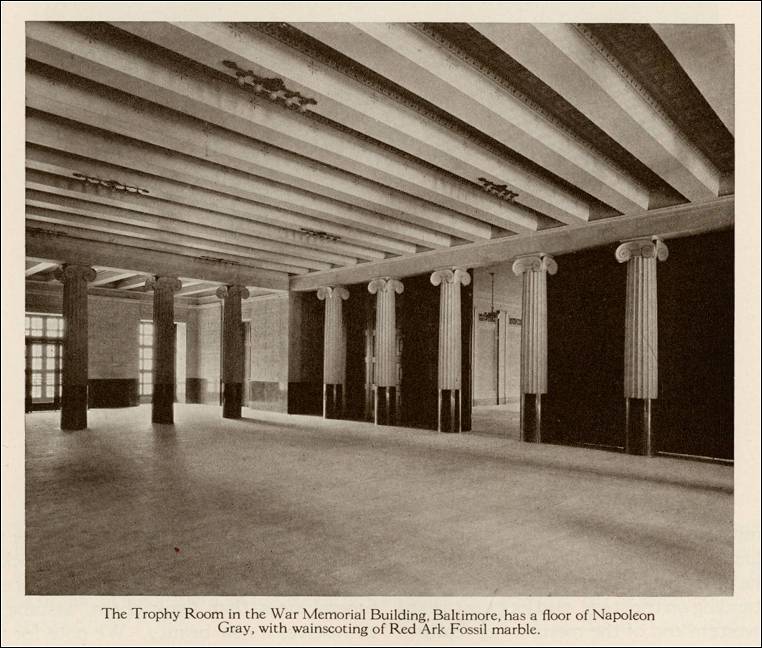
The Trophy Room in the War Memorial Building, Baltimore, has a floor of Napoleon Gray, with wainscoting of Red Ark Fossil marble. (pp. 8) 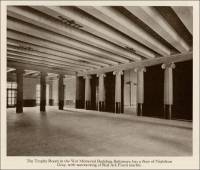
(pp. 8) “On the floor below the main hall, space is taken up chiefly by a large open room of moderate height with a beamed ceiling, and intended as a Trophy Hall. The floor of this compartment is of Napoleon Gray; the same material is also used for the adjoining chambers, which have been assigned to various patriotic societies. Around the sides of the Trophy Hall are fluted columns bearing rather odd looking capitals of Ionic motif and sheathed at the base in Red Ark Fossil marble....”
-
Baltimore, Maryland – the Standard Oil Building – the Washrooms (from Napoleon Gray, An Adaptable Marble, Phenix Marble Company, Kansas City, Missouri, Producers, and Tompkins-Kiel Marble Company, New York City, New York, Distributors, 1926, pp. 28)
- Baltimore, Maryland - the War Memorial Building (from Stone Magazine, September 1925, Vol. XLVI, No. 9, pp. 546)
New War Memorial Erected by the State of Maryland and the City of Baltimore. Exterior of Indiana Limestone. Napoleon Gray and Red Ark Fossil Among Several Marbles Used in Interior Decorations. Architect: Laurence Hall Fowler. 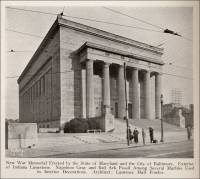
- Bethesda, Maryland - the Madonna of the Trail Statue in Bethesda, Maryland, dedicated on April 19, 1929 (photographs) The following quotation is from Wikipedia, the free encyclopedia.
The following quotation is from Wikipedia, the free encyclopedia.
“Madonna of the Trail is a series of monuments dedicated to the spirit of pioneer women in the United States. The monuments were commissioned by the National Society of Daughters of the American Revolution (NSDAR). They were placed along the National Old Trails Highway and extended from Bethesda, Maryland, to Upland, California, in each of the 12 states the road passed through.
“Created by sculptor August Leimbach and funded by contributions, the Madonna of the Trail monuments were intended to provide a symbol of the courage and faith of the women whose strength and love aided so greatly in conquering the wilderness and establishing permanent homes.
“Dedicated in 1928 and 1929, with each of the 12 located in a different state, they became a source of local pride. Through the continuing efforts of local and national groups, all are currently in good condition and on display....”
“The figure stands 10 feet high with a weight of 5 tons. The figure and the base are made of algonite stone (a poured mass) of which Missouri granite is used as the main aggregate, thus giving the monument a warm, pink shade. With the base, the monuments are about 18 feet high. The inscriptions on the east and west sides of each base are the same, but the north and south sides of each monument usually include local information as well.”
“The floors of the corridors in the big new Citizens National Bank Building, Baltimore, are of Napoleon Gray marble. Graham, Anderson, Probst & White, Chicago, Architects; Marble Contractor, Hilgartner Marble Co., Baltimore.” (pp. 39) 
“Standard Oil Building, Baltimore, Maryland, showing the washrooms of Napoleon Gray marble. Clyde N. Friz, Baltimore Architect; Marble Contractor, Hilgartner Marble Company, Baltimore.” (pp. 28) 
- Baltimore, Maryland - the Baltimore Life Insurance
Company Building (from Missouri Marble,
by Norman S. Hinchey, Report of Investigations No. 3, Missouri Geological
Survey and Water Resources, Rolla, Missouri, 1946. Used with permission
of the Missouri Department of Natural Resources.)
- Finished Products from Missouri Stone in
Massachusetts
- Boston, Massachusetts - the National Shawmut Bank (Philip H. Butler & Son., Co. Somerville, Massachusetts, advertisement from June 1923, Vol. 1, No. 2, pp. 61. The same advertisement was published in the following issue of Throvgh The Ages Magazine: August 1923, Vol. 1, No. 4, pp. 61.)
National Shawmut Bank, Boston, Mass. Parker, Thomas & Rice, Architects. Showing a pleasing combination of Blanco P. and Napoleon Gray Marble. 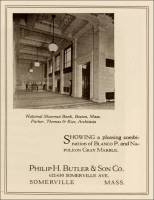
Philip H. Butler & Son Co., 622-630 Somerville Ave., Somerville, Mass.
- Boston, Massachusetts - the Professional Building (from Missouri Marble,
by Norman S. Hinchey, Report of Investigations No. 3, Missouri Geological
Survey and Water Resources, Rolla, Missouri, 1946. Used with permission
of the Missouri Department of Natural Resources.)
Ozark Veined Marble (a limestone) quarried at Carthage, Missouri, was used in the construction in the interior of the Bank of Manhattan building.
- Pittsfield, Massachusetts - Granite Monolith in Pittsfield, Massachusetts (from Building Stones and Clay-Products: A Handbook For Architects, by Heinrich Ries, Ph.D., 1912)
“Graniteville. The largest and most important quarries in the state are here. The stone is a red granite of pleasing red color, medium to coarse grained....” “Blocks of large size can be extracted, and columns 16 feet long and 2 feet 6 inches in diameter have been obtained.” Granite quarried at Graniteville, Missouri, was used to create the polished monolith of 42 tons weight in Pittsfield, Massachusetts. (The author does not note where this column was placed in Pittsfield. ).
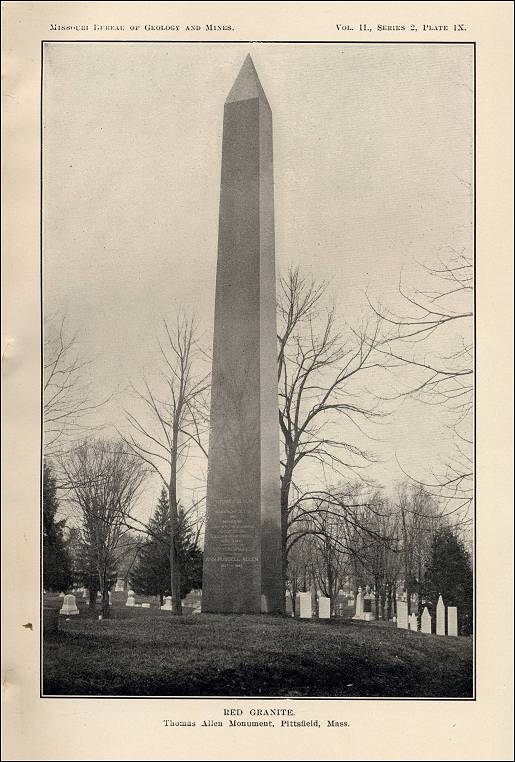
- Pittsfield, Massachusetts – the Thomas Allen Monument.
(Photograph from The Quarrying Industry of Missouri, by E. R. Buckley, Director and State Geologist, and H. A. Buehler, Missouri Bureau of Geology and Mines Vol. II, 2nd Series, 1904.)
Plate IX. Red Granite. Thomas Allen Monument, Pittsfield, Mass. 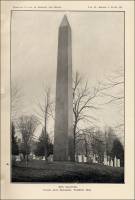
This monument was made of red granite quarried at Graniteville, Missouri. (42 tons in one piece)
- Springfield, Massachusetts -
the Massachusetts Mutual Life Building (Phenix Marble Co., Kansas City, Missouri, advertisement from Throvgh
The Ages Magazine, October 1927, Vol. 5, No. 6, pp. 43.)
They Wanted Distinction. The Massachusetts Mutual Life Insurance Company wanted the toilets in their new Home Building at Springfield, Massachusetts, to be on a par with the rest of the structure. For the wall wainscot and the stalls, Napoleon Gray marble was selected - as the most logical material.

Phenix Marble Company, Suite 609, Scarritt Bldg., Kansas City, Missouri
Napoleon Gray Universally Adaptable
They Wanted Distinction. The Massachusetts Mutual Life Insurance Company wanted the toilets in their new Home Building at Springfield, Massachusetts, to be on a par with the rest of the structure. For the wall wainscot and the stalls, Napoleon Gray marble was selected - as the most logical material.
Napoleon Gray has a richness of tone, a pleasing finish, that is not found in monotones of equal durability and soundness. It is impervious to stains, practically non-absorbent and thoroughly economical. May we send you a copy of our book containing views of various installations of Napoleon gray? Marble samples sent upon request.
- Boston, Massachusetts - the National Shawmut Bank (Philip H. Butler & Son., Co. Somerville, Massachusetts, advertisement from June 1923, Vol. 1, No. 2, pp. 61. The same advertisement was published in the following issue of Throvgh The Ages Magazine: August 1923, Vol. 1, No. 4, pp. 61.)
- Finished Products from Missouri Stone in
Michigan
- Ann Arbor, Michigan - the University of Michigan
Building (from Missouri Marble, by Norman S. Hinchey,
Report of Investigations No. 3, Missouri Geological Survey and Water
Resources, Rolla, Missouri, 1946. Used with permission of the Missouri
Department of Natural Resources.)
Ozark Fleuri Marble (a limestone) quarried at Carthage, Missouri, was used in the construction in the interior of the University of Michigan building.
- Detroit, Michigan -
the Book-Cadillac Hotel - Interior Walls & Floor Border (Alabama
Marble Co. advertisement from Throvgh
The Ages Magazine, January 1926, Vol. 3, No. 9, pp. 64. The
same advertisement was published in the following issues of Through
The Ages Magazine: Throvgh The Ages Magazine, July
1925, Vol. 3, No. 3, pp. 45; and December 1925, Vol. 3, No. 8, pp.
66.)
Alabama Marble Company
Main Office and Plant: Gantt’s Quarry, Alabama - Sales Department: 1701 Avenue A, Birmingham, Alabama. Producers of all grades of Alabama Marble, Manufacturers and Contractors for interior marble work in any kind of marble.
Alabama Cream A
A recognized standard among Interior White marbles. Unsurpassed for decorative and utilitarian purposes. Fine-grained, with Creamy-White background and moderate clouding. Imperious, non-staining, weather-proof and durable. Carves perfectly; takes and holds any polish from dull gloss to brilliant luster. The Alabama Marble Company has supplied millions of dollars’ worth of Alabama marble in hundreds of buildings without causing a single day’s delay on any one of them.
View in Book-Cadillac Hotel, Detroit, Michigan, Louis Kamper, Architect 
All interior marble work finished and set in place by Alabama Marble Company, Gantt’s Quarry, Ala. Wall marble mainly Breche Violette and St. Genevieve. White trim of wall marble Alabama Cream A; floor marble Alabama Cream A, with St. Genevieve border.
- Detroit, Michigan - the Book-Cadillac Hotel (from
article entitled, “The Book-Cadillac Hotel: Located in Detroit,
on Washington Boulevard, the ‘Tightest-owned Street in the
World,’ in Throvgh The Ages Magazine, July 1926,
Vol. 4, No. 3, pp. 9-15.)
The Michigan Avenue entrance. The floor, steps and base are Pink and Gray Tennessee marble. The piers are St. Genevieve; the wall panels, Breche Violette. (pp. 10) 
- Detroit, Michigan - the Book-Cadillac Hotel (from
article entitled, “The Book-Cadillac Hotel: Located in Detroit,
on Washington Boulevard, the ‘Tightest-owned Street in the
World,’ in Throvgh The Ages Magazine, July 1926,
Vol. 4, No. 3, pp. 9-15.)
- Detroit, Michigan - Cass High School (from“New
Missouri Marble Mill,”in Stone Magazine,
November 1925, Vol. XLVI, No. 11, pp. 674-676)
Colonial Grey Marble quarried by F. W. Steadley & Co., Inc., of Carthage, Missouri, was used in the construction of the Cass High School building prior to 1926.
- Detroit, Michigan - the Fisher Building (from Missouri
Marble, by Norman S. Hinchey, Report of Investigations No. 3,
Missouri Geological Survey and Water Resources, Rolla, Missouri, 1946.
Used with permission of the Missouri Department of Natural Resources.)
Ste. Genevieve Golden Vein Marble, quarried in Ste. Genevieve County, Missouri, was used in the construction of the Fisher building.
- Lansing, Michigan - State Office Building (from Throvgh
The Ages Magazine, April 1924, Vol. 1, No. 12, pp. 60. This
advertisement was found in a bound book of many issues of Throvgh
The Ages Magazine at the back of the book.)
Corridor in State Office Building, Lansing, Mich. All standing marble throughout this building is Colonial Gray Veinless marble and was finished and installed by Jas. B. Clow & Sons Co., Chicago, Ill. 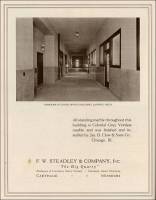
F. W. Steadley & Company, Inc. Carthage, Missouri
“The Big Quarry”
Producers of Colonial Gray Veined - Colonial Gray Veinless
- Traverse City, Michigan - the United States Post Office (from Missouri
Marble, by Norman S. Hinchey, Report of Investigations No. 3,
Missouri Geological Survey and Water Resources, Rolla, Missouri, 1946.
Used with permission of the Missouri Department of Natural Resources.)
Eldorado or Ste. Genevieve Istrian Marble quarried from the Inkley Marble Quarries Company quarry located southwest of Ste. Genevieve, Missouri, was used in the construction of the Post Office building.
- Ypsilanti, Michigan -
the Charles McKenny Hall Building -
the Partitions and Stiles of toilets (Christa-Batchelder
Marble Co., Detroit, Michigan, advertisement from Throvgh
The Ages Magazine, January 1932, Vol. 9, No. 9, pp. 51.)
Charles McKenny Hall Building. The illustration shows a portion of the main double stairs leading from the lobby to the second floor. Dark Tennessee marble was used for borders and base throughout the lobby and corridors, also for treads, risers and string of main stairs. Colonial Gray Carthage marble was used for partitions and stiles of toilets. Lovering-Longbotham Company, General Contractors; Frank Eurich, Architect. 
Christa-Batchelder Marble Company, Detroit, Michigan
Michigan State Normal College Alumni Association, Owners, Ypsilanti, Michigan
- Ann Arbor, Michigan - the University of Michigan
Building (from Missouri Marble, by Norman S. Hinchey,
Report of Investigations No. 3, Missouri Geological Survey and Water
Resources, Rolla, Missouri, 1946. Used with permission of the Missouri
Department of Natural Resources.)
- Finished Products from Missouri Stone in
Minnesota
- Minneapolis, Minnesota - the Lake of the Isles Boulevard - Garden Ornamentation Shell (Drake Marble and Tile Co., St. Paul, Minn. advertisement from Throvgh The Ages Magazine, September 1923, Vol. 1, No. 5, pp. 66.)
Garden Ornamentation. Lake of the Isles Boulevard, Minneapolis, Minn. Figure and Base of White Italian Marble Shell of Colonial Gray Carthage. 
Drake Marble and Tile Company, Interior Marble Work, St. Paul, Minn. - Minneapolis, Minn.
Quality Service
- Minneapolis, Minnesota - the Northwestern Guarantee Loan CompanyBuilding (from “Notes on The Building Stones, Clays and Sands of Iron, St. Francois and Madison Counties,” by G. E. Ladd, Assistant Geologist, in Bulletin 1, Geological Survey of Missouri, Jefferson City, April 1890.)
Granite quarried from one of the quarries at Graniteville, Iron County, Missouri, operated by the Syenite Granite Company, was used in the construction of the Northwestern Guarantee Loan Company building. “The color of this stone is red or dark pink, mottled with gray and black, the red shades being due to feldspar, the others to a more or less smoky quartz. The rock takes a high, lustrous and handsome polish....”
-
Saint Paul, Minnesota – one of the Saint Paul Schools – Interior (from Napoleon Gray, An Adaptable Marble, Phenix Marble Company, Kansas City, Missouri, Producers, and Tompkins-Kiel Marble Company, New York City, New York, Distributors, 1926, pp. 29)
- Saint Paul, Minnesota – the Union Depot, currently
Lee Ann Chin's Restaurant (The link from which
the following information was obtained is no longer available.) You
can read about the history of the Saint Paul Union Depot on the Mississippi
River Field Guide web site.
<http://www.isd.net/jjohnso6/tour2/union_depot.html>This material is from the Saint Paul, Minnesota, Geology Walking Tour web site presented by Jeremy D. Johnson. Several types of stone were used in the construction of the building: Indiana limestone, Kasota dolostone from southern Minnesota, pink marble from Tennessee, and gray marble from Missouri.
“A view showing one of the uses of Napoleon Gray marble, in the St. Paul, Minnesota, schools. F. X. Tewes, St. Paul, Architect; Marble Contractor, Northwestern Marble & Tile Company, of Minneapolis.” (pp. 29) 
- Minneapolis, Minnesota - the Lake of the Isles Boulevard - Garden Ornamentation Shell (Drake Marble and Tile Co., St. Paul, Minn. advertisement from Throvgh The Ages Magazine, September 1923, Vol. 1, No. 5, pp. 66.)
- Finished Products from Missouri Stone in
Mississippi
- Jackson, Mississippi - the Post Office Building (from Missouri Marble,
by Norman S. Hinchey, Report of Investigations No. 3, Missouri Geological
Survey and Water Resources, Rolla, Missouri, 1946. Used with permission
of the Missouri Department of Natural Resources.)
Ste. Genevieve Rose Marble, quarried in Ste. Genevieve County, Missouri, was used in the construction of the Post Office building.
- Jackson, Mississippi - the Federal Building (from Missouri Marble,
by Norman S. Hinchey, Report of Investigations No. 3, Missouri Geological
Survey and Water Resources, Rolla, Missouri, 1946. Used with permission
of the Missouri Department of Natural Resources.)
Ste. Genevieve Rose Marble, quarried in Ste. Genevieve County, Missouri, was used in the construction of the Federal building.
- Meridian, Mississippi - the U.S. Post Office or
Court House Buildings (from Missouri Marble,
by Norman S. Hinchey, Report of Investigations No. 3, Missouri Geological
Survey and Water Resources, Rolla, Missouri, 1946. Used with permission
of the Missouri Department of Natural Resources.)
Marble quarried from the Phenix Marble Company’s “Old West Quarry” at Phenix, Greene County, Missouri, was used in the construction of the U.S. Post Office or Court House buildings prior to 1942.
- Vicksburg, Mississippi - the “Adler” Monument (A. J. Sheahan Granite Co., Graniteville, Missouri, advertisement from American Stone Trade, October, 1927, Vol. XXVIII, No. 3, pp. 49.)
As an All-polished Spire of Sheahan’s Missouri Red Syenite Granite at Vicksburg, Mississippi. 
Red Missouri Granite
Unequalled for Memorial Purposes.
We Supply Rough Stock Only - Any Sizes - Any Quantities
Known to the trade as Sheahan’s Missouri Red, it is the best choice for memorials of all kinds and shapes - Vaults and Public Monuments as well as family memorials.
A.J. Sheahan Granite Company, Quarriers, Graniteville, Mo.
- Jackson, Mississippi - the Post Office Building (from Missouri Marble,
by Norman S. Hinchey, Report of Investigations No. 3, Missouri Geological
Survey and Water Resources, Rolla, Missouri, 1946. Used with permission
of the Missouri Department of Natural Resources.)






Commercial use of material within this site is strictly prohibited. It is not to be captured, reworked, and placed inside another web site ©. All rights reserved. Peggy B. and George (Pat) Perazzo.