
Structures and Monuments in Which Missouri Stone was Used
- Finished Products from Missouri Stone in
Indiana
- Bloomington, Indiana - the University of Indiana - the Hall of Music Building (from Missouri Marble, by Norman S. Hinchey, Report of Investigations No. 3, Missouri Geological Survey and Water Resources, Rolla, Missouri, 1946. Used with permission of the Missouri Department of Natural Resources.)
Gradorado Marble quarried from the Inkley Marble Quarries Company quarry located southwest of Ste. Genevieve, Missouri, was used in the construction of the Hall of Music at the University of Indiana.
- Fort Wayne, Indiana - the E. Ross Adair Federal Building and
U. S. Courthouse
The interior walls were constructed of Ste. Genevieve marble from Missouri quarries. Tennessee marble was used on the floor of the vestibules and the lobby. The colonnade at the front of the building was constructed of stone quarried in Bedford Indiana. The exterior of the building was clad in gray buff limestone with a base of gray granite.
- Hammond, Indiana - the First Trust and Savings Bank - Interior, located on Homan Avenue (from Throvgh The Ages Magazine, from article entitled, “The New Home of The First Trust and Savings Bank, Hammond, Indiana: Travertine Predominates in the Banking Room; Napoleon Gray Marble is Used in the Office Portions,” in December 1926, Vol. 4, No. 8, pp. 6-9.)
“...The toilets, corridor wainscoting and corridor floors in the office portion are of Napoleon Gray marble....”
- Indianapolis, Indiana - the Bankers Trust Company - Banking Room (from Throvgh The Ages Magazine, December 1923, Vol. 1, No. 8, pp. 59.)
Banking Room of Bankers Trust Company, Indianapolis, Ind. The room, except for the floors, was finished throughout with our Colonial gray Veinless Marble. It is a rich monotone and gives a dignified effect. The marble was finished and installed by F. E. Gates Marble Co., of Indianapolis. McGuire and Shook, Architects, Indianapolis. 
F. W. Steadley & Company, Inc., Carthage, Missouri
“The Big Quarry”
- Indianapolis, Indiana -
the Union Depot Building (from “Notes
on The Building Stones, Clays and Sands of Iron, St. Francois and
Madison Counties,” by G. E. Ladd, Assistant
Geologist, in Bulletin 1, Geological Survey of Missouri,
Jefferson City, April 1890.)
Granite quarried from one of the quarries at Graniteville, Iron County, Missouri, operated by the Syenite Granite Company, was used in the construction of the Union Depot building. “The color of this stone is red or dark pink, mottled with gray and black, the red shades being due to feldspar, the others to a more or less smoky quartz. The rock takes a high, lustrous and handsome polish....”
- Indianapolis, Indiana – the Indianapolis Union Depot (from The Quarrying Industry of Missouri, by Ernest Robertson Buckley and H. A. Buehler, 1904, page 74)
Deep red colored granite quarried in the Graniteville, Missouri, quarries was used with wholly or in part in the construction of the Indianapolis Union Depot.
- Indianapolis, Indiana – the Indianapolis Union Depot (from The Quarrying Industry of Missouri, by Ernest Robertson Buckley and H. A. Buehler, 1904, page 74)
- Richmond, Indiana - the Madonna of the Trail Statue in Richmond, Indiana, dedicated on October 28, 1928 (photographs) The following quotation is from Wikipedia, the free encyclopedia.
The following quotation is from Wikipedia, the free encyclopedia.
“Madonna of the Trail is a series of monuments dedicated to the spirit of pioneer women in the United States. The monuments were commissioned by the National Society of Daughters of the American Revolution (NSDAR). They were placed along the National Old Trails Highway and extended from Bethesda, Maryland, to Upland, California, in each of the 12 states the road passed through.
“Created by sculptor August Leimbach and funded by contributions, the Madonna of the Trail monuments were intended to provide a symbol of the courage and faith of the women whose strength and love aided so greatly in conquering the wilderness and establishing permanent homes.
“Dedicated in 1928 and 1929, with each of the 12 located in a different state, they became a source of local pride. Through the continuing efforts of local and national groups, all are currently in good condition and on display....”
“The figure stands 10 feet high with a weight of 5 tons. The figure and the base are made of algonite stone (a poured mass) of which Missouri granite is used as the main aggregate, thus giving the monument a warm, pink shade. With the base, the monuments are about 18 feet high. The inscriptions on the east and west sides of each base are the same, but the north and south sides of each monument usually include local information as well.”
- South Bend, Indiana - Notre Dame University Building (from Missouri
Marble, by Norman S. Hinchey, Report of Investigations No. 3,
Missouri Geological Survey and Water Resources, Rolla, Missouri, 1946.
Used with permission of the Missouri Department of Natural Resources.)
Ozark Veined Marble (a limestone) quarried at Carthage, Missouri, was used in the construction in the interior of a Notre Dame University building constructed prior to 1946.
- Bloomington, Indiana - the University of Indiana - the Hall of Music Building (from Missouri Marble, by Norman S. Hinchey, Report of Investigations No. 3, Missouri Geological Survey and Water Resources, Rolla, Missouri, 1946. Used with permission of the Missouri Department of Natural Resources.)
- Finished Products from Missouri Stone in
Iowa
- Allerton, Iowa - Monument Bases, Bridge Abutments, Foundations, Sills, Crosswalks, etc. (Limestone) (from The Quarrying Industry of Missouri, by E. R. Buckley, Director and State Geologist, and H. A. Buehler, Missouri Bureau of Geology and Mines Vol. II, 2nd Series, 1904.)
“(The Ballew limestone) quarry, which is owned by T. W. Ballew and operated by Al. Phillips, is located about two miles south of Princeton (Missouri) on the Chicago, Rock Island and Pacific railroad in the N. ½ of the N.E. ¼ of sec. 4, T. 64, R. 24 W. This quarry was opened in 1892 and has a face extending along the hill over a quarter of a mile...”
“...It is worked from March to December, during which time from ten to twelve men are employed. The stone has been used for foundations, sills, crosswalks, monument bases, concrete, macadam and bridge abutments. The Chicago, Rock Island and Pacific railroad has used this stone very extensively. It has also been used in Lineville, Allerton and Seymore, Iowa, and at Union, Missouri. One hundred car loads were shipped in 1900 and a similar amount in 1901; $1.00 a perch is obtained for rubble stone.”
- Ames, Iowa - the U.S. Post Office Building (from Missouri
Marble, by Norman S. Hinchey, Report of Investigations No. 3,
Missouri Geological Survey and Water Resources, Rolla, Missouri, 1946.
Used with permission of the Missouri Department of Natural Resources.)
Ste. Genevieve Golden Vein Marble, quarried in Ste. Genevieve County, Missouri, was used in the construction of the Post Office building.
Marble quarried from the Phenix Marble Company’s “Old West Quarry” at Phenix, Greene County, Missouri, was used in the construction of the U.S. Post Office or Court House buildings prior to 1942.
- Atlantic, Iowa - the Sandstone used in the Atlantic Area (from The Quarrying Industry of Missouri, by E. R. Buckley, Director and State Geologist, and H. A. Buehler, Missouri Bureau of Geology and Mines Vol. II, 2nd Series, 1904.)
“The Carroll County Sandstone Company, by which (the White Rock sandstone) quarry is owned, is a corporation consisting of A. T. Kendrick, B. D. Kendrick, O. A. Kendrick and Wm. Bushy. The quarry was opened in 1868 and has been operated almost continuously ever since....”
“As a whole, the stone consists of fine rounded grains of translucent quartz, cemented together chiefly with calcium carbonate. Small flakes of mica, grains of iron oxide and nodules of pyrites are lesser constituents of the rock. Large oval areas in the stone have been changed practically to a quartzite....”
“This sandstone has been used in the construction of the Iowa State Capitol, the Methodist Church at Carrollton, the Public Library at Fulton and for bridge abutments along the Wabash railroad. It has also been shipped to the following cities for miscellaneous uses: St. Joseph, St. Louis, Kansas City and Marysville, Missouri; Lincoln, Nebraska; Ottumwa, Des Moines, Atlantic, and Bloomfield, Iowa.”
- Bloomfield, Iowa - the Sandstone used in the Bloomfield Area (from The Quarrying Industry of Missouri, by E. R. Buckley, Director and State Geologist, and H. A. Buehler, Missouri Bureau of Geology and Mines Vol. II, 2nd Series, 1904.)
“The Carroll County Sandstone Company, by which (the White Rock sandstone) quarry is owned, is a corporation consisting of A. T. Kendrick, B. D. Kendrick, O. A. Kendrick and Wm. Bushy. The quarry was opened in 1868 and has been operated almost continuously ever since....”
“As a whole, the stone consists of fine rounded grains of translucent quartz, cemented together chiefly with calcium carbonate. Small flakes of mica, grains of iron oxide and nodules of pyrites are lesser constituents of the rock. Large oval areas in the stone have been changed practically to a quartzite....”
“This sandstone has been used in the construction of the Iowa State Capitol, the Methodist Church at Carrollton, the Public Library at Fulton and for bridge abutments along the Wabash railroad. It has also been shipped to the following cities for miscellaneous uses: St. Joseph, St. Louis, Kansas City and Marysville, Missouri; Lincoln, Nebraska; Ottumwa, Des Moines, Atlantic, and Bloomfield, Iowa.”
- Cherokee, Iowa - the Cherokee Court House Building (from Missouri Marble,
by Norman S. Hinchey, Report of Investigations No. 3, Missouri Geological
Survey and Water Resources, Rolla, Missouri, 1946. Used with permission
of the Missouri Department of Natural Resources.)
Warrensburg sandstone quarried from the Pickel Sandstone Quarry located north of Warrensburg, Missouri, was used in the construction of the Cherokee Court House building prior to 1904.
- Clarinda, Iowa - the Insane Asylum Building(s) (from Missouri Marble,
by Norman S. Hinchey, Report of Investigations No. 3, Missouri Geological
Survey and Water Resources, Rolla, Missouri, 1946. Used with permission
of the Missouri Department of Natural Resources.)
Warrensburg sandstone quarried from the Pickel Sandstone Quarry located north of Warrensburg, Missouri, was used in the construction of the Insane Asylum building(s) prior to 1904.
- Council Bluffs, Iowa - the Grand Hotel Building (from Missouri Marble,
by Norman S. Hinchey, Report of Investigations No. 3, Missouri Geological
Survey and Water Resources, Rolla, Missouri, 1946. Used with permission
of the Missouri Department of Natural Resources.)
Warrensburg sandstone quarried from the Pickel Sandstone Quarry located north of Warrensburg, Missouri, was used in the construction of the Grand Hotel building prior to 1904.
- Council Bluffs, Iowa - the U.S. Post Office Building (from Missouri Marble,
by Norman S. Hinchey, Report of Investigations No. 3, Missouri Geological
Survey and Water Resources, Rolla, Missouri, 1946. Used with permission
of the Missouri Department of Natural Resources.)
Ste. Genevieve Rose Marble, quarried in Ste. Genevieve County, Missouri, was used in the construction of the Post Office building.
- Davenport, Iowa - the U.S. Post Office or Court House
Buildings (from Missouri Marble, by Norman S. Hinchey,
Report of Investigations No. 3, Missouri Geological Survey and Water
Resources, Rolla, Missouri, 1946. Used with permission of the Missouri
Department of Natural Resources.)
Marble quarried from the Phenix Marble Company’s “Old West Quarry” at Phenix, Greene County, Missouri, was used in the construction of the U.S. Post Office or Court House buildings prior to 1942.
- Des Moines, Iowa – the Savery Hotel (from The Quarrying Industry of Missouri, by Ernest Robertson Buckley and H. A. Buehler, 1904, page 74)
Deep red colored granite quarried in the Graniteville, Missouri, quarries was used with wholly or in part in the construction of the Savery Hotel.
- Des Moines, Iowa - the Iowa State House (from “Notes on The Building Stones, Clays and Sands of Iron, St. Francois and Madison Counties, ” by G. E. Ladd, Assistant Geologist, in Bulletin 1, Geological Survey of Missouri, Jefferson City, April 1890.)
Granite quarried from Ozark Mountain granite quarry located a quarter of a mile south of Graniteville, Iron County, Missouri, was used in the construction of the Iowa State house. “The stone taken out was, however, inferior to what can be obtained, as it was mostly surface rock.”
- Des Moines, Iowa - the Iowa State Capitol (from The Quarrying Industry of Missouri, by E. R. Buckley, Director and State Geologist, and H. A. Buehler, Missouri Bureau of Geology and Mines Vol. II, 2nd Series, 1904.)
“Formerly, a number of quarries were operated in the Aux Vases sandstone, about four miles south of Ste. Genevieve. Large quantities of this stone were used in the abutments of the Eads bridge, at St. Louis; in the Iowa State Capitol, at Des Moines; and in the Equitable and McLean buildings in St. Louis....”
- Des Moines, Iowa - The Iowa State Capitol (from The Quarrying Industry of Missouri, by E. R. Buckley, Director and State Geologist, and H. A. Buehler, Missouri Bureau of Geology and Mines Vol. II, 2nd Series, 1904.)
“The Carroll County Sandstone Company, by which (the White Rock sandstone) quarry is owned, is a corporation consisting of A. T. Kendrick, B. D. Kendrick, O. A. Kendrick and Wm. Bushy. The quarry was opened in 1868 and has been operated almost continuously ever since....”
“As a whole, the stone consists of fine rounded grains of translucent quartz, cemented together chiefly with calcium carbonate. Small flakes of mica, grains of iron oxide and nodules of pyrites are lesser constituents of the rock. Large oval areas in the stone have been changed practically to a quartzite....”
“This sandstone has been used in the construction of the Iowa State Capitol, the Methodist Church at Carrollton, the Public Library at Fulton and for bridge abutments along the Wabash railroad. It has also been shipped to the following cities for miscellaneous uses: St. Joseph, St. Louis, Kansas City and Marysville, Missouri; Lincoln, Nebraska; Ottumwa, Des Moines, Atlantic, and Bloomfield, Iowa.”
- Des Moines, Polk County, Iowa – Iowa
State
Capitol (Scroll down to photograph)
“The state capitol building in Des Moines, constructed from 1872-1884 from a variety of building stones, is a spectacular example of late 19th-century stone construction. The granite base was secured from Buchanan County boulders and quarries in Minnesota. Limestone blocks comprising the foundation and lower levels were quarried in Iowa at locations in Johnson and Madison counties. The bulk of the exterior was constructed from sandstone blocks derived from quarries in Missouri. Additional stone, both local and imported, was used in the interior construction, including a number of decorative marbles.”
- Des Moines, Iowa - the State Capitol – The
following information is from Geologic Sources of Historic Stone
Architecture in Iowa, Iowa
Department of Natural Resources, Geological Survey Bureau, Educational
Materials: EM-29 (2001)
This online brochure presents a very good photograph of the State Capitol in Des Moines. This article states that the “Limestone blocks comprising the foundation and lower levels were quarried in Johnson and Madison counties. Most of the exterior was constructed of sandstone blocks from quarries in Missouri.”
- Des Moines, Iowa - the Iowa State Capitol (from The Quarrying Industry of Missouri, by E. R. Buckley, Director and State Geologist, and H. A. Buehler, Missouri Bureau of Geology and Mines Vol. II, 2nd Series, 1904.)
- Des Moines, Iowa - the Sandstone used in the Des Moines Area (from The Quarrying Industry of Missouri, by E. R. Buckley, Director and State Geologist, and H. A. Buehler, Missouri Bureau of Geology and Mines Vol. II, 2nd Series, 1904.)
“The Carroll County Sandstone Company, by which (the White Rock sandstone) quarry is owned, is a corporation consisting of A. T. Kendrick, B. D. Kendrick, O. A. Kendrick and Wm. Bushy. The quarry was opened in 1868 and has been operated almost continuously ever since....”
“As a whole, the stone consists of fine rounded grains of translucent quartz, cemented together chiefly with calcium carbonate. Small flakes of mica, grains of iron oxide and nodules of pyrites are lesser constituents of the rock. Large oval areas in the stone have been changed practically to a quartzite....”
“This sandstone has been used in the construction of the Iowa State Capitol, the Methodist Church at Carrollton, the Public Library at Fulton and for bridge abutments along the Wabash railroad. It has also been shipped to the following cities for miscellaneous uses: St. Joseph, St. Louis, Kansas City and Marysville, Missouri; Lincoln, Nebraska; Ottumwa, Des Moines, Atlantic, and Bloomfield, Iowa.”
- Dubuque, Iowa - the U.S. Post Office or Court House
Buildings (from Missouri Marble, by Norman S. Hinchey,
Report of Investigations No. 3, Missouri Geological Survey and Water
Resources, Rolla, Missouri, 1946. Used with permission of the Missouri
Department of Natural Resources.)
Marble quarried from the Phenix Marble Company’s “Old West Quarry” at Phenix, Greene County, Missouri, was used in the construction of the U.S. Post Office or Court House buildings prior to 1942.
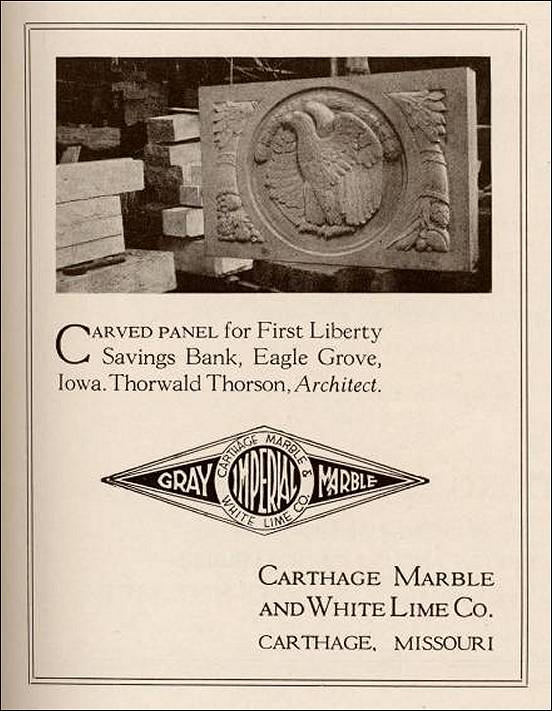
- Eagle Grove, Iowa – the First Liberty Savings Bank – Carved
Panel (The following advertisement is for the Carthage
Marble and White Lime Co. from Throvgh The Ages Magazine, October
1923, Vol. 1, No. 6, pp. 57.)
Carved panel for First Liberty Savings Bank, Eagle Grove, Iowa. Thorwald Thorson, Architect. 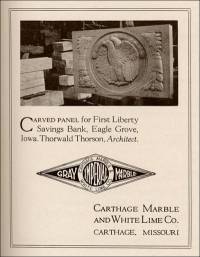
Carthage Marble and White Lime Co., Carthage, Missouri
- Ft. Dodge, Iowa – the Court House (water table and sills) (From The Quarrying Industry of Missouri, by Ernest Robertson Buckley and H. A. Buehler, 1904, pages 133-134.)
Limestone quarried from the Carthage, Missouri, area was used for the water table a sills. The color of the Carthage limestone ranges from brown and gray to white. Some of the stone has a faint blue tint.
- Greenfield, Iowa - the Greenfield Court House Building (from Missouri Marble,
by Norman S. Hinchey, Report of Investigations No. 3, Missouri Geological
Survey and Water Resources, Rolla, Missouri, 1946. Used with permission
of the Missouri Department of Natural Resources.)
Warrensburg sandstone quarried from the Pickel Sandstone Quarry located north of Warrensburg, Missouri, was used in the construction of the Greenfield Court House building prior to 1904.
- Keokuk, Iowa - the United States Custom House Building (from “Notes on The Building Stones, Clays and Sands of Iron, St. Francois and Madison Counties, ” by G. E. Ladd, Assistant Geologist, in Bulletin 1, Geological Survey of Missouri, Jefferson City, April 1890.)
Granite quarried from the Milne and Gordon quarry located in township 34 north, range 6 east, section 5, near the center, St. Francois County, Missouri, was used in the construction of the United States custom house building.
- Keokuk, Iowa - the United States Post Office (from “Notes on The Building Stones, Clays and Sands of Iron, St. Francois and Madison Counties, ” by G. E. Ladd, Assistant Geologist, in Bulletin 1, Geological Survey of Missouri, Jefferson City, April 1890.)
Granite quarried from the Milne and Gordon quarry located in township 34 north, range 6 east, section 5, near the center, St. Francois County, Missouri, was used in the construction of the United States Post Office building.
- Lineville, Iowa - Monument Bases, Bridge Abutments, Foundations, Sills, Crosswalks, etc. (Limestone) (The following information is from The Quarrying Industry of Missouri, by E. R. Buckley, Director and State Geologist, and H. A. Buehler, Missouri Bureau of Geology and Mines Vol. II, 2nd Series, 1904.)
“(The Ballew limestone) quarry, which is owned by T. W. Ballew and operated by Al. Phillips, is located about two miles south of Princeton (Missouri) on the Chicago, Rock Island and Pacific railroad in the N. ½ of the N.E. ¼ of sec. 4, T. 64, R. 24 W. This quarry was opened in 1892 and has a face extending along the hill over a quarter of a mile...”
“...It is worked from March to December, during which time from ten to twelve men are employed. The stone has been used for foundations, sills, crosswalks, monument bases, concrete, macadam and bridge abutments. The Chicago, Rock Island and Pacific Railroad has used this stone very extensively. It has also been used in Lineville, Allerton and Seymore, Iowa, and at Union, Missouri. One hundred car loads were shipped in 1900 and a similar amount in 1901; $1.00 a perch is obtained for rubble stone.”
- Osceola, Iowa - the Osceola Court House Building (from Missouri Marble,
by Norman S. Hinchey, Report of Investigations No. 3, Missouri Geological
Survey and Water Resources, Rolla, Missouri, 1946. Used with permission
of the Missouri Department of Natural Resources.)
Warrensburg sandstone quarried from the Pickel Sandstone Quarry located north of Warrensburg, Missouri, was used in the construction of the Osceola Court House building prior to 1904.
- Ottumway, Iowa - the Sandstone used in the Ottumway Area (The following information is from The Quarrying Industry of Missouri, by E. R. Buckley, Director and State Geologist, and H. A. Buehler, Missouri Bureau of Geology and Mines Vol. II, 2nd Series, 1904.)
“The Carroll County Sandstone Company, by which (the White Rock sandstone) quarry is owned, is a corporation consisting of A. T. Kendrick, B. D. Kendrick, O. A. Kendrick and Wm. Bushy. The quarry was opened in 1868 and has been operated almost continuously ever since....”
“As a whole, the stone consists of fine rounded grains of translucent quartz, cemented together chiefly with calcium carbonate. Small flakes of mica, grains of iron oxide and nodules of pyrites are lesser constituents of the rock. Large oval areas in the stone have been changed practically to a quartzite....”
“This sandstone has been used in the construction of the Iowa State Capitol, the Methodist Church at Carrollton, the Public Library at Fulton and for bridge abutments along the Wabash railroad. It has also been shipped to the following cities for miscellaneous uses: St. Joseph, St. Louis, Kansas City and Marysville, Missouri; Lincoln, Nebraska; Ottumwa, Des Moines, Atlantic, and Bloomfield, Iowa.”
- Red Oak, Iowa - the Red Oak Court House Building (from Missouri Marble,
by Norman S. Hinchey, Report of Investigations No. 3, Missouri Geological
Survey and Water Resources, Rolla, Missouri, 1946. Used with permission
of the Missouri Department of Natural Resources.)
Warrensburg sandstone quarried from the Pickel Sandstone Quarry located north of Warrensburg, Missouri, was used in the construction of the Red Oak Court House building prior to 1904.
- Seymore, Iowa - Monument Bases, Bridge Abutments, Foundations, Sills, Crosswalks, etc. (Limestone) (from The Quarrying Industry of Missouri, by E. R. Buckley, Director and State Geologist, and H. A. Buehler, Missouri Bureau of Geology and Mines Vol. II, 2nd Series, 1904.)
“(The Ballew limestone) quarry, which is owned by T. W. Ballew and operated by Al. Phillips, is located about two miles south of Princeton (Missouri) on the Chicago, Rock Island and Pacific railroad in the N. ½ of the N.E. ¼ of sec. 4, T. 64, R. 24 W. This quarry was opened in 1892 and has a face extending along the hill over a quarter of a mile...”
“...It is worked from March to December, during which time from ten to twelve men are employed. The stone has been used for foundations, sills, crosswalks, monument bases, concrete, macadam and bridge abutments. The Chicago, Rock Island and Pacific railroad has used this stone very extensively. It has also been used in Lineville, Allerton and Seymore, Iowa, and at Union, Missouri. One hundred car loads were shipped in 1900 and a similar amount in 1901; $1.00 a perch is obtained for rubble stone.”
- Allerton, Iowa - Monument Bases, Bridge Abutments, Foundations, Sills, Crosswalks, etc. (Limestone) (from The Quarrying Industry of Missouri, by E. R. Buckley, Director and State Geologist, and H. A. Buehler, Missouri Bureau of Geology and Mines Vol. II, 2nd Series, 1904.)
- Finished Products from Missouri Stone in
Kansas
- Cherokee, Kansas – the Crawford County High School (from The Quarrying Industry of Missouri, by Ernest Robertson Buckley and H. A. Buehler, 1904, pages 133-134.)
Limestone quarried from the Carthage, Missouri, area was used with wholly or in part in the construction of the school. The color of the Carthage limestone ranges from brown and gray to white. Some of the stone has a faint blue tint.
- Council Grove, Kansas - the Madonna of the Trail Statue in Council Grove, Kansas, dedicated on September 7, 1928 (photographs) The following quotation is from Wikipedia, the free encyclopedia.
The following quotation is from Wikipedia, the free encyclopedia.
“Madonna of the Trail is a series of monuments dedicated to the spirit of pioneer women in the United States. The monuments were commissioned by the National Society of Daughters of the American Revolution (NSDAR). They were placed along the National Old Trails Highway and extended from Bethesda, Maryland, to Upland, California, in each of the 12 states the road passed through.
“Created by sculptor August Leimbach and funded by contributions, the Madonna of the Trail monuments were intended to provide a symbol of the courage and faith of the women whose strength and love aided so greatly in conquering the wilderness and establishing permanent homes.
“Dedicated in 1928 and 1929, with each of the 12 located in a different state, they became a source of local pride. Through the continuing efforts of local and national groups, all are currently in good condition and on display....”
“The figure stands 10 feet high with a weight of 5 tons. The figure and the base are made of algonite stone (a poured mass) of which Missouri granite is used as the main aggregate, thus giving the monument a warm, pink shade. With the base, the monuments are about 18 feet high. The inscriptions on the east and west sides of each base are the same, but the north and south sides of each monument usually include local information as well.”
- Kansas - Cemetery Headstone carved from Carthage Missouri Limestone. Photograph of headstone carved by Kansas artist Bruce Sherratt Burkholder, Photo Realist Artist. (Scroll down to the photographs of the cemetery headstone.)
- Lindsborg, Kansas - Bethany College Building (from Missouri Marble, by Norman S. Hinchey, Report of Investigations No. 3, Missouri Geological Survey and Water Resources, Rolla, Missouri, 1946. Used with permission of the Missouri Department of Natural Resources.)
“Marble quarried from the Shoal Creek Quarry in Newton County, Missouri, operated by the Joplin Marble Quarries Company was used in the construction of the exterior of a building at Bethany College. The color of the stone was described as ‘medium dark gray color, stylolitic, coarsely crinoidal to rather fine-grained, with appreciable variations in texture.’”
- Maryville, Kansas - the Maryville Court House Building (from Missouri Marble,
by Norman S. Hinchey, Report of Investigations No. 3, Missouri Geological
Survey and Water Resources, Rolla, Missouri, 1946. Used with permission
of the Missouri Department of Natural Resources.)
Warrensburg sandstone quarried from the Pickel Sandstone Quarry located north of Warrensburg, Missouri, was used in the construction of the Maryville Court House building prior to 1904.
- Olathe, Kansas - the Olathe Court House Building (from Missouri Marble,
by Norman S. Hinchey, Report of Investigations No. 3, Missouri Geological
Survey and Water Resources, Rolla, Missouri, 1946. Used with permission
of the Missouri Department of Natural Resources.)
Warrensburg sandstone quarried from the Pickel Sandstone Quarry located north of Warrensburg, Missouri, was used in the construction of the Olathe Court House building prior to 1904.
- Ottawa, Kansas – the Franklin County Courthouse (photograph and history)
The Courthouse was constructed of pressed red-faced brick, limestone, and sandstone. The sandstone was shipped from Warrensburg, Missouri, and the limestone used for the basement walls was shipped from Strong City, Kansas. The building was constructed in 1893.
- Ottawa, Kansas - the Ottawa Court House Building (from Missouri Marble,
by Norman S. Hinchey, Report of Investigations No. 3, Missouri Geological
Survey and Water Resources, Rolla, Missouri, 1946. Used with permission
of the Missouri Department of Natural Resources.)
Warrensburg sandstone quarried from the Pickel Sandstone Quarry located north of Warrensburg, Missouri, was used in the construction of the Ottawa Court House building prior to 1904.
- Paola, Kansas – the
Miami County Court House – (photograph and history)
(from The Quarrying Industry of Missouri, by Ernest Robertson
Buckley and H. A. Buehler, 1904, pages 133-134 & the Miami County,
Kansas, web site.)
Limestone quarried from the Carthage, Missouri, area was used for the foundation of the Court House. The color of the Carthage limestone ranges from brown and gray to white. Some of the stone has a faint blue tint.
- Paola, Miami County, Kansas - Miami County Courthouse (photograph and history)
The Miami County Courthouse is built of Carthage limestone and brick in the Romanesque style. Building commenced in 1897 and the cornerstone was laid in July 1898.
- Paola, Miami County, Kansas - Miami County Courthouse (photograph and history)
- Parsons, Kansas – School Building (water table and trimmings) (from The Quarrying Industry of Missouri, by Ernest Robertson Buckley and H. A. Buehler, 1904, pages 133-134.)
Limestone quarried from the Carthage, Missouri, area was used for the water table and trimmings of the building. The color of the Carthage limestone ranges from brown and gray to white. Some of the stone has a faint blue tint.
- Pittsburg, Kansas – the Stillwell Hotel (from The Quarrying Industry of Missouri, by Ernest Robertson Buckley and H. A. Buehler, 1904, pages 133-134.)
Limestone quarried from the Carthage, Missouri, area was used with wholly or in part in the construction of the hotel. The color of the Carthage limestone ranges from brown and gray to white. Some of the stone has a faint blue tint.
- Pittsburg, Kansas– the William PattersonBuilding (from The
Quarrying Industry of Missouri, by Ernest Robertson Buckley and
H. A. Buehler, 1904, pages 133-134.)
Limestone quarried from the Carthage, Missouri, area was used with wholly or in part in the construction of the building. The color of the Carthage limestone ranges from brown and gray to white. Some of the stone has a faint blue tint.
- Topeka Kansas - Security Benefit Association Office Building (F. W. Steadley, Inc., advertisement from Stone Magazine, Vol. XLVI, No. 5, May, 1925, Stone Publishing Company, pp. 301)
“Security Benefit Association Office Bldg., Topeka, Kansas, W. E. Glover, Architect, Topeka, Kansas. “The entire exterior is of Colonial Grey Marble in a smooth sand rubbed finish and the owners are assured of a beautiful and enduring building. The marble was finished and set by the Sargent Cut Stone Company of Topeka, Kansas.” 
“Security Benefit Association Office Bldg., Topeka, Kansas, W. E. Glover, Architect, Topeka, Kansas.
F. W. Steadley & Co., Inc., “The Big Quarry”
Producers of Colonial Grey Veined - Colonial Grey Veinless
Representatives for New York City: Michael Cohen & Co., 8 West 40th St., New York City
- Wichita, Kansas - the Masonic Temple - Interior Work (from Building Stones and Clay-Products: A Handbook For Architects, by Heinrich Ries, Ph.D., 1912)
“This state does not produce any true marble, but the dense, light cream white limestone quarried near Carthage is often classed as such in the trade. This stone takes a polish and might be classed as a monotone marble.” Limestone quarried near Carthage, Missouri, was used in interior of the Masonic Temple in Wichita, Kansas.
- Cherokee, Kansas – the Crawford County High School (from The Quarrying Industry of Missouri, by Ernest Robertson Buckley and H. A. Buehler, 1904, pages 133-134.)


Commercial use of material within this site is strictly prohibited. It is not to be captured, reworked, and placed inside another web site ©. All rights reserved. Peggy B. and George (Pat) Perazzo.