
Quarries in Missouri & Quarry Links, Photographs, and
Articles
Springfield thru St. Joseph
- Springfield, Greene County, Missouri - Springfield
Area Limestone Quarries (Limestone) (from Report on The
Building Stones of The United States, and Statistics of the Quarry
Industry for 1880, by George W. Hawes, Curator of the Department
of Mineralogy and Lithology at the National Museum, and by F.
W. Sperr and Thomas C. Kelly, Joint production of the Census Office
and the National Museum, 1883)
“The sub-Carboniferous limestone has been quarried for local use at Springfield, Greene county. The quarry rock shows a face of 10 feet in depth of coarse, gray limestone. The upper beds resemble the Keokuk limestone, and the lower beds are more of the Burlington type. The geological divisions recognized in Iowa, Illinois, and eastern Missouri cannot strictly be sustained in southwest Missouri.”
- Springfield, Missouri - the Springfield Area Limestone Quarries (The
following information is from The Quarrying Industry of Missouri, by
E. R. Buckley, Director and State Geologist, and H. A. Buehler, Missouri
Bureau of Geology and Mines Vol. II, 2nd Series, 1904.)
“The principal quarries in and near Springfield are quarrying limestone belonging to the Burlington formation. According to Dr. E. M. Shepard,* this formation covers a greater part of the S.W. ½ of Greene county and contains a maximum thickness of 215 feet. Shepard** recognizes three divisions of the Burlington in this county.
(* Page 201, footnote 1: Mo. Geol. Sur., Vol. XII, Geol. of Greene Co., by Dr. E. M. Shepard, p. 115.)
(** Page 201, footnote 2: ibid, p. 113.)
“1st. A heavy bedded chert, or alternating thin beds of shaly limestone and chert, from a few to forty feet in thickness.
“2nd. A coarse grained, crystalline, soft, grayish colored limestone, carrying rather soft, Lenticular masses of chert, from a few inches to a foot or two in diameter. In places the chert is absent. The beds are characterized by having suture joints and the stone is alternately fine and coarse.
“3rd. A decidedly shaly horizon much harder than the upper two. These beds have a thickness of from fifty to eighty feet and are remarkably pure limestone, containing only traces of silica, alumina, magnesia and iron. Chert nodules are present and increase as the formation is followed to the southeast.
“The most important quarries in this locality are operated by H. F. Denton, the Marble Head Lime Co., J. D. Coutlet and R. S. Denny.
“With the exception of the Hollman quarry, the stone differs very little in its general characteristics, being rather coarsely crystalline, but to light gray and fossiliferous, containing layers and occasional nodules of flint. The stone is suitable for building purposes, but is too soft for macadam. It might be used for foundations, but even in this position a harder stone is more desirable. The following are descriptions of the individual quarries.”
- Springfield, Missouri - Limestone / Lime Quarries in the Springfield Area (photograph and history), presented in the Historical Postcards of Springfield, Missouri, “Lime Quarries” section of the Springfield-Greene Public Library web site.
- Springfield, Missouri - Lime Quarries, Springfield, Mo. (postcard
photograph; early 1900s; unmailed)
- Springfield (near), Green County, Missouri - the
Burns Kiln (Limestone) (from Past
and Present of Greene County, Missouri: Early and Recent
History and Genealogical Records of Many of the Representative
Citizens,
Jonathan Fairbanks and Clyde Edwin Tuck, (ca. 1914.), presented
by the Springfield-Greene
County Library.)
(The following information is from Chapter 3. Economic Geology, by Edward M. Shepard, Part 1.)
“The Burns kiln, discontinued many years ago, was situated east of the present site of the Marblehead kilns. It was started in 1975 and was operated until 1890. Up to 1884, one kiln supplied all the demand for lime in Springfield and vicinity.”
- Springfield, Missouri - John Cullen’s Quarry (listed in The Mine, Quarry and Metallurgical Record of the United States, Canada, and Mexico, The Mine and Quarry News Bureau, Chicago, Ill., 1897)
- Springfield, Missouri - the Denton Limestone Quarry (Limestone) (The
following information is from The Quarrying Industry of Missouri, by
E. R. Buckley, Director and State Geologist, and H. A. Buehler,
Missouri Bureau of Geology and Mines Vol. II, 2nd Series, 1904.)
“This quarry is located between West Walnut and College streets in the West End addition. It has a west face 200 feet long and has been worked into the hill about 150 feet. The following is a description of the stone from top to bottom:
1-2 ft. - Red clay and chert stripping.
8 ft. - Coarsely crystalline, gray, fossiliferous limestone. This bed has suture joints from two to eight inches apart. At either end of the quarry it is bouldery on account of its nearness to the surface.
6 ft. - Limestone, containing numerous flint nodules. It is coarse and fine grained and contains suture joints.
3 ft. 6 in. - Bluish gray, very coarsely crystalline limestone. Occasional flint nodules occur near the middle of the bed. Here there is also a suture joint along which the stone will split.
14 ft. - Bluish gray, coarsely crystalline, fossiliferous limestone. Contains tight suture joints. A layer of flint nodules occurs at the top of the bed. The stone is difficult to work but is said to be the best stone for macadam.
6 in. - Bed of chert.
“The major joints strike N. 45° E.
“The stone is quarried without machinery, a hand-crane being used to lift the larger blocks. The quarry is equipped with a crushing plant which has not been used for some time. This stone was used in the construction of the macadam pavement leading to the National Cemetery. It has a pleasing color and can be used to advantage for constructional purposes.
“North of this quarry is an abandoned opening owned by the John O’Day estate. The stone is very similar to that in the one just described. It has not been operated for several years.
“Laboratory Examination.
“Chemical Analysis. - The following is a chemical analysis of this limestone. Attention is called to the very small percentage of impurities, such as silica, iron and alumina:
Insoluble -.36
Fe2 O3, Al2 O3 -.13
CaCO3 - 99.34
MgCO3 -.227
Total - 100.057”
- Springfield, Missouri - the Galloway Quarry (Limestone) Excerpt
from Missouri Mining Heritage Guide, by John R. Park, Stonerose
Publishing Co., Miami, Florida, March 2005. (The following excerpted
quotations are used with the permission of John R. Park, author.)
“...A waste pile of the Galloway Quarry is said to be the highest point in Springfield. All or part of the quarry is underground. Eventually, about 50 acres of space will be quarried and developed for underground storage.
“The quarry was operated by the Ash Grove Cement Company until 2001 (...Ash Grove Limeworks). It is now operated by Conco Quarries.”
- Springfield, Missouri - the Granola Monument Company
(Advertisement) (from Granite, Marble & Bronze Magazine,
October 1920, Vol. XXX, No. 10, pp. 38)
News of the Retail Trade: “The Granola Monument Co., Springfield, Mo., is opening a new office at Colorado Springs, Colo. This will be the main office of the concern, and branch offices will be located in Nebraska, Kansas, Missouri, Arkansas, Oklahoma and Texas.”
- Springfield, Missouri - the Hollman Flagstone Quarry (Limestone) (The
following information is from The Quarrying Industry of Missouri, by
E. R. Buckley, Director and State Geologist, and H. A. Buehler,
Missouri Bureau of Geology and Mines Vol. II, 2nd Series, 1904.)
“This quarry, which was opened thirteen years ago by Geo. Hollman, is located nine miles northeast of Springfield. It is now owned by R. B. Coutlet and operated by J. D. Coutlet. It is located in a valley just north of the Little Sac creek, and has a total face of 400 feet, consisting of beds of limestone from four to six inches in thickness.
“The stone is a compact sub-crystalline, bluish gray limestone, having a rather fine texture. Blue shaly seams occur in the stone, especially in the lower beds. The stone in the lower part of the quarry contains thin seams of calcite known as ‘glass’ seams. All of the stone contains small nodules of pyrite, but these are most common in the two lower beds. The stripping consists of four feet of soil and chert.
“The major joints, which strike N. 75°-80° E., and are from fifteen to sixty feet apart, have determined the direction in which the quarry is being worked. The stone also contains dries. In quarrying, the stone is split between the joints, with plugs and feathers, to any desired dimensions. The stone is very durable when used for curbing and sidewalks, as shown by streets in Springfield on which it was laid ten to thirteen years ago.
“Laboratory Examination.
“Chemical Analysis. - The following is a chemical analysis of this stone which shows it to be somewhat arenaceous and not as pure as that occurring in the Denton quarry:
Insoluble - 4.51
Fe2 O3, Al2 O3 -.52
CaCO3 - 92.24
MgCo3 - 2.35
Total - $99.62
“Physical Tests. - Two-inch cubes were examined in the laboratory to determine the physical qualities of this stone with the following results:
Specific Gravity - 2.715
Porosity -.927 per cent.
Ratio of Absorption -.274
Weight per cubic foot - 168.1 lbs.
Crushing Strength -
{ 20,779 lbs. per sq. in. on bed.
{ 19,580 lbs. per sq. in. on edge.
Crushing strength of samples subjected to freezing test - 17,814 lbs. per sq. in.
“These test show the stone to have an especially high crushing strength, being surpassed only by the limestones form Noel and Jackson. The cubes subjected to the freezing and thawing test lost 2,965 pounds per square inch, as shown in the above table. It is interesting again to note that the low porosity of less than one per cent. is accompanied by a correspondingly high loss in strength through freezing and thawing.”
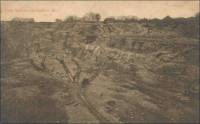
- Springfield, Missouri – “Limes
Quarries” Postcard Photograph (photograph & history),
presented on the Springfield-Greene County Library web site.
“The photograph in the postcard shows a lime quarry in Springfield, presumably the one at the intersection of National Avenue and East Trafficway. The quarry has an interesting history beginning in 1884 when James H. Smith built a kiln at the junction of the St. Louis and San Francisco and the Kansas City, Fort Scott and Memphis railroads....”
- Springfield, Missouri - the Marble Head Lime Company’s
Limestone Quarry (Limestone) (The following information is
from The Quarrying Industry of Missouri, by E. R. Buckley,
Director and State Geologist, and H. A. Buehler, Missouri Bureau
of Geology and Mines Vol. II, 2nd Series, 1904.)
“The quarry owned by this company is located on Phelps between Sherman and Springfield avenues. The quarry consists of a rectangular, sunken pit about 1,000 feet by 250 feet. The portion which is worked at present is about 250 feet square and has a vertical face of 57 feet. The stone from this quarry is used extensively for the manufacture of quicklime, the plant for this purpose being the second largest in the State. The following is a description of the stone from top to bottom of the quarry:
8 ft. - Coarsely crystalline limestone, containing suture joints about twelve inches apart along which the stone is split with plugs and feathers.
12 ft. - Gray, coarsely crystalline limestone. Very few suture joints and no chert nodules occur in this bed. This stone makes good ashler blocks, which can be obtained in large dimensions. It is well suited for this purpose. This and the bed immediately above are used exclusively for building stone.
2 ft. to 6 in. - Bed of chert.
37 ft. - Gray, coarse to fine grained, crystalline limestone. The texture of the stone varies. Suture joints occur from two to twelve inches apart and vary from very fine pencil lines to two inches in size. The stone is used chiefly for the manufacture of quicklime. Some chert nodules, especially near the bottom of the bed.
“The upper portion of the quarry has been leased to Mr. H. Hanson who works it without machinery. Rubble stone is the chief product.
“The major joints strike N. 40°-45° E.
“The lime-kilns are located at the west end of the quarry. The stone is hauled to the kilns over an inclined tramway. The equipment consists of a gasoline engine, a modern air compressing plant, Ingersoll drills, centrifugal pump and other necessary machinery. The plant has a cooperage, in which the barrels in which the quicklime is shipped, are made. About 50 men are employed in the quarry.
“The broken flint and waste limestone, which are hauled out of the quarry and dumped near the kilns, are removed by the city and used as a road metal.”
- Springfield, Missouri - the John O’Day Estate
Limestone Quarry (Limestone) (The following information
is from The Quarrying Industry of Missouri, by E. R. Buckley,
Director and State Geologist, and H. A. Buehler, Missouri Bureau
of Geology and Mines Vol. II, 2nd Series, 1904.)
“North of (the Denton ) quarry is an abandoned opening owned by the John O’Day estate. The stone is very similar to that in the one just described. It has not been operated for several years.”
- Springfield, Missouri - the Résumé Limestone
Quarry (Limestone) (The following information is from The
Quarrying Industry of Missouri, by E. R. Buckley, Director and
State Geologist, and H. A. Buehler, Missouri Bureau of Geology
and Mines Vol. II, 2nd Series, 1904.)
“The limestone in the quarries at Springfield has a uniform color and a texture which makes it well adapted for constructional work. However, the abundant chert nodules which occur in some parts of nearly all the beds practically preclude the possibility of working the quarries exclusively for this purpose. Channeling machines cannot be operated successfully and quarrying by hand is too expensive.
“The limestone has been used for sills, caps and ashler blocks in many of the buildings in Springfield. Drury College Chapel and St. Johns Episcopal Church were erected entirely out of Springfield limestone. The suitability of the stone for this purpose is well illustrated by these buildings.
“The purity of the limestone and its coarse texture make it very valuable for the manufacture of quicklime. That which is manufactured by the Marble Head Lime Co. is as pure and white as any lime in the State.”
- Springfield, Missouri - the Shea & Cullen Quarry (listed in The Mine, Quarry and Metallurgical Record of the United States, Canada, and Mexico, The Mine and Quarry News Bureau, Chicago, Ill., 1897)
- Springfield, Green County, Missouri - the
Springfield White Lime Association/Marblehead Company (Limestone) (from Past
and Present of Greene County, Missouri: Early and Recent
History and Genealogical Records of Many of the Representative
Citizens,
Jonathan Fairbanks and Clyde Edwin Tuck, (ca. 1914.), presented
by the Springfield-Greene
County Library.)
(The following information is from Chapter 3. Economic Geology, by Edward M. Shepard, Part 1.)
“In 1884 Mr. James H. Smith built a kiln at the junction of St. Louis and San Francisco and the Kansas City, Fort Scott and Memphis railroads, in Springfield and sold a one-half interest to J. G. Schermerhorn. Another kiln was soon added when Mr. J. S. Atkinson purchased an interest and the Springfield White Lime Association was organized. One kiln was added in 1885, and another in 1886. In 1894, this company sold out to the Marblehead Company, of Chicago, which continues the operation of the plant with a number of new kilns (circa 1914).”
- Springfield, Missouri - the Tindell Limestone Quarry
(Limestone) (The
following information is from The Quarrying Industry of Missouri, by
E. R. Buckley, Director and State Geologist, and H. A. Buehler,
Missouri Bureau of Geology and Mines Vol. II, 2nd Series, 1904.)
“This quarry, which is owned by A. Tindell and operated by R. S. Denney of 914 Dale street, is located at the north end of Jefferson street. It has been operated about fifteen years and has a face of about 125 feet. It consists of two ledges, the lower of which contains nine feet of coarsely crystalline, gray limestone of Burlington age. This lower bed separates into two layers four feet three inches and four feet nine inches in thickness. These layers can be split into blocks about twelve inches in thickness which make very good ashler. Suture joints occur from two to eight inches apart. Coarse and fine grained layers alternate in this stone.
“The upper ledge is eight feet in thickness and works into three beds. The stone in these beds is more coarsely crystalline and more uniform in texture than that in the lower bed. It contains suture joints from four to ten inches apart. Occasional chert nodules occur near the north end of the quarry. The stone is suitable for heavy rubble masonry or foundations, such as have been used in the base of the water tower in Springfield.”
- Springfield(near), Missouri - the Phoenix
Marble Quarries – The
information below about the C. R. Hunt residence was presented
by the Kansas City Public Library - Local History section
in the past, although the link from which the information
was obtained is no longer available.
<http://www.kclibrary.org/sc/post/streets/20000011.htm>Marble from the Phoenix marble quarries was used to build the home of C. R Hunt in Kansas City, Missouri.
- St. Charles (south of), Missouri - the Dirker Limestone
Quarry (Limestone) (The following information is from The
Quarrying Industry of Missouri, by E. R. Buckley, Director
and State Geologist, and H. A. Buehler, Missouri Bureau of Geology
and Mines Vol. II, 2nd Series, 1904.)
“This quarry, which is owned by Dirker Bros., and operated by Micheal (sic) Hanson, is located one mile south of St. Charles on the Missouri, Kansas and Texas railroad.
“The face of the quarry is 500 feet long, but at present it is being worked only near the middle. The stone is a bluish gray, crystalline limestone similar to that at the Hoelcher quarry. The middle of the quarry is covered with ten feet of clay stripping.
“The quarry is equipped with a small crusher. The principal products are crushed stone and rubble.”
- St. Charles (southwest of), Missouri - the Hoelcher Limestone
Quarry (Limestone) (The following information is from The
Quarrying Industry of Missouri, by E. R. Buckley, Director and
State Geologist, and H. A. Buehler, Missouri Bureau of Geology
and Mines Vol. II, 2nd Series, 1904.)
“This quarry, which is owned by Fred Hoelcher and operated by Fred Elsner, is located two miles southwest of St. Charles on the west side of the Missouri, Kansas and Texas railroad. Formerly the quarry was operated quite extensively by Mr. J. Short for government work, but up to September, 1901, it had been idle for a number of years. It has been opened along the east side of the bluff for a distance of about 325 feet. The following is a section from top to bottom:
4-6 ft. - Loess stripping.
7 ft. - Sandy, argillaceous, yellow limestone of inferior quality. Cannot be used.
2 ft. 1 in. - Finely crystalline, bluish gray limestone, containing calcite nodules and geodes. Splits into three beds seven to eight inches in thickness.
8 in. - Soft yellowish limestone, containing greenish spots. Two inches of shale at top.
1 ft. 6 in. - Finely crystalline limestone. Works into large blocks.
1 ft. 4 in. - Fine grained, compact, dark gray limestone. Had an uneven splintery fracture.
3 ft. 3 in. - Similar to layer above. Splits in middle of bed. Breaks with uneven fracture. Used mostly for macadam.
10 in. - Hard, fine grained, bluish gray limestone.
2 ft. - Fine grained, compact, gray limestone. Splintery fracture.
3 ft. - Fine grained, bluish gray limestone. Works well.
“The lower ledge of three feet is not being quarried at present. In general, the stone is compact and, although it breaks rather irregularly and does not work easily into rectangular pieces, it is a durable building stone. The quarry is not worked very extensively at present. Hand tools are used. The output is chiefly rubble.”
- St. Charles, Missouri - R. F. Pouri’s Quarry (listed in The Mine, Quarry and Metallurgical Record of the United States, Canada, and Mexico, The Mine and Quarry News Bureau, Chicago, Ill., 1897)
- St. Charles, Missouri - William Pundman’s Quarry (listed in The Mine, Quarry and Metallurgical Record of the United States, Canada, and Mexico, The Mine and Quarry News Bureau, Chicago, Ill., 1897)
- St. Charles County, Missouri - the St. Charles Quarry - The Petrography and Stratigraphy of St. Charles Quarry in St. Charles, Missouri, in 1992, by Robert C. Beste, R.P.G. and Robert E. Woody, 1994, 99 pp. [PDF]
- St. Charles County, Missouri - the Tavern Rock Quarry, (location & map) (from Brainy Geography)
- St. Charles, Missouri - Julius Waye’s Quarry (listed in The Mine, Quarry and Metallurgical Record of the United States, Canada, and Mexico, The Mine and Quarry News Bureau, Chicago, Ill., 1897)
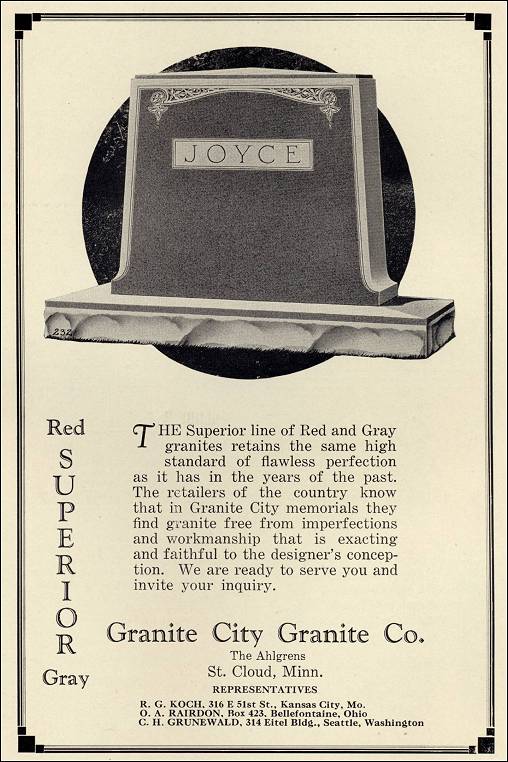
- St. Cloud, Missouri - R. G. Koch, Branch Office of Granite
City Granite Co., St. Cloud, Minnesota (Advertisement) (from Design
Hints for Memorial Craftsmen, September 1929, Vol. 6, No. 3,
pp. 37. A similar advertisement ran in the following Design Hints
for Memorial Craftsmen issue: August 1929, Vol. 6, No. 2, pp.
1)
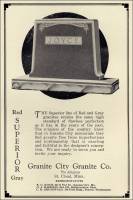
Granite City Granite Co. - The Ahlgrens, St. Cloud, Minn.
Red Superior Gray
The Superior line of Red and Gray granites retain the same high standard of flawless perfection as it has been in the years of the past. The retailers of the country now that in Granite City memorials they find granite free from imperfections and workmanship that is exacting and faithful to the designer’s conception. We are ready to serve you and invite your inquiry.
Representatives
R. G. Koch, 316 E. 51st St., Kansas City, Mo.
O. A. Rairdon, Box 423 Bellefontaine, Ohio - C. H. Grunewald, 314 Eitel Bldg., Seattle, Washington
- St. Francois County, Missouri - Building Stones in St. Francois County, Missouri (circa 1890) - “Notes on The Building Stones, Clays and Sands of Iron, St. Francois and Madison Counties, Missouri,” by G. E. Ladd, Assistant Geologist, in Bulletin 1, Geological Survey of Missouri, Jefferson City, April 1890, pp. 22-44.
- St. Francois County, Missouri - Granite
Quarries in St. Francois County, Missouri. The following
information is from Encyclopedia of the History of Missouri on
the Missouri Agricultural Statistics Service web site. (The
date of publication is not stated.) (The link from which the
following information was obtained is no longer available.)
<http://agebb.missouri.edu/mass/agrifact/stfranco/narative.htm>St. Francois County is located in the east central part of Missouri. “Granite of excellent quality is found in different parts of the county, and near Knob Lick are extensive quarries. John Simpson opened the first quarry, and from this was taken the first granite block used for paving in St. Louis.”
- St. Francois County, Missouri - the Allen and Vieths
Syenite Quarry (Syenite) (from“Notes
on The Building Stones, Clays and Sands of Iron, St. Francois
and Madison Counties,” by
G. E. Ladd, Assistant Geologist, in Bulletin 1, Geological
Survey of Missouri, Jefferson City, April 1890.)
“Allen and Vieths. In township 35 north, range 5 east, section 36, on Doe Run creek, is a large quarry which was opened a few years ago. It is situated on the east slope of a hill, and is drainable by siphons. It is not worked, though capable of furnishing excellent dimension stone. The rock outcrop has practically no cover, and is cut by joint planes in an advantageous manner. There are two varieties of stone: a pink, fine grained syenite, and a gray to pale pink and rather coarse grained granite which in places is handsomely mottled with crystals of a pale green mineral. The former is apparently intrusive in the latter. The quarry has produced about 400,000 paving blocks to date.”
- St. Francois County, Missouri - Andersons Quarry (Historical) (from Brainy Geography)
- St. Francois County, Missouri - the P. V. Ashburn Limestone
Quarry (Limestone) (from“Notes
on The Building Stones, Clays and Sands of Iron, St. Francois and
Madison Counties,” by
G. E. Ladd, Assistant Geologist, in Bulletin 1, Geological
Survey of Missouri, Jefferson City, April 1890.)
“P. V. Ashburn. In township 36 north, range 6 east, section 31, southwest quarter, is a limestone quarry, sixty feet square and twelve feet deep. The limestone is covered by about thirty inches of stripping. The strata vary in thickness from three to eight inches. The color of the stone varies, being yellow, gray and blue. The product is used mostly for macadam, and to some extent for foundations and flagging.”
- St. Francois County, Missouri - Beals’ Limestone
Quarry (Limestone) (from “Notes
on The Building Stones, Clays and Sands of Iron, St. Francois
and Madison Counties,” by
G. E. Ladd, Assistant Geologist, in Bulletin 1, Geological
Survey of Missouri, Jefferson City, April 1890.)
“Beals’ Quarry. In township 35 north, range 5 east, section 1, northeast quarter, is a quarry in which the limestone is porous, filled with calcite veins and pockets, and unfit for building purposes. The output has been used principally for macadam and foundations.”
- St. Francois County, Missouri - the J. B. Miller Limestone
Quarry (Limestone) (from “Notes
on The Building Stones, Clays and Sands of Iron, St. Francois and
Madison Counties,” by
G. E. Ladd, Assistant Geologist, in Bulletin 1, Geological
Survey of Missouri, Jefferson City, April 1890.)
“J. B. Miller. Mr. Miller has a quarry in limestone similar to Mr. Ashburn’s, in the southeast quarter of the same section. The rock, however, is covered by several feet of stripping. It is used for foundations.”
- St. Francois County, Missouri - the Missouri Granite Works, (historical site) (location) (from Brainy Geography)
- St. Francois County, Missouri - the A. Parkhurst Limestone
Quarry (Limestone) (from “Notes
on The Building Stones, Clays and Sands of Iron, St. Francois
and Madison Counties,” by
G. E. Ladd, Assistant Geologist, in Bulletin 1, Geological
Survey of Missouri, Jefferson City, April 1890.)
“A. Parkhurst. In township 35 north, range 5 east, section 2, near the center, is a small quarry in the limestone from which about sixteen hundred cubic feet of stone have been taken, to be used for macadam.
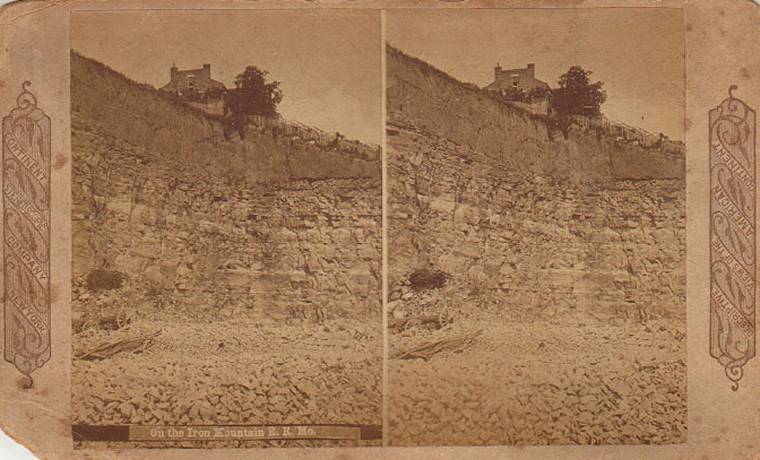
- St. Francois County (?), Missouri - “On the Iron
Mountain R.R. Missouri”
(stereoview; Continent Stereoscopic Company, New York; circa late 1800s) 
- St. Francois County, Missouri - the J. M. Ritters
Limestone Quarry (Limestone) (from “Notes
on The Building Stones, Clays and Sands of Iron, St. Francois and
Madison Counties,” by
G. E. Ladd, Assistant Geologist,
“J. M. Ritters. In township 36 north, range 5 east, section 23, northeast quarter, is a quarry in the limestone where blocks as large as ten feet square by eighteen inches are obtainable. The stone is fine grained, gray to yellow in color, and dresses very easily. The output has been used mostly for monument bases, window sills, etc.”
- St. Francois County, Missouri - the St. Joe Lead Company
- North Quarry Limestone Quarry (Limestone) (from “Notes
on The Building Stones, Clays and Sands of Iron, St. Francois
and Madison Counties,” by G. E. Ladd,
Assistant Geologist, in Bulletin 1, Geological Survey
of Missouri, Jefferson City, April 1890.)
“St. Joe Lead Company, North Quarry is in township 38 north, range 4 east, section 35. The strata vary from six inches to two feet in thickness, and large slabs are obtainable. The stone varies in color from gray to yellow, is coarse grained, dendritic, and occasionally blotched with calcite crystals. It does not dress easily. The output has been used for piers and abutments for a railway bridge over the Big river, and for the construction of drains and culverts. It has also been crushed and used largely for ballast in the construction of a railway bed.”
- St. Francois County, Missouri - the Turpin Granite Quarry (Granite), (historical quarry) (location) (from Brainy Geography)
- St. Joseph, Missouri - the St. Joseph Area Limestone
Quarries (Limestone) (The following information is from The
Quarrying Industry of Missouri, by E. R. Buckley, Director
and State Geologist, and H. A. Buehler, Missouri Bureau of Geology
and Mines Vol. II, 2nd Series, 1904.)
“The Pennsylvanian or Upper Coal Measures in the vicinity of St. Joseph consist of alternating heavy beds of shale and limestone overlain with a variable but generally thick deposit of loess.
“Limestone occurs at three different horizons. The upper two are the only ones quarried in this vicinity. The uppermost or surface ledge consists of from sixteen to eighteen feet of limestone which splits into beds from four to twenty-four inches in thickness. Underneath this occurs a heavy bed of clayey shale. Underneath the shale occurs a massive bed of finely crystalline limestone, eighteen feet in thickness. Another bed of shale of about fifty feet underlies this limestone. This in turn is underlain with four feet of finely crystalline limestone. This bed is underlain by blue shale.
“The middle limestone horizon is the most important and is the one from which most of the stone is quarried.
“The principal output is crushed stone, although the upper portion of the middle ledge has been used to some extent for rubble.
“The following are the quarries which are being operated in the vicinity of St. Joseph : Farmer & Dunn, Roth, Eagle Contracting Co. and Helsley Bros. With the exception of the last named, these quarries are all in the northern part of the city. The Helsley Bros. quarry is located about two and a half miles north of St. Joseph. The following is a brief description of each.”
- St. Joseph, Missouri - the Bielhen Foundry and Machine
Company (from Stone:
An Illustrated Magazine, December 1897, Vol. XVI, No. 1, pp.
xxiii. This advertisement also ran in the following issues of Stone:
January 1898, Vol. XVI, No. 2, pp. xxii; February 1898, Vol.
XVI, No. 3, pp. xxii; March 1898, Vol. XVI, No. 4, pp. xxii;
November 1898, Vol. XVII, No. 6, pp. xiii; December 1898, Vol. XVIII,
No. 1, pp. x; February 1899, Vol. XVIII, No. 3, pp. 86; April 1899,
Vol. XVIII, No. 5, pp. 259; and May 1899, Vol. XVIII, No. 6, pp. 357)

The Bielhen Foundry and Machine Company, St. Joseph, Mo.
Write us for Stone Saw-Mill Machinery.
- St. Joseph, Missouri - the Bielhen Foundry and Machine
Company (from Stone: An Illustrated Magazine,
January 1898, Vol. XVI., No. 2, pp. 194)
“The Bielhen Foundry and Machine Company, of St. Joseph, Mo., write under recent date that they are just completing the erection of the third saw gang for W. WcMillan (sic - McMillan ?) & Son, of Chicago, put up in 1897. They were then making ready for shipment three gangs to R. Robertson & Co., Detroit, Mich., who have the contract for the stone and granite work of the new Wayne county court-house. They are also building a gang for the Butler-Ryan Company, of St. Paul, who have the contract for the new Minnesota capitol. Western stone-sawing machinery is making a record, and the Bielhen gang is becoming famous the world over.”
- St. Joseph, Missouri - the Bielhen Foundry and Machine
Company (from Stone: An Illustrated Magazine,
January 1898, Vol. XVI., No. 2, pp. 194)
- St. Joseph, Missouri - Charles Bremer Stone
Yard (from Stone Magazine,
June 1898, Vol. XVII, No. 1, pp. 216)
“St. Joseph, Mo. - Charles Bremer has purchased 80 feet of ground at Fifth and Walnut streets to be used as a stone yard.”
- St. Joseph, Missouri - the Eagle Contracting Company’s
Limestone Quarry (Limestone) (The following information is
from The Quarrying Industry of Missouri, by E. R. Buckley,
Director and State Geologist, and H. A. Buehler, Missouri Bureau
of Geology and Mines Vol. II, 2nd Series, 1904.)
“The Eagle Contracting Co. of Kansas City, Missouri, operated a crusher near the northeast limits of the city in 1902. The quarry from which the stone was obtained has a vertical face of about twelve feet. The stone has a gray to buff color, is fine grained and fossiliferous. When examined it was covered with from two to five feet of red clay stripping.
“The company operates a No. 4 Gates crusher and is engaged exclusively in the production of crushed stone. Since visiting this quarry the company has located their crushing plant one mile north of the Roth quarry.”
- St. Joseph, Missouri - the Farmer and Dunn Limestone
Quarry (Limestone) (The following information is from The
Quarrying Industry of Missouri, by E. R. Buckley, Director
and State Geologist, and H. A. Buehler, Missouri Bureau of Geology
and Mines Vol. II, 2nd Series, 1904.)
“A. M. Farmer and J. P. Dunn operate a quarry on the west side of the hill. The land on which it is located is owned by H. W. Dunn.
“The quarry has a working face 250 feet long. The middle ledge of limestone has a thickness of seventeen feet, as developed in this quarry. The stone is covered with a heavy stripping of loess and clay which increases as the quarry is worked east.”
Plate XLI. Pennsylvania Limestone. A section of the Farmer and Dunn quarry, St. Joseph. Mo. 
“The stone occurs in thick massive beds. The upper four to five feet is medium grained limestone, through which is disseminated particles of iron oxide. Due to the iron, the stone has a gray to buff color. This bed is known as the ‘pudding ledge.’ It is used to some extent for rubble and works well under the cutting tools.
“The remainder of the face consists of finely crystalline, heavily bedded limestone, having a gray to brown color. It is used almost exclusively for crushing.
“The quarry is equipped with a Gates crusher No. 3, a 30-horse power boiler, a 25-horse power engine and other necessary accessories for quarrying.
“H. W. Dunn formerly quarried another ledge near the crest of the hill, above the present quarry.”
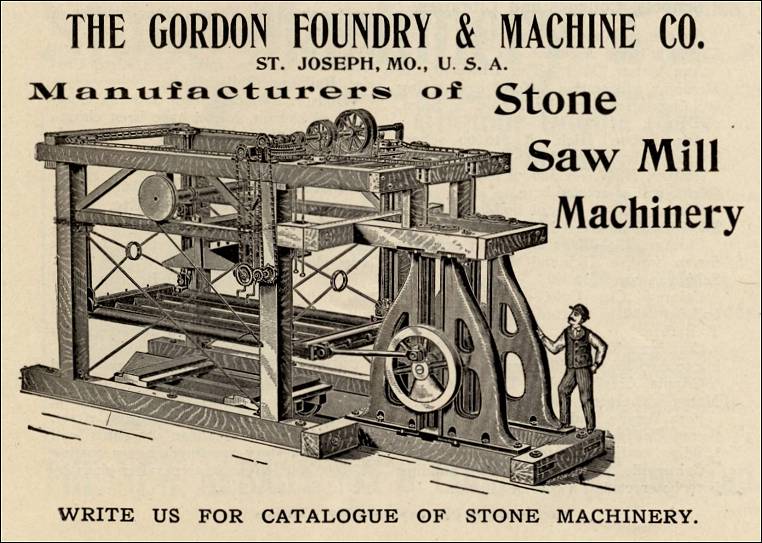
- St. Joseph, Missouri – The Gordon Foundry & Machine
Co. (Stone Machinery) (The following information is from
an advertisement in Stone: An Illustrated Magazine Devoted
to Stone, Marble, Granite, Slate, Cement, Contracting and Building,
Vol. XXIV, No. 1, January, 1902, Stone Publishing Co., New York,
pp. 83.
This advertisement was also published in the following issues of Stone Magazine:
February 1902, Vol. XXIV, No. 2, pp. 185; March 1902, Vol. XXIV, No. 3, pp. 285;
April 1902, Vol. XXIV, No. 4, pp. 385; May 1902, Vol. XXIV, No. 5, pp. 485; and
June 1902, Vol. XXIV, No. 6, pp. 585.)

The Gordon Foundry & Machine Co., St. Joseph, MO., U.S.A.
Manufacturers of Stone Saw Mill Machinery
Write Us For Catalogue of Stone Machinery.
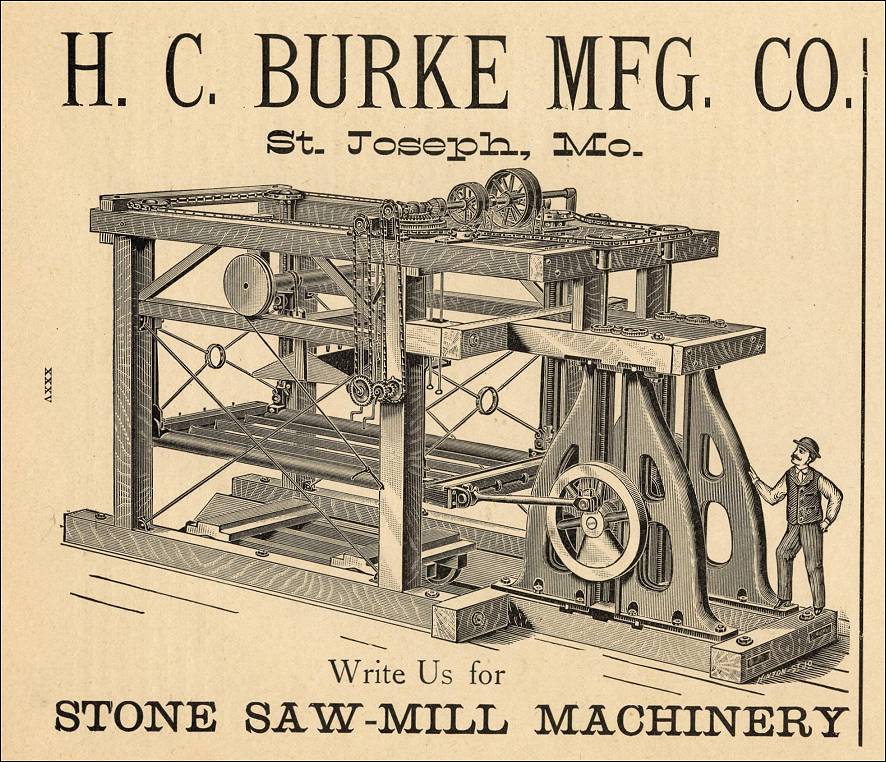
- St. Joseph, Missouri – the H. C. Burke Manufacturing
Co. (from Stone: An Illustrated Magazine, Vol. XII,
No. 1, December, 1895, “Notes From Quarry and Shop” section,
Stone Publishing Co., New York, pp. xxxv.)

H. C. Burke Mfg. Co. - St. Joseph, Mo.
Write Us for Stone Saw-Mill Machinery
- St. Joseph (north of), Missouri - the Helsley Bros.
Limestone Quarry (later owned by the The St. Joseph Street Construction
Co.) (The
following information is from The Quarrying Industry of Missouri, by
E. R. Buckley, Director and State Geologist, and H. A. Buehler,
Missouri Bureau of Geology and Mines Vol. II, 2nd Series, 1904.)
“The quarry owned and operated by Helsley Bros. is located in sec. 31, T. 58, R. 35 W., about two and one-half miles north of St. Joseph. It was opened in 1898 and has been operated almost continuously since that time.
“The base of the quarry is about fifty feet above the tracks of the Burlington railroad, which skirt the west side of the bluff. Between the base of the quarry and railroad tracks there are about forty feet of blue shale, covered with ten feet of shaly sandstone. The quarry itself has a vertical face of fourteen feet, all of which is dark gray limestone. In places the stone contains considerable iron oxide, which occurs in spots and small veins. Portions of the quarry are entirely free from iron oxide staining, and at these places the stone has a very light color. This ledge is the same as that worked at the Farmer and Dunn quarry.
“The quarry contains no prominent jointing or bedding planes.
“Above the limestone bed, which constitutes the quarry face, there occurs a fifteen-foot bed of blue shale. At the south end of the present face of the quarry, a four-foot bed of very hard buff colored limestone occurs above the shale. On top of this is a stripping of loess clay.
“This company owns thirty-nine acres of land extending for a distance of a half mile along the bluff. The quarry face is 300 feet long and can be extended at either end. The stripping costs about fourteen cents per cubic yard and although quite heavy, can be handled very cheaply. It is thrown into the quarry and dumped upon the hillside below by means of wheeled scrapers.
“This quarry is equipped with modern machinery, including a Badger steam drill, Gates crusher No. 4 and a 75-horse power engine. The company produces four sizes of crushed rock for macadam, as well as stone for foundation work, sidewalks, paving, crosswalks, curbing, bridge abutments and concrete. On an average, forty men are employed at the quarry between April and December of each year. Most of the output is sold in St. Joseph and Marysville. Since this quarry was visited it has become the property of ‘The St. Joseph Street Construction Co.’”
- St. Joseph, Missouri - J. Pfeiffer & Son - See: “St. Joseph, Missouri - Pfeiffer Stone Company” below.
- St. Joseph, Missouri - Sebastian Maier’s Quarry (listed in The Mine, Quarry and Metallurgical Record of the United States, Canada, and Mexico, The Mine and Quarry News Bureau, Chicago, Ill., 1897)
- St. Joseph, Missouri – the J. J. McGinnis,
Marble, etc. (from Stone: An Illustrated Magazine,
April 1897, Vol. XIV, No. 5, “Notes from Quarry and Shop” section,
pp. 534)
“St. Joseph, Mo. – J. J. McGinnis, marble, etc., succeeded by McGinnis & Kell.”
- St. Joseph, Missouri - the Missouri Granite Company (from Monumental
News Magazine, April 1938, Vol. 50, No. 4, pp. 164.)
Trade News: The Missouri Granite Company at St. Joseph, Missouri, has recently installed new sandblast machinery and a Stone Take-About Saw.
- St. Joseph, Missouri - the Pfeiffer Stone Company (AKA
J. Pfeiffer & Son) (Biography
of Charles A. Pfeiffer, from Stone: An Illustrated Magazine,
September 1892, Vol. V, No. IV, pp. 400. A photograph of Charles
A. Pfeiffer is presented as the Frontispiece of this magazine issue
on pp. 365. This book is available on Google Book Search - Full View
Books <http://books.google.com/>.
Charles A. Pfeiffer
“Chas. A. Pfeiffer, the subject of our frontispiece, was born in Sigmaringen, Hohenzollern, Germany, Dec. 19, 1844, and is therefore at present in his forty-eighth year. Four years after his birth his father emigrated to America, and a year later his mother followed taking her son with her. His father was a practical stone-cutter, at which trade he readily found employment in New York, Philadelphia and Chicago, respectively, in which cities the son was given the benefits of a common school education. While yet a mere lad he assisted his father in his labors and the thorough methods acquired by the father in the mother country were gradually instilled into the mind of young Pfeiffer, who was also taught how to sketch and draw, to estimate on cut-stone work and prepare himself generally for the requirements of the trade he had adopted. Having acquired a thorough common school education, he entered a commercial college attending evening sessions. At the age of 24 he became his father’s associate in the business which had been established eight years before, and the firm name was changed to J. Pfeiffer & Son, under which title it was conducted until 1881, when it was incorporated under the laws of Missouri as the Pfeiffer Stone Co., of which Charles A. is president, with headquarters at St. Joseph, Mo. At the annual meeting of the Missouri Valley Cut-Stone Contractors’ and Quarrymen’s Association, held at Kansas City, Mo., Jan. 26, 1892, Mr. Pfeiffer was elected its president and was delegated to attend the convention of the Ohio Valley Association for the purpose of effecting relations insuring a uniformity of action relative to issues affecting cut-stone contractors generally and those of the Ohio and Missouri valleys particularly. This he accomplished to the satisfaction of both organizations.”
- St. Joseph, Missouri - the Roth Limestone Quarry (later
owned by the St. Joseph Street Construction Co.) (The
following information is from The Quarrying Industry of Missouri, by
E. R. Buckley, Director and State Geologist, and H. A. Buehler,
Missouri Bureau of Geology and Mines Vol. II, 2nd Series, 1904.)
“The quarry owned and operated by Frederick Roth is located just north of the Farmer and Dunn quarry. Two openings have been made, one near the crest of the hill and one lower down, in what is known as the second ledge. The latter is the one being operated at the present time.
“The upper opening has a stripping of eighteen feet of loess, which is removed by washing the clay through a sluice-way to the valley below. The water is pumped from the valley for this purpose. In this opening there is exposed twenty-one feet of rock, which occurs in beds from two to twelve inches in thickness. The beds are separated by thin layers of shale. The stone is somewhat decomposed along the bedding planes. It is finely crystalline and contains fine veins of calcite and occasional flint nodules.
“The stone is used mainly for macadam pavements. Some of the larger blocks have been used for foundations.
“The lower opening has a face 725 feet long on the west side of the hill. This opening is now being operated at the south end and the stone is very similar to that obtained at the farmer and Dunn quarry. It contains dries. The so-called ‘pudding ledge’ is used to some extent for rubble. The remainder of the stone is crushed for macadam.”



Commercial use of material within this site is strictly prohibited. It is not to be captured, reworked, and placed inside another web site ©. All rights reserved. Peggy B. and George (Pat) Perazzo.