
Wolf's Neck, The Gem of Casco Bay,
The Charming Suburb of Freeport, Maine,
With Its Many Important Industries and Superior Granite
Productions.
(Page 2)
(Circa 1889)
_______
By George H. Haynes, Portland, Maine.
_______
"Granite is a well-known igneous rock, composed of the three minerals, quartz, feldspar, and mica, united in a confused crystallization; that is, without a regular arrangement of the crystals. The feldspar is the most abundant ingredient and the proportion of quartz is greater than that of mica. Granite is always a compact rock, it never passes into or alternates with tuffs or breccias, and the absence of cellular cavities, such as are produced in trappean and volcanic rocks by the expansion of the contained gases, has led to the belief that granite has been formed at considerable depths in the earth, and has crystallized under great pressure, either from superimposed strata or deep seas; and according to the best authority appears to be the fundamental rock of the earth's crust. Whenever we reach the base of the stratified rocks, we find them resting on granite, and we have no reason to suppose that below the granite there occur beds of older date. The varieties of granite depend upon the number and quantity of its mineral constituents and upon the state of aggregation of these materials. As granite is composed of feldspar, mica, and quartz, the feldspar may be either the flesh-colored potash variety, orthoclase, or the pure white soda variety, albite, or both potash and soda may enter into its composition. The mica varies in color from pure silvery white, through the more common brown, into black. The quality is generally white, seldom dark gray or brown. The predominance of one or the other of the ingredients, or of a particular variety, gives the peculiar color to the mass, which is either red, gray, or white. The red is produced from the predominance of orthoclase, the white of albite, and the intervening gray from the mica or sometimes from the quartz. The feldspar forms generally a half, and sometimes even more, of the bulk of the rock. The mica in one variety and the quartz in another are so minute as to be scarcely visible. Sometimes the feldspar separates into large and distinct crystals, forming a phosphoritic granite. The substitution of hornblends for mica produces that variety called Syenite, and if talc takes the place of mica the rock is called Protignic. When the ingredients exist in a compact and finely granular condition, the compound is known as Eurite." Granite is now quarried extensively at Freeport, Hallowell, and North Jay, Maine, at Fall River and Quincy, Mass., and at North Conway, N. H.
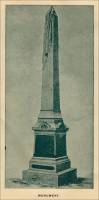
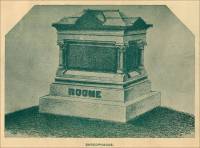
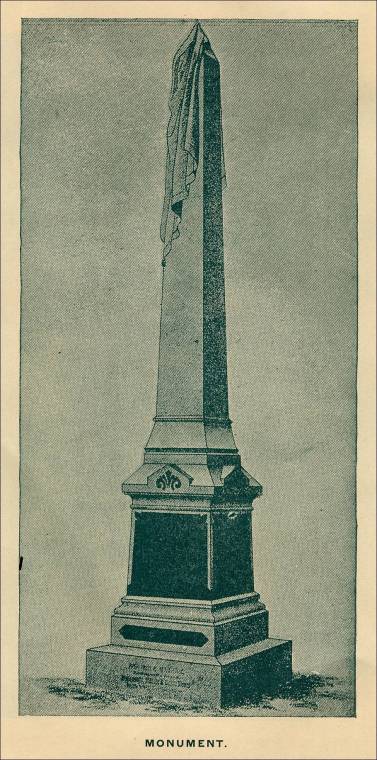
The Freeport granite is of the Eurite order, is susceptible of a high polish, and is one of the best granites known for general use or ornamental purposes, and is used very extensively for statue cutting. The fine statue on page 27 was cut from this granite, and now adorns a beautiful lot in Lake View Cemetery, Cleveland, Ohio, near the Garfield Monument. The statue of such exquisite design on page 28, which is called one of rare symmetry and beauty at the tree-embowered cemetery, the "Pere la Chaise," of Dayton, Ohio, was the handiwork of Mr. Mallet's designer, and the product of his valuable quarry. The Sarcophagus on page 30, which shows such fine combinations in the arrangements of its design, was made from the Freeport granite, and now is placed in the "city of the dead," at North Yarmouth, Maine. The monument draped so gracefully on page 29 shows what elegant designs can be produced from the handsome granite of Freeport, which makes any of its products worth of a place in the sacred precinct where nature and art join hands. And the fact that this granite was selected for this fine class of work speaks volumes for it, as does its use for the same purpose in the cemeteries of Michigan, Indiana, and Wisconsin. The quality is fine and of uniform hardness, which makes it excellent for the best uses. One advantage, there is not much difference between the rift and the grain, making it a very safe granite for all carving and molding work; and the following assay shows its quality is unexcelled:
Maine State Assay Office.
E. B. Mallet, Jr., Portland, May 17, 1889.
Dear Sir: I have tested the samples of granite submitted by you, taken from your Freeport quarries, with the following results:
Specific Gravity Iron in Form of Pyrite Percentage Insoluble in Strong Acids (Quartz) Hardness Iron in Form of Oxide, in Combination Percentage Soluble in Dilute Acids Absorption in Water
The examination of this granite, as shown by the above tests, indicates that it contains an excess of silica, and that it contains no sulphides of iron or lime, that it is compact and insoluble in water, all of which proves that the stone is suitable for monumental purposes and will stand under either salt or fresh water. So far as I can see, it has all the properties required by a good building stone. Its composition is silica, black mica, and feldspar; the silica predominates, consequently it would be called Quartzose granite.
Yours truly,
F. L. Bartlett.
_______
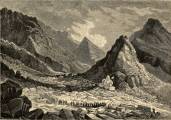
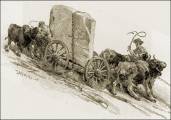
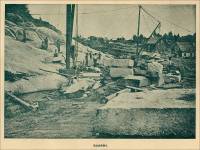
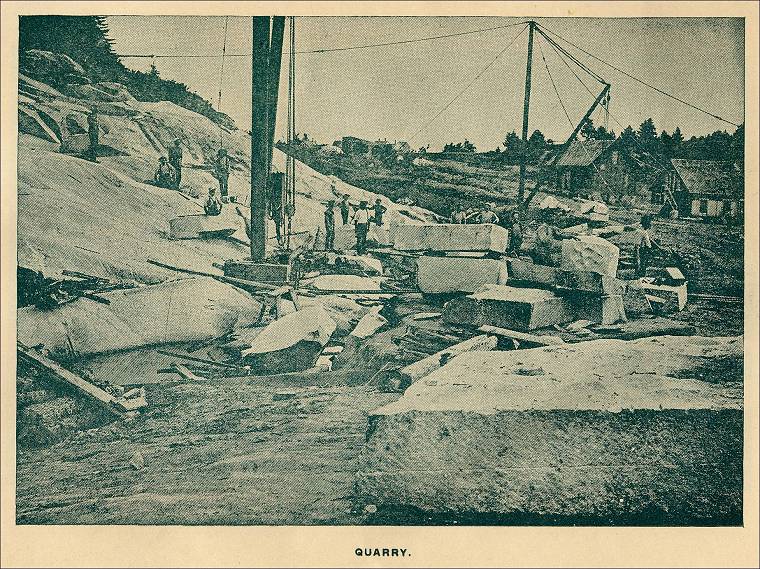
As a brief description of the quarries which produce such fine material may be of interest, we submit them as gathered by a personal inspection: Quarry No. One (1), shown on page 22, is one-half mile from the busy town of Freeport. The plant covers thirty-five acres and contains fine granite enough to build a thousand cities. It was opened in 1886 to obtain foundation stone for the shoe factory, grist mill, etc., etc. Upon quarrying it proved to be of such excellent quality, in 1887 it was decided to work it. A force of six men were at first employed; now it takes thirty-five, and orders on hand for a year's work for them. Messrs. Kendall & Whitney of Portland used it for trimmings for their elegant block. All the granite for the extension of the Maine General Hospital is obtained here. Large contracts have been filled for Portland city authorities and at Cincinnati, Ohio. At the present time they have one hundred and fifty thousand (150,000) paving blocks on hand and have thirty men at work quarrying them. The formation of the granite at this quarry is wonderful. It lays in sheets, so to speak, from three to eleven feet thick; at the present time there are several huge blocks in sight, one of which measures forty-four (44) feet long by twenty feet wide and nine feet six inches deep. Anther's dimensions are seventy-five feet long, fifteen and a half feet wide and six feet thick, rivaling the pillars found among the ruins of the Temple of Baalbec. Quarry No. Two (2), covering eleven and one-half acres, is at Mallet's Station, one and a half miles from town, on the direct line of the Maine Central Railroad. This quarry has just been opened; it shows a granite of a texture a trifle coarser and darker than No. 1, and takes a beautiful polish. Both quarries show great contrast between polished and hammered surface, which shows the cutting to advantage.
-
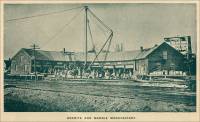
Granite and Marble Manufactory (one-half mile from Freeport).
-
Quarry (Quarry of Freeport Granite one-half mile from Freeport).

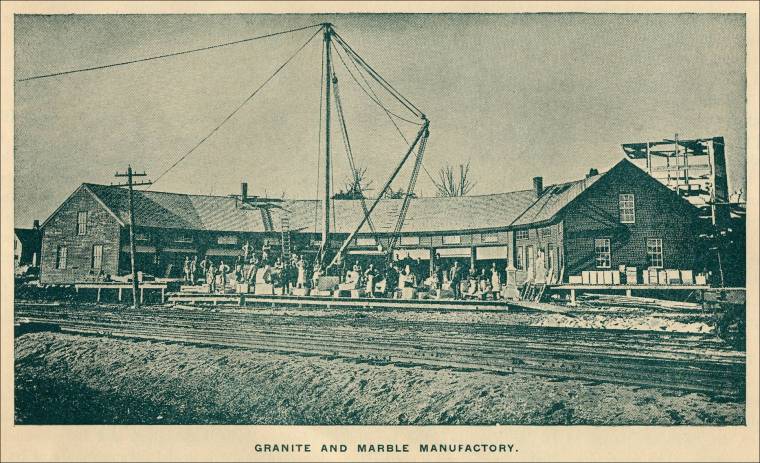

The quarries are under the management of Stephen W. Reed, well known throughout the New England States as an experienced quarryman and one of the best. This brief description will give a faint idea of the quarries. Now we will notice the stone manufactory where the granite is worked and polished, a cut of which is shown on page 20. This building is 198 x 22 feet, with engine room 30 x 30; here there is a thirty horse-power boiler and engine. The water to supply same is taken from an artesian well near, 295 feet deep. The blacksmith shop is 17 x 22 feet; on these premises are fifty skilled workmen. In this building is a fine office, and a room for marble work 17 x 22 feet. Here is always on hand a stock of foreign and American marble, and they are ready at any time to fill all orders for any work in that line as well as granite. At the manufactory there are all kinds of monumental work, bases, shafts, sarcophagi, plinths, dies, and caps, completed and in process of completion.
-
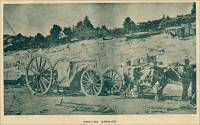
Hauling Granite.
-
Quarry.
-
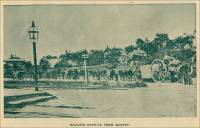
Hauling Granite from Quarry.
-
Statue (created from Freeport Granite, located in Lake View Cemetery, Cleveland Ohio, near the Garfield Monument, page 27).

-
Statue (created from Freeport Granite, located at "Pere la Chaise" in Dayton, Ohio, page 28)

-
Monument (created from Freeport Granite, page 29)
-
Sarcophagus (created from Freeport Granite, located in the "city of the dead," at North Yarmouth, Maine, page 30)
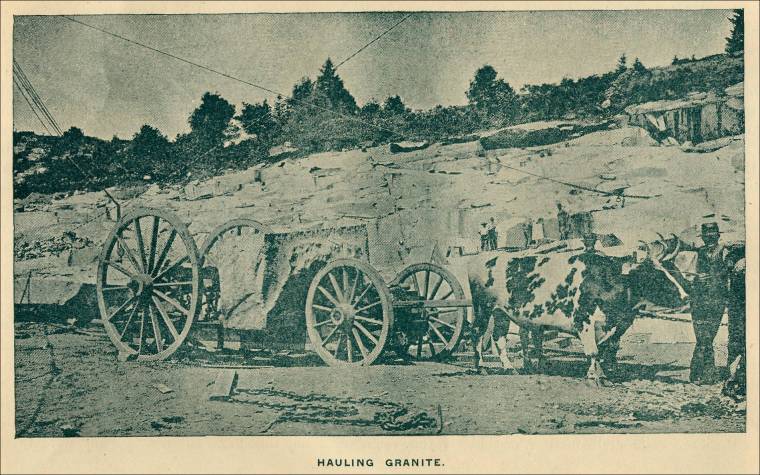
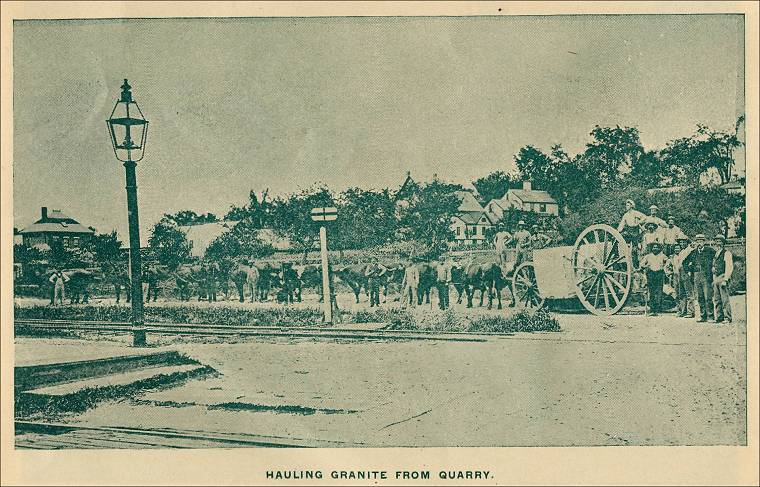



This important industry is under the charge of the efficient superintendent, George C. Lovell, who has a thorough knowledge of all its branches, learned by ten years' experience in the same business for himself and eight years in charge of works. Mr. Lovell makes a trip through the West and South twice a year, in the interest of Mr. Mallet. This extensive plant required in 1889 one hundred men, twelve horses, and six oxen. For 1890 the force will be doubled to meet orders. But in order to appreciate the magnitude of the business carried on by Mr. Mallet one should visit Freeport and see his fine factory, mills, business blocks, office, houses, granite and marble manufactory, etc. His one branch, the granite business, is well worth a trip to see. And Wolf's Neck, the charming suburb, which is destined to be the Newport of Maine, will amply repay inspection by any lover of the grand and the beautiful.

Commercial use of material within this site is strictly prohibited. It is not to be captured, reworked, and placed inside another web site ©. All rights reserved. Peggy B. and George (Pat) Perazzo.