
Quarries in Maine & Quarry Links, Photographs, and
Articles
(Continued)
-
Waldoboro, Lincoln County – the Waldoboro Quarry, from The Commercial Granites of New England, Bulletin 738, by T. Nelson Dale, U. S. Geological Survey, 1923.
This quarry was "in the town of Waldoboro, 1 1/2 miles north of Waldoboro village, on the Boston & Maine Railroad." The operator was the Booth Bros. & Hurricane Isle Granite Co., 208 Broadway, New York. The granite from the quarry was reportedly a medium-gray shade, "a trifle darker than 'Hallowell granite'" and still darker than "North Jay granite.'" It had a fine to medium texture. Transport of the granite was by cart 1,300 feet (and 120 feet down) from the quarry to the mill, and then by cars 19 miles to the wharf at Rockland. "The distance from the quarry to tidewater at Waldoboro is only 1 1/2 miles, but the water there is only 11 feet deep at high tide."
The Waldoboro Quarry was opened in 1860. In 1905 the quarry measured "400 feet N. 59° E. to S. 52° W, by 140 feet across, and was 60 to 85 feet deep." The quarry was not operated in 1916, and it was abandoned at the time of the report.
Granite from the Waldoboro Quarry was used for buildings and monuments but not polished work. Waste was used for paving and road ballast. "About 250,000 paving blocks were shipped annually, mostly to Philadelphia, Pennsylvania."
Granite from the Waldoboro Quarry was used in the following examples: the Buffalo Savings Bank in Buffalo, New York; the Armory, boat house, and cadets' quarters at the United States Naval Academy at Annapolis, Maryland; the Crockett monument in the Acorn Cemetery in Rockland, Maine; Chemical National Bank, "platforms" for sidewalk around Schwab Building, and Riverside Drive, New York.
-
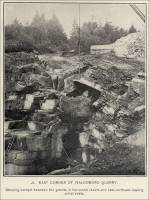
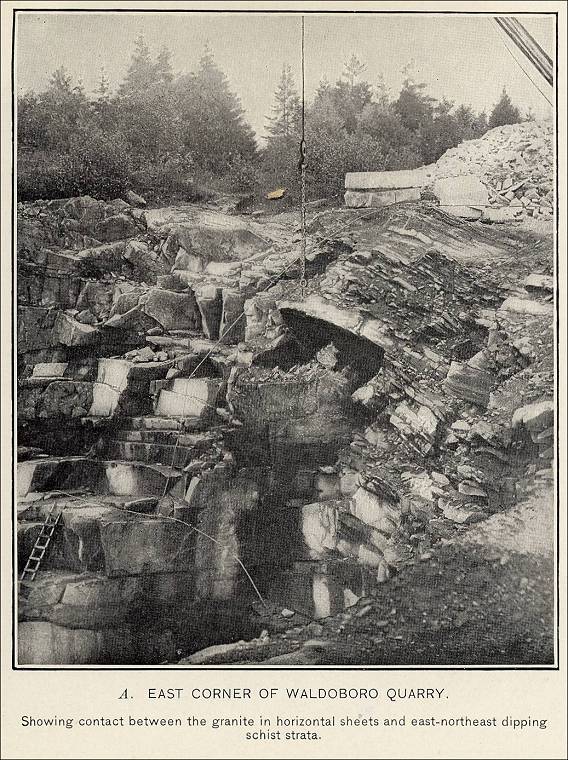
Waldoboro Quarry - East Corner of Waldoboro Quarry. Showing contact between the granite in horizontal sheets and east-northeast dipping schist strata. Plate IX (photograph) (From The Granites of Maine, Bulletin 313, 1907, Plate IX-A.)
-
Waldoboro, Lincoln County, Maine - the Waldoboro Granite Quarry (medium gray color) Structures in which this stone was used include: the Armory, boat house, and cadets' house at the Naval Academy in Annapolis, Maryland; the Buffalo Savings Bank in Buffalo, New York; the Chemical National Bank in New York City; the fine carvings on keystones for a building at the United States Naval Academy in Annapolis, Maryland; 2 fluted columns 23 feet long for a block in New York City; and the Platforms for the sidewalk around the Schwab building at 74th and Riverside Drive in New York City. (For a more detailed description of the granite and location of quarry, see Maine Quarries and Prospects published by the Maine Geological Survey, written by M. B. Austin and A. M. Huseey, II, John R. Rand, State Geologist, May 1, 1958, pp. 30.)
-
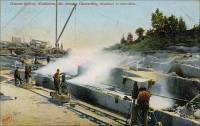
Waldoboro, Maine - Granite Quarry, Waldoboro, Maine, Showing Channelling Machines in Operation
-
(colorized postcard photograph #9185; published by Robbins Bros., Boston, Mass. and Germany; postmark August 26, 1908)
-
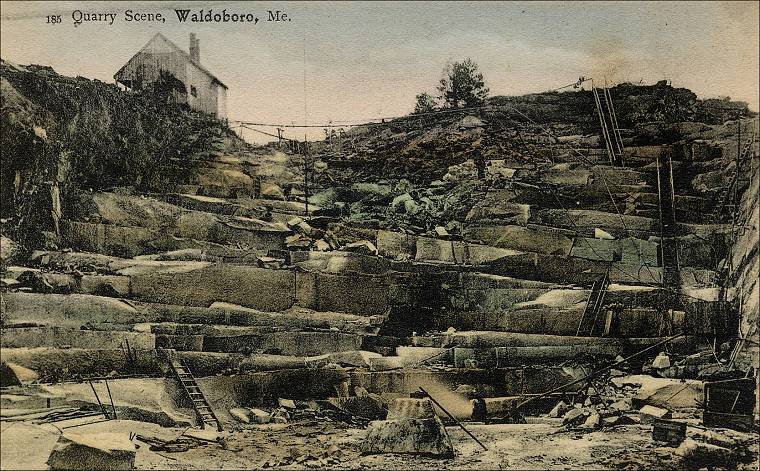
Waldoboro, Maine - Quarry Scene, Waldoboro, Me.
-
(postcard, #185; published by W. G. Labe, Waldoboro, Me; printed in Germany, unmailed)

-
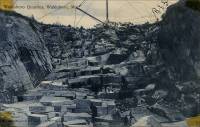
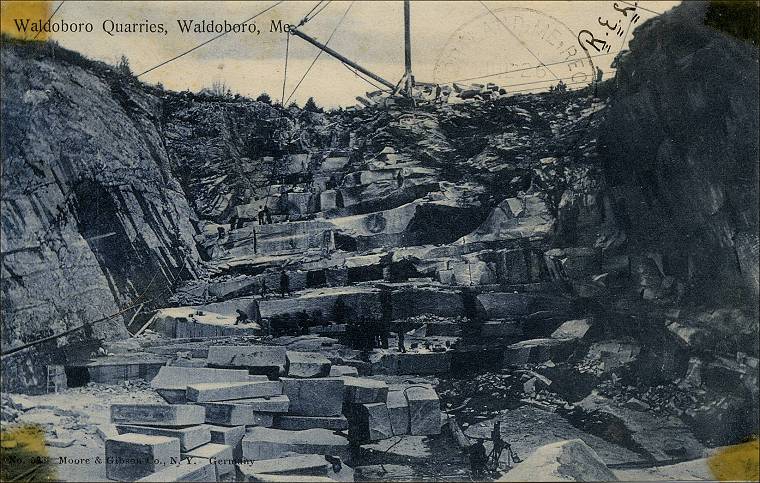
Waldoboro, Maine - Waldoboro Quarries
-
(colorized postcard photograph, postmark July 1905)
-
Warren, Knox County, Maine - Limestone Resources in Warren, Knox County (This information is presented on the Davistown Museum web site. The quotation below is used with permission.) (The link from which the following information was obtained is no longer available.)
<http://www.davistownmuseum.org/InfoWarren.html>The following excerpts are from the Davisville Information File, taken from Annals of the Town of Warren in Knox County, Maine, with the early history of St. George, Broadbay and neighboring settlements on the Waldo Patent. Masters, by Cyrus Eaton, Smith and Co., Hallowell, 1851, reprinted in 1887 by Masters and Livermore, Hallowell and in 1968:
"1754. Lime-burning was then, as now, the principal business; and two sloops were kept running to Boston. The rock was dug at the quarry now belonging to the prison, and burnt at four small kilns near the block-house, where were also a small wharf and lime store. There was also a wharf at the fort, but no kilns.The land was pretty well cleared of trees and bushes from the present burial ground in Thomaston to the quarry.."
"...The trade and navigation of this place prior to 1812 was inconsiderable, many of its inhabitants purchasing their English goods at Warren. Since that period, its business, wealth, and population have rapidly increased; the last of which [1850] amounts to 5221. Its lime quarries are an inexhaustible source of wealth. (pg. 144)."
-
Web Cove, Stonington, Maine - Old Quarry Ocean Adventures (commercial web site - photographs) This site provides information on visiting the area, which is reportedly :.bordered by a 50-acre granite quarry park that has a hilltop scenic vista as well as nice hiking trails.," which border their site. Boats can be used to visit the nearby Deer Isle-Stonington shoreline. This site reports that the Deer Isle-Stonington area includes a granite swim quarry.
-
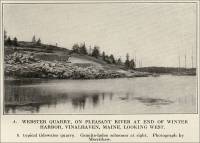
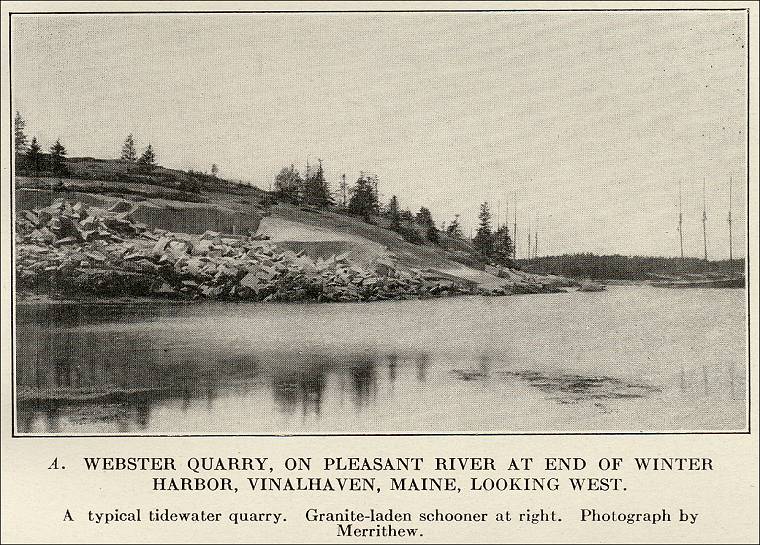
Webster Quarry, on Pleasant River at end of Winter Harbor, Vinalhaven, Maine, looking west. Typical tidewater quarry. Granite-laden schooner at right. Photograph by Merrithew. (From The Commercial Granites of New England)
-
Wells, York County, Maine - The Lord Quarry, from The Commercial Granites of New England, Bulletin 738, by T. Nelson Dale, U. S. Geological Survey, 1923.
This quarry was "in the town of Wells, about 1 mile east-northeast of Wells Depot on the Boston & Maine Railroad (eastern division), near a school house at a road fork." The operator was Granville W. Lord of Wells Depot, Maine. Granite from the quarry was a light pinkish-gray color, with sparse conspicuous biotite, and a medium to coarse texture.
The openings to the Lord Quarry were small. At the time of the report, the quarry had been idle since 1915.
-
Wells, York County, Maine - the Hatch Quarry (medium light gray) Stone from this quarry was used for miscellaneous railroad structures for the Boston & Maine Railroad in the Wells-North Berwick area. (For a more detailed description of the granite and location of quarry, see Maine Quarries and Prospects published by the Maine Geological Survey, written by M. B. Austin and A. M. Huseey, II, John R. Rand, State Geologist, May 1, 1958, pp. 17.)
-
Wells, York County, Maine - the Lord Prospect (light pinkish gray color) (For a more detailed description of the granite and location of quarry, see Maine Quarries and Prospects published by the Maine Geological Survey, written by M. B. Austin and A. M. Huseey, II, John R. Rand, State Geologist, May 1, 1958, pp. 19.)
-
West Monson, Maine - Slate in West Monson, Maine (1906). Click on the preceding link to read the details of the West Monson slate quarries ca 1906. The information on the West Monson slate quarries is from Slate Deposits and Slate Industry of the United States, Bulletin No. 275, by T. Nelson Dale With sections by E. C. Eckel, W. F. Hillebrand, and A. T. Coons, Department of the Interior, United States Geological Survey, Government Printing Office, Washington, 1906.
-
West Monson, Maine - Slate in West Monson, Maine (1914). Click on the preceding link to read the details of the West Monson slate quarries ca 1914. The information on the Monson slate quarries is from Slate in The United States, Bulletin 586 - Maine, by T. Nelson Dale and Others, Department of the Interior, United States Geological Survey, Washington, Government Printing Office, 1914.
-
Westbrook, Maine - Blue Rock Industries (present-day aggregate supplier, since 1920)
-
Westbrook, Cumberland County, Maine - Pride's Quarry, from The Commercial Granites of New England, Bulletin 738, by T. Nelson Dale, U. S. Geological Survey, 1923.
This quarry was "in the town of Westbrook, 3 1/2 miles northeast of Westbrook (Saccarappa) and a quarter of a mile north of Prides Corners." The operator was James H. Pride, R.D. in Woodford. The granite was a medium-gray color with conspicuous black mica and had a fine texture.
Minerals in descending order of abundance: potash feldspar (microcline and orthoclase), smoky quartz, a little soda-lime feldspar (oligoclase), and biotite with accessory apatite.
Pride's Quarry opened in 1898. When measured in 1905 the quarry was about 200 by 100 feet and had a depth of 6 feet. Transport of the granite was to the nearest railroad at Westbrook about 3 1/2 miles away.
Granite from Pride's Quarry was used for curbing and bases of monuments locally.
-
Westbrook, Cumberland County, Maine - the Prides Granite Quarry (medium gray color) Stone from this quarry was used for curbing and bases of monuments - locations not stated. (For a more detailed description of the granite and location of quarry, see Maine Quarries and Prospects published by the Maine Geological Survey, written by M. B. Austin and A. M. Huseey, II, John R. Rand, State Geologist, May 1, 1958, pp. 25.)
-
Whitefield, Lincoln County, Maine - the Jewett's Quarry, from The Commercial Granites of New England, Bulletin 738, by T. Nelson Dale, U. S. Geological Survey, 1923.
This quarry was "in the town of Whitefield, 1 1/2 miles southeast of Whitefield village (Kings Mills). The granite from the quarry was reportedly a very dark gray color with a bluish tinge and a fine to medium texture. The quarry had two adjacent openings. One of the openings was 50 by 25 feet and the other was 60 by 30 feet. When they were measured in 1905 these openings were 6 and 8 feet deep, respectively. The quarry was only worked at intervals, and the stone was used for monuments locally. At the time of the report, the quarry was abandoned.
-
Whitefield, Lincoln County, Maine - the Jewetts Black Granite Quarry (very dark gray color with bluish tinge) Stone from this quarry was used for monuments - locations not stated. (For a more detailed description of the granite and location of quarry, see Maine Quarries and Prospects published by the Maine Geological Survey, written by M. B. Austin and A. M. Huseey, II, John R. Rand, State Geologist, May 1, 1958, pp. 18.)
-
Woodstock, Oxford County, Maine - The Bryant Pond Quarry, from The Commercial Granites of New England, Bulletin 738, by T. Nelson Dale, U. S. Geological Survey, 1923.
This quarry was located "in the town of Woodstock, half a mile south of Bryant Pond station, on the east side of the Grand Trunk Railway." The operator was the Grand Trunk Railway, Master of Bridges and Buildings, Grand Trunk Railway, Montreal, Canada. Rock from this quarry was "a quartz diorite with conspicuous black particles on a bluish-white rather than a yellow-white ground" and had a medium texture.
The Bryant Pond Quarry opened about 1864. When measured at a later date it was 150 feet north to south by 250 feet east to west with a depth from 10 to 50 feet. The quarry was located on the west side of a north-south ridge.
The granite from the Bryant Pond Quarry was used exclusively for bridges and stations on the Grand Trunk Railway. This granite can be seen in the following examples: the vestibule, first story, and trimmings of the station at Portland, Maine, and the station at Battle Creek, Michigan.
-
Woodstock, Oxford County, Maine - the Bryant Pond Granite Quarry. Structures in which this stone was used include: the Grand Trunk Station in Battle Creek, Michigan; and the Grand Trunk Station (the vestibule, first story and trim) in Portland, Maine; and in bridges of the Grand Trunk Railroad, western Maine. (For a more detailed description of granite and location of quarry, see Maine Quarries and Prospects published by the Maine Geological Survey, written by M. B. Austin and A. M. Huseey, II, John R. Rand, State Geologist, May 1, 1958, pp. 11.)
-
York, York County, Maine - the Swenson Green Granite Quarry (dark greenish-gray color) (For a more detailed description of the granite and location of quarry, see Maine Quarries and Prospects published by the Maine Geological Survey, written by M. B. Austin and A. M. Huseey, II, John R. Rand, State Geologist, May 1, 1958, pp. 29.)

Commercial use of material within this site is strictly prohibited. It is not to be captured, reworked, and placed inside another web site ©. All rights reserved. Peggy B. and George (Pat) Perazzo.