
Quarries in Maine & Quarry Links, Photographs, and Articles
(The following list of Maine quarries is not a complete list of all of the historical quarries in the state, only the ones I have been able to locate. If you know of more historical quarries in Maine, please contact me. Peggy B. Perazzo)
- Active Quarries in Maine (present-day quarries), listed on Superyellowpages.com.
- Maine Granite Quarries List (historic quarries): This link will take you to a list of Maine granite quarries extracted from The Commercial Granites of New England, Bulletin 738, Department of the Interior, United States Geological Survey, by T. Nelson Dale, 1923. I have also listed these quarries by location in the “Quarry” section of the web site below.
- Maine Quarries and Prospects: An Extensive Listing of All The Quarries in Maine with a description of each quarry, its location and accompanying maps. Scanned from a document by the Maine Geological Survey, written by M. B. Austin and A. M. Huseey, II, John R. Rand, State Geologist, Department of Economic Development, Augusta, Maine, May 1, 1958. (This publication is out of print and is no longer available from the Maine Geological Survey.)
-
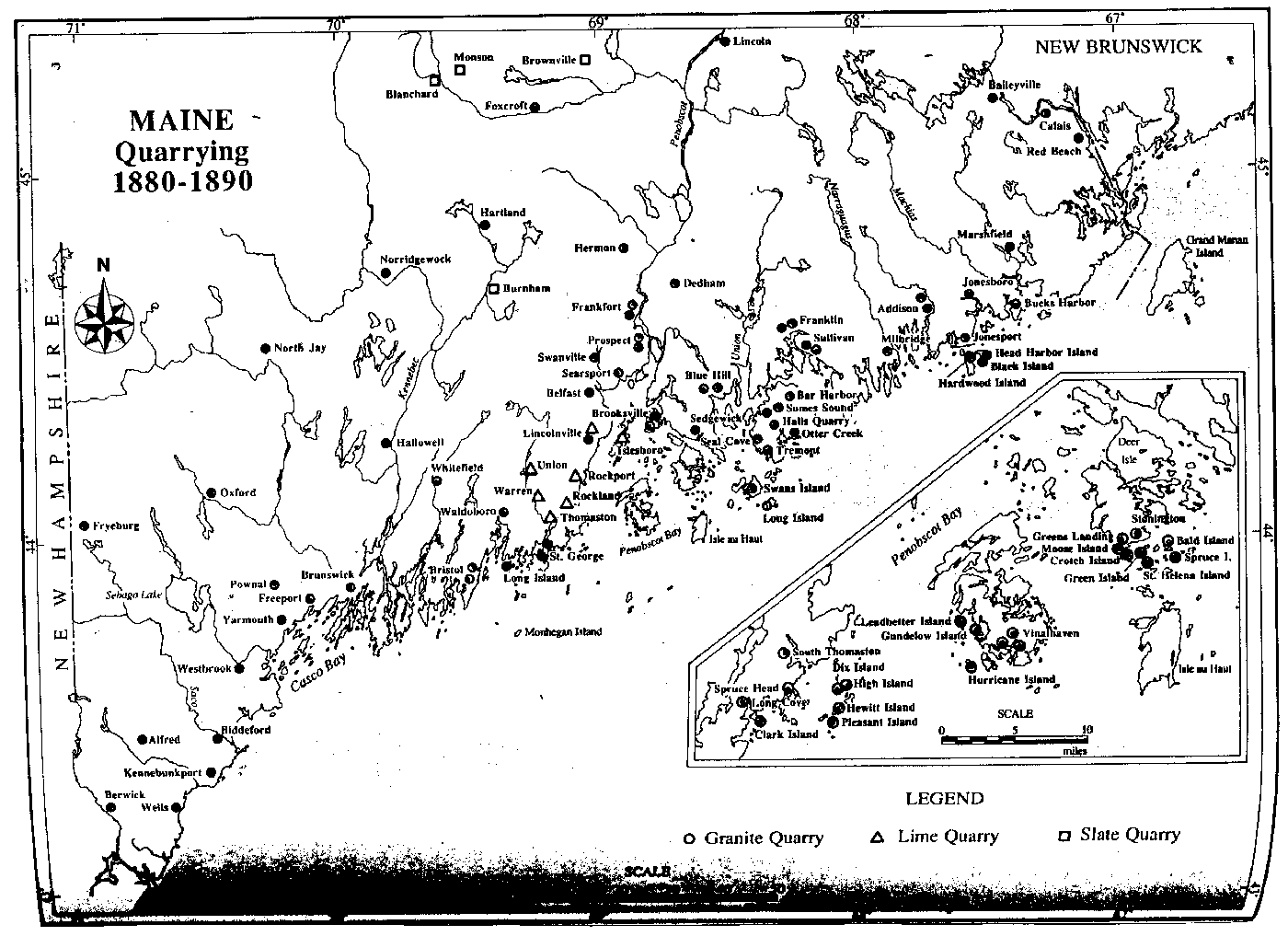
Map - Map of Stone Quarries in Maine Around the Turn of
the Century From 1880-1890.
Maine Quarrying 1880 - 1890. ( Map sent to us by David Gunning 11/13/02.) 
-
Map Showing the Distribution of Granite and Related Rocks
in Maine - 1922.
Map Showing the Distribution of Granite and Related Rocks in Maine - 1922.
(From The Commercial Granites of New England, pg. 206 - 581K)
-
Map - Map Showing Location of Quarries in Fox
Islands. (From Vinalhaven sheet of Topographical
Atlas of the United States, U. S. Geol. Survey.) Fig.
25 (From The Granites of Maine, Bulletin 313, 1907.)
(From Vinalhaven sheet of Topographical Atlas of the United States, U. S. Geol. Survey.) Fig. 25 (From The Granites of Maine, Bulletin 313, 1907.) 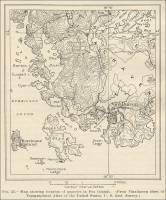
-
Map - Slate Region in Maine (Map) (From Slate
in the United States, Bulletin 536, 1914.)
Map of slate region in Maine. From post-route map. The chief quarrying centers are shown by crossed hammers. (Photograph from Slate in the United States, Bulletin 536, 1914.) 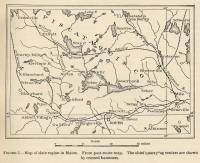
-
Map - Stonington, Maine - Map Showing Location of Quarries
about Stonington, Maine.
(Reduced from Deer Isle Sheet, Topographic Atlas U.S., U.S. Geological Survey.) (From The Granites of Maine, Bulletin 313, 1907, Figure 15.) 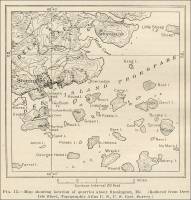
- A typical Maine paving-block quarry, called a “motion.” Operated by one man provided with a tent, rarely with very small hand derrick. Photograph by Merrithew. (From The Commercial Granites of New England, 1923)


-
Addison, Washington County, Maine - the Black Diamond
Quarry, from The Commercial Granites of New England,
Bulletin 738, by T. Nelson Dale, U. S. Geological Survey,
1923.
This quarry was "in the town of Addison, on Yoho Bay." The operator was the Maine, Black Diamond Granite Co. Rock from the quarry, known as "Indian Black Diamond Granite," is a hypersthene gabbro of very dark gray shade, with slight brownish tinge, and of fine to medium ophitic texture.A polished block, reported as from this quarry and shown to the writer in a stonecutter's yard at Quincy, Mass., had become pitted from exposure, but monuments erected 20 years or more ago in New York City are reported to be in good condition. There was a track 600 feet long to the wharf which admitted schooners of 11 feet draft.
The Black Diamond Quarry opened in 1902. When measured the quarry was 200 feet square and had a depth from 10 to 20 feet. The oldest part of the quarry had been worked down to sea level.
- Addison, Washington County, Maine - the Black Diamond Granite Quarry (very dark gray color) Stone from this quarry was used for monuments - locations not stated. (For a more detailed description of granite and location of quarry, see Maine Quarries and Prospects published by the Maine Geological Survey, written by M. B. Austin and A. M. Huseey, II, John R. Rand, State Geologist, May 1, 1958, pp. 8.)
- Addison, Maine – John L. Dalot & Co. Black Granite Quarries (From Stone: An Illustrated Magazine, Vol. XII, No. 1, December, 1895, “Notes From Quarry and Shop” section, Stone Publishing Co., New York, pp. 80.)
“John L. Dalot & Co., of Addison, Me., have bought a wharf in Portland, Me., and have started to repair it. They will build offices and granite polishing works upon it. The firm operates large quarries of black granite at Addison.”
- Addison, Washington County, Maine - the Pleasant River
Quarry, from The Commercial Granites of New England,
Bulletin 738, by T. Nelson Dale, U. S. Geological Survey,
1923.
This quarry was “in the town of Addison at Dalotville, on the east side of Pleasant River Bay.” The operator was the Pleasant River Granite Co. of Addison. Rock from the quarry (“black granite”) was reportedly “an hypersthene-olivine gabbro of almost black shade and of medium phitic texture, with black particles up to half an inch and slender whitish crystals. The polished surface is jet-black mottled with a little white.” Transport of the granite was by cart on a track 300 feet from quarry to mill and 300 feet then on to the wharf on Pleasant River Bay.
The Pleasant River Quarry opened about 1885. In 1905 the quarry measured 75 by 50 feet and had a working face about 50 feet high. “It is on the south side of an east-west ridge 70 feet high, the upper 5 to 10 feet of which consists of morainal sand and boulders.” The quarry was idle in 1921 and 1922.
Granite from this quarry was “used for monuments and interior decorations. The dimensions of the blocks are limited by the spacing of the joints and sheets. The usual sizes shipped measure 2 feet 6 inches b 2 feet 6 inches b 1 foot and also 3 to 6 feet by 1 foot by 1 foot. The largest block shipped measured 6 feet by 4 feet 6 inches by 4 feet 6 inches.”
The granite from this quarry can be seen in the following examples: base of wainscoting in the city hall at Philadelphia, Pennsylvania; the tablet with Welsh inscription in the Washington Monument, Washington, D.C; the Danforth monument in Morristown, New Jersey; the Zeller monument in Lewisburg, Pennsylvania; the Center monument in the Gree(n)wood Cemetery in Brooklyn, New York; the mantle piece in the public library at Machias, Maine; and the memorial to Architect French in New York.
-
Addison, Maine - the Pleasant River Black-Granite Quarry,
in Addison.
Looking North-Northwest. Showing the sheets crossed by frequent joints striking N. 80° E., the banding of the olivine gabbro, and several dikes of whitish quartz monzonite. (From The Granites of Maine, Bulletin 313, 1907, Pl. X-A.) 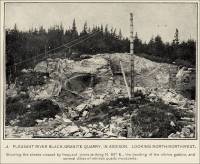
- Addison, Washington County, Maine - the Pleasant River Black Granite Quarry (almost black color) Structures from this stone include: the Mantle piece in the Public Library in Machias, Maine; the Base of Wainscoating (sic) in City Hall in Philadelphia, Pennsylvania; the Welsh inscription in the Washington Monument in Washington, D. C.; the Center monument in Brooklyn, New York; the Zeller monument in Greenwood Cemetery, New York; the Danforth monument in Morristown, New Jersey; and the Memorial to architect French in New York City. (For a more detailed description of the granite and location of quarry, see Maine Quarries and Prospects published by the Maine Geological Survey, written by M. B. Austin and A. M. Huseey, II, John R. Rand, State Geologist, May 1, 1958, pp. 24)
-
Addison, Washington County, Maine - the Thornberg
Quarry, from The Commercial Granites of New England,
Bulletin 738, by T. Nelson Dale, U. S. Geological Survey,
1923.
This quarry was "in the town of Addison, 3 miles south of Addison village. In 1905 the operator was A. M. Thornberg of Addison, Maine. Rock from the quarry ("black granite") was reportedly a "hypersthene gabbro of almost black shade and medium ophitic texture. There are two varieties-a dark one, which is externally identical with that from the Pleasant River quarry, and a lighter one, in which the white mottling due to the feldspar is a little more abundant.The stone takes a very fine polish, and the hammered or cut surfaces are almost white." The quarry was not operated in 1916.
- Addison, Washington County, Maine - the Thornberg Black Granite Quarry (almost black color) (For a more detailed description of the granite and location of quarry, see Maine Quarries and Prospects published by the Maine Geological Survey, written by M. B. Austin and A. M. Huseey, II, John R. Rand, State Geologist, May 1, 1958, pp. 29.)
-
Albany, Maine - the Sango Pond Quarry, presented by the
Maine
Geological Survey.
(The link to the photograph of Sango Pond Quarry is no longer available.)
<http://www.state.me.us/doc/nrimc/pubedinf/photogal/mincolec/minphot.htm> -
Alfred, York County, Maine - the Bennett Quarry, from
The Commercial Granites of New England, Bulletin 738,
by T. Nelson Dale, U. S. Geological Survey, 1923.
This quarry was "in the town of Alfred, 1 mile southwest of Alfred village, south of the Portland & Rochester Railroad, at the north foot of a 480-foot hill." The operator was Bennett Bros. of Alfred, Maine, in 1905. Granite from the quarry was reportedly a slightly greenish dark-gray color with conspicuous black mica and a medium texture. Transport of the granite was by cart 1 mile to the Alfred railroad station.
The Bennett Quarry opened prior to 1875. In 1905 the quarry measured 60 by 150 feet and had a depth up to 30 feet. At the time of the report, the quarry was no longer in operation.
The granite from the Bennett Quarry was used for curbing and buildings. An example is the Parsons Memorial Library in Alfred village, Maine.
- Alfred, York County, Maine - the Bennett Granite Quarry (slightly greenish dark gray color) This stone was used for curbing - location not stated. (For a more detailed description of granite and location of quarry, see Maine Quarries and Prospects published by the Maine Geological Survey, written by M. B. Austin and A. M. Huseey, II, John R. Rand, State Geologist, May 1, 1958, pp. 8.)
- Andrews
Pond, Maine - Lime Kilns (history) (This material is presented in the "Lincolnville Comprehensive Plan Inventories: History and Archaeology.")
In the small community of Andrews Pond in 1859 there were quarries and lime kilns located "at the eastern end of what is now called Coleman Pond." The lime was delivered to Ducktrap "on a "horse-drawn wooden railroad." Ducktrap "was the "industrial hub of Lincolnville" from the 1770s through 1905.
- Augusta, Kennebec County, Maine - the Ballard Ledge, one of the Hallowell Granite Quarries (light gray color) Structures in which this stone was used include: the State House in Augusta, Maine; the Courthouse in Augusta, Maine; and the County Jail in Augusta, Maine. (For a more detailed description of granite and location of quarry, see Maine Quarries and Prospects published by the Maine Geological Survey, written by M. B. Austin and A. M. Huseey, II, John R. Rand, State Geologist, May 1, 1958, pp. 16.)
- Baileyville, Washington County, Maine - the Hall
Quarry, from The Commercial Granites of New England,
Bulletin 738, by T. Nelson Dale, U. S. Geological Survey,
1923.
This quarry was "in the town of Baileyville, at the north edge of Meddybemps Lake, 5 miles southwest of Baring, on the Washington County Railroad, about 7 miles southwest of Calais." The operator was F. H. Hall of Calais, in 1905. Rock from the quarry ("black granite") was reportedly a "norite of brilliant luster, very dark gray shade without any yellowish tinge and a coarse texture and marked rift, with jet-black particles up to 0.5 inch in diameter in a network of translucent whitish feldspar." Transport of the rock was by cart 5 miles to Baring on the Washington County Railroad.
The Hall Quarry opened in 1902 and had "two adjacent openings in the northeast side of a northwest-southeast ridge over one-fourth mile long and about 50 feet high. These openings measure 60 by 25 feet and 35 feet in depth and 50 by 20 feet and 20 feet in depth, respectively." At the time of the report, the quarry was no longer in operation.
Granite from the Hall Quarry can be seen in the monument erected by Stephen A. Lovejoy at the Melrose Cemetery in Melrose, Massachusetts.
- Baileyville, Washington County, Maine - the Hall Black Granite Quarry (very dark gray color) Structures in which this stone was used include: Several monuments in the cemetery in Calais, Maine; and the Monument in Melrose Cemetery (Stephen A. Lovejoy) in Melrose, Massachusetts. (For a more detailed description of granite and location of quarry, see Maine Quarries and Prospects published by the Maine Geological Survey, written by M. B. Austin and A. M. Huseey, II, John R. Rand, State Geologist, May 1, 1958, pp. 16.)
-
Baileyville, Washington County, Maine - the Tarbox
Quarry, from The Commercial Granites of New England,
Bulletin 738, by T. Nelson
This quarry was "in the town of Baileyville, about 900 feet northeast of the Hall quarry.at the north edge of Meddybemps Lake, 5 miles southwest of Baring, on the Washington County Railroad, and about 7 miles southwest of Calais." The operator was Redbeach Granite Co. of Redbeach, Maine. The rock in the quarry was identical to that in the Hall Quarry: ("black granite") was reportedly a "norite of brilliant luster, very dark gray shade without any yellowish tinge and a coarse texture and marked rift, with jet-black particles up to 0.5 inch in diameter in a network of translucent whitish feldspar."
- Baileyville, Washington County, Maine - the Tarbox Granite Quarry (For a more detailed description of the granite and location of quarry, see Maine Quarries and Prospects published by the Maine Geological Survey, written by M. B. Austin and A. M. Huseey, II, John R. Rand, State Geologist, May 1, 1958, pp. 29.)
- Bangor, Maine – Jewell Granite Co., and I. A. Crockett & Co., Granite Workers and Dealers (The following advertisement is from The Reporter: Devoted To The Interests of Marble and Granite Workers, Vol. XVII, No. 6, published by Nichols & Co., Chicago, Illinois, June, 1884, pp. 13.)
Jewell Granite Co., and I. A. Crockett & Co.
Granite Workers and Dealers
Manufacturers of Polished Monuments, Tablets and Headstones, in White, Grey, Red and Black Granites. Designs and Estimates Furnished for all kinds of Cemetery Work.
Quarries at Lincoln, ME.
Office and Works, Cor. Maine and Rail Road Street,
Bangor, Maine.
- Barnard, Maine – John R. Hughes – Slate Quarry (From Stone: An Illustrated Magazine, Vol. XII, No. 1, December, 1895, “Notes From Quarry and Shop” section, Stone Publishing Co., New York, pp. 88.)
“John R. Hughes, of Sebec, Maine, has sold his slate quarry at Barnard to a party of capitalists for $5,000.”
- Beals, Maine (Great Wass Island) - Moosa-Bec Quarries Company,
Inc., Quarry (previously known as “Providence Granite Company
Inc.” Quarry. (Granite) The following description and
photographs were contributed by Dan Riley.
“The quarry is open to the sea and floods and empties with the tide. It was owned and operated by Amelio Bernardo of Massachusetts, first under the name, ‘Providence Granite Company, Inc.,’ and then as, ‘Moose-A-Bec Quarries Company, Inc.,’ which was a subsidiary of Providence Granite Company, Inc. It is listed on our deed with Hardwood Island which is to the west of Beals Island. The quarry on Hardwood Island was a much larger site than the one on our property. I was told the reason they didn't take more granite than what they did from the quarry on our property is because they put too large of a charge of dynamite in and fractured much of the granite. Hardwood Island was retained by Emelio Bernardo’s grandson, Brad, when he sold us our property to in 2002…Hardwood Island was for sale, though, for just over one million dollars in 2004.
“The latitude and longitude for our quarry is 40 30 59 N and 67 35 06 W. The coordinates for the Hardwood Island site are 44 30 48 N and 67 39 40 W. On the topographical map that I attached, I outlined both sites in red rectangles. Ours is the smaller rectangle in the middle.”

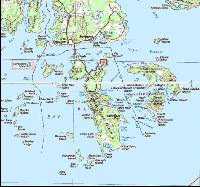
Click this link to see all photographs and descriptions -
Belfast, Maine – the Oak Hill Granite and Paving Company (Advertisement from The Monumental News, Vol. 7, #11, November 1895, pp. 691)
Oak Hill Granite & Paving Company Advertisement, November 1895 
Again in the Market – Oak Hill Granite.
“The famous Oak Hill Granite Quarries near Belfast, Maine, are again in operation and are producing granite that for monumental purposes cannot be surpassed. It is a fine grained even textured blue, suitable for the best grades of monumental work. A spur track from the Maine Central R. R., has been built directly to the quarries.
“Rough Stock. We are prepared to furnish the trade with rough stock in any sizes for building or monumental purposes. Our facilities for quarrying and shipping insure prompt attention to all orders. The popularity of this granite when on the market some years ago, will be remembered by many dealers. Send for price list and estimates.
“Manufactured Work. All of our cut work is made at the works of Swingle & Falconer, Quincy, Mass. They are authorized to quote the most liberal prices for our granite, and with their improved appliances, pneumatic tools, polishing mills etc., can guarantee entire satisfaction. Write them for estimates on monumental work.
- Berwick, York County, Maine - the Miniutti Quarry, from The Commercial Granites of New England, Bulletin 738, by T. Nelson Dale, U. S. Geological Survey, 1923.


Oak Hill Granite & Paving Co., Belfast, Maine.”
-
Berwick, York County, Maine - the Spence & Coombs
Quarry, from The Commercial Granites of New England,
Bulletin 738, by T. Nelson Dale, U. S. Geological Survey,
1923.
This quarry was "in the town of Berwick, 1 1/2 miles southeast of North Berwick village and station." The operator was Perry Bros. of Concord, New Hampshire. Granite from the quarry ("black granite") was reportedly a very dark olive-brownish color with a medium texture. There were two openings in the quarry. In 1905 the quarry was "about 25 feet square by 5 to 10 feet deep." Granite from the quarry was used entirely for monuments, and the quarry was only worked occasionally.
- Granite Quarries: Digging Into Biddeford’s History (Maine), (PDF) by Ryan Kingston.
- Biddeford, York County, Maine - the Andrews Quarries,
from The Commercial Granites of New England, Bulletin
738, by T. Nelson Dale, U. S. Geological Survey, 1923.
These quarries were "in the town of Biddeford, about 1 1/2 miles southeast of Biddeford city and half a mile south of Saco River." The operator was George Willett Andrews of Biddeford. Granite from the quarry was reportedly a light-gray color with conspicuous black mica with a coarse texture. Transport of the granite was by cart half a mile to the Saco River, or 2 miles to the railroad at Biddeford.
The Andrews Quarries opened in 1862 and again in 1895. There were six small openings of varying dimensions. One of the quarries was a "boulder quarry," which was worked in 1905. At the time of the report, the quarry was abandoned.
Granite from the Andrews Quarries was used in buildings, monuments, etc. Examples are: the Tribune Building in New York; and the General Dix monument in Portland, Maine. "This quarry has furnished granite for the Delaware and Saco River breakwaters and curbing for Dover and Rochester, N. H."
- Biddleford, York County, Maine - the Andrews and Perkins Granite Quarries (light gray color) Structures in which this stone was used include: the Tribune Building, New York City; Breakwaters on the Delaware and Saco (Maine) Rivers; the Foundation and trimmings of the Watson and Miller Building, Portland, Maine; the General Dix Monument, Fort Monroe, Virginia; Curbing in Dover and Rochester, New Hampshire. (For a more detailed description of granite and location of quarry, see Maine Quarries and Prospects published by the Maine Geological Survey,written by M. B. Austin and A. M. Huseey, II, John R. Rand, State Geologist, May 1, 1958, pp. 6.)
- Biddleford, York County, Maine - the Emmons (Gowen) Granite Quarry (light gray color) Structures in which this stone was used include: the Hospital in Dover, New Hampshire; and the Lincoln Monument in Springfield, Illinois. (For a more detailed description of granite and location of quarry, see Maine Quarries and Prospects published by the Maine Geological Survey, written by M. B. Austin and A. M. Huseey, II, John R. Rand, State Geologist, May 1, 1958, pp. 14.)
- Biddleford, York County, Maine - the Estate of Capt. Wm. Hill (granite quarry) (dark color) Stone from this quarry was used as building stone - locations not stated. (For a more detailed description of granite and location of quarry, see Maine Quarries and Prospects published by the Maine Geological Survey, written by M. B. Austin and A. M. Huseey, II, John R. Rand, State Geologist, May 1, 1958, pp. 14.)
- Biddleford, York County, Maine - the Goodwin Granite Quarry (For a more detailed description of granite and location of quarry, see Maine Quarries and Prospects published by the Maine Geological Survey, written by M. B. Austin and A. M. Huseey, II, John R. Rand, State Geologist, May 1, 1958, pp. 15.)
-
Biddeford, York County, Maine - the Gowen Emmons
Quarry, from The Commercial Granites of New England,
Bulletin 738, by T. Nelson Dale, U. S. Geological Survey,
1923.
This quarry was "in Biddeford city, at 17 Granite Street." The operator was Frank Morin of Biddeford, Maine. Granite from the quarry was reportedly a light-gray color with conspicuous smoky quartz and slightly bluish-white feldspar and a coarse texture. Transport of the granite was by cart 1 mile to the railroad.
The Gowen Emmons quarry opened about 1865. In 1905 the quarry had two openings: an old opening 200 feet northeast to southwest, 100 feet across and had a depth from 30 to 70 feet; and a new opening 250 feet from northeast to southwest, 200 feet across with a depth from 10 to 60 feet.
Granite from the Gowen Emmons Quarry was used for buildings and monuments and examples are the hospital at Dover, New Hampshire; and the Lincoln Monument in Springfield, Illinois.
- Biddleford, York County, Maine - the Marcille and Wormwood Granite Quarry (Wormwood Quarry) (medium gray, pinkish buff color) Structures in which this stone was used include: St. Mary's Convent in Biddeford, Mine; the Trimmings on St. Mary's Church in Biddeford, Maine; and the trimmings on St. Joseph Church in Biddeford, Maine. (For a more detailed description of the granite and location of quarry, see Maine Quarries and Prospects published by the Maine Geological Survey, written by M. B. Austin and A. M. Huseey, II, John R. Rand, State Geologist, May 1, 1958, pp. 20.)
-
Biddeford, York County, Maine - the Ricker Quarry,
from The Commercial Granites of New England, Bulletin
738, by T. Nelson Dale, U. S. Geological Survey, 1923.
This quarry was "in Biddeford city, at 19 Granite Street." The operator was George H. Yates of Biddeford, Maine. Granite from the quarry was reportedly a light-gray shade with conspicuous smoky quartz and slightly bluish-white feldspar with a coarse texture. Transport of the granite was by cart 1 mile to the railroad.
The Ricker Quarry opened in 1865. In 1905 the quarry was 100 by 50 feet and had a depth from 5 to 25 feet. Granite from the quarry was used for monuments, etc.
- Biddleford, York County, Maine - the Ricker Granite Quarry (light gray color) Stone from this quarry was used for monuments - locations not stated. (For a more detailed description of the granite and location of quarry, see Maine Quarries and Prospects published by the Maine Geological Survey, written by M. B. Austin and A. M. Huseey, II, John R. Rand, State Geologist, May 1, 1958, pp. 25.)
-
Biddeford, York County, Maine - the Wormwood Quarry,
from The Commercial Granites of New England, Bulletin
738, by T. Nelson Dale, U. S. Geological Survey, 1923.
This quarry was located "in the town of Biddeford, 1 1/4 miles southwest of Biddeford city, in West Biddeford." The operator was Ira T. Wormwood & Sons of Biddeford, Maine. Granite from the quarry was reportedly a medium pinkish-buff color with a coarse texture.
At the time of the report, the quarry measured 40 by 20 feet and had a depth from 6 to 8 feet. At the time of the report, the quarry had been idle since 1916.
Granite from the Wormwood Quarry was used for buildings. Examples are: the trimmings on the St. Joseph's Church in Biddeford, Maine. Material for the dry dock at Charleston, Massachusetts, was quarried from an old adjacent opening.
This quarry was "in North Berwick, in the township of Berwick." The operator was Miniutti Bros. & Co. of Concord, New Hampshire. Granite from the quarry, "North Berwick Black Granite," was reportedly a very dark olive-greenish color with a medium texture.
The Miniutti Quarry was opened about 1912. In 1922 the quarry was idle. Granite from the quarry was used for inscribed monuments.
Commercial use of material within this site is strictly prohibited. It is not to be captured, reworked, and placed inside another web site ©. All rights reserved. Peggy B. and George (Pat) Perazzo.