

Iowa
Geology Resources - Iowa
- Geologic Map of Iowa (1907), Samuel Calvin, State Geologist,
from the Fifteenth Annual Report of the Indiana State Geologist,
Volume XVII, Iowa Geological Society, Des Moines, Iowa, 1906.
The map reads as follows:
"A Geological Map of Iowa showing commercial quarries, lime kilns and Portland Cement plants in Iowa"Map is dated 1907. (Size is 220KB.)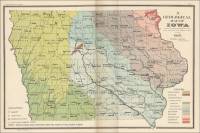
- Iowa State Geological Survey, Iowa Department of Natural Resources.
- Stone-related publications offered by the Iowa State Geological Survey
from A Guidebook to Mining In America: Volume 2: East (Minnesota,
Iowa, Missouri, Arkansas, Louisiana, and farther East), by John R.
Park, Stonerose
Publishing Co., Miami, Florida, April, 2000.
- The Minerals of Iowa (ES-2, 88p.)
- Iowa Geology, " An annual non-technical publication, is probably the best of it's kind. Best of all, back issues are free!.Various other publications cover individual mineral resources."
- Iowa's Minerals: Their Occurrence, Origins, Industries, and Lore," by Paul Garvin.
- Geological Society
of Iowa
- Geological
Society of Iowa - Guidebooks. Following are a few examples
of the guidebooks that pertain to Iowa stone quarries:
- Underburden - Overburden: An examination of Paleozoic and Quaternary Strata at the Conklin Quarry near Iowa City, 1984, GSI-41, Bunker, B.J. and Hallberg, G.R., 81 pp.
- An Excursion to the Historic Gilmore City Quarries, 1989, GSI-50, Woodson, F.J., 41 pp. (This entry includes a PDF version with a section entitled: "A Short History of the Quarry Industry at Gilmore City," by Frederick J. Woodson, Department of Geology, University of Iowa.)
- Virtual Field Trips
-
The Natural History of Maquoketa Caves
State Park, Jackson County, Iowa, GSI 2001 Fall Field Trip.
This field trip includes photographs of the Hurstville Lime Kilns
and the Hurstville Quarry that provided the dolostone for the kilns.
The stone quarry was located directly behind the lime kilns on the
east side of the North Fork of the Maquoketa River. (The link from
which the above information was obtained is no longer available. You
can order this booklet from the Iowa
Geological Survey – List of Publications.
<http://www.igsb.uiowa.edu/gsi/fall.01_trip/ftfall.htm>
- Geological
Society of Iowa - Guidebooks. Following are a few examples
of the guidebooks that pertain to Iowa stone quarries:
- Iowa State Minerals Information (USGS)
- A Location Guide for Rockhounds, (PDF) Collected by Robert C. Beste, PG, St. Louis, Missouri: Hobbitt Press, 2nd ed., December 1996, 148 pp. (Includes chapters on “Mineral Locations by State,” “Appendix and Glossary,” and “Bibliography.”)
- Minerals of Iowa, by Jean Cutler Prior - Adapted from Iowa Geology 1994, No. 19, Iowa Department of Natural Resources.
- Geologic Sources of Historic Stone Architecture in Iowa, by Brian J. Witzke. Adapted from Iowa Geology 1996, No. 21, Iowa Department of Natural Resources.
- Geology of Iowa: Iowa's Earth History Shaped by Ice, Wind, Rivers, and Ancient Seas, by Jean Cutler Prior. Adapted from Iowa Geology 1997, Iowa Department of Natural Resources.
- Geology of the Loess Hills, Iowa (USGS)
- Iowa Limestone Producers Association
- “Lithograph City – Limestone,” by Bill J. Bunker.
Adapted from Iowa Geology 1991, No. 16, Iowa Department of Natural
Resources. This site includes photographs of the Lewis Quarry
and the Gable Quarry, both southwest of Osage, Mitchell County,
Iowa. (The link from which this publication was obtained is no longer available.)
< http://www.igsb.aruiowa.edu/browse/lithcity/lithcity.htm> -
Lithographic City Formation (Limestone) – Upper Cedar Valley Stratigraphy, North-Central Iowa, Lithoraphic City Formation, by Bill J. Bunker, Brian J. Witzke, and Jed Day, Geological Society of Iowa Guidebook 44, April 27, 1986.
- National Geologic Map Database, presented by the United States Geologic Survey.
- U. S. Geological Survey Fact Sheet on Iowa
- Chalk Cliff - Chalk Cliff on the Sioux river, Plymouth County,
Plate LXI. (From Iowa Geological Survey, Vol. XVII, Fifteenth
Annual Report of the Iowa State Geologist, 1906.)
Chalk Cliff on the Sioux river, Plymouth County. 
- Forbes Limestone - Exposure of the Forbes limestone near Hawleyville,
Page County, Fig. 44. (From Iowa Geological Survey,
Vol. XVII, Fifteenth Annual Report of the Iowa State Geologist, 1906.)
Exposure of the Forbes limestone near Hawleyville, Page County. 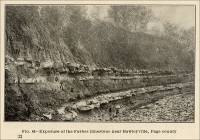


Research Resources - Iowa
- Archives
- Archival Research Catalog, U. S. National Archives & Records Administration (NARA)
- Archives of Women in Science and Engineering, Advisory Board - Digital Collections, Department, Iowa State University.
- Iowa State University Archives - Special Collections Department: Archives & Manuscript Collections.
- Iowa Women's Archives
- Library of Congress Digitized American Memory Collection
- National Archives and Records Administration-Rocky Mountain Region, Denver, Colorado.
- National Geologic Map Database, presented by the United States Geologic Survey.
- National Union Catalog of Manuscript Collections (NUCMC) – Listing of Archives and Manuscript Repositories in Iowa.
- State Historical Society of Iowa
- U. S. National Archives & Records Management (NARA)
- The University of Iowa Archives at the University of Iowa Libraries
- Historical Sources
- American Folklife Center - The Library of Congress' repository for American folk music and folklore and folklife collections.
- American Memory - the Library of Congress' gateway to primary source materials relating to the history and culture of the United States. “Mission: American Memory provides free and open access through the Internet to written and spoken words, sound recordings, still and moving images, prints, maps, and sheet music that document the American experience. It is a digital record of American history and creativity. These materials, from the collections of the Library of Congress and other institutions, chronicle historical events, people, places, and ideas that continue to shape America, serving the public as a resource for education and lifelong learning.”
- Anamosa State Penitentiary Virtual Museum, Anamosa, Iowa - historic photos and stories, presented by Steve Wendl, curator, of the Anamosa State Penitentiary virtual museum.
- Cedar County Historical Society & Museum, Tipton Iowa.
- Geologic Sources of Historic Stone Architecture in Iowa, Iowa Department of Natural Resources.
- Ghost Towns of Iowa, presented by Gary B Speck Publications.
- Greenwood Cemetery, Cedar Falls, Iowa, created by history and social studies education students at the University of Northern Iowa in Cedar Falls, Iowa.
- Iowa Historical and Genealogical Societies
- Iowa Buildings, Structures, & Architects on the Philadelphia Architects & Buildings Project (PAB) web site. You can search the database for buildings, structures, and architects either as a visitor or you can register free. You cannot search for specific cities, but you can search for county locations. There are no photographs presented, but the location and/or address and the name of the architect are included if known; and the historic registration information is also included.
- Iowa State Parks, presented by the Iowa Department of Natural Resources.
- Iowa IAGenWeb Project (history and genealogy resources)
- Library of Congress Digitized American Memory Collection
- Linkpendium - Iowa
- Making of America (MOA) Making of America is a digital library of primary sources in American social history from the antebellum period through reconstruction.
- The National Parks Service - History and Culture: “Explore America 's cultural resources - buildings, landscapes, archeological sites, ethnographic resources, objects and documents, structures and districts.”
- National Register - Online Travel Itineraries in the United States
- The Nineteenth Century in Print: The Making of America in Books and Periodicals. A distributed digital library collaboration at the Cornell University Library - Library of Congress - American Memories.
- Resources for Historians - The History Guide, presented by Steven Kreis.
- State Historical Society of Iowa
- Libraries
- LIBCAT (Library Resources on the Web)
- Library of Congress Digitized American Memory Collection
- NARA's Rocky Mountain Region (Denver) (Research resources of retired records from Federal agencies and courts in Colorado, Montana, New Mexico, North Dakota, South Dakota, Utah, and Wyoming.)
- National Archive in the Central Plains
- State Library of Iowa
- University of Iowa Libraries
(Below are but a few of the resources presented on this web site.)
- Map Collection
- Scholarly Digital Resources Center: UIowa Digital Library - The Scholarly Digital Resources Center is the collection for all University of Iowa Libraries Digital Library Initiative.
- Museums
- Anamosa State Penitentiary Virtual Museum, Anamosa, Iowa - historic photos and stories, presented by Steve Wendl, curator, of the Anamosa State Penitentiary virtual museum.
- Appanoose County Historic and Coal Mining Museum, Centerville, Iowa.
-
Bertrand Museum
in the DeSoto National Wildlife Refuge (The following
information and quote are used with permission from the author, John
R. Park, "A Guidebook to Mining In America: Volume 2:
East (Minnesota, Iowa, Missouri, Arkansas, Louisiana, and farther
East)," by John R. Park, Stonerose Publishing Co., Miami, Florida,
April, 2000," available at Stonerose
Publishing Company.)
The Museum is located at 1434 316th Lane, Missouri Valley, Iowa 51555-7033; phone (712) 642-4121.
"The Museum features mining supplies recovered from the Bertrand, a sternwheel paddleboat that was recently discovered buried in a field in the Refuge. Interpretive plaques are also at the site of discovery. "The Bertrand sank on its way to the Montana goldfields in 1865. Most of the cargo consisted of mining tools, mercury (for gold refining), and supplies."The Bertrand was only one of many steamboats which, following the discovery of gold in Adler Gulch, Montana, in 1862.attempted the 2000-mile upriver voyage from St. Louis to Fort Benton. The 178' Bertrand was built in Wheeling, West Virginia in 1864 and sank on her first voyage on the Missouri River. Nor was the loss of the Bertrand unusual, dozens of steamboats were lost within a few decades. In fact, it was the sinking of the Cora II, several hundred yards upstream, that interrupted salvage of the Bertrand. Sometime later, the Missouri River shifted its course, leaving the Bertrand buried in river mud. The Arabia, in Kansas City, is a similarly recovered riverboat, and is actually a few decades older. The Arabia did not carry mining supplies, as the Montana rush had not begun at that time."The brochure, Bertrand, provides a brief account of historic shipping on the Missouri, of the Bertrand, and the discovery, excavation, and preservation."
- Dallas County Forest Park Museum, Perry, Iowa - This museum exhibits natural, cultural, and historical events and artifacts of central Iowa. Displays include early transportation, farm machinery, small tools, railroading, a blacksmith shop, and much more.
- Jackson County Historical Museum, Maquoketa, Iowa.
- John L. Lewis Mining & Labor Museum, Lucas, Iowa - The museum presents historical documents and artifacts pertaining to "coal mining, labor history and John L. Lewis who was a labor leader born 1 mile from Lucas, Iowa."
- The Lucas County Historical Museum, Chariton, Iowa - The museum is located at 123 N. 17th Street, Chariton, Iowa 50049-1618. Phone (515) 774-4464.
- National Mississippi River Museum and Aquarium, Dubuque, Iowa - There are three sections to the Mississippi River Museum: the Mississippi River Museum, the Riverboat Museum, and the William M. Black Museum.
- Old Capitol Museum
- University of Iowa - Museum of Natural History
- University of Northern Iowa Museum, Cedar Rapids Iowa.
- Vesterheim Norweign-American Museum, P.O. Box 379, 523 W. Water Street, Decorah, Iowa 52101; (563) 382-9681.
- Wabash Depot Museum, Moravia, Iowa; 651-724-3777. The Wasbash Depot Museum is located north of Centerville. The depot was obtained from the Norfolk and Southern Railroad in 1976 when the line was discontinued through Moravia.
- Wapello County Historical Museum, Amtrack Depot, 210 West Main Street, Ottumwa, Iowa 52501 (loacated at 210 West Main Street at Washington Street) (A description of the museum is available on the PlanetWare, Inc. web site.)
- Other
- 1882 Iowa State Gazetteer and Business Directory, IA USGenWeb Archives, a part of the USGenWeb Project.
- 1895 U.S. Atlas - Iowa
- Cyndi's List - Online Research Resources - Iowa
- Eastern Iowa Tourism, presented by the Eastern Iowa Tourism Association.
- Grant Wood: Going Back To Iowa: The World of Grant Wood.
- Iowa Almanac, presented by Netstate.com.
- Iowa City Area Chamber of Commerce
- Iowa Department of Natural Resources
- Iowa Lincoln Highway Association
- Iowa State Gazetteer and Business Directories, presented by the Palo Alto County Iowa USGenWeb Project
- “Lithograph City,” by Bill J. Bunker – Limestone. Adapted
from Iowa Geology 1991, No. 16, Iowa Department of Natural
Resources. “This lithograph was published in Clement Webster’s
1915 issue of Contributions to Science to help illustrate the
quality of Iowa's lithographic limestone for printing.” (This link is no longer available, although you can view “Lithographic City” on the Internet Archive Wayback Machine.)
<http://www.igsb.uiowa.edu/browse/lithcity/lithcity.htm> - National Geologic Map Database, presented by the United States Geologic Survey.
- State of Iowa Website
- TopoZone “The TopoZone is the Web's center for recreational and professional topographic map users.” (Includes a place name search form.)
- World Almanac for Kids Online – Iowa
- WorldAtlas.com – Iowa
The Iowa Stone Industry
- 1882 - The Iowa Stone and Building Industry in 1882 (transcription), Excerpts from Mineral Resources of the United States, Calendar Year 1882, J. S. Powell, Director, Department of the Interior, United States Geological Survey, Government Printing Office, Washington, D. C., 1883. Excerpts from the chapters on 1) "Structural Materials" and 2) "The Useful Minerals of the United States."
- 1883 and 1884 Stone and Building Industry, Excerpts from Mineral Resources of the United States - Calendar Years 1883 and 1884 (PDF images of sections), Department of the Interior, United States Geological Survey, Government Printing Office, Washington, D. C., 1885.
- 1885 - The Iowa Stone and Building Industry in 1885 (transcription), Excerpts from Mineral Resources of the United States, Calendar Year 1885 (PDF images of sections), David T. Day, Geologist, Department of the Interior, United States Geological Survey, Government Printing Office, Washington, D. C., 1887. Excerpt from the chapter on "Structural Materials," by H. S. Sproull.
- 1886 - The Iowa Stone and Building Industry, 1886 (transcription), Excerpts from Mineral Resources of the United States, Calendar Year 1886 (PDF images of sections), David T. Day, Chief of Division of Mining Statistics and Technology, Department of the Interior, United States Geological Survey, Government Printing Office, Washington, D. C., 1887. Excerpts from the chapter on "Structural Materials," by William C. Day.
- 1887 - The Iowa Stone and Building Industry, 1887, Excerpts from Mineral Resources of the United States - Calendar Year 1887 (PDF images of sections), J. W. Powell, Director, David T. Day, Chief of Division of Mining Statistics and Technology, Department of the Interior, United States Geological Survey, Government Printing Office, Washington, D. C., 1888
- 1888 - The Iowa Stone and Building Industry, 1888, Excerpts from Mineral Resources of the United States - Calendar Year 1888 (PDF images of sections), J. W. Powell, Director, David T. Day, Chief of Division of Mining Statistics and Technology, Department of the Interior, United States Geological Survey, Government Printing Office, Washington, D. C., 1890
- 1889 and 1890 - The Iowa Stone and Building Industry, 1889, Excerpts from Mineral Resources of the United States - Calendar Year 1889 and 1890 (PDF images of sections), J. W. Powell, Director, David T. Day, Chief of Division of Mining Statistics and Technology, Department of the Interior, United States Geological Survey, Government Printing Office, Washington, D. C., 1892
- 1891 - The Iowa Stone and Building Industry, 1891, Excerpts from Mineral Resources of the United States - Calendar Year 1891 (PDF images of sections), J. W. Powell, Director David T. Day, Chief of Division of Mining Statistics and Technology, Department of the Interior, United States Geological Survey, Government Printing Office, Washington, D. C., 1893
- 1892 - The Iowa Stone and Building Industry, 1892, Excerpts from Mineral Resources of the United States - Calendar Year 1892 (PDF images of sections), J. W. Powell, Director, David T. Day, Chief of Division of Mining Statistics and Technology, Department of the Interior, United States Geological Survey Government Printing Office, Washington, D. C., 1893
- 1893 - The Iowa Stone and Building Industry, 1893, Excerpts from Mineral Resources of the United States - Calendar Year 1893 (PDF images of sections), J. W. Powell, Director, David T. Day, Chief of Division of Mining Statistics and Technology, Department of the Interior, United States Geological Survey, Government Printing Office, Washington, D. C., 1894
- 1894 - Iowa Stone and Building Industry in 1894 (transcription), Excerpts from the Sixteenth Annual Report of the United States Geological Survey, Part IV.-Mineral Resources of the United States, 1894, Nonmetallic Products (PDF images of sections). Chapter on "Stone," by William C. Day.
- 1894 - Notes of Iowa Building Stones (transcription), by H. Foster Bain from the Sixteenth Annual Report of the United States Geological Survey, Part IV.-Mineral Resources of the United States, 1894, Nonmetallic Products (PDF images of sections). Chapter on "Stone," by William C. Day.
- 1895 - The Iowa Stone and Building Industry, 1895, Excerpts from Seventeenth Annual Report of the United States Geological Survey (PDF images of sections), Part III. Mineral Resources of the United States, 1895, Nonmetallic Products, Except Coal. Washington: Government Printing Office, 1896.
- 1895-1938 – “A Summary of Mineral Production in Iowa 1895-1938,” by H. Garland Hershey.
- 1896 - The Iowa Stone and Building Industry, 1896, Excerpts from Eighteenth Annual Report of the United States Geological Survey (PDF images of sections), Part V. Mineral Resources of the United States, 1896, Nonmetallic Products, Except Coal. Washington: Government Printing Office, 1897.
- 1897 - The Iowa Stone and Building Industry, 1897, Excerpts from Nineteenth Annual Report of the United States Geological Survey (PDF images of sections), Part V. Mineral Resources of the United States, 1896, Nonmetallic Products, Except Coal. Washington: Government Printing Office, 1898.
- 1898 - The Iowa Stone and Building Industry, 1898, Excerpts from Twentieth Annual Report of the United States Geological Survey (PDF images of sections), Part VI. Mineral Resources of the United States, 1898, Nonmetallic Products, Except Coal and Coke. Washington: Government Printing Office, 1899.
-
1898 – Mineral Production of Iowa in 1898, by Samuel W. Beyer, Iowa Geological Survey.
- 1899 – The Iowa Stone and Building Industry, 1899, Excerpts from Twenty-first Annual Report of the United States Geological Survey (PDF images of sections), Part VI. Mineral Resources of the United States, 1899, Nonmetallic Products, Except Coal and Coke. Washington: Government Printing Office, 1901.
-
1899 – Mineral Production of Iowa in 1899, by S. W. Beyer, Iowa Geological Survey.
- 1900 – The Iowa Stone and Building Industry, 1900, Excerpts from Mineral Resources of the United States - Calendar Year 1900 (PDF images of sections), Charles D. Walcott, Director, David T. Day, Chief of Division of Mining and Mineral Resources, Department of the Interior, United States Geological Survey, Government Printing Office, Washington, D. C., 1901.
-
1900 – Mineral Production of Iowa in 1900, by S. W. Beyer, Iowa Geological Survey.
- 1901 - The Iowa Stone and Building Industry, 1901, Excerpts from Mineral Resources of the United States - Calendar Year 1901 (PDF images of sections), Charles D. Walcott, Director, David T. Day, Chief of Division of Mining and Mineral Resources, Department of the Interior, United States Geological Survey, Government Printing Office, Washington, D. C., 1902
-
1901 – Mineral Production of Iowa in 1901, by S. W. Beyer, Iowa Geological Survey.
- 1902 – The Iowa Stone and Building Industry, 1902, Excerpts from Mineral Resources of the United States, Calendar Year 1902 (PDF images of sections), Charles D. Walcott, Director, Department of the Interior, United States Geological Survey, Government Printing Office, Washington, D. C., 1904.
-
1902 – Mineral Production of Iowa in 1902, by S. W. Beyer, Iowa Geological Survey.
- 1903 – The Iowa Stone and Building Industry, 1903, Excerpts from Mineral Resources of the United States, Calendar Year 1903 (PDF images of sections), Charles D. Walcott, Director Department of the Interior, United States Geological Survey, Government Printing Office, Washington, D. C., 1904.
- 1904 – The Iowa Stone and Building Industry, 1904, Excerpts from Mineral Resources of the United States, Calendar Year 1904 (PDF images of sections), Charles D. Walcott, Director, Department of the Interior, United States Geological Survey, Government Printing Office, Washington, D. C., 1905.
-
1904 – Mineral Production in Iowa in 1904, by S. W. Beyer, Iowa Geological Survey.
-
1904 – Cement and Cement Materials of Iowa, by Edwin C. Eckel, H. F. Bain, Iowa Geological Survey Annual Report: Vol. 15, 1904, pp. 33-124.
- 1905 – The Iowa Stone and Building Industry, 1905, Excerpts from Mineral Resources of the United States - Calendar Year 1905 (PDF images of sections), Charles D. Walcott, Director, Department of the Interior, United States Geological Survey, Government Printing Office, Washington, D. C., 1906.
-
1905 – Mineral Production in Iowa in 1905, by S. W. Beyer, Iowa Geological Survey.
-
1906 – Iowa Geological Survey, Vol. XVII, Annual
Report, 1906 (This link is not yet available. Please
check back in the future. When it is available, you will use this
link to read the portion of the book that pertains to quarries from, "Iowa
Geological Survey, Vol. XVII, Annual Report," 1906, which includes
geology, history, quarry information. The photographs from this book have
been presented in the "Quarries & Quarry Links, Photographs and
Articles" of the Iowa section of the web site.)
"In the early days of Iowa, the pioneers used local stone in several of the early forts. In 1840 stone was used in the buildings at Fort Atkinson in Wineshiek County and also for foundations for houses and barns. Native stone was also used in public buildings., street curbing, gutters, paving blocks, and ballast for the railroads.
"Lime was quarried early on to be used in cement and mortar. Eventually, this industry disappeared from Iowa.
"Once Portland Cement was widely used, the need for great quantities of quarried stone from Iowa for use in buildings diminished. "Then plants for manufacture of Portland cement came to Iowa, and presently were quarrying enormous tonnages of limestone and shale from locations in the vicinity of Winterset, at Mason City, and at Buffalo.""By 1957 only a few quarries were still producing building stone.
"Most of the quarries in Iowa were concentrated in the eastern portion of the state. By 1957 most of the quarries had been abandoned, although since then some have reopened. Beds of limestone have been quarried in Allamakee, Winneshiek, and Dubuque counties. In 1957 St. Peter sandstone was being mined in Clayton County. "The Silurian variety of limestone can be found in the eastern counties of Iowa in Jones, Delaware, Jackson, Cedar, Clinton, and Scott counties. Large quantities of limestone were quarried from these areas, especially the quarries in Jones County. At Anamosa penitentiary personnel quarried stone to be used in buildings, walls and terraces. This stone was also used in Botan Hall and Morrill Hall at Iowa State College. This is the 'Anamosa stone.' In 1957 this stone was still being quarried for use as crushed stone." - 1906 - The Iowa Stone and Building Industry, 1906, Excerpts from Mineral Resources of the United States - Calendar Year 1906 (PDF images of sections), George Otis Smith, Director, Department of the Interior, United States Geological Survey, Government Printing Office, Washington, D. C., 1907.
-
1906 – Mineral Production in Iowa in 1906, by S. W. Beyer, Iowa Geological Survey.
-
1906 – Geology of Quarry Products, by S. W. Beyer, Ira A. Williams, and Samuel Calvin, Iowa Geological Survey Annual Report, by S. W. Beyer Ira A. Williams Samuel Calvin, Iowa Geological Survey Annual Report: Vol. 17, 1906, pp. 185-526.
- 1907 – The Iowa Stone and Building Industry, 1907, Excerpts from Mineral Resources of the United States, Calendar Year 1907 (PDF images of sections), Part II. Nonmetallic Products, George Otis Smith, Director, Department of the Interior, United States Geological Survey, Government Printing Office, Washington, D. C., 1908.
-
1907 – Mineral Production in Iowa in 1907, by S. W. Beyer, Iowa Geological Survey.
- 1908 – The Iowa Stone and Building Industry, 1908 (transcription), Excerpts from Mineral Resources of the United States, Calendar Year 1908, Part II - Nonmetallic Products (PDF images of sections), Department of the Interior, United States Geological Survey, Government Printing Office, Washington, D. C., 1909. Excerpts from the book are from the chapter on "Stone," by A. T. Coons.
-
1908 – Mineral Production in Iowa in 1908, by S. W. Beyer, Iowa Geological Survey.
-
1909 & 1910 – Mineral Production in Iowa in 1909 and 1910, Iowa Geological Survey.
-
1912 – Mineral Production in Iowa in 1911 and 1912, by George F. Kay, Iowa Geological Survey.
-
1913 – The Road and Concrete Materials of Iowa, Pt. 1, by S. W. Beyer and H. F. Wright, Iowa Geological Survey Annual Report: Vol. 24, 1913, pp. 33-358.
-
1913-1914 – Mineral Production in Iowa for 1913 and 1914, by George F. Kay, Iowa Geological Survey.
- 1915 – Mineral Production in Iowa for 1915, by George F. Kay, Iowa Geological Survey.
-
1916 – Mineral Production in Iowa for 1916, by George F. Kay, Iowa Geological Survey.
-
1917-1918 – Mineral Production in Iowa for 1917 and 1918, by James H. Lees, Iowa Geological Survey.
-
1919-1920 – Mineral Production in Iowa in 1919 and 1920, by James H. Lees, Iowa Geological Survey.
- 1921-1922 – Mineral Production in Iowa in 1921 and 1922, by James H. Lees, Iowa Geological Survey.
-
1923-1924 – Mineral Production in Iowa in 1923 and 1924, by James H. Lees, Iowa Geological Survey.
-
1925 – Mineral Production in Iowa in 1925, by James H. Lees, Iowa Geological Survey.
-
1926 – Mineral Production in Iowa in 1926, by James H. Lees, Iowa Geological Survey.
-
1927 – Thirty-Sixth Annual Report of the State Geologist, Vol. 33, 1927, p. 5-8, by George F. Kay, Iowa Geological Survey.
-
1927 – Mineral Production in Iowa in 1927, by James H. Lees, Iowa Geological Survey.
-
1928 – Mineral Production in Iowa in 1928 and 1929, by James H. Lees, Iowa Geological Survey.
-
1929 – Thirty-Eighth Annual Report of the State Geologist, by George F. Kay, Iowa Geological Survey Annual Report, Vol. 35, 1929, pp. 5-14.
-
1930, 1931, & 1932 – Mineral Production in Iowa in 1930, 1931 and 1932, by James H. Lees, Iowa Geological Survey.
-
1933-1938 – Mineral Production in Iowa for the years 1933-1938, by H. Garland Hershey, Iowa Geological Survey.
- 1895-1938 – A Summary of Mineral Production in Iowa 1895-1938, by H. Garland Hershey, Iowa Geological Survey.
-
1939-1940 – Mineral Production in Iowa in 1939 and 1940, by H. Garland Hershey, Iowa Geological Survey.
-
1939 – Forty-Third, Forty-Fourth, Forty-Fifth, Forty-Sixth, Forty-Seventh & Forty-Eighth Annual Reports of the State Geologist, by Arthur C. Trowbridge, Iowa Geological Survey Annual Report: Vol. 37, 1939, pp. vii-xiv.
-
1941 – Forty-ninth and Fiftieth Annual Reports of the State Geologist, by Arthur C. Trowbridge, Iowa Geological Survey Annual Report: Vol. 38, 1941, pp. vii-xii.
- 1957 – The Iowa Stone Industry, 1957, Excerpts from The Palimpsest: Quarrying in Iowa, by Charles S. Gwynne and William J. Petersen, published monthly by the State Historical Society of Iowa, Iowa City, Iowa, May 1957.
- 1967 – Stone Industry in Iowa – (From Mining and Mineral Operations in the United States: A Visitor’s Guide, by Staff, Bureau of Mines, Area Mineral Resource Offices, U. S. Department of the Interior, Bureau of Mines, 1967, pp. 28.)
“Although Iowa is renowned as an agricultural State, its production of mineral commodities in 1964 was valued at more than $100 million. Construction materials (cement, stone, sand, gravel, and gypsum) make up most of the mineral output of the state, but some fossil fuels (coal and petroleum) also are produced.”
- 1994 through 2010-2011 – The Mineral Industry of Iowa – United States Geological Survey (1994 through 2010-2011)
- Geological Map of Iowa, 1907 (Indicates quarry locations) (From
Iowa Geological Survey, Vol. XVII, Fifteenth Annual Report of the Iowa
State Geologist, 1906.)
The map reads as follows: "A Geological Map of Iowa showing commercial quarries, lime kilns and Portland Cement plants in Iowa"
Map is dated 1907. (Size is 220KB.) -
Anamosa Limestone, presented by Benson Stone Co.
-
Anamosa Limestone, on Wikipedia
-
Calvin Photographic Collection -
Images of Stone Quarries - from Calvin's Scrapbook, presented
by the University of Iowa, Iowa City, Iowa. These photographs,
among many others, were taken by Samuel Calvin, Professor of Natural Sciences
at the University of Iowa (1873-1911) and State Geologist. Click here to access the entire
photographic collection by Samuel Calvin.
- List of the quarries available on "Calvin's Scrapbook" from the photographic collection of Professor Samuel Calvin. The list of quarries mentioned in the scrapbook is used with the permission of the Department of Geoscience, University of Iowa, Iowa City, Iowa.
- Flowers of the Iowa Seas - Minerals, the State Historical Society of Iowa. This site includes photographs and origin of Iowa minerals.
- Geologic Sources of Historic Stone Architecture in Iowa, Iowa Department of Natural Resources.
- Iowa - A Century of Change: 1800 to 1900. (The link from which the following information was obtained is no longer available.)
< http://www.igsb.uiowa.edu/portrait/3change/change.htm> -
As the Iowa developed, people learned that good building material could be obtained from Iowa's bedrock. Iowa limestone was used to build the Old Capitol in the territorial capital of Iowa City in 1849, and in 1872 limestone was used in the construction of the Iowa Men's Reformatory in Anamosa. Many of the old stone buildings have become landmarks. The building-stone quarries were concentrated in eastern Iowa. Also, a number of buildings were constructed from Sioux Quartzite obtained from an exposed bedrock at the far northwest tip of Iowa.
-
Iowa – Mineral Resource Facts, by Robert M. McKay and presented by
the Iowa Department of Natural Resources. Limestone and Dolostone,
produced in Dubuque, Jackson, and Jones counties, were used as Dimension
stone (flagging, veneer, and quarry blocks). Quarries in the Stone
City area in Jones County began producing dimension stone and have continued
since the 1880s. This stone is called Anamosa Stone, and it is marketed
throughout the midwest and as far as California. (The link to this document is no longer available, although you can read the document on the Internet Archive Wayback Machine.)
<http://www.igsb.uiowa.edu/browse/MineralResourcesFacts.htm> - 1886 - Iowa Building Stone (Part 1) (August 1886) The Manufacturer and Builder, Vol. 18, Issue 8, August 1886, pg. 180. (Article in digital images viewed at American Memory, Library of Congress - slow to load.)
- 1886 - Iowa Building Stone (Part 2) (September 1886) The Manufacturer and Builder, Vol. 18, Issue 9, September 1886, pg. 202. (Article in digital images viewed at American Memory, Library of Congress - slow to load.)
- Iowa's Cement Industry, by Robert M. McKay and presented by Iowa Department of Natural Resources.
- Iowa Limestone Producers Association Inc. - ILPA, Des Moines, Iowa (present-day company) This site has a short history on Iowa's stone industry and present-day quarries.
- Iowa Marble and Granite Dealers’ Association (1895) The following information is from The Monumental News, August, 1895, Vol. 7, No. 8, Chicago, Illinois, pp. 499.
“President: W. C. Spaulding, Fairfield.
Secretary and Treasurer: W. W. Woods, Marshalltown.”
- Landscape Features of Iowa, by Jean Cutler Prior, adapted from Iowa Geology 1995, Iowa Department of Natural Resources, presented by Iowa Department of Natural Resources. (Scroll down to the last photograph - 1800s-era quarry) Outcrops at Gitchie Manitou State Preserve in Lyon County is the location of the oldest bedrock formation visible anywhere in Iowa. The Sioux Quartzite has a distinctive reddish color and can be seen ".along the edges of 'Jasper Pool,' an 1800's-era quarry on the preserve.."
- Listing of Mineral Producers and Mineral Production Sites in Iowa
- Mineral Production in Iowa, by Robert M. McKay and presented by the Iowa Department of Natural Resources, Energy and Geological Services Division, Geological Survey Bureau. (The following quote is used with the permission.)
-
"Stone: Many of Iowa's 19th-century bridges and buildings were built of limestone in towns along major rivers, where rock exposures were common. The growth of railroads, the need for improved highways, and the increased use of ag-lime required sources of crushed stone. Prominent production districts included Cedar, Jones, Des Moines, Marshall, Lee, Madison, Jackson, and Scott counties. By 1982 the value of crushed stone surpassed cement and became the leading mineral commodity, accounting for 41% of the state's total mineral value. By 1990 there were 460 registered quarry sites in Iowa." (This site includes a large photograph of the Bealer Quarries in Cedar County circa 1900.)
- Mineral Resource Facts, by Robert M. McKay.
- Natural Resource Mapping of Linn County, by Robert D. Libra, adapted from Iowa Geology 1996, No. 21, Iowa Department of Natural Resources.
- Underground Limestone Mining, by Robert M. McKay and Michael J. Bounk (Adapted from Iowa Geology 1987, No. 12, Iowa Department of Natural Resources.) (This article includes a photograph of an underground limestone quarry.)
Printed & Online Sources
Google Book Search: You can use Google Book Search to search for specific subjects in thousands of books available through the Google Book Search - both books under copyright and in the public domain. Hundreds of books are added regularly, so check back if you do not find books on the subject for which you are seeking information. Some of the books published prior to 1923 are available in their entirety and can be downloaded to you computer for your personal use.
- “Detail Carving for the Iowa’s Soldiers’ Monument,” presented in Charles H. More & Co. advertisements in 1894, Barre, Vermont. Published in three parts in The Monumental News, July 1894, August 1894, & September 1894
- Eleventh Annual Report of the United States Geological and Geographical Survey of the Territories, Embracing Idaho and Wyoming, Being a report of progress of the exploration for the year 1877, by F. V. Hayden, United States Geologist, United States Geological Survey, Washington: Government Printing Office, 1879.
- Geologic Sources of Historic Stone Architecture in Iowa, Iowa Department of Natural Resources.
- A Guidebook to Mining In America: Volume 2: East (Minnesota, Iowa, Missouri, Arkansas, Louisiana, and farther East), by John R. Park, Stonerose Publishing Co., Miami, Florida, April, 2000," available at Stonerose Publishing Company.
- Iowa - Geological Survey, Vol. XVII, Annual Report, 1906 With Accompanying Papers. Published for Iowa Geological Survey, Des Moines, Iowa: 1907. Samuel, Calvin, Ph. D., State Geologist. (Chapter on Mineral Production in Iowa for 1906, by S. W. Beyer.)
- “Iowa State Penitentiary Prison Cemetery, Fort Madison, Lee County, Iowa,” by Darie M. Hind Posz, in Association for Gravestone Quarterly, Vol. 31, No. 3, Summer, 2007, pp. 6-8.
- A Location Guide for Rockhounds, (PDF) Collected by Robert C. Beste, PG, St. Louis, Missouri: Hobbitt Press, 2nd ed., December 1996, 148 pp. (Includes chapters on “Mineral Locations by State,” “Appendix and Glossary,” and “Bibliography.”)
- “Nineteenth Century Mortuary Styles,” by Jason Holm.
- "Notes on Iowa Building Stones," by H. F. Baine, in Sixteenth Annual Report, Part 4, United States Geological Survey, Washington, D. C., Government Printing Office, 1895, pp. 500-503.
- The Palimpsest: Quarrying in Iowa, by Charles S. Gwynne and William J. Petersen, published monthly by the State Historical Society of Iowa, Iowa City, Iowa, May 1957.
- Physical Properties of Typical American Rocks, by John H. Griffith, publisher: Ames, Iowa., Iowa State College of Agriculture and Mechanic Arts, 1937.
- “Portland Cement Materials Near Dubuque, Iowa,” by Ernest F. Burchard, Contributions to Economic Geology, Bulletin 315, United States Geological Survey, Washington: Government Printing Office, 1907, pp. 225-231. (This book is available on Google Book Search – Full View Books for reading or downloading to your computer in PDF format.)
- “The Remarkable Crosses of Charles Andera,” by Loren N. Horton, in Markers XIV, Association for Gravestone Studies, 1997. (Iowa, Kansas, Michigan, Minnesota, Missouri, Nebraska, New York, North Dakota, Oklahoma, South Dakota, Texas, Wisconsin, USA)
- Surficial Geologic Map of The Greater Omaha Area, Nebraska and Iowa, by Ralph R. Shroba, Theodore R. Brandt, and Jeffrey C. Blossom, Miscellaneous Field Studies Map MF-2391, U.S. Department of the Interior U.S. Geological Survey. [PDF]
- The Technology of Marble Quarrying, U. S. Bureau of Mines Bulletin 106, by Oliver Bowles, Washington: Government Printing Office, 1916.
- “Tributes in Stone and Lapidary Lapses: Commemorating Black People in Eighteenth- and Nineteenth-Century America,” by Angelika Krüger-Kahloula, in Markers VI: pp. 32-100, Association for Gravestone Studies. (Connecticut, Delaware, Georgia, Iowa, Massachusetts, Mississippi, New Hampshire, New York, Pennsylvania, Rhode Island, Texas, Vermont, USA)
 |
 |
Model of the top capital on the Iowa State Soldiers’ Monument |
Reproduction from the model of the “more or less conventional style of carving shown on the original plans have been changed by the eminent artist Carl Rohlsmith….” (on the Iowa State Soldiers’ Monument) |
 |
 |
Model of the columns of the Iowa State Soldiers’ Monument |
Section of pediment design (on the Iowa State Soldiers’ Monument) |
Stone Carvers, Stone Cutters, etc., in Iowa
- Charles Andera - “The Remarkable Crosses of Charles Andera,” by Loren N. Horton, in Markers XIV, Association for Gravestone Studies, 1997. (Iowa, Kansas, Michigan, Minnesota, Missouri, Nebraska, New York, North Dakota, Oklahoma, South Dakota, Texas, Wisconsin, USA)
Commercial use of material within this site is strictly prohibited. It is not to be captured, reworked, and placed inside another web site ©. All rights reserved. Peggy B. and George (Pat) Perazzo.