
The Building Industry and Building Stone
(Also see “Quarries – Economics,
Methods, Stone Types, Equipment and Other Considerations”
& “The
Quarry Industry in General”)
- Building Construction, Showing the Employment of Brick, Stone, and Slate in the Practical Construction of Buildings (April 1874) (book reviews) The Manufacturer and Builder, Vol. 6, Issue 4, April 1874, pg. 92. (Article in digital images viewed at American Memory, Library of Congress.)
- Building Stones of America: 50 Years of the NIST Stone Test Wall
[PDF],
by Jaime Raz and Paul
E. Stutzman, Inorganic Building Materials Group, Building
and Fire Research Laboratory, National Institute of Standards and Technology,
Gaithersburg, MD 20899. The Building Stones
of America: 50 Years of the Nist Stone Test Wall web site is
presented by the National Park Service. (The following quote
is used with the permission of the National Center for Preservation Technology
and Training.)
“In 1880 the Census Office and the National Museum in Washington, DC conducted a study of building stones of the United States and collected a set of reference specimens from working quarries. This collection was merged with the Centennial Collection of US Building Stones that was first displayed at the 1876 Centennial Exhibition in Philadelphia." The collection was augmented to include stones from other countries. The collection was displayed at the Smithsonian Institute. In 1942 it was decided to use some of the stones to build a test wall at the National Bureau of Standards. The test wall was built in Washington D. C. and then moved intact in 1977 to the NBS site in Gaithersburg, Maryland. "The purpose of the stone test wall is to study the performance of stone subjected to weathering. It contains 2,352 individual samples of stone, 2,032 of which are domestic stone from 47 states, and 320 are from 16 foreign countries.”
- The Building Stones in the United States (October 1884) The Manufacturer and Builder, Vol. 16, Issue 10, October 1884, pgs. 229-230. (Article in digital images viewed at American Memory, Library of Congress.)
- Buildings and Building Stone, A Web Gallery of Stone Buildings and Their Building Stone, presented by Bruce Railsback, Professor, Department of Geology, University of Georgia.
- The Building Industry during the early 1900s demonstrated by French and Italian Trade Cards (circa 1903) (The following building industry trade cards were published circa 1903. The translations below are not entirely accurate. If any of the translations are not correct, please let me know. Peggy B. Perazzo.)
- Italian Marble Work – Sawing Trade Card – loosely translated (below): Marble Work – 4. Sawing – To use the marble in the work of cladding and flooring, it is necessary to reduce the plates. This operation was made in ancient times, and until a few decades ago, by sawing by hand, which required an enormous amount of manpower and human energy. At this time slaves were used, then Christians in the Middle Ages, and people condemned to hard labor. In the modern era, the car could eventually replace the man with the multi-frame driven by the driving force.
A number of steel blades without teeth, up to 7 centimeter long and up to 5 meters, with a thickness of 3 or 4 millimeters, make up this frame, under which is arranged the block to be sawn. The frame is impress (?) a movement to and fro by a connecting rod, and cutting is continuously sprinkled with water mixed with sand for abrasion. The work of the machine can continue night and day. Depending on the hardness of the material, the blades descend slowly until the block is reduced into plates, of various thicknesses, from 2 to 6 centimeters. For certain blocks of granite the time required for sawing is up to 40 days. To cut slabs of a thickness greater than 6 cm, is used normally to the helical wire, with a processes analogous to the cutting of the blocks in the quarry.
In the box: a copy of – Rosso Levanto

Marble Work - 4. Sawing
(Back of trade card to the left)
- Italian Marble Processing Trade Card – loosely translated (below): Marble Work – 5. Processing Laboratory – From sawmills, marble slabs pass to the laboratory, to be prepared according to various needs. The great consumption of sawn timber, which is the most economical form for the application of the marble construction, requires a rapid machine that can square the slabs in a very short time to the desired sizes. The circular saw with steel discs at the periphery of carborundum size the slabs with a speed almost equal to that of the wood, and the point of contact between the disc and the marble must be constantly sprayed with water which serves as a lubricant and for cooling.
Other machines piallano, smooth and torniscono marble.
The polishing machine is a machine consisting of a doubly articulated pantograph arm, the end of which is fixed a platò impeller, or abrasive wheel, that by moving in all senses on the plate and then smoothes the shiny (?), with the use of abrasive increasingly tender to the lead that gives it the shine.
The air hammer driven by compressed air at 3 or 4 atmospheres, enabling the operator to maneuver the stone mason who perform the work of the chisel without tiring too. The compressed air is distributed by the compressor through a system of air tubes Mannesmann steel; openings appropriately distributed socket allow to use the pneumatic hammer in all points of the laboratory. We make this system work breakdown, various shapes and decorative elements.
In the box: a copy of – Onyx Italian.

Marble Work -
5. Processing Laboratory(Back of trade card to the left)
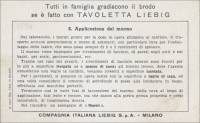
- Italian Marble Application – Exterior Building Trade Card – loosely translated (below): Marble work – 6. Application of the marble – From the workshop, the marble ready for installation goes to the site. The transport is usually by truck, with particular attention to the packing of the slabs, which are almost always 2 or 3 centimeters thick.
The marble is used for cladding, facades, walls in the hallways and bathrooms, stairs, flooring, etc.
Except in the case of granite, exterior coatings are supplied mostly smooth surface or with split slates, while the interiors, where agents do not alter the atmospheric clarity, are coated with polished surface.
For the floors, put themselves in the work sheets with the surface-cut saw, and once established the background switches to cement polishing in place, made with machines portal.
They end with the various phases of marble from the quarry to the place of application, stage slow and expensive, but give the rough stone properties and inimitable qualities, extremely durable.
In the box: a copy of – Repen.
Marble Work
6. Application of the Marble(Back of trade card to the left)
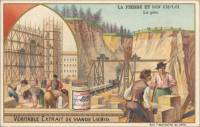
- French Sandstone Trade Card – loosely translated (below): Sandstone with the ease with which we work, is a stone of employ frequent in the construction industry. It is used for paving roads and in the manufacture of grindstones. Utilize it also works with any kind of sculpture and ornamentation.

The Stone and Its Use - Sandstone
(Back of trade card to the left)
- French Granite Trade Card – loosely translated (below): The Stone and Its Use – Granite The granite stone as a building stone. Granite possesses high hardness and resisted for a long time has the influence of weather. It is an excellent building stone because of its great inalterability. It is used primarily in construction of bridges, lighthouses, etc. Granite is very well polished.


The Stone and Its Use - Granite
(Back of trade card to the left)
- Italian Street Paving Trade Card – loosely translated (below): The Paving. Is used for the paving stone with hard limestone, granite, lava, marble, etc. The slabs of...must rest on solid ground and beaten, they are joined together by a waterproof cement. There is little that paving for sidewalks, as this method of paving, comfortable for pedestrians, deviant easily sliding and offers no support for the horses’ feet.


The Paving.
(Back of trade card to the left)
- French Basalt Trade Card – loosely translated (below): The basalt rock is a rock of a brown or black extraordinary hardness. It is too hard and too brittle to be pure cut can not use it in constructions like rubble. The basalt is generally used in paving and paving. (?)


The Stone and Its Use - Basalt
(Back of trade card to the left)
- Italian Sandstone Street Paving Trade Card – loosely translated (below): The cobbles of sandstone are 20 to 25 cubic centimeters it poses, usually without bond, on a leveled ground and covered with sand filling the interstices of the same substance and each tile is pressed by dropping a drumstick (?) that known or hie lady (?). The sandstone paving lasts, but it has the disadvantage of being noisy.


The Sandstone Paving.
(Back of trade card to the left)
- French Slate Trade Card – loosely translated (below): The Slate as Roofing. Slates are hardened clay that can be sheared (?) easily in thin sheets. The color of slate varies, but generally model goes from green to from green to blue gray. They are used primarily to coat the roofs and also in large, thick plates to make the billiards. They often replace the paper in schools for teaching writing and arithmetic.


The Stone and Its Use - Slate
(Back of trade card to the left)
- French Marble Trade Card – loosely translated (below): The marble, called in Greek brilliant stone, is likely to receive a high polish and is used especially in the Arts and Architecture year. It is found mainly in Greece and Italy, particularly in Carrara, Genoa, Florence, but in France also operates one of the marbles in several departments. The Algeria provides marble onyx.


The Stone and Its Use - Marble
(Back of trade card to the left)
- French Marble Trade Card – loosely translated (below):
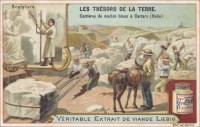

The Treasures of the earth. Marble quarries white Carrara (Italy) - Sculpture
(Back of trade card to the left)
- Italian Marble Work – Sawing Trade Card – loosely translated (below): Marble Work – 4. Sawing – To use the marble in the work of cladding and flooring, it is necessary to reduce the plates. This operation was made in ancient times, and until a few decades ago, by sawing by hand, which required an enormous amount of manpower and human energy. At this time slaves were used, then Christians in the Middle Ages, and people condemned to hard labor. In the modern era, the car could eventually replace the man with the multi-frame driven by the driving force.
- Causes of Decay in Building Stones, by Dr. John C. Smock in "Building Stones of New York" (Part I) (August 1891) The Manufacturer and Builder, Vol. 23, Issue 8, page 182, August 1891. (Article in digital images viewed at American Memory, Library of Congress.)
- Causes of Decay in Building Stones, by John C. Smock in "Building Stones of New York" (Part II) (September 1891) The Manufacturer and Builder, Vol. 23, Issue 9, page 206, September 1891. (Article in digital images viewed at American Memory, Library of Congress.)
- Cement & Concrete – You will find several articles and publications relating to concrete and cement, including Portland Cement, on Paul E. Stutzman's web site. He is with the Materials and Construction Research Division of the National Institute of Standards and Technology.
- Chicago Marble Finishers Train for Restoration, by Hazel Bradford on the International Masonry Institute web site. (The link from which the title of this article was obtained is no longer available, although you can still visit the International Masonry Institute web site.)


<http://www.imiweb.org/stonemagazine/stone_mag8-15-99-chi.htm>
- “A Closer Look Into The World of Natural Stone,” a video available for purchase at this web site. Quarries and factories are filmed in Italy, Turkey, Norway, and India. There is also a visit to the Carrara Trade Show. The web site lists these sample subjects available on the video: quarry rock work, stone cutting, marble and granite tile, rock polishing, stone masonry, marble slabs and granite slabs, granite quarry, and installation of natural stone.
- Concerning Building Stones (June 1890) The Manufacture and Builder, Vol. 22, Issue 6, June 1890, pgs. 129-130. (Article in digital images viewed at American Memory, Library of Congress.) (This article describes: rock face, pointed face, aze-hammered face, patent hammered, bush hammered, square drove, tooth chiseled, sawed face, fine sand finish, pumice finish, polished surface, and includes a few diagrams of some of these faces.)
- Concrete, presented by MAST Modules, Department of Materials Science and Engineering, University of Illinois (UIUC)
- Conservation - Friedrich Rathgen: The Father of Modern Archaeological Conservation, by Mark Gilberg, from the Journal of the American Institute for Conservation, JAIC 1987, Volume 26, Number 2, Article 4 (pp. 105 to 120) (The site copyright is to American Institute for Conservation of Historic and Artistic Works.)
- Decay and Preservation of Building-Stone (July 1871) The Manufacturer and Builder, Vol. 3, Issue 7, page 149, July 1871. (Article in digital images viewed at American Memory, Library of Congress.)
- The Decay of Building Stones in New York City (February 1883) The Manufacturer and Builder, Vol. 15, Issue 2, pages 43-44, February 1883. (Article in digital images viewed at American Memory, Library of Congress.)
- The Decay of Building Stones in New York City (March 1883) The Manufacturer and Builder, Vol. 15, Issue 3, page 66, March 1883. (Article in digital images viewed at American Memory, Library of Congress.)
- Decay of Building Stones (1886) The Manufacturer and Builder, Vol. 18, Issue 12, page 274, December 1886. (Article in digital images viewed at American Memory, Library of Congress.)
- The Decay of the Building Stones of the City of New York and Vicinity - The Buildings, Their Number, and Common Materials (July 1890) The Manufacturer and Builder, Vol. 22, Issue 7, pages 152-153, July 1890. (Article in digital images viewed at American Memory, Library of Congress.)
- The Decay of the Building Stones of the City of New York and Vicinity - Durability of Building-Stones, in New York City and Vicinity, by Dr. Alexis A. Julien (August 1890) The Manufacturer and Builder, Vol. 22, Issue 8, page 176, August 1890. (Article in digital images viewed at American Memory, Library of Congress.)
- The Decay of the Building Stones of the City of New York and Vicinity - Means of Protection and Preservation of Stone (September 1890) (Continued from August 1890) by Dr. Alexis A. Julien, The Manufacturer and Builder, Vol. 22, Issue 9, page 200, September 1890. (Article in digital images viewed at American Memory, Library of Congress.)
- The Decay of the Building Stones of the City of New York and Vicinity, by Dr. Alexis A. Julien (October 1890) The Manufacturer and Builder, Vol. 22, Issue 10, page 224, October 1890. (Article in digital images viewed at American Memory, Library of Congress.)
- The Decay of Building Stones of the City of New York and Vicinity - Light-Colored Sandstones (November 1890) (Continued from October 1890) by Dr. Alexis A. Julien, The Manufacturer and Builder, Vol. 22, Issue 11, page 248, November 1890.(Article in digital images viewed at American Memory, Library of Congress.)
- The Decay of the Building Stones of the City of New York and Vicinity - Limestone & Marble, by Dr. Alexis A. Julien (December 1890) The Manufacturer and Builder, Vol. 22, Issue 12, page 272, December 1890. (Article in digital images viewed at American Memory, Library of Congress.)
- The Decay of the Building Stones of the City of New York and Vicinity (January 1891) (Continued from the September 1890 article.) Notes on Quarrying - The Manufacture and Builder, Vol. 23, Issue 1, pages 8-9, January 1891. (Article in digital images viewed at American Memory, Library of Congress.)
- The Decay of the Building Stones of the City of New York and Vicinity - Granite, Gneiss, by Dr. Alexis A. Julien (February 1891) The Manufacturer and Builder, Vol. 23, Issue 2, page 36, February 1891. (Article in digital images viewed at American Memory, Library of Congress.)
- The Decay of the Building Stones of the City of New York and Vicinity - General Conclusions, by Dr. Alexis A. Julien (March 1891) The Manufacturer and Builder, Vol. 23, Issue 3, page 56, March 1891. (Article in digital images viewed at American Memory, Library of Congress.)
- Decay of Stone (November 1893) The Manufacturer and Builder, Vol. 25, Issue 11, page 255, November 1893. (Article in digital images viewed at American Memory, Library of Congress.)
- Fire & Stone use in Buildings circa 1872 – “The Risk of Buildings from Fire,” In Scientific American, September 14, 1872.
- Granite Architecture (February 1892) The New England Magazine, Vol. 24, Issue 2, February 1892, pg. 39. (Article in digital images viewed at American Memory, Library of Congress.)
- History of Stonecutting - Freemasonry: History of Stonecutting, by Wor. Bro. Dennis Stocks, Barron Barnett Lodge.
- Maintenance of Interior Marble (pdf), by D. W. Kessler, Research Associate, National Bureau of Standards, Compliments of Carthage Marble Corporation, Carthage, Missouri, Published by National Association of Marble Dealers, 648 Rockefeller Building, Cleveland, Ohio (no date of publication in the booklet – possibly early 1900s) W. D. Carol, Sales Representative, P.O. Box 945, Columbus, Ohio.
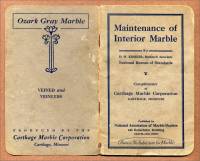
Maintenance of Interior Marble, Carthage Marble Corp., Carthage, Missouri
- Marble - "To Clean Marble" (December 1884) Quarrying Notes - The Manufacturer and Builder, Vol. 16, Issue 12, December 1884, pgs. 275-276. (Article in digital images viewed at American Memory, Library of Congress.)
- Marble - "To Clean Marble" (October 1886) The Manufacturer and Builder, Vol. 18, Issue 10, October 1886, pg. 228. (Article in digital images viewed at American Memory, Library of Congress.)
- Masonry Construction - A Treatise on Mason Construction, (Book) by Ira Osborn Baker, New York: John Wiley & Sons, 1889, 552 pp. (This book is available for reading or downloading to your computer in PDF format on Google Book Search. There are also editions available for the years 1899, 1909, and 1914.)
This book contains sections on the following subjects: Part I. The Materials. Chapter 1. Natural Stone, Chapter 2. Brick, Chapter 3. Lime and Cement; Part II. Preparing and Using the Materials: Chapter IV. Mortar, Concrete, and Artificial Stone; Chapter V. Quarrying; Chapter VI. Stone Cutting; Chapter VII. Stone Masonry; Part III. Foundations; Part IV. Masonry Structures; Appendix I. Specifications for Masonry.
- Plaster – The History of Plaster in Architecture The Ancient and Classical Periods: The art of plastering is as old as civilization, by Patrick Webb, August 1, 2012.
- Quarries video: "A Closer Look Into The World of Natural Stone," a video available for purchase at this web site. Quarries and factories are filmed in Italy, Turkey, Norway, and India. There is also a visit to the Carrara Trade Show. The web site lists these sample subjects available on the video: quarry rock work, stone cutting, marble and granite tile, rock polishing, stone masonry, marble slabs and granite slabs, granite quarry, and installation of natural stone.
- Quarries DVD: Modern Marvels: Quarries, by A&E. “QUARRIES travels from ancient Egypt to the present day to show how rock has been mined throughout the ages and transformed into roads, building, bridges and other structures. Archeologists reveal how ancient quarrymen used simple levers, wedges and hammers, while visits to three modern quarries--Georgia Marble, Rock of Ages granite quarry and Luck Stone aggregate-showcase the massive, specialized machines that do the job today. At each stop, MODERN MARVELS® unearths fascinating nuggets about the industry--such as the fact that it takes 40,000 tons of aggregate to make one mile of two-lane highway.”
- "Stone, Dimension," by W. Robert Power, in Donald D.
Carr, Senior Editor, Industrial Minerals and Rocks, 6th edition, Society
of Mining, Metallurgy, and Exploration, Inc.: Littleton, CO, 1994, pp.
987-1001. Society for Mining, Metallurgy,
and Exploration (SME).
Topics covered by Mr. Power in this book include:
- Definitions.
- Stone Sold and Used in Natural or Broken Sizes: Field Stone, Rough Construction and Jetty Stone, Rubble, Flagstone, Paving Blocks.
- Stone Cut to Size: Dimension Stone, Tile, Monumental Stone, Ashlar, Split.Faced Ashlar, Roofing Slate, Mill Stock Slate, Slate Dimension Stone, Curbing, Miscellaneous Uses.
- Lithologic Classification: Granite, Sandstone, Limestone, Marble, Slate; Other Stone: Greenstone, Basalt, Soapstone.
- Quarry Methods: Quarry Plan, Cutting the Stone, Drilling and Broaching, Line Drilling, Jet Channeling, Wire Saws Using Abrasives, Diamond Wire Saws, Chain and Belt Saws, Water Jet, Breaking and Lifting the Stone, Removing Blocks from the Quarry.
- Mill Operations: Sawing Slabs, Secondary Cuts, Shaping, Grinding, and Polishing.
- Distribution of Deposits and Reserves: The United States and Canada: Atlantic and Gulf Coastal Plain, Appalachian Crystalline Province, Georgia, New England (Vermont, New Hampshire, and Massachusetts), Other (North Carolina); Canadian Shield; Western Province; Outside the United States and Canada.
- Evaluation of Deposits: Marketability, Soundness, Other Factors.
- Bibliography and References.
- New York - Bluestone Sidewalks (Hudson River Bluestone Industry History) (April 1891) The Manufacturer and Builder, Vol. 23, Issue 4, April 1891, pgs. 80-81. (Article in digital images viewed at American Memory, Library of Congress.)
- Nomenclature of Building Stones and of Stone Masonry (March 1885) The Manufacturer and Builder, Vol. 17, Issue 3, March 1885, pgs. 60-61. (Article in digital images viewed at American Memory, Library of Congress.)
- Portland Cement – “Making Portland Cement and Concrete,” from The Monumental News, Vol. XVIII, No. 2, February 1906, pp. 166.
- Sandstones of New York from Building Stones of New York (July 1891) The Manufacturer and Builder, Vol. 23, Issue 7, July 1891, pgs. 158-159. (Article in digital images viewed at American Memory, Library of Congress.)
- Sandstone - Popularity of Sandstone in the Boston of To-Day (December 1884) The Manufacturer and Builder, Vol. 16, Issue 12, December 1884, pg. 274. (Article in digital images viewed at American Memory, Library of Congress.)
- Slate - The Repair,
Replacement & Maintenance of Historic Slate Roofs by Jeffrey S.
Levine, presented
on the On House Journal Online web site. (Preservation Brief 29).
(A couple of the topics are below.)
- History of Slate Use
- Where Does Slate Come From?
- Slated
for Preservation - Philip
Cryan Marshall and Collins, Allison Brooks. "Slated for Preservation,"
presented at The Roofing Conference and Exposition for Historic Buildings,
Philadelphia, Pennsylvania, March 17-19, 1999.
- The Story on Slate - A Brief History of American Rooftops
- A History of Slate Roofing in America (Summary & Detailed Accounts)
- American Traditions (Slate industry)
- Slate Sources
- Slate Quarries, Suppliers, and Service-Providers
- Annotated Bibliography
- Slate Museums
- Additional Slate Deposits (U. S.)
- Glossary
- The Story on Slate - A Brief History of American Rooftops
- Slate - "The Uses of Slate in Building" (January 1885) Quarrying Notes - The Manufacturer and Builder, Vol. 17, Issue 1, January 1885, pg. 14.(Article in digital images viewed at American Memory, Library of Congress.)
- "Stone" (December 1895 magazine) This magazine includes many articles, advertisements, equipment, instruction, and many photographs and sketches of quarries, men working, etc.
- Stonecutting History - Freemasonry: History of Stonecutting, by Wor. Bro. Dennis Stocks, Barron Barnett Lodge.
- The Stone Roofing Association
- Sandstone & Slate
- The slate industry - historical
sources
- Historical aspects of the Welsh Slate Industry: D Dylan Pritchard
- Slate and Stone Roofing Bibliography
- Stone Roofing Association bibliography of slate and stone-slate
- The slate industry - historical
sources
- The Use of Substitute Materials on Historic Building Exteriors, by Sharon C. Park, AIA, presented on the Old House web site. (Preservation Brief 16)
- Weathering Stone (February 1887) The Manufacturer and Builder, Vol. 19, Issue 2, February 1887, pgs. 34-35. (Article in digital images viewed at American Memory, Library of Congress.)
- Where the Building Stones Came From, presented by Brett Ketter, University of Wisconsin, Milwaukee.
Stones identified include: Athelstane and Amberg Granites; Bedford Limestone; Berea Sandstone; Bethel White; Carnelian Granite; Diamond Pink; Hallowell and Fox Island Granite; Joliet Limestone; Lac Du Bonnet; Lake Superior Sandstone; Mankato-Kasota Limestone; Morton Gneiss (Rainbow Granite); Wauwatosa Limestone; Winona Travertine; and Woodbury Granite.

The article begins: “The growth of the Portland cement industry has been so rapid, especially during the past year (1905), that nearly everyone is now more or less familiar with its character, says Concrete. A great many, however, are of the opinion that the word was quite different from this. Portland cement was first manufactured in England by an English engineer by the name of John Smeaton, who discovered, that by grinding together a certain proportion of limestone and clay he obtained a mortar which would harden under water, and to it the name of hydraulic lime was applied. Somewhat later than this Joseph Aspdin took out a patent for an improved cement, made from limestone and clay, which he called Portland cement, because when it hardened, a stone was produced resembling that from the famous quarries of Portland England….”
Commercial use of material within this site is strictly prohibited. It is not to be captured, reworked, and placed inside another web site ©. All rights reserved. Peggy B. and George (Pat) Perazzo.